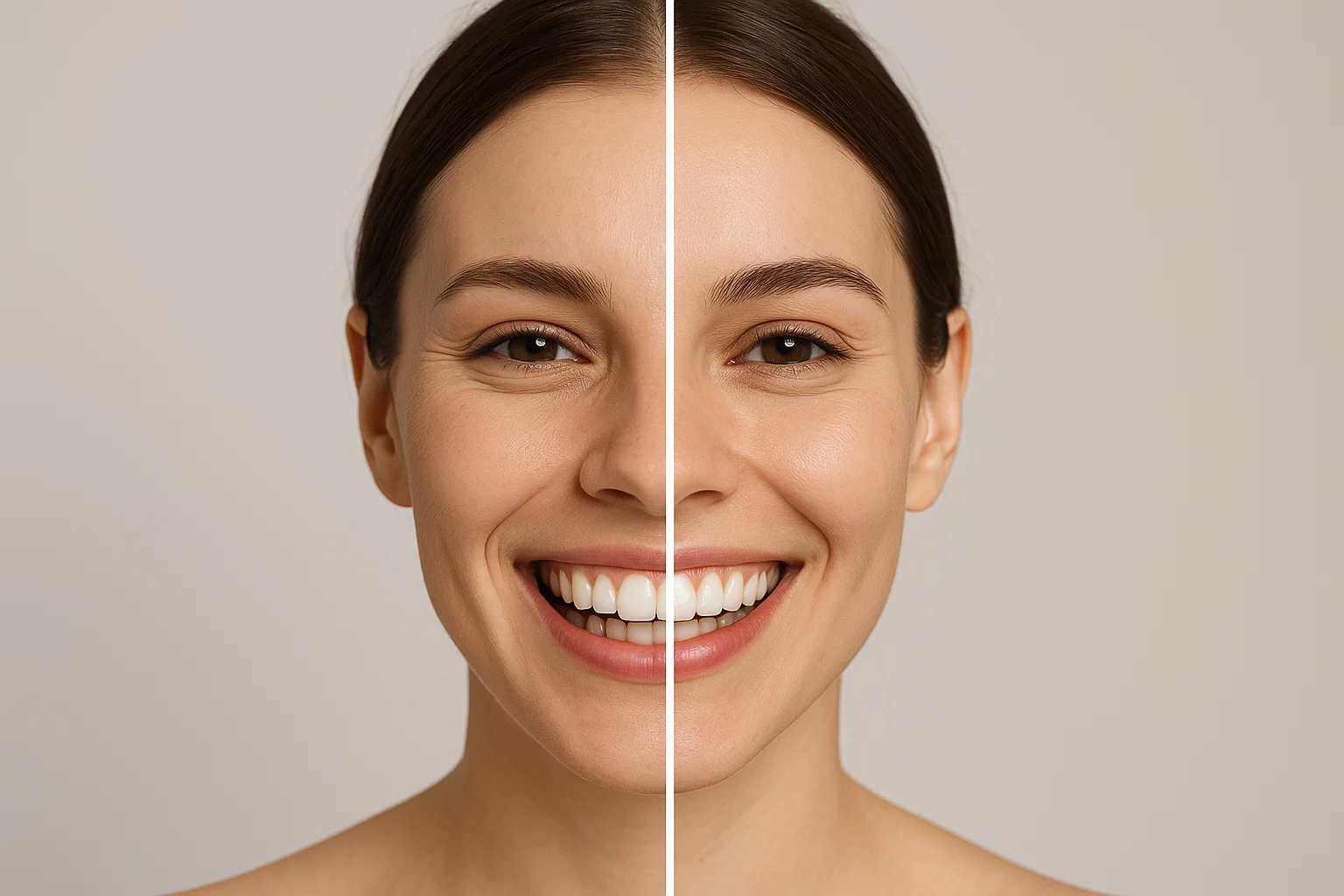
A gummy smile, clinically excessive gingival display, is the exposure of 3 to 4 mm or more of gum tissue above the upper teeth when smiling, against roughly 2 mm in a healthy adult smile. It is a finding with several possible causes, and treatment follows the cause: hyperactive lip elevators, gum overgrowth, altered passive eruption or vertical maxillary excess. In 123 adults with a display of 4 mm or more, altered passive eruption was involved in 73.2% of cases and 55.3% had more than one cause at the same time (PubMed 39176165). Correct diagnosis therefore comes before the choice of treatment.
- 01Excessive gingival display is defined by measurement: 3 to 4 mm or more of gum above the upper crowns, compared with roughly 2 mm in an ordinary adult smile.
- 02Causes often occur together. Among 123 people with a display of 4 mm or more, 55.3% had more than one cause and altered passive eruption was involved in 73.2% (PubMed 39176165).
- 03Botulinum toxin acts on the lip elevator muscles: across 9 studies and 269 patients, 1.25 to 6 units per side of onabotulinumtoxinA improved display by 24.85% to 99.65%, with the effect lasting 12 to 36 weeks (PubMed 35577306).
- 04Lip repositioning is the surgical route for a hyperactive lip: a meta-analysis of 13 studies found a mean reduction in gingival display of 3.06 mm at 6 months, 2.91 mm at 12 months and 2.76 mm still present at 36 months (PubMed 35347420).
- 05Skeletal cases do not respond to soft tissue work; vertical maxillary excess is addressed with Le Fort I impaction under general anaesthesia, combined with orthodontics before and after.
What a Gummy Smile Is and How It Is Measured
A gummy smile, clinically called excessive gingival display, is a smile that shows an unusually large band of gum above the upper teeth. The definition rests on a measurement. In a healthy adult smile roughly 2 mm of gum is visible above the upper crowns, and dental professionals generally treat 3 to 4 mm or more as excessive. A smile at that level can make the teeth look short and the gum line dominant, even when the teeth and gums themselves are healthy.

The threshold varies slightly between research groups. A meta-analysis comparing surgical and non-surgical treatments defined excessive gingival display as more than 2 mm of gum above the upper incisors at maximum smile (PubMed 38920855). In a cross-sectional study of adults recruited because they had a gummy smile, every one of the 123 participants showed a display of 4 mm or more (PubMed 39176165). These figures are guides for diagnosis. The same millimetre reading can look different on a long face and a short one, and the length of the upper lip and the size of the teeth change how much gum reads as too much.
A gummy smile carries no health risk on its own. It is a finding, and the first clinical task is to work out what produces it. Four mechanisms account for most cases: an upper lip that lifts too far, gum tissue that covers too much of the tooth, teeth whose gum and bone never receded to the usual level, and an upper jaw that grew too far downward. Each mechanism has its own treatment, which is why the measurement is only the starting point of the examination.
How People Judge the Gum Line in a Smile
Whether a gummy smile bothers someone depends partly on how others see it and partly on how the person sees themselves. Many people with excessive gingival display report feeling self-conscious in social and work settings where smiling matters, and some learn to smile with a closed mouth or keep the upper lip low on purpose. Because more gum makes the teeth look shorter, the smile can appear out of proportion with the rest of the face.
Research on public perception gives a useful counterweight to the idea that any visible gum is a problem. A systematic review of 34 studies on how laypersons rate gum exposure found that the median ideal was 0.0 mm, meaning the upper lip resting at the gum line, and that a range from 3 mm of visible gum to 2.7 mm of tooth covered by the lip was still considered acceptable (PubMed 35587001). In other words, the general public tolerates a band of gum that a dentist might already note in a chart.
This matters for treatment decisions in aesthetic dentistry. A person showing 3 mm of gum sits at the edge of what most observers accept, and a mild correction may be all that is needed. A person showing 6 mm or more is outside that range for most observers, and the choice of treatment becomes more consequential. The patient's own concern still carries weight. Some people are comfortable with a display that others would treat, and some are bothered by a display within the accepted range. The clinical role is to measure accurately, explain where the finding sits, and let the patient decide with that information in hand.
Upper Lip Movement as a Cause
The first mechanism is muscular. When a person smiles, a group of muscles lifts the upper lip: the levator labii superioris, the levator labii superioris alaeque nasi and, to a lesser extent, the zygomaticus minor. In some people these muscles pull the lip higher than usual, so a smile that starts with normal gum display reveals far more gum at its peak. Lip mobility measurements of more than 6 to 8 mm between rest and full smile are typical of this pattern, which is called a hyperactive or hypermobile upper lip.
A short upper lip produces a similar picture by a different route. If the distance from the base of the nose to the lower edge of the upper lip is short relative to the height of the teeth, less of the gum is covered at rest and more is exposed during a smile. Both conditions involve the soft tissue of the lip, and both leave the teeth, gum and jaw bone in their normal positions.
This distinction shapes treatment. When the lip is the only cause, the gum line on the teeth is normal and the tooth crowns are of normal length. Procedures that act on the lip, such as botulinum toxin injections or surgical lip repositioning, address the excess display directly. Removing gum from the teeth would not change how far the lip moves and would expose tooth surface that does not need exposing. In the Saudi cross-sectional study, a hypermobile upper lip and vertical maxillary excess were significantly associated with the class of smile line (PubMed 39176165). Clinicians therefore measure lip length and lip movement at rest and at full smile before deciding whether the lip is the driver.
Gum Overgrowth and Altered Passive Eruption
The second group of causes sits in the gum and the tooth. Gingival overgrowth, or gingival hypertrophy, means gum tissue that has thickened and extended down over the crowns. Common triggers include genetic tendency, plaque-induced inflammation, mouth breathing, hormonal change during puberty or pregnancy, and some medicines, including certain antiepileptics, immunosuppressants and calcium channel blockers. The teeth look short because gum covers part of the enamel that would normally be visible.
Altered passive eruption produces a similar appearance for a developmental reason. As teeth erupt during childhood, the gum and the bone around them normally recede to a level near the junction between enamel and root. In altered passive eruption this recession stops early, leaving gum, and sometimes bone, over part of the crown. The teeth look square and short, and the smile shows more gum than the lip position alone would explain.
Altered passive eruption is common among people with a gummy smile. In 123 adults with a display of 4 mm or more, it was the predominant cause and was present in 90 participants, or 73.2% (PubMed 39176165). Of those 90, 29 people had altered passive eruption alone, while the remaining 61 had it in combination with another cause (PubMed 39176165). In a separate study of 190 patients, altered passive eruption was found in 29.5% of those who had never had orthodontic treatment and 42.1% of those who had, a difference that did not reach statistical significance (PubMed 25126692). The same study found it in 75.6% of patients with a thick, flat gum type (PubMed 25126692). Gum type is therefore one of the details recorded during the examination.
Vertical Maxillary Excess and Mixed Causes
The third cause is skeletal. In vertical maxillary excess the upper jaw has grown too far downward, which lengthens the lower third of the face and places the teeth and gums lower relative to the lip. Gum exposure in these patients can go well beyond the 3 to 4 mm threshold even when the lip, gum and teeth are otherwise normal. Other signs often accompany it: lips that do not close comfortably at rest, a long face in profile, and a bite that may also need correction.
Because the cause lies in the bone of the upper jaw, soft tissue procedures have limited effect. Botulinum toxin can reduce how far the lip rises, and crown lengthening can expose more tooth, but neither changes the height of the jaw. For moderate or severe skeletal cases the stable correction involves orthodontic treatment combined with jaw surgery.
In practice, many patients have more than one cause at the same time. Among the 123 adults in the Saudi study, 55 people, or 44.7%, had a single cause, and the remaining 68, or 55.3%, had more than one (PubMed 39176165). The presence of more than one cause in the same person was associated with greater gum display (PubMed 39176165). A typical combination is altered passive eruption together with a hypermobile lip: the teeth look short because gum covers them, and the smile shows even more gum because the lip rises high. Treating only one of the two leaves part of the problem in place. The authors of that study concluded that an etiology-based, sequential, multiple-treatment strategy is needed (PubMed 39176165). This is the reason treatment planning starts from a complete list of causes.
The Diagnostic Workup Before Any Treatment
A reliable plan depends on a structured examination. The first step is a clinical assessment of the face, lips, teeth and gums. The clinician measures the gum display at rest and at full smile, the length of the upper lip, and how far the lip moves between the two positions. Photographs and short video of the smile help document these measurements and allow comparison after treatment.
The teeth and gum are assessed next. The clinician measures the length and width of the upper front crowns, checks where the gum margin lies relative to the enamel, and probes the gum to see whether the bone crest sits at a normal distance below it. Pocket depth and bleeding on probing show whether inflammation is present. If the gum is inflamed, periodontal treatment comes first, because swollen tissue can mimic overgrowth and will change shape once it settles.
Radiographs complete the picture. A periapical or panoramic image shows root length and bone level, and cone beam computed tomography can show the thickness of the gum and bone over the front teeth. For suspected skeletal causes, a lateral cephalometric radiograph measures the vertical dimensions of the face and jaw. Dental models or digital scans record the bite.
At the end of the workup each cause is either confirmed or ruled out. A person may leave with a single diagnosis, such as a hypermobile lip, or with a combination, such as altered passive eruption with a mild skeletal component. The treatment plan is then written as a sequence, and the patient can see which step addresses which cause and what result each step can realistically produce.
Botulinum Toxin for a Hyperactive Lip
Botulinum toxin type A is the least invasive treatment for a gummy smile caused by the lip. It blocks the release of acetylcholine at the junction between nerve and muscle, which reduces the contraction of the lip elevator muscles. The lip rises less during a smile and covers more gum. Small doses are injected into specific points beside the nose, usually on both sides, and the session takes about 10 to 15 minutes with no downtime. Results begin to appear within days and are usually clear by two weeks.
A systematic review of 9 studies covering 269 patients found that doses ranged from 1.25 to 6 units per side of onabotulinumtoxinA and from 2.5 to 7.5 units per side of abobotulinumtoxinA (PubMed 35577306). The average improvement across those studies ranged from 24.85% to 99.65%, and the effect persisted from 12 to 36 weeks (PubMed 35577306). The wide range in improvement reflects differences in dose, injection points and the type of gummy smile treated; the authors found no standardized protocol in the literature.
A second meta-analysis measured the change in millimetres. Its quantitative analysis estimated a mean reduction of 2.51 mm at two weeks and 2.24 mm at three months (PubMed 36835971). In the qualitative analysis, pre-treatment gum exposure ranged between 3.5 and 7.2 mm, and reductions of up to 6 mm were reported at 12 weeks (PubMed 36835971). That review excluded patients whose gummy smile came only from altered passive eruption or gum thickening, which fits the mechanism: the toxin acts on muscle and has no effect on gum that covers the tooth.
The effect is temporary because the nerve endings recover. Keeping the result means repeat injections at intervals that vary from person to person.
Botulinum Toxin Side Effects and Limits
Botulinum toxin for a gummy smile has a favourable safety record in the published series. The systematic review of 269 patients reported fourteen adverse events, all of them mild and transient (PubMed 35577306). The effects people most often notice are small bruises or swelling at the injection points, a brief feeling of tightness or heaviness in the upper lip, and some awkwardness when pronouncing certain sounds, sipping through a straw or puckering. These usually settle as the muscles adapt.
Less common effects include an asymmetrical smile, a drooping upper lip and spread of weakness to nearby facial muscles. They are linked mainly to dose and injection point and wear off as the toxin effect fades. Mild headache or flu-like symptoms are occasionally reported. The risk falls with an experienced injector who adjusts the dose to the individual lip and places the injection precisely. After treatment, patients are usually asked to avoid rubbing or massaging the area, strenuous exercise and lying flat for several hours.
There are situations in which the toxin is unsuitable. It is avoided in people with neuromuscular diseases such as myasthenia gravis, during pregnancy and breastfeeding, in people with known allergy to the product, and with some medicines that interact with neuromuscular transmission. A clinical assessment of medical history comes before the first injection.
The limit of the treatment lies in its mechanism. Botulinum toxin only changes how far the lip rises. If the gum covers too much of the tooth or the upper jaw is too long, the toxin can reduce the display but leaves the underlying cause unchanged, and the result will be partial. In mixed cases it can still play a role alongside other treatments, for example after crown lengthening when a hyperactive lip remains.
Lip Repositioning Surgery
Lip repositioning is the surgical option for a hyperactive or short upper lip. Under local anaesthesia, the surgeon removes a strip of mucosa from the inside of the upper lip, between the lip and the gum, and sutures the lip to a lower position. This shortens the vestibule and limits how far the lip can rise during a smile. The procedure usually takes under an hour. Swelling, bruising and a feeling of tightness are common in the first days, and most of this settles over the following weeks.
The evidence for this technique comes from a meta-analysis of 13 studies that met strict inclusion criteria out of 783 retrieved. It found an overall reduction in gum display of 3.06 mm at 6 months, 2.91 mm at 12 months and 2.76 mm at 36 months compared with baseline (PubMed 35347420). The slight decline over time shows that some relapse occurs, but most of the correction held at three years. The authors identified six modifications of the original technique, and the version with periosteal suturing showed the largest decrease, 5.22 mm at 6 months and 4.94 mm at 12 months (PubMed 35347420).
Another review notes that relapse after lip repositioning tends to appear in the first 6 to 8 weeks after surgery (PubMed 36835971). This is why follow-up visits in the early months matter; they show whether the lip is settling in its new position.
The risks include infection, bleeding, scarring, temporary asymmetry, lip tightness and partial return of the original display. Lip repositioning is suitable when the lip is the main cause. It does not lengthen short teeth or correct a long upper jaw, so in mixed cases it is combined with other procedures.
Crown Lengthening and Gum Contouring
Crown lengthening, often called a gum lift, removes excess gum, and sometimes a small amount of bone, to expose more of each tooth. It is the treatment for gummy smiles caused by gingival overgrowth or altered passive eruption. The procedure is done under local anaesthesia, with sedation as an option for anxious patients. The surgeon marks the planned gum line, reshapes the gum, and if the bone crest sits too close to the enamel, recontours the bone to leave room for a healthy gum attachment. Sutures are usually removed after one to two weeks, and any restorative work on the teeth waits until the gum has stabilized.
Two small randomized trials describe how the procedure performs. In sixteen patients with altered passive eruption type 1B, crown lengthening using a 3D-printed surgical guide gave the same wound healing, pain scores and gum margin stability as the conventional freehand method, with a shorter operating time (PubMed 38461241). In a split-mouth trial of eighteen patients with altered passive eruption, a diode laser and a scalpel produced similar postoperative pain at 3 and 7 days (PubMed 35083533). In that trial the new gum margin level was stable one month after the procedure, with no significant change over the following months (PubMed 35083533).
When only gum needs to be removed, a gingivectomy with a scalpel or laser can be enough. When bone also needs adjusting, a flap is raised so the surgeon can see and shape the bone. The choice depends on the probing and radiographic findings during the workup.
The risks include post-operative tenderness and swelling, sensitivity if root surface becomes exposed, and uneven healing if tissue is removed asymmetrically. Excessive removal can lead to gum recession or bone loss, which may need grafting to repair. Careful planning of the gum line reduces these risks.
Orthognathic Surgery for a Skeletal Cause
When the gummy smile comes from vertical maxillary excess, the correction has to reach the bone. The standard procedure is a Le Fort I osteotomy with impaction of the upper jaw: the surgeon cuts the upper jaw free above the tooth roots, removes a measured amount of bone, and fixes the jaw in a higher position with plates and screws. This moves the teeth and gums upward relative to the lip. When the lower jaw is also out of position, both jaws may be operated on in the same procedure.
Jaw surgery is combined with orthodontic treatment before and after the operation. Braces or aligners first align the teeth over each jaw, so that the bite fits once the jaws are repositioned, and then fine-tune the bite after surgery. The full sequence usually extends over many months.
A systematic review of randomized trials on orthodontic and surgical approaches concluded that orthognathic surgery offers lasting outcomes, particularly for patients with vertical maxillary excess (PubMed 39597985). The same review found orthodontic treatment, including skeletal anchorage devices that intrude the upper teeth, particularly effective for less severe cases (PubMed 39597985). It described botulinum toxin as giving temporary but promising results for patients reluctant to undergo surgery (PubMed 39597985).
Of the treatments described here, this one involves the largest operation. It requires general anaesthesia and a hospital stay, and recovery takes several weeks. The risks include infection, bleeding, altered sensation or numbness from nerve involvement, prolonged swelling, and in rare cases relapse of the corrected position. The benefit is a structural correction that also improves facial proportion and, often, the bite.
How Surgical and Non-Surgical Results Compare Over Time
A useful way to compare treatments is to look at what happens to the result months after the procedure. A systematic review and meta-analysis published in 2024 pooled studies of surgical and non-surgical treatments for excessive gingival display and measured the change in gum display at 1, 3, 6 and 12 months (PubMed 38920855).
At one month the two approaches looked almost identical. Surgical treatments reduced gum display by a mean of 3.50 mm and non-surgical treatments by 3.43 mm (PubMed 38920855). The picture changed with time. By six months the non-surgical reduction had fallen to 0.51 mm, while the surgical reduction was 2.86 mm (PubMed 38920855). Surgical outcomes remained stable past six months, while non-surgical outcomes partly relapsed at six months and returned to baseline levels at twelve months (PubMed 38920855).
The same analysis found that non-surgical treatments were more effective in mild cases, while surgical treatments gave better outcomes in severe cases (PubMed 38920855). This matches the mechanisms. Botulinum toxin gives a quick, reversible reduction that suits a mild, lip-driven gummy smile, or a person who wants to see the effect before considering surgery. Surgical options take longer to recover from but hold their result.
The authors noted that more rigorous primary studies are needed, and the number of patients in each comparison was modest. The trend is still clear enough to guide a conversation: a person choosing between the two is choosing between a temporary result that needs repeating and a longer-lasting result that requires surgery.
Matching Treatment to Cause and Caring for the Result
Once the workup has identified the cause, the choice of treatment follows from it. The table summarizes the usual match.
| Cause | Usual treatment |
|---|---|
| Hyperactive or short upper lip | Botulinum toxin, or lip repositioning for a longer-lasting result |
| Gum overgrowth or short-looking teeth | Crown lengthening, with bone recontouring if needed |
| Altered passive eruption | Crown lengthening, sometimes combined with orthodontics |
| Vertical maxillary excess | Orthodontics combined with orthognathic surgery |
Mixed causes call for combined plans, carried out in sequence. A common order is to treat gum inflammation first, then correct the tooth and gum proportion with crown lengthening, and then address remaining lip movement with botulinum toxin or lip repositioning. Skeletal correction, when needed, is planned together with orthodontics from the start.
Aftercare depends on the procedure. After botulinum toxin, the treated area is left alone for the rest of the day and follow-up is arranged to check symmetry. After gum or lip surgery, patients follow the prescribed medication, use cold compresses, keep to soft food for the first days, avoid smoking and alcohol, and clean the area gently as instructed. After jaw surgery the recovery plan is longer and is managed jointly by the surgeon and the orthodontist.
Follow-up visits are part of the result. They confirm that the gum has healed at the planned level, that the lip has settled, and that no relapse is developing. Good daily oral hygiene protects the new gum line from inflammation and recession, and retainers keep the teeth in place after orthodontic treatment. Botulinum toxin results are maintained with repeat sessions scheduled around the time the effect begins to fade.
Let’s plan the right treatment together.
Free Assessment→- 1.Al Jasser R, AlSaif R, AlSohaim L, Baidas R, AlOtibi FA, Andijani R. Etiologies of excessive gingival display in a Saudi population. Saudi Dent J 2024;36:1135-1140. PubMed 39176165
- 2.Rasteau S, Savoldelli C, Winter C, Lerhe B, Castillo L, Kestemont P. Botulinum toxin type A for the treatment of excessive gingival display - A systematic review. J Stomatol Oral Maxillofac Surg 2022;123:e717-e723. PubMed 35577306
- 3.Mendoza-Geng A, Gonzales-Medina K, Meza-Mauricio J, Muniz FWMG, Vergara-Buenaventura A. Clinical efficacy of lip repositioning technique and its modifications for the treatment of gummy smile: systematic review and meta-analysis. Clin Oral Investig 2022;26:4243-4261. PubMed 35347420
- 4.Maleki M, Huang B, Mendes VC, Caminiti MF, Finer Y. A Systematic Review and Meta-Analysis Comparing Surgical and Nonsurgical Treatments for Excessive Gingival Display. Dent J (Basel) 2024;12. PubMed 38920855
- 5.Batra P, Kaur H, Dawar A, Mehta V. The threshold of acceptability of excessive gingival display by laypersons: a systematic review. Int J Esthet Dent 2022:216-235. PubMed 35587001
- 6.Nart J, Carrió N, Valles C, Solís-Moreno C, Nart M, Reñé R, et al. Prevalence of altered passive eruption in orthodontically treated and untreated patients. J Periodontol 2014;85:e348-53. PubMed 25126692
- 7.Rojo-Sanchis C, Montiel-Company JM, Tarazona-Álvarez B, Haas-Junior OL, Peiró-Guijarro MA, Paredes-Gallardo V, et al. Non-Surgical Management of the Gingival Smile with Botulinum Toxin A-A Systematic Review and Meta-Analysis. J Clin Med 2023;12. PubMed 36835971
- 8.Borham E, Abuel-Ela HA, Mohamed IS, Fouad YA. Treatment of excessive gingival display using conventional esthetic crown lengthening versus computer guided esthetic crown lengthening: (a randomized clinical trial). BMC Oral Health 2024;24:317. PubMed 38461241
- 9.Abdelhafez RS, Rawabdeh RN, Alhabashneh RA. The use of diode laser in esthetic crown lengthening: a randomized controlled clinical trial. Lasers Med Sci 2022;37:2449-2455. PubMed 35083533
- 10.Inchingolo AD, Inchingolo AM, Viapiano F, Netti A, Ciocia AM, Ferrara I, et al. Effectiveness and Personalized Approaches in the Correction of Gummy Smile: A Systematic Review of Orthodontic and Surgical Treatments. J Clin Med 2024;13. PubMed 39597985