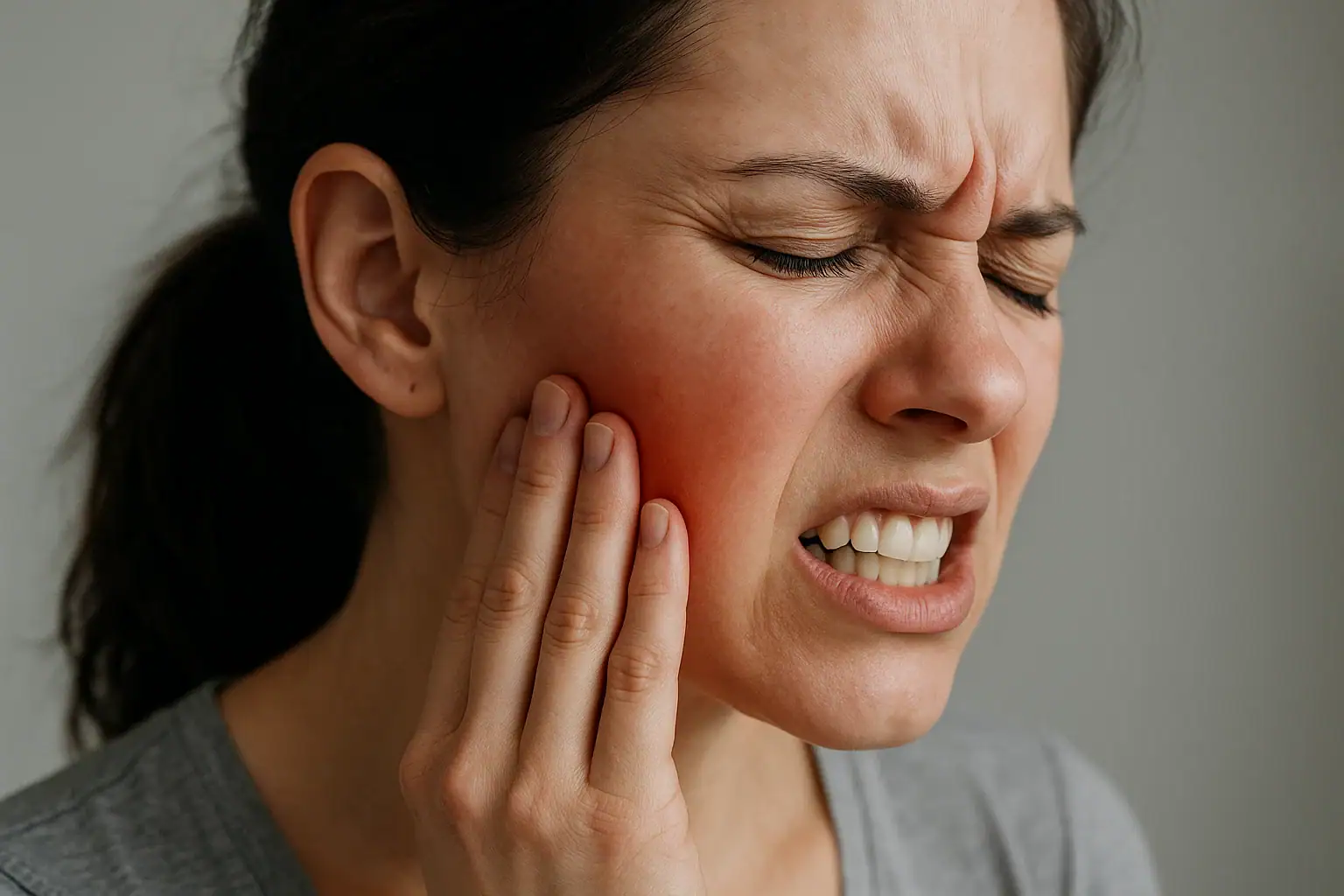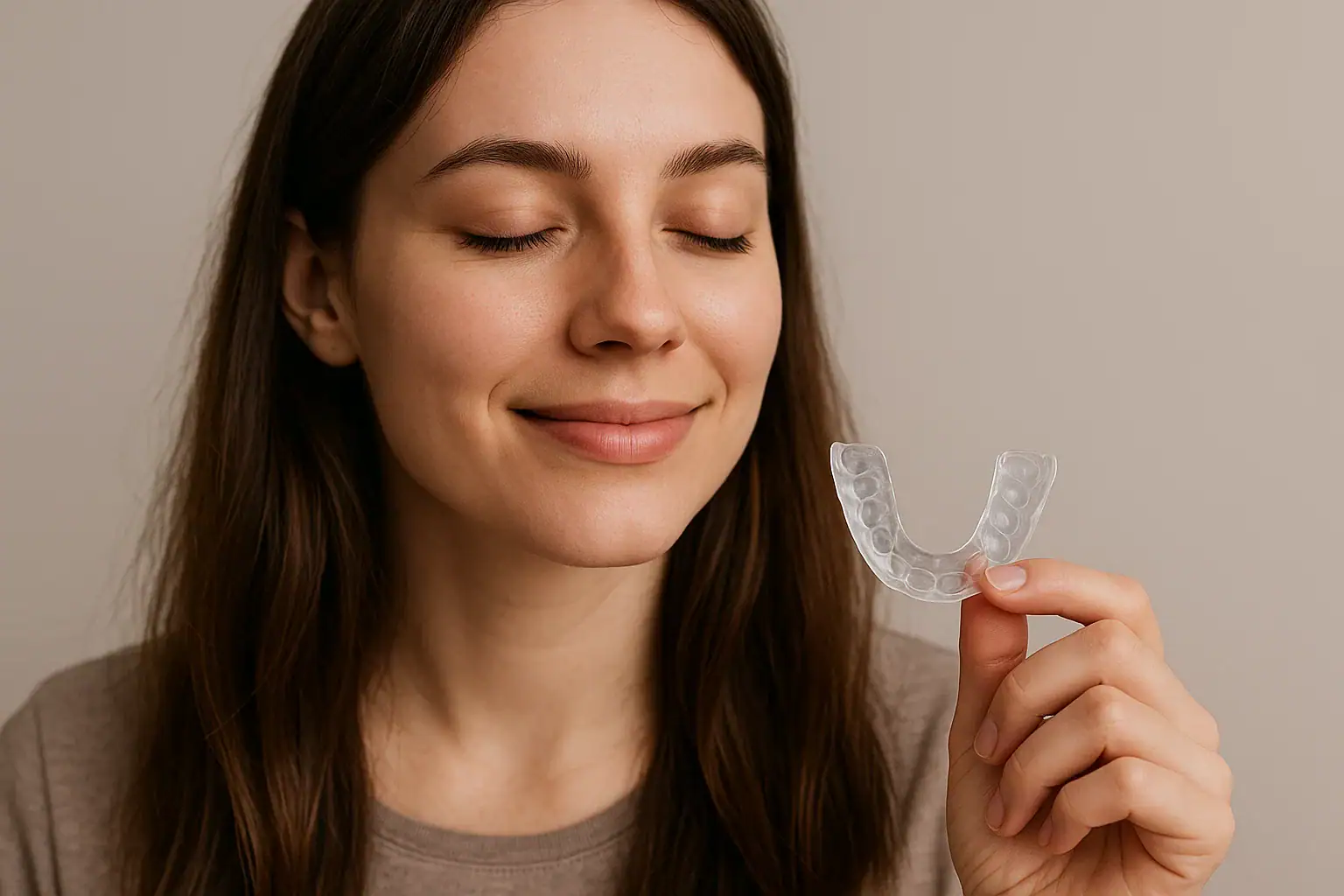
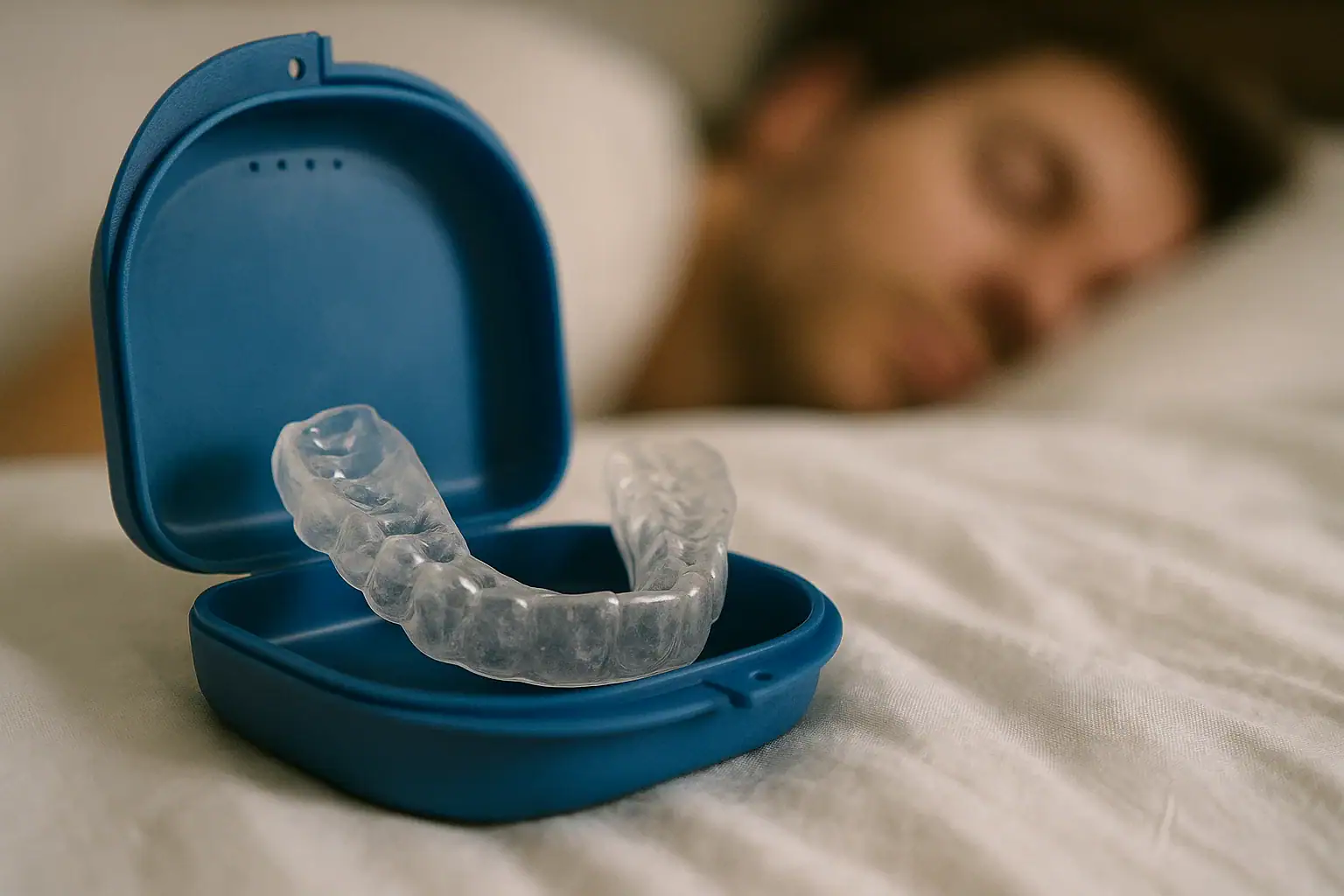
A gum shield for bruxism, also called a night guard or occlusal splint, is a removable appliance worn over the teeth that prevents direct tooth-to-tooth contact during grinding and spreads the load across the arch. Bruxism is common: a meta-analysis of studies published between 2003 and 2023 put global prevalence of sleep and awake bruxism combined at 22.22%, and sleep bruxism alone at 21% (PubMed 39064299). A guard protects tooth structure and restorations, but it does not treat the cause. A systematic review of 14 eligible randomised and quasi-randomised trials found insufficient evidence that splint therapy outperforms no treatment for bruxism itself (PubMed 33652054).
- 01A gum shield for bruxism is a removable barrier placed between the upper and lower arches; it manages the consequences of grinding and does not remove its cause, which may be stress, a sleep disorder or a bite problem.
- 02Global prevalence of bruxism (sleep and awake combined) is 22.22%, sleep bruxism 21% and awake bruxism 23%; when measured by polysomnography rather than self-report, sleep bruxism reaches 43% (PubMed 39064299).
- 03A systematic review identified 22 studies and included 14: it found insufficient evidence that occlusal splints benefit bruxism over no treatment, other oral appliances, TENS, behavioural or drug therapy, with most trials at medium to high risk of bias (PubMed 33652054).
- 04Three device classes differ in fit and durability: stock guards worn straight from the box, boil-and-bite guards softened in hot water and moulded at home, and custom guards made from an impression or intraoral scan.
- 05Service life follows the class: stock and boil-and-bite guards deform sooner because the material is softer, while custom guards last longer with proper cleaning and storage; there is no fixed replacement date.
What Bruxism Is and How It Shows Up
Bruxism is the involuntary grinding or clenching of the teeth, and a gum shield is the most common way to protect the mouth from it. The grinding can happen during sleep (sleep bruxism) or during the day (awake bruxism), and many people only find out about it when a partner hears the noise or a dentist sees the wear. A gum shield, also called a night guard, dental guard, occlusal splint or bite plate, is a removable appliance that sits between the upper and lower teeth and takes the force that the teeth would otherwise take from each other.
The condition is common. A meta-analysis of studies published between 2003 and 2023 put the global prevalence of sleep and awake bruxism combined at 22.22%, sleep bruxism at 21% and awake bruxism at 23% (PubMed 39064299). Based on polysomnography, the objective sleep laboratory recording, the occurrence of sleep bruxism was estimated at 43% (PubMed 39064299). The gap suggests that a good share of people who grind at night do not know it.
The signs that bring people to a dentist tend to be the same. Morning jaw pain or tightness, headaches at the temples, flattened or chipped chewing surfaces, new sensitivity, clicking or pain in the jaw joint and disturbed sleep are the usual ones. Readers who want a shorter overview of relief measures can also see our earlier piece on the gum shield for bruxism. Left alone over years, grinding keeps wearing enamel, loading the jaw joints and tiring the chewing muscles.
Causes of Grinding and the People It Affects
Bruxism usually has more than one contributing factor, and working out which ones apply shapes the plan around the guard. Stress and anxiety are the triggers people report most often. Sleep disorders, obstructive sleep apnoea in particular, are linked to night grinding. Bite problems and misaligned teeth can play a part, as can some neurological and movement disorders. Certain medications, SSRI antidepressants among them, are associated with clenching, and caffeine, alcohol and nicotine add to the picture.
The prevalence figures also vary by region and sex. In the same meta-analysis, sleep bruxism was most common in North America at 31%, followed by South America at 23%, Europe at 21% and Asia at 19% (PubMed 39064299). Awake bruxism was highest in South America at 30%, with Asia at 25% and Europe at 18%, and the authors concluded that one in four individuals may experience awake bruxism (PubMed 39064299). Bruxism was also a significant factor among women, and age mattered for sleep bruxism in women (PubMed 39064299).
These numbers describe populations and do not say why a given person grinds. For that reason an evaluation starts with questions about sleep, stress, medication and daytime habits, followed by an examination of the teeth, muscles and joints. When the history points to sleep apnoea or a strong psychological component, a sleep physician or psychologist may be brought in, because the guard alone cannot reach those causes. The dentist's role is to protect the teeth and joints while the cause is looked for, and to watch whether the wear pattern changes over time.
What a Gum Shield Does and Where Its Evidence Stops
A gum shield protects the teeth and restorations from grinding forces, but the research does not show that it treats bruxism itself. Its mechanism is physical. The guard forms a layer between the arches, so enamel no longer rubs on enamel, edges are less likely to chip and chewing surfaces stop flattening. Because the load is spread across the whole guard, the pressure on individual teeth, the chewing muscles and the jaw joints is lower. Some patients also report a biofeedback effect, where simply having the guard in place seems to lower the intensity of clenching.
The trial evidence is modest. A systematic review identified 22 studies and included 14 randomised or quasi-randomised trials, and it found insufficient evidence to say whether occlusal splints benefit bruxism compared with no treatment, other oral appliances, TENS, behavioural therapy or drug therapy (PubMed 33652054). Most comparisons rested on one or two studies, all with a medium to high risk of bias (PubMed 33652054). The authors asked for larger and better trials.
That finding does not make the guard pointless. It means the guard should be seen as protection for tooth structure and dental work while the underlying cause is managed. The protective role matters most where there is something expensive or fragile to protect. Porcelain restorations such as Emax veneers, crowns and implant-supported teeth can fracture under heavy night loading, and a guard is often recommended after this kind of work as part of long-term care. For people with a sore jaw in the morning, the guard may ease muscle strain, but whether it does so for a given person is something to observe over the first weeks of use.
Stock, Boil-and-Bite and Custom Guards
There are three classes of gum shield, and they differ mainly in fit, comfort and how long they last. The right one depends on how hard the person grinds, what dental work is in the mouth and how the bite and joints behave.
Stock guards are pre-formed and worn straight from the box. They are easy to buy and need no appointment, but the fit is loose. A loose guard tends to be bulky, can interfere with breathing and speech during sleep and usually gives little protection, so it is not a sensible choice for long-term management of bruxism.
Boil-and-bite guards are sold in pharmacies. They are softened in hot water and moulded by biting into them at home. The fit is better than a stock guard, but the material is soft and deforms over time, the result is often thick, and in heavy grinding the protection may not be enough.
Custom guards are made by a dentist from an impression or a digital scan of the teeth. At Mosdent, intraoral scanners and CAD/CAM design can be used to produce these splints with close adaptation to the teeth. A custom guard gives the closest fit and retention, usually lasts longer than the other two types and can be designed to hold the jaw in a slightly different position when joint strain needs relief. The trade-offs are that it requires dental appointments and costs more at the outset. It is the usual choice for heavy grinding, for patients with implants or veneers, and for people with a complex bite, where a poorly fitting guard could create new contact problems.
Sports Mouthguards and Night Guards Are Built for Different Loads
A sports mouthguard should not be used as a night guard, because the two devices are designed for different forces. A sports guard is made to absorb a single impact on the field. It is thick, less breathable and keeps the lips apart, which makes it uncomfortable to sleep in and can affect breathing. A night guard is thinner, shaped to the bite and made for continuous wear over several hours of repetitive grinding.
On the field, sports guards do the job they were designed for. A systematic review and meta-analysis of 26 studies found that in 12 cohort trials the risk of orofacial injury was 2.33 times higher in athletes who did not wear a mouthguard (PubMed 31148073). Orofacial injuries range from chipped teeth to jaw fractures. In 11 trials that used self-report questionnaires the ratio was 2.32, while the effect on concussion across five cohort studies was modest (PubMed 31148073). The authors recommended mouthguards for sports with a significant orofacial injury risk.
So a person who both plays a contact sport and grinds at night may need two appliances, each doing its own job. Using the sports guard at night adds bulk without the fit a grinder needs, and wearing a thin night guard on the pitch would not give the impact protection the sport requires. Some people also clench during the day, at a desk or under stress, and a thin daytime guard designed to be discreet can help them. The dentist can advise which combination fits the person's week, and the same impression or scan can often serve more than one appliance.
Patients Who Tend to Benefit From a Guard
A gum shield is worth discussing when there are signs that grinding is damaging the teeth, the muscles or dental work. People who wake up with jaw pain, stiffness or headaches are the typical group. So are those whose partner hears grinding at night, and those whose dentist has noticed worn, flat or cracked teeth. A history of crowns, veneers or implants failing without an obvious reason is another prompt, because heavy night forces are a common hidden cause.
People who clench during stress or concentration may benefit too, especially if the clenching is noticed during the day and has already caused muscle soreness. Anyone planning major restorative or cosmetic work should raise the question before treatment starts, since a guard protects the new work from the same forces that damaged the old teeth. At Mosdent, custom night guards are frequently recommended as a protective measure in complex restorative or implant cases.
Children can grind their teeth as well. In children the habit is often linked to growth phases, airway problems or stress, and in many it is temporary and fades as they grow. In others it causes tooth wear, enamel fractures or jaw discomfort. Paediatric dentists sometimes recommend soft or specially designed guards for children, but these need close monitoring because the jaws and teeth are still developing and a guard that fits today may not fit in a few months. For a child, the first step is usually to look for the trigger, such as a blocked airway or a stressful period, before deciding on an appliance.
Treatments That Work Alongside the Guard
A gum shield is a first-line, non-invasive option, and it is often combined with other treatments aimed at the cause of the grinding. Which ones make sense depends on what the evaluation finds.
When stress or anxiety drives the clenching, behavioural approaches come first. Cognitive behavioural therapy, relaxation and breathing exercises, meditation, yoga and regular physical activity are the usual tools. They are slow to show results but address a trigger the guard cannot touch.
When a bite problem contributes significantly, orthodontic treatment with braces or clear aligners may be recommended to improve how the teeth meet and to lower the strain on the joints and muscles. In some cases the bite is corrected with restorations instead. Treatment of sleep apnoea, where present, belongs in the same plan, because night grinding and disturbed breathing often occur together.
In severe cases, botulinum toxin injections into the masseter muscles can temporarily reduce the strength of clenching. This is usually considered when a guard alone is not enough, or when there is marked muscle enlargement or joint pain. The effect wears off, so it is a management tool and needs repeating.
For patients with advanced jaw joint disorders, jaw deformities or trauma, maxillofacial surgery and joint therapies may be considered alongside splint therapy. These are specialist decisions based on imaging and a joint examination. Across all of these options, the guard keeps protecting the teeth while the other treatment takes effect.
The Appointment, From Examination to Try-In
Getting a custom guard usually takes a short series of visits: an examination, a scan or impression, and a try-in with adjustments. The first visit is a consultation with a dentist. The dentist asks about symptoms such as pain, headaches and sleep problems, examines the teeth for wear and fractures, checks the jaw joints and the chewing muscles, and reviews the medical and medication history. This is also where the question of cause is opened, since the answers may lead to a referral as well as a guard.
For the guard itself, the dentist either takes traditional impressions or uses an intraoral scanner to create a three-dimensional model of the teeth. Scanning is common in modern clinics, and at Mosdent it is part of how splints are designed. The model is used to shape a guard that follows the teeth closely and meets the opposing arch evenly.
When the guard is ready, it is tried in the clinic. The dentist checks the fit, how tightly it grips and how the opposing teeth contact it. Fine adjustments are made so that contact is even and the guard is comfortable to sleep in. Follow-up visits allow the bite on the guard to be refined as the muscles relax, which is common in the first weeks.
Insurance cover varies by country and policy. In many places a custom night guard may be partly covered when bruxism is causing tooth damage or joint problems, so it is worth checking with the insurer and with the clinic's patient coordinators. At Mosdent, the team often helps patients with treatment plans, documentation and cost information, both for local patients and for those travelling for treatment.
Cleaning, Storage and Replacement
A gum shield lasts longer and stays hygienic when it is cleaned after every use and stored dry and cool. After each night, rinse it in cool water straight away, then brush it gently with a soft brush and a non-abrasive soap or a dedicated guard cleanser. Once or twice a week, soak it in a denture or retainer cleaning solution and rinse it thoroughly before wearing it again.
Heat is the main enemy of the material. Hot water can warp the guard, and so can leaving it in a car, on a radiator or in direct sun. A warped guard no longer fits evenly and can create uneven contacts. Keep it in a ventilated case so that it dries between uses, and keep it out of reach of pets, which are known to chew them.
How long a guard lasts depends on the material, how hard the person grinds and how well it is looked after. Stock and boil-and-bite guards wear out sooner because the softer material deforms. Custom guards last longer with good care, and there is no fixed replacement date for either type. Signs that a guard needs attention include cracks, holes worn through by grinding, a loose or tight fit, and a change in how the teeth meet when it is in. Bringing the guard to regular check-ups lets the dentist look at the wear pattern, which also shows how hard and where the person is grinding, and decide when a replacement is due.
Signs That It Is Time for an Examination
An examination is worth booking if there are signs of grinding, and sooner if there is already wear, fracture or jaw joint discomfort. Morning jaw pain, headaches at the temples, a partner hearing grinding, chipped or flattened teeth, new sensitivity and clicking in the joint are the usual reasons. Restorations that keep breaking are another, since they are often the first visible cost of night forces.
A guard is a simple, low-risk way to protect teeth and restorations, and it may ease jaw and muscle pain for some people. It does not cure the cause of bruxism, and the trial evidence for splints treating bruxism itself is thin, so it earns its place as one part of a plan that may also include stress management, orthodontic or restorative correction of the bite and treatment of sleep disorders. For headaches in particular, a guard may help when they come from muscle tension, but other causes need to be ruled out by a dentist or physician.
At the visit, the questions that shape the decision are how much wear is present and where, whether the jaw joints are painful or noisy, what restorations and implants are in the mouth, whether the history suggests sleep apnoea, stress or a medication effect, and whether the person grinds at night, clenches during the day or both. When the joint itself is involved, the discussion may extend to joint splint therapy, which is designed differently from a simple protective guard. The answers decide the type of guard, how it is shaped and which other treatments to start alongside it.
Let's plan the right treatment together.
Free Assessment→- 1.Zieliński G, Pająk A, Wójcicki M. Global Prevalence of Sleep Bruxism and Awake Bruxism in Pediatric and Adult Populations: A Systematic Review and Meta-Analysis. J Clin Med 2024;13. PubMed 39064299
- 2.Hardy RS, Bonsor SJ. The efficacy of occlusal splints in the treatment of bruxism: A systematic review. J Dent 2021;108:103621. PubMed 33652054
- 3.Knapik JJ, Hoedebecke BL, Rogers GG, Sharp MA, Marshall SW. Effectiveness of Mouthguards for the Prevention of Orofacial Injuries and Concussions in Sports: Systematic Review and Meta-Analysis. Sports Med. 2019;49(8):1217-1232. PubMed 31148073