A dental retainer holds teeth in their corrected position after braces or aligners, and the replacement interval follows the type: clear vacuum-formed retainers are usually renewed every 6 to 12 months, Hawley retainers every 3 to 5 years, and bonded wires only when the wire breaks or debonds. A randomised trial of 60 patients measured 12-month retainer survival at 73.3 percent for upper and 80 percent for lower vacuum-formed retainers, against 63.6 percent and 50 percent for bonded retainers (PubMed 29059289). Cracks, warping, odour or a loose fit mean replacement rather than repair.
- 01Replacement interval follows the retainer type: clear vacuum-formed every 6 to 12 months, Hawley every 3 to 5 years, bonded wire only on breakage or debonding.
- 02In a 60-patient randomised trial, 12-month retainer survival was 73.3 percent for upper and 80 percent for lower vacuum-formed retainers, against 63.6 percent and 50 percent for bonded retainers (PubMed 29059289).
- 03The same trial recorded 0.77 mm of lower incisor change with bonded retainers against 1.69 mm with vacuum-formed ones, so the two designs trade stability against durability.
- 04A systematic review of 15 randomised trials found vacuum-formed retainers better at preventing incisor irregularity relapse and preferred by patients, with no survival difference between the types (PubMed 32201168).
- 05Warped plastic cannot be reshaped, so a cloudy, cracked or loose retainer is replaced rather than repaired; fit is the test, not the calendar.
/ Dental Retainer Lifespan, Care & Replacement Guide
Dental retainer replacement starts with understanding lifespan, care, and warning signs.
After orthodontic treatment, a retainer keeps the teeth in their new position. It is a wearing part: it loses fit over time and has to be replaced.
What Is a Dental Retainer?
A dental retainer is a custom-made orthodontic appliance worn after braces or clear aligner treatment. Its main purpose is to:
✔ Prevent teeth from shifting back
✔ Maintain orthodontic results
✔ Stabilize jaw position
✔ Protect your investment in orthodontics
Without a retainer, teeth naturally try to return to their original position, a process called relapse.
Types of Dental Retainers
Before answering how often should you replace your dental retainer, it’s important to understand the different types.
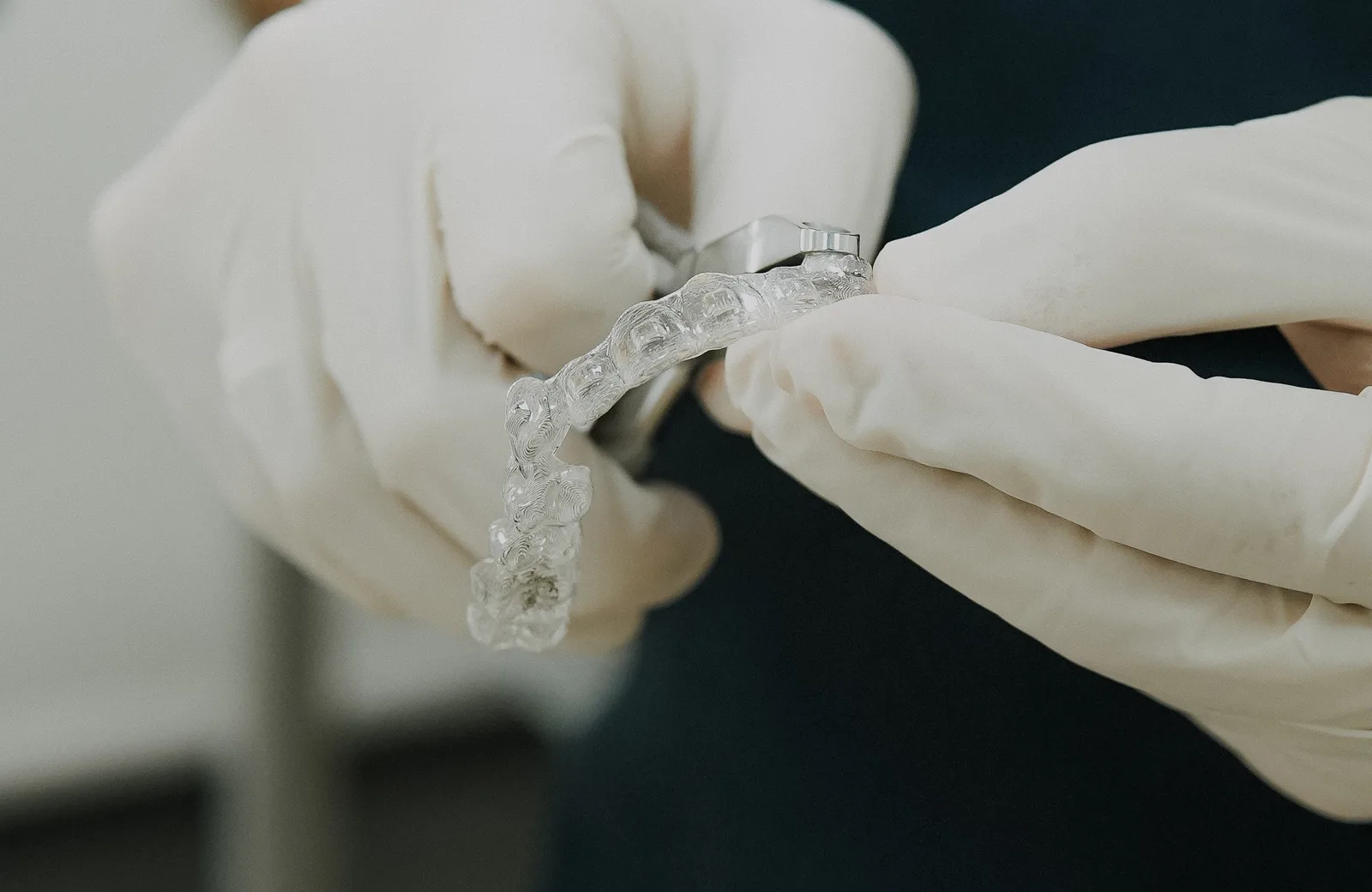
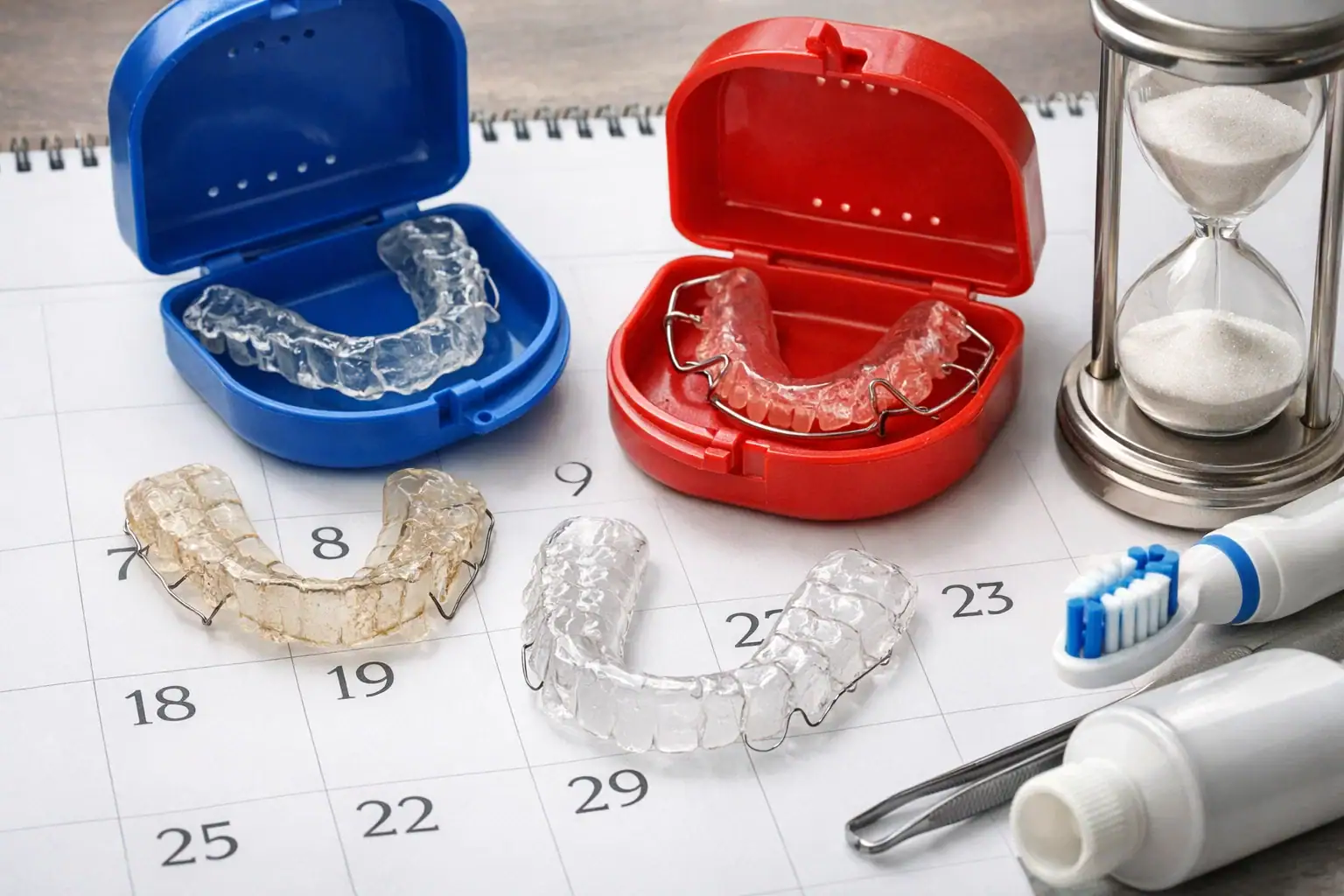
1. Clear (Essix) Retainers
- Transparent plastic
- Similar to Invisalign trays
- Most popular option
Lifespan: 6–12 months
2. Hawley Retainers
- Acrylic base
- Metal wire across front teeth
- Adjustable
Lifespan: median survival before repair, replacement or loss was 1529 days, just over four years, in patient records covering 591 retainers (PubMed 29370399)
3. Permanent (Fixed) Retainers
- Thin wire bonded behind teeth
- Not removable
Lifespan: with repairs, wires often stay in place for 10 years or more; in one cohort 98.9% of lower and 97.6% of upper wires were still in place 10-15 years after treatment (PubMed 31328248)
How Often Should You Replace Your Dental Retainer?
The replacement frequency depends on the type of retainer and how well you care for it.
/ Retainer Replacement Timelines, Signs and Lifespan
Clear Retainers
Replace every 6–12 months
Why?
- Plastic wears out
- Loses shape
- Cracks easily
- Bacteria buildup
Hawley Retainers
Replace every 3–5 years
More durable but:
- Wire can bend
- Acrylic can crack
Permanent Retainers
No fixed timeline
Replace when:
- Wire breaks
- Glue loosens
- Teeth shift
Signs You Need to Replace Your Retainer
Look out for these warning signs:
✔ Retainer feels loose
✔ Cracks or breaks
✔ Warping
✔ Discoloration
✔ Bad odor
✔ Pain when wearing
✔ Teeth shifting
✔ Retainer no longer fits
If you notice any of these, schedule a dental visit immediately.
Why Do Retainers Need to Be Replaced?
Even with proper care, retainers degrade over time due to:
- Daily wear
- Bacteria buildup
- Temperature changes
- Grinding (bruxism)
- Improper storage
What Happens If You Don’t Replace Your Retainer?
Ignoring retainer replacement can lead to:
❌ Teeth shifting
❌ Bite changes
❌ Jaw discomfort
❌ Need for re-treatment
❌ Wasted orthodontic investment
How Long Does a Dental Retainer Last?
| Retainer Type | Average Lifespan |
|---|---|
| Clear Retainer | 6–12 months |
| Hawley Retainer | 3–5 years |
| Fixed Retainer | 5+ years |
How to Extend Retainer Lifespan
You can increase your retainer’s lifespan by:
✔ Cleaning daily
✔ Avoiding hot water
✔ Storing in a case
✔ Keeping away from pets
✔ Removing before eating
✔ Handling gently
/ Retainer Care and Replacement Guidance
Retainer care depends on cleaning, damage checks, storage, and orthodontist guidance.
How to Clean Your Retainer Properly
Daily Cleaning
- Rinse with lukewarm water
- Use soft toothbrush
- Mild soap (no toothpaste)
Weekly Deep Cleaning
- Retainer cleaning tablets
- Vinegar + water (15 min)
- Baking soda paste
⚠ Avoid:
- Hot water
- Bleach
- Alcohol
- Dishwasher
Can You Wear a Broken Retainer?
❌ NO.
A damaged retainer can:
- Misalign teeth
- Cause pain
- Damage gums
Always replace it immediately.
How Much Does Retainer Replacement Cost?
Average prices:
- Clear retainer: $100 – $300
- Hawley retainer: $150 – $400
- Fixed retainer repair: $100 – $500
Prices vary by:
- Clinic
- Country
- Technology used
Do You Need to Wear Retainers Forever?
Most orthodontists recommend:
- Full-time wear: first 3–6 months
- Night-time wear: indefinitely
Teeth can shift even years later.
Retainer vs Invisalign: What’s the Difference?
| Feature | Retainer | Invisalign |
|---|---|---|
| Purpose | Maintain position | Move teeth |
| Movement | No | Yes |
| Duration | Long-term | Temporary |
Common Retainer Mistakes
❌ Leaving it in napkins
❌ Using hot water
❌ Skipping nights
❌ Not cleaning
❌ Letting pets chew it
Retainer Care for Night Grinders
If you grind teeth:
- Ask for thicker retainer
- Use night guard
- Replace more frequently
When to See Your Orthodontist
Visit your orthodontist if:
✔ Retainer feels tight
✔ Teeth moving
✔ Pain occurs
✔ Retainer lost
✔ Cracks appear
Can Old Retainers Be Adjusted?
Sometimes yes, but:
- Warped retainers cannot be fixed
- Cracked plastic must be replaced
How to Store Your Retainer Safely
✔ Hard case
✔ Away from heat
✔ Dry environment
✔ Label case
Traveling With Retainers
Tips:
- Carry backup case
- Avoid hotel napkins
- Don’t leave in car
/ Retainer Replacement FAQs
How often should you replace your dental retainer?
Clear retainers every 6–12 months, Hawley every 3–5 years.
Can I wear an old retainer?
Only if it still fits perfectly.
What if I lost my retainer?
Contact your orthodontist immediately.
Can teeth shift in one night?
Yes, especially early after treatment.
/ Digital Retainer Technology and Final Thoughts
Digital Retainer Technology
Modern clinics use:
- 3D scans
- CAD/CAM fabrication
- Same-day retainers
Directly printed retainers are the newest part of this workflow, and the clinical evidence behind them is still limited. A 2023 systematic review found only five eligible studies on directly 3D-printed retainers, four of them laboratory studies (PubMed 37189925). A 2026 randomized trial in 30 adult patients found that 3D-printed and thermoformed retainers gave comparable stability over six months of part-time wear (PubMed 41840261).
Directly printed retainers are the newest part of this workflow, and the clinical evidence behind them is still limited. A 2023 systematic review found only five eligible studies on directly 3D-printed retainers, four of them laboratory studies (PubMed 37189925). A 2026 randomized trial in 30 adult patients found that 3D-printed and thermoformed retainers gave comparable stability over six months of part-time wear (PubMed 41840261). More broadly, a 2023 Cochrane review of 47 studies with 4,377 participants found the evidence on retention methods to be of low to very low certainty, so no single retainer approach can yet be recommended over another (PubMed 37219527).
Psychological Impact of Retainer Use
Patients report:
✔ Peace of mind
✔ Confidence
✔ Satisfaction with smile
Final Thoughts
Knowing how often you should replace your dental retainer is essential for long-term orthodontic success. Retainers protect your investment and ensure your smile stays perfect.
Key takeaways:
- Clear retainers: 6–12 months
- Hawley: 3–5 years
- Fixed: as needed
- Regular checkups are crucial
Summary
Dental retainers:
✔ Prevent teeth relapse
✔ Require proper care
✔ Need timely replacement
✔ Protect your smile long-term
Let’s plan the right treatment together.
Free Assessment→- 1.Forde K, Storey M, Littlewood SJ, Scott P, Luther F, Kang J. Bonded versus vacuum-formed retainers: a randomized controlled trial. Part 1: stability, retainer survival, and patient satisfaction outcomes after 12 months. Eur J Orthod 2018;40:387-398. PubMed 29059289
- 2.Outhaisavanh S, Liu Y, Song J. The origin and evolution of the Hawley retainer for the effectiveness to maintain tooth position after fixed orthodontic treatment compare to vacuum-formed retainer: A systematic review of RCTs. Int Orthod 2020;18:225-236. PubMed 32201168
- 3.Tsoukala E, Lyros I, Tsolakis AI, Maroulakos MP, Tsolakis IA. Direct 3D-Printed Orthodontic Retainers. A Systematic Review. Children (Basel) 2023;10:676. PubMed 37189925
- 4.Boo HS, Mohd Tahir NNZ, Bahar AD, Littlewood SJ, Sivarajan S. A Randomised Controlled Trial Comparing Thermoformed and 3D-Printed Retainers in Young Adults: Evaluation of Post-treatment Stability and Patient Satisfaction. Clin Oral Investig 2026;30:126. PubMed 41840261
- 5.Jin C, Bennani F, Gray A, Farella M, Mei L. Survival analysis of orthodontic retainers. Eur J Orthod 2018;40:531-536. PubMed 29370399
- 6.Kocher KE, Gebistorf MC, Pandis N, Fudalej PS, Katsaros C. Survival of maxillary and mandibular bonded retainers 10 to 15 years after orthodontic treatment: a retrospective observational study. Prog Orthod 2019;20:28. PubMed 31328248
- 7.Martin C, Littlewood SJ, Millett DT, Doubleday B, Bearn D, Worthington HV, et al. Retention procedures for stabilising tooth position after treatment with orthodontic braces. Cochrane Database Syst Rev 2023;5:CD002283. PubMed 37219527