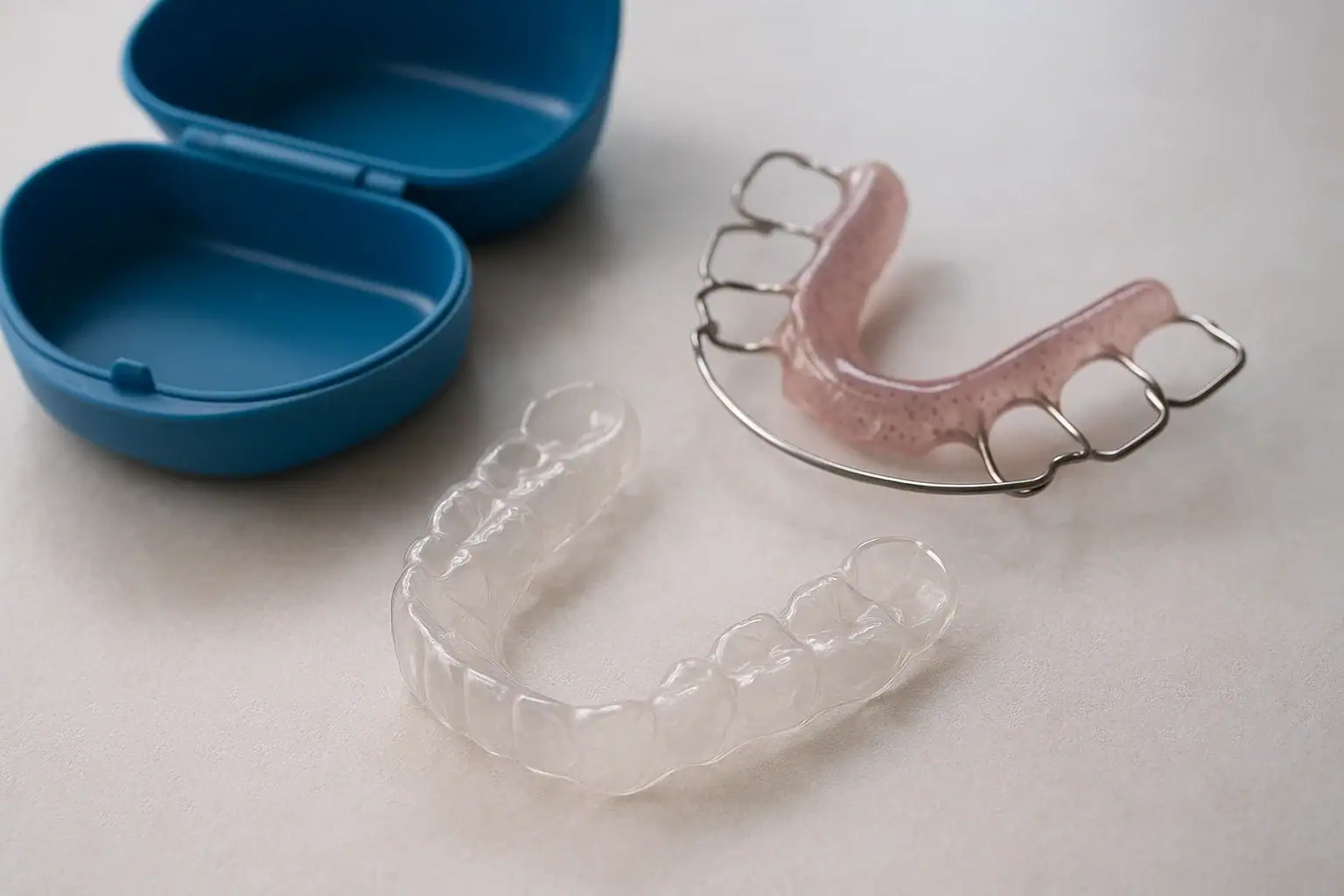
A retainer is a custom appliance worn after braces or aligners to hold teeth in their corrected position while bone and periodontal ligament settle, a process that takes roughly 3 to 12 months. Three designs are in use: removable Hawley plates of wire and acrylic, clear thermoformed Essix trays, and fixed multistrand wires bonded behind the front teeth. A Cochrane review of 47 randomised trials with 4377 participants found differences between removable and fixed retention at 12 months fell below the 1 mm of Little's Irregularity Index judged clinically important (PubMed 37219527).
- 01Retention exists because bone and the periodontal ligament need roughly 3 to 12 months to stabilise around the new tooth positions, and elastic fibres pull teeth back until they do.
- 02Cochrane's 2023 review of 47 randomised trials with 4377 participants found removable and fixed retainers differed by less than the 1 mm of Little's Irregularity Index judged clinically important at 12 months, with the evidence rated low to very low certainty (PubMed 37219527).
- 03Bonded retainers fail often: pooled failure was 35.22% (95% CI 27.46-42.98) across 34 studies with 3484 participants, climbing from 24.18% at short-term follow-up to 53.85% in the long term (PubMed 37824794).
- 04In the trials Cochrane pooled, removable retainers caused more discomfort but showed fewer failures and better gingival scores than fixed wires (PubMed 37219527).
- 05Service life differs by type: in patient records covering 591 retainers, median survival before repair, replacement or loss was 105 days for Essix trays, 1529 days for Hawley plates and 1604 days for bonded wires (PubMed 29370399).
A beautiful smile doesn’t end when your braces or aligners come off; it is only the beginning of long-term maintenance. Retainers for teeth are essential orthodontic devices designed to hold your teeth in their corrected positions after treatment. Without them, teeth naturally tend to shift back, undoing months or even years of orthodontic progress.
/ 1. Retainers for Teeth Overview
1.1 Definition
A retainer is a custom-made orthodontic appliance used to maintain tooth position after braces, clear aligners, or other orthodontic procedures. Retainers prevent teeth from shifting back due to natural forces such as:
- Periodontal ligament elasticity
- Jaw growth
- Muscle pressure
- Tongue posture
- Chewing forces
Orthodontists often say:
“Braces move teeth. Retainers keep them there.”
1.2 Why Retainers Are Essential After Orthodontic Treatment
Even after teeth are aligned:
- The bone surrounding them is still soft
- The ligaments are elastic and want to revert
- Chewing and swallowing exert forces
- Natural aging reshapes dental arches
Without a retainer, relapse can occur within weeks. In some cases, significant shifting can happen overnight.
2. Types of Retainers for Teeth
Different patients require different retention strategies. Modern orthodontics uses three main categories.
2.1 Hawley Retainers (Removable Wire Retainers)
These retainers consist of:
- A metal wire
- Acrylic or biocompatible plate
- Clasps for stability
Advantages
- Durable and long-lasting
- Easy to adjust
- Allows teeth to settle naturally
- Good airflow, less plaque accumulation
Disadvantages
- Visible wire
- Can affect speech initially
- Not ideal for patients needing strict retention
2.2 Essix Retainers (Clear Removable Retainers)
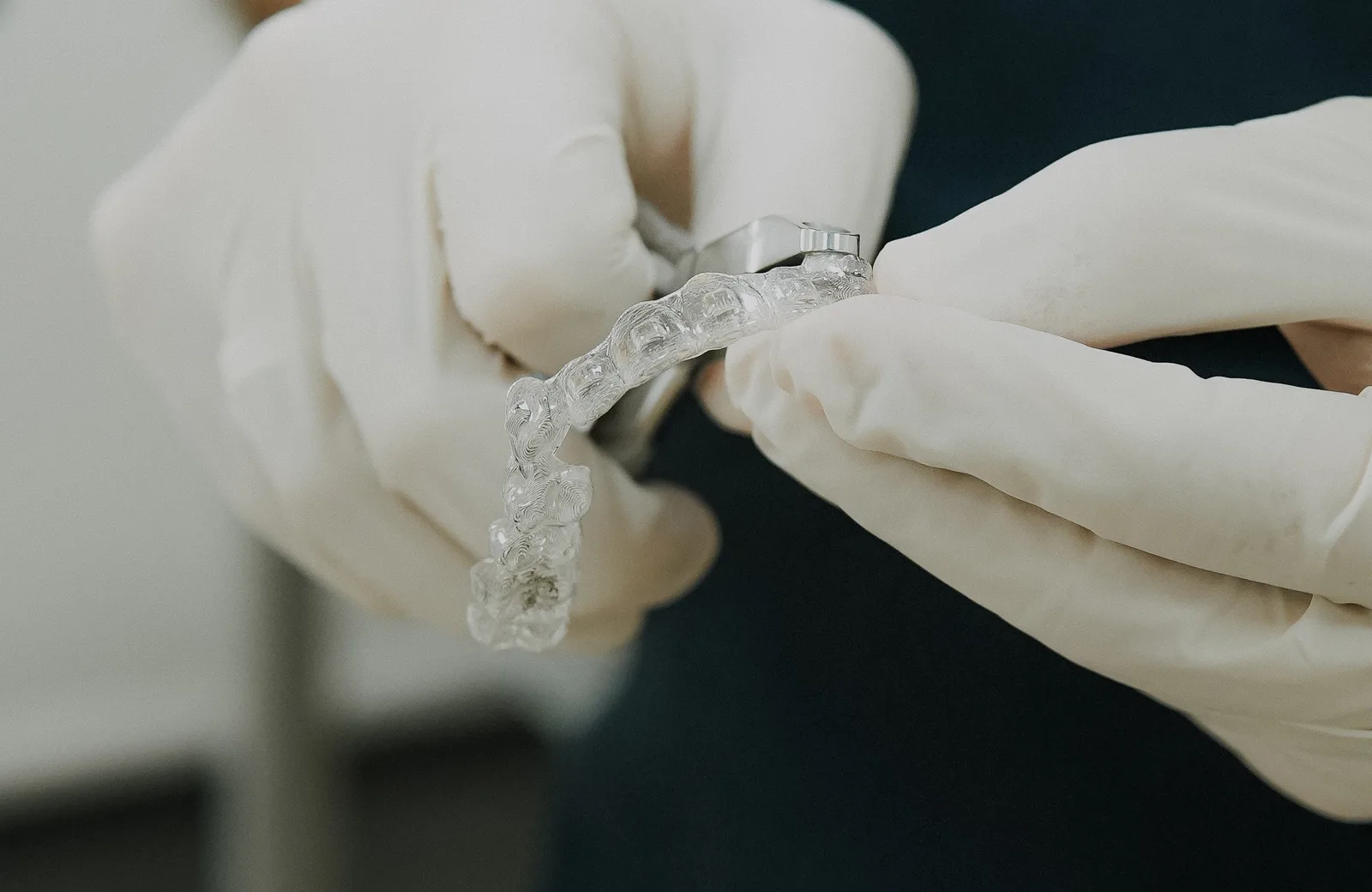
Essix retainers are transparent plastic trays that resemble Invisalign aligners.
Advantages
- Nearly invisible
- Comfortable
- Holds teeth very tightly in place
- Excellent for cosmetic retention
Disadvantages
- Can crack if not handled properly
- Requires meticulous cleaning
- Can trap saliva if worn incorrectly
Essix retainers are among the most popular cosmetic dentistry retention tools used worldwide.
2.3 Fixed (Bonded) Retainers
These consist of a thin metal wire bonded behind the front teeth, usually canine to canine.
Advantages
- Always in place
- Great for preventing relapse
- Ideal for severe crowding cases
- Invisible from the outside
Disadvantages
- More plaque accumulation if not cleaned well
- Requires regular dental hygiene appointments
- Wire may detach and need repair
Fixed retainers are often used along with removable retainers for maximum stability.
/ 3. How Retainers Work and How to Clean Retainers
3. How Retainers Work: The Science Behind Stability
3.1 The Periodontal Ligament Memory Effect
The fibers holding your teeth in place become stretched during orthodontic movement. These fibers have "memory" and try to pull teeth back similar to a stretched rubber band.
Retainers neutralize this force.
3.2 Bone Remodeling
Orthodontic treatment changes bone structure. It takes 3–12 months for the bone to fully harden around your new tooth position.
Retainers maintain the position while bone stabilizes.
3.3 Muscle Forces and Tongue Posture
Teeth are influenced by:
- Tongue
- Lips
- Cheeks
- Swallowing patterns
A retainer helps retrain these forces.
4. How to Clean Retainers: Complete Guide
One of the most common questions patients search is “how to clean retainers.”
Below is an in-depth guide for all types.
4.1 Daily Cleaning Routine
For Removable Retainers (Essix & Hawley)
- Rinse with lukewarm water immediately after removal
- Use a soft toothbrush with liquid soap, not toothpaste
- Gently brush the inside and outside
- Rinse thoroughly
- Allow to air-dry
For Fixed Retainers
- Use an interdental brush
- Floss with superfloss or floss threaders
- Apply gentle pressure around the wire area
4.2 What NOT to Use on Retainers
Avoid:
- Hot water (warps plastic)
- Toothpaste (abrasive)
- Alcohol or mouthwash containing alcohol (micro-cracks plastic)
- Bleach
- Denture cleaner for metal retainers (unless approved)
4.3 Weekly Deep Cleaning
Use:
- Retainer cleaning tablets
- Hydrogen peroxide diluted 50/50
- White vinegar soak for 10–15 minutes
- Ultrasonic cleaners (safe for removable retainers)
/ 5. Retainer Wear, Replacement, Problems, Materials, Oral Hygiene, and Myths
5. Retainer Wear Schedule: How Long Do You Need It?
Most orthodontists recommend:
First 6 Months After Treatment:
✔ Wear full-time (22 hours/day)
6–12 Months:
✔ Wear nightly
After 1 Year:
✔ Wear a few nights per week, long term
This is because teeth can shift at any age due to aging, bone resorption, or muscle habits.
6. When to Replace Your Retainer
Replace your retainer if:
- It cracks
- Becomes loose
- Causes discomfort
- Looks distorted or warped
- Develops persistent odor
- Fails to fit properly
In patient records covering 591 retainers, median survival before repair, replacement or loss was 105 days for Essix retainers, 1529 days for Hawley retainers and 1604 days for fixed retainers (PubMed 29370399).
7. Common Retainer Problems & Solutions
7.1 My retainer feels tight. Why?
Possible reasons:
- Slight relapse
- You skipped wearing it
- Natural jaw changes
Solution: resume full-time wear for 2–5 days.
7.2 My retainer causes pain.
Stop using it and contact your dentist. Pain may indicate tooth movement.
7.3 My fixed retainer broke.
This requires immediate repair, teeth may shift within days.
8. Retainer Materials Explained (Advanced Section)
Essix (Vacuum-Formed Plastic):
- PETG
- Polyurethane
- BPA-free thermoformed materials
Hawley (Acrylic + Metal):
- Stainless steel
- Nickel-free options available
Fixed Retainer Wire:
- Multistrand braided wire
- Titanium-coated options
9. Retainers & Oral Hygiene: Maintaining a Healthy Mouth
Retainers can trap bacteria if not cleaned properly, causing:
- Bad breath
- Plaque build-up
- Gum irritation
- Cavities on the retainer-contact surfaces
To prevent this:
- Brush teeth before wearing the retainer
- Store the retainer in a ventilated case
- Avoid wearing it when eating
10. Retainer Myths vs. Facts
Myth: Retainers are optional.
Fact: Teeth will shift without retention.
Myth: Only teenagers need retainers.
Fact: Adults also experience orthodontic relapse.
Myth: Retainers weaken teeth.
Fact: Retainers protect teeth.
/ 11. FAQ Section
11.1 How to clean retainers?
Use mild soap and a soft brush daily; deep-clean weekly.
11.2 How to brush a retainer?
Brush gently with liquid soap, not toothpaste.
11.3 Why do my teeth shift even with a retainer?
Possible causes:
- Inconsistent use
- Growth changes
- Gum recession
- Bone remodeling
- Incorrect fit
/ 12. Digital Dentistry in Retainer Treatment
12. The Role of Digital Dentistry in Retainers (Mosdent-Inspired)
Modern clinics like Mosdent Dental Hospital use:
- Intraoral scanners instead of impressions
- 3D digital models
- CAD/CAM fabrication
- High-precision occlusal mapping
Advantages:
- Perfect fit
- Better comfort
- Faster fabrication
- Long-term accuracy
13. Long-Term Consequences of Not Wearing a Retainer
If retainers are not worn:
- Teeth shift
- Bite becomes misaligned
- Crowding returns
- Invisalign or braces may be required again
- Gum and bone changes accelerate
14. Retainers vs. Other Orthodontic Hold Devices
| Device | Purpose | Duration | Removable? |
|---|---|---|---|
| Retainer | Stabilizes teeth | Long-term maintenance | Yes/No |
| Bite plate | Jaw correction | Short-term | Yes |
| Expansion device | Widens palate | Growth phase | Yes |
| Orthodontic aligner | Moves teeth | Treatment phase | Yes |
15. Conclusion: Retainers Are the Key to a Stable Smile
Orthodontic treatment rewrites your smile, but retainers protect that investment over the long term . Whether you choose a clear Essix retainer, a Hawley appliance, or a fixed bonded retainer, the key is consistency, proper cleaning, and regular dental checkups.
A well-maintained retainer:
✔ Preserves alignment
✔ Prevents relapse
✔ Protects cosmetic restorations
✔ Supports healthy bite function
✔ Ensures long-term orthodontic results
Your smile is a lifelong asset, protect it with the right retainers for teeth and proper care.
Let’s plan the right treatment together.
Free Assessment→- 1.Martin C, Littlewood SJ, Millett DT, Doubleday B, Bearn D, Worthington HV, et al. Retention procedures for stabilising tooth position after treatment with orthodontic braces. Cochrane Database Syst Rev 2023;5:CD002283. PubMed 37219527
- 2.Aye ST, Liu S, Byrne E, El-Angbawi A. The prevalence of the failure of fixed orthodontic bonded retainers: a systematic review and meta-analysis. Eur J Orthod 2023;45:645-661. PubMed 37824794
- 3.Jin C, Bennani F, Gray A, Farella M, Mei L. Survival analysis of orthodontic retainers. Eur J Orthod 2018;40:531-536. PubMed 29370399