
Bracket Treatment
Bracket treatment, or fixed braces, moves teeth in three planes using metal or ceramic brackets bonded to the teeth and an archwire running through them.
- Most precise for complex cases
- Metal or aesthetic ceramic
- Standard for paediatric & adolescent orthodontics
First consultation free · same-day reply · no price pressure
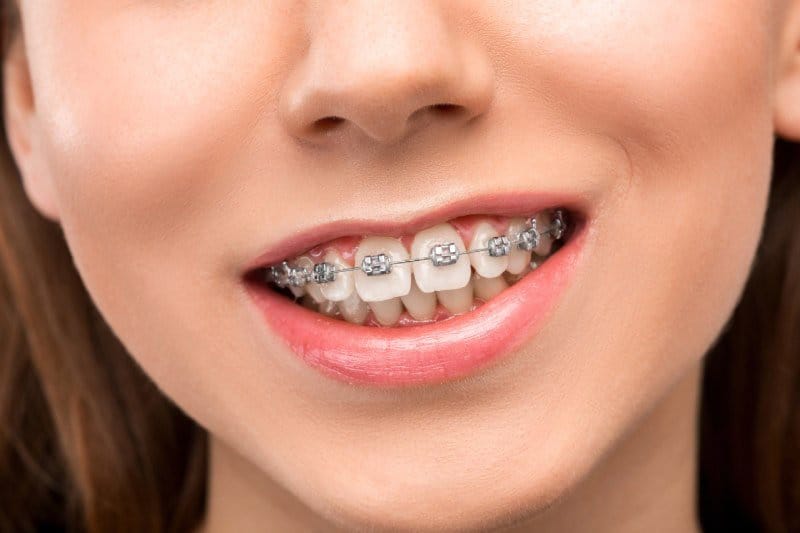
Bracket treatment, or fixed braces, moves teeth in three planes using brackets bonded to the teeth and an archwire running through them. In a review of eight comparative studies, the three that could be pooled showed clear aligner therapy finishing on average 6.31 months sooner than braces (weighted mean difference -6.31, 95% CI -8.37 to -4.24, P < 0.001), but the review found aligners not as effective at producing occlusal contacts, controlling torque, increasing transverse width or holding the result, and the difference in Objective Grading System score did not reach significance (PubMed 30674307). That trade-off is what should decide the appliance for a complex case.
- 01Self-ligating brackets are marketed as faster, and that has not been shown. A systematic review of six randomised and eleven controlled trials found no significant difference between bracket types in pain experience, could not pool other outcomes because of heterogeneous design, and concluded there is insufficient high-quality evidence to favour either system (PubMed 20050755).
- 02White spot lesions are the measured principal risk of fixed appliances. Across fourteen studies, the incidence of new carious lesions forming during treatment was 45.8% and the prevalence of lesions in patients under treatment was 68.4% (PubMed 26759794).
- 03That risk is manageable and the prevention plan should be written into your quote. In a network meta-analysis of remineralising agents, sodium fluoride varnish ranked first for the short-term decalcification index (cumulative ranking 99.3%) and acidulated phosphate fluoride foam ranked first for long-term lesion incidence after debonding (96.9%), while no agent was shown to reverse established lesions (PubMed 33057826).
- 04Root resorption tracks the force applied. A systematic review of thirteen studies reported that comprehensive orthodontic treatment increases the incidence and severity of root resorption and that heavy forces may be particularly harmful, while archwire sequencing, bracket prescription and self-ligation had no effect; a two to three month pause reduced total resorption (PubMed 20362905).
- 05Debonding is not the end of the case, and a travelling patient should plan for it. The 2023 Cochrane update covering 47 studies and 4,377 participants found no retainer type better than another by a clinically significant margin, on low to very low certainty evidence (PubMed 37219527).
/ What is a Bracket?
The small metal pieces that are attached to the teeth during braces treatment are called "brackets". Braces treatment is applied to correct the shape and position of the teeth, and brackets are applied to align the teeth correctly.
During braces treatment to correct the teeth, brackets are glued onto the teeth. Wires are then used to connect the brackets to each other and these wires are stretched. After the brackets are attached to the patient's teeth, the braces are checked at regular intervals and the wires are tightened. In this way, the position of the teeth is changed. The duration of braces treatment can vary from a few months to several years, depending on the current condition of the patient's teeth.
One of the most important parts of braces treatment is the brackets. This is because the brackets play a critical role in the process of straightening the teeth. Although braces treatment can be a long process that requires regular check-ups, it is considered an excellent way to have correctly aligned and healthy teeth.
However, it is possible to experience various problems during bracket use. The main one is pain. Pain may occur in the mouth during or after the braces are inserted. Although this pain, which is usually mild, subsides within a few days, painkillers can increase the comfort of the patient during this period.
Gum sensitivity may develop after the braces are fitted. In this case, it is necessary to clean the gums regularly and use the dental floss and toothbrush recommended by the dentist.
It is possible to see discoloration of the teeth during the use of braces. Such situations can be remedied by cleaning the teeth after the brackets are removed. Some patients may experience speech problems after the braces are fitted. This situation improves within a few days after getting used to the brackets. If the brackets cause swallowing problems, dentists may need to correct the brackets. For the success and comfort of bracket treatment, the dentist's recommendations should be followed exactly.
| At a glance | |
|---|---|
| Duration | 12-24 months |
| Sessions | 18 |
| Warranty | · |
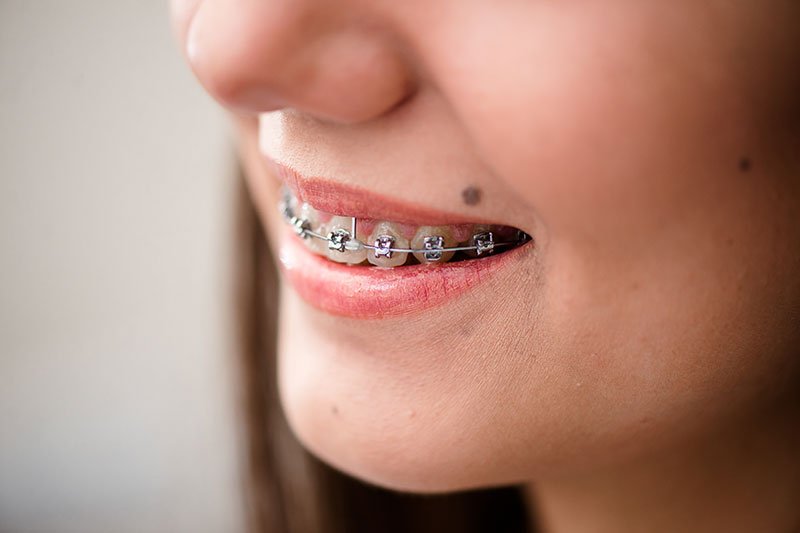
| Materials Used | Metal bracket · Clear ceramic bracket |
/ Metal and Ceramic Bracket Types
There are different types of brackets and the type of bracket to be used depends on various patient-specific factors.
Metal Bracket
Metal brackets, which are frequently used in dentistry, are mostly made of stainless steel. In this way, they adhere better to the teeth. In braces treatment, small elastics are used to hold the wire passing through the metal brackets in place. Arc wires in metal braces have a thin structure. Today, smaller metal brackets are used in braces treatment. Metal brackets are considered to be advantageous solutions because they have less friction with the archwires.
Ceramic Bracket
Because they are made of ceramic material, ceramic braces have a more natural tooth color. Thanks to the aesthetic advantage it brings with it, it is often preferred in braces treatments. However, since ceramic brackets have large sizes, food accumulation may occur on the teeth. Accordingly, patients with ceramic braces should pay due attention to oral and dental care. The structure of ceramic brackets is more fragile than metal brackets. In addition, it is possible to prolong the treatment time due to more friction with archwires.
/ Lingual, Damon and Transparent Bracket Options
Other bracket options include lingual braces, Damon braces and clear aligners.
Lingual Bracket
Lingual braces, which are more costly than other types of braces, are designed specifically for the patient. Since the braces are placed on the back of the teeth and the brackets are located on the back of the teeth, the braces are not visible when laughing or talking. This eliminates aesthetic concerns. The lingual bracket, which is less affected by the procedures performed on the surface of the teeth because it is behind the teeth, also prevents marks on the teeth.
Damon Bracket
Damon braces, also called self-ligating brackets, are similar to metal braces and are designed for low friction. However, there is insufficient high-quality evidence to support them over conventional brackets (PubMed 20050755).
Clear Aligners
Clear aligner treatment, also known as brace-free treatment, can replace braces or brackets. In this method, which uses patient-specific transparent aligners instead of brackets, a slight pressure is applied to move the teeth to the desired position.
Compared to traditional metal brackets, clear aligner treatment brings many advantages. It is also aesthetically advantageous as it is less prominent. Clear aligners that fit snugly to the teeth are easy to use. Since they are removable, oral and dental hygiene is easily ensured.
/ Cases Where Braces Are Applied
Although braces are thought to be a treatment method that works only in childhood, braces can also be applied in adulthood and extremely successful results can be obtained. For braces to be applied in children, deciduous teeth must have fallen out and all permanent teeth must have erupted. Bracket treatment cannot be applied to children whose deciduous teeth have not fallen out.
- Braces are applied to ensure that the teeth are properly aligned, to close the gaps between the teeth, to correct crooked or jaw closure problems.
- Braces can be applied to ensure the correct positioning of the teeth in the jawbone and to increase the chewing function of the teeth.
- Braces can be used to correct incompatibilities between the upper and lower jaw and to achieve a healthier jaw bite.
- Bracket treatment can also be used in case of overlapping teeth or rotation problems in the teeth.
However, it is not correct and possible to use a bracket to solve every dental problem. In this context, dentists identify and evaluate the problem specific to each patient and determine the most appropriate treatment method.
/ How Bracket Care and Breakage Are Managed
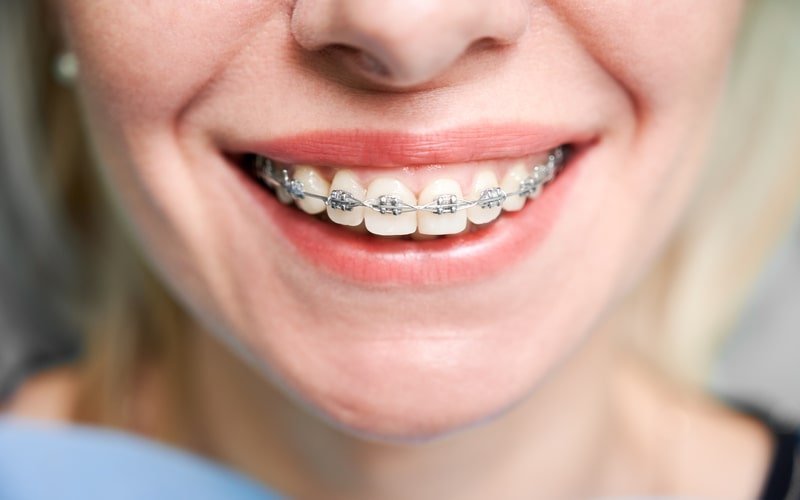
One of the most important factors for the protection of dental health and the success of the treatment is to apply bracket care correctly. For this, teeth should be brushed and flossed regularly. The area around the brackets and wires should be brushed carefully, especially around the brackets, as food accumulation around the brackets and wires can cause tooth decay.
Hard and sticky foods should be avoided to prevent food accumulation around the brackets. In addition, the dentist should be visited regularly for the maintenance of the brackets. During this visit, the dentist will check the brackets and make the necessary adjustments.
Why Do Brackets Break?
Since brackets are made of extremely durable materials, it is not common for them to break. Rarely seen bracket fracture is usually due to the consumption of hard foods. There is a risk of breaking the brackets when hard foods with shells are bitten with the teeth.
Another factor that causes the brackets to break is the weakening of the adhesives used during the application over time and the adhesives that come out of their place and cause rapid fracture. In such cases, even if the bracket does not break, if the adhesive material weakens and the brackets dislodge, the bracket must be re-glued. Otherwise, the success of the treatment may be negatively affected.
Treatment Process
- 01Consultation: Initial examination and needs assessment; imaging where required.
- 02Treatment: Bracket bonding, periodic wire changes and tightening.
- 03Follow-up: Outcome review and aftercare guidance.
/ Dental Brackets in Turkey: Affordable Orthodontic Care
Patients mainly ask about bracket treatment in Turkey because the cost is lower than at home. Cost is one input into the decision and not the whole of it: bracket treatment runs over months, so the plan also has to say how many appointments it needs and who follows the case between them.
Clinics offer a wide range of orthodontic options tailored to fit each patient's needs and preferences. Whether you're opting for traditional metal braces, clear ceramic brackets, or invisible aligners, Turkish dental clinics provide solutions for every lifestyle and budget.
/ Choosing Mosdent Dental Hospital for Dental Brackets
Mosdent plans bracket treatment in Istanbul both for patients living here and for patients travelling for treatment. The examination and the records come first, and the appliance is chosen after them.
Each case is assessed on its own records, and the plan is written for that case rather than taken from a standard package.
Pricing is written down before treatment starts, with the number of appointments and what each stage covers set out in the same document.
/ Choosing Brackets in Braces Treatment
In the orthodontic treatment process, the attachments glued on the teeth to move the teeth are called "brackets". There are many different types of brackets. However, even though the type of brackets changes, their role in the braces treatment process and the purpose of the treatment do not change. Which bracket will be used during braces treatment is determined by the dentist on a patient-specific basis, depending on the shape of the defect in the teeth and the problem to be eliminated.
During bracket selection, the patient's age, aesthetic expectations, cost and the dentist's recommendations are evaluated. Then the right choice is made to ensure the success and comfort of the treatment.
Bracket Prices
Bracket prices vary depending on the current condition of the patient's teeth, the type of bracket preferred, the duration of the treatment and other factors. Since the treatment process is planned individually for the patient, bracket prices can be determined after the patient is examined.
- 1.Ke Y, Zhu Y, Zhu M. A comparison of treatment effectiveness between clear aligner and fixed appliance therapies. BMC Oral Health 2019;19:24. PubMed 30674307
- 2.Fleming PS, Johal A. Self-ligating brackets in orthodontics. A systematic review. Angle Orthod 2010;80:575-84. PubMed 20050755
- 3.Sundararaj D, Venkatachalapathy S, Tandon A, Pereira A. Critical evaluation of incidence and prevalence of white spot lesions during fixed orthodontic appliance treatment: A meta-analysis. J Int Soc Prev Community Dent 2015;5:433-9. PubMed 26759794
- 4.Hu H, Feng C, Jiang Z, Wang L, Shrestha S, Yan J, et al. Effectiveness of remineralizing agents in the prevention and reversal of orthodontically induced white spot lesions: a systematic review and network meta-analysis. Clin Oral Investig 2020;24:4153-4167. PubMed 33057826
- 5.Weltman B, Vig KW, Fields HW, Shanker S, Kaizar EE. Root resorption associated with orthodontic tooth movement: a systematic review. Am J Orthod Dentofacial Orthop 2010;137:462-76; discussion 12A. PubMed 20362905
- 6.Martin C, Littlewood SJ, Millett DT, Doubleday B, Bearn D, Worthington HV, et al. Retention procedures for stabilising tooth position after treatment with orthodontic braces. Cochrane Database Syst Rev 2023;5:CD002283. PubMed 37219527
- 7.Tsichlaki A, Chin SY, Pandis N, Fleming PS. How long does treatment with fixed orthodontic appliances last? A systematic review. Am J Orthod Dentofacial Orthop 2016;149:308-18. PubMed 26926017

Who is this treatment for?
- Improper alignment of the teeth
- Gaps between the teeth
- Crooked teeth or jaw closure problems
- Incorrect positioning of the teeth in the jawbone
- Incompatibilities between the upper and lower jaw
- Overlapping teeth or rotation problems in the teeth
Doctors specialising in this treatment

Frequently asked
01Metal or ceramic brackets?+
Metal brackets are more durable; ceramic brackets are more aesthetic but more susceptible to staining. Our recommendation depends on the case and patient preference.
02Is there pain when braces are placed?+
Mild pressure for 2-4 days after fitting is normal. Similar brief discomfort may follow each activation appointment.
Orthodontics
Crooked Teeth Treatment
Crooked teeth treatment moves overlapping teeth into the space they lack using braces or clear aligners, with space creation or extraction where indicated.
Explore→02Invisalign Treatment
Invisalign is an orthodontic system that aligns teeth with a custom series of clear trays, worn 20-22 hours a day and taken out to eat and brush.
Explore→Speak with your doctor about this treatment.
Not sure which treatment fits? Tell us what’s wrong →