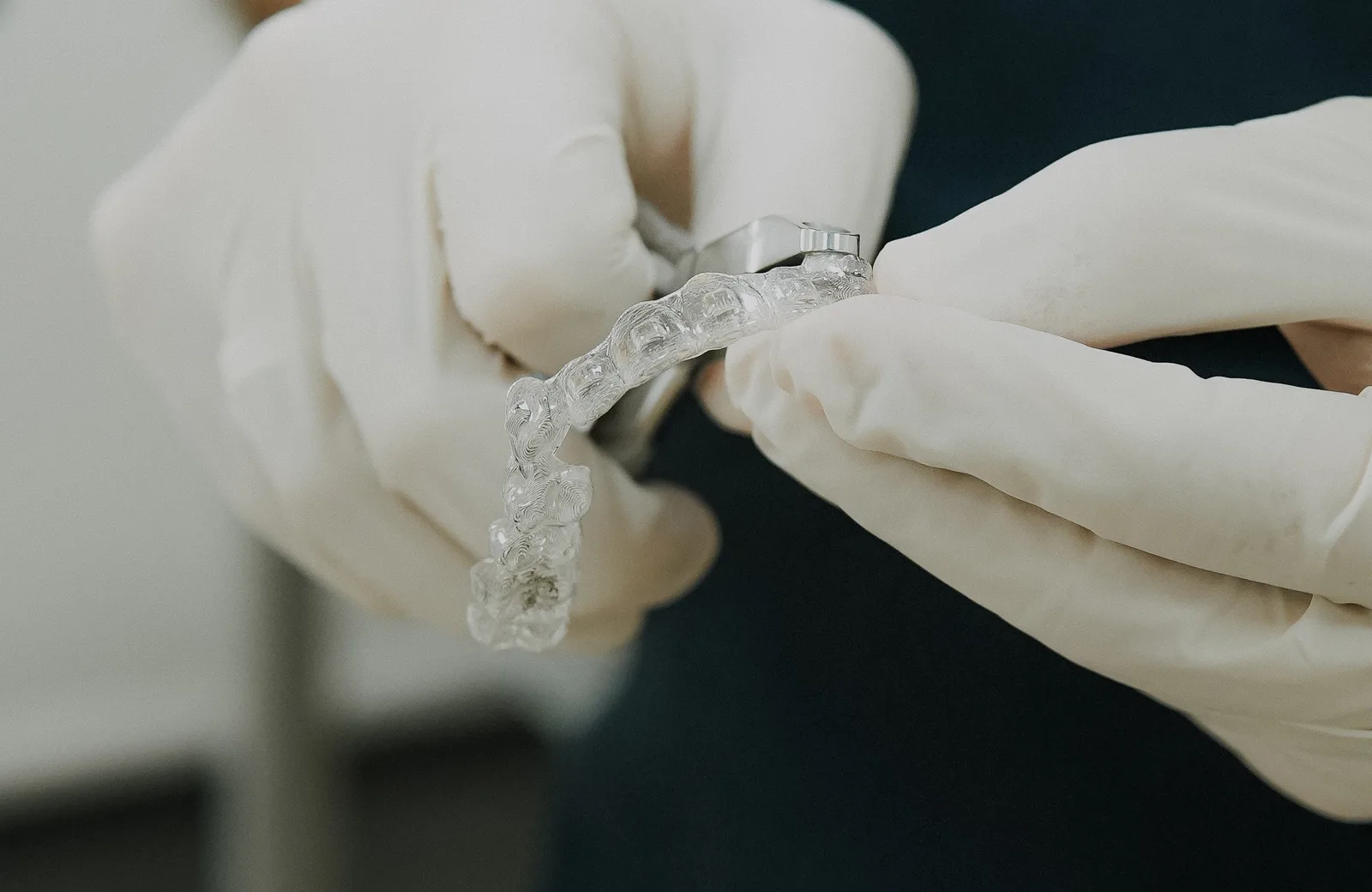
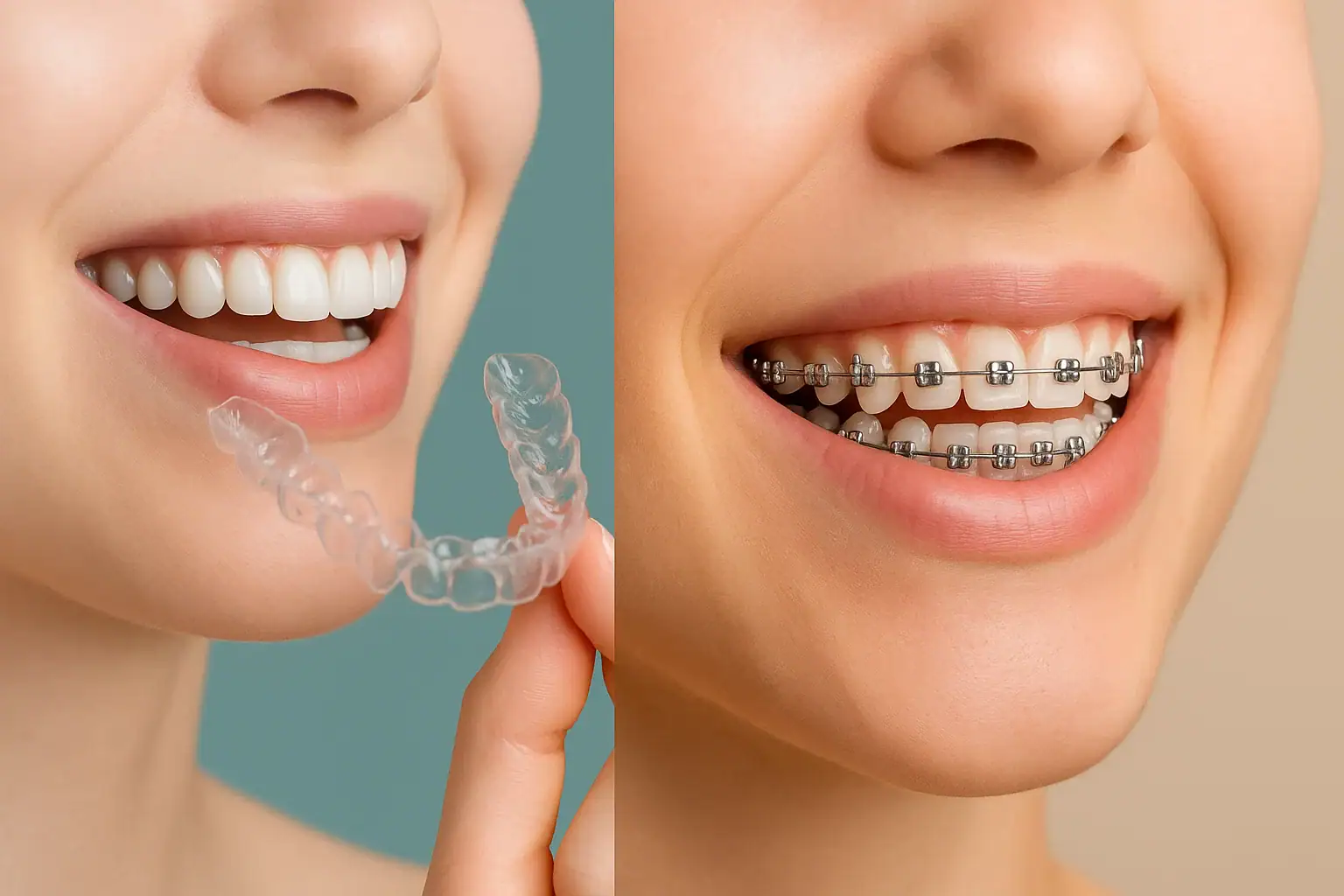
For mild to moderate problems treated without extractions, clear aligners and fixed braces give comparable results: a systematic review and meta-analysis involving 1084 patients found no significant differences in treatment quality or duration (PubMed 41127933). Where teeth have to be extracted, the same review found that fixed appliances provided superior treatment quality (PubMed 41127933). Aligners are kinder to gums and enamel during treatment, but they only work while they are worn, and either route ends with retainers.
- 01In non-extraction cases, a meta-analysis of fifteen trials involving 1084 patients found no significant differences in treatment quality or duration between clear aligners and fixed appliances; in extraction cases fixed appliances were superior (PubMed 41127933).
- 02Aligners do not deliver every planned movement: in a prospective study of 38 Invisalign patients the mean accuracy across all tooth movements was 50%, and rotation was the weakest at 46% (PubMed 32620479).
- 03Aligners are not reliably faster: a randomised trial of 66 patients found treatment took 4.8 months longer with Invisalign than with braces, with similar occlusal outcomes (PubMed 35168256).
- 04The pain advantage of aligners is short: across 12 studies, pain was lower than with braces only at 3 and 4 days after the start of treatment (PubMed 38001455).
- 05Enamel fares better with aligners: approximately 1.2% of 244 aligner patients developed white spot lesions compared with 26% of 206 braces patients (PubMed 30556747).
- 06Remote monitoring trims clinic visits but not treatment time: a systematic review of 11 studies found 1.68 to 3.5 fewer in-office visits and no reduction in treatment duration (PubMed 37278017).
/ Braces vs Invisalign head-to-head trials
Braces vs Invisalign evidence suggests similar results for non-extraction, simple cases, while fixed braces have an advantage when teeth are removed as part of treatment. If your case is mild or moderate and no extractions are planned, clear aligners such as Invisalign and fixed appliances can both be reasonable options. If your orthodontist has planned extractions, large space closure or difficult root control, the evidence leans toward fixed braces. For braces vs Invisalign cost, use the separate Invisalign cost in Turkey article, because this page focuses on clinical choice.
A systematic review and meta-analysis of 15 trials involving 1084 patients found no significant difference in treatment quality or duration between clear aligners and fixed appliances in non-extraction cases (PubMed 41127933). In the same review, fixed appliances produced superior treatment quality in extraction cases, which the authors linked to better control of tooth movement (PubMed 41127933). Another systematic review of randomised trials found no significant difference in objective grading scores, Little's Irregularity Index or PAR scores in simple malocclusions treated without extractions, although the overall certainty of the evidence was low (PubMed 39947778).
The practical limit is case type. A broad overview of systematic reviews concluded that clear aligners are effective for mild to moderate malocclusions, but outcomes are inferior in severe cases or for specific movements, with an overall moderate level of evidence (PubMed 34993617). That means the appliance choice should start with the movements your teeth need, rather than with appearance alone.
/ Invisalign vs braces effectiveness by tooth movement
Invisalign vs braces effectiveness depends on the movement being prescribed, because aligners control some movements well and struggle more with others. Aligners are often used effectively in mild or moderate crowding and in open bite cases, but they have biomechanical limits (PubMed 40760282). Fixed braces tend to become more relevant when the plan includes extraction space closure, root control or severe tooth movement demands. A mixed or staged plan can be considered by an orthodontist, but comparative evidence for switching from braces to aligners during treatment is limited to case reports.
The movement details matter. A systematic review reported extrusion as the hardest movement to control with clear aligners, with 30% accuracy, followed by rotation; upper molar distalisation was the most predictable movement, reaching 88% when bodily movement of at least 1.5 mm was prescribed (PubMed 25412265). In a prospective Invisalign study, mean accuracy across all tooth movements was 50%, with buccal-lingual crown tip at 56% and rotation at 46% (PubMed 32620479). In premolar extraction treatment, a meta-analysis found under-retraction of the front teeth of 1.93 mm compared with the digital plan, with inferior root control and occlusal contact scores for aligners compared with fixed appliances (PubMed 41195763).
Deep bite is another area where planning often needs a margin. A systematic review found clear aligner deep bite correction accuracy between 33% and 48.88% of the planned amount, so overcorrection or refinements are often needed, and the evidence quality was low (PubMed 40394411). In one Invisalign study, most patients improved after the first refinement, but no patient improved further when refinements continued after 3 (PubMed 35868952). No systematic review or comparative trial was found for planned hybrid treatment that starts with braces and finishes with aligners, so that decision rests with the treating orthodontist.
/ Treatment time with aligners and with braces
Invisalign vs braces which is faster depends on the diagnosis, because mild to moderate crowding can take a similar time while individual studies point in different directions. The shortest or longest estimate from another patient's case should not be used as a promise for yours. For an adult or teenager travelling to Istanbul, the more useful question is whether the appliance can deliver the planned movements within the visit schedule you can realistically keep. Treatment time is also affected by refinements, missed wear, breakages and finishing requirements.
For fixed appliances, a systematic review of prospective university-based studies found a mean comprehensive treatment duration of 19.9 months across 22 studies and 1089 participants (PubMed 26926017). A separate review that included ten studies found low-certainty evidence that treatment duration in mild to moderate crowding is similar with clear aligners and fixed appliances, and it called for trials in severe cases (PubMed 38607436). In a randomised trial of 66 patients with simple malocclusions, Invisalign took 4.8 months longer than braces, while occlusal outcomes at the end of treatment and after 6 months of retention were similar (PubMed 35168256).
The adolescent evidence is not the same as the adult evidence. In a retrospective study of patients who started treatment between age 12 and 18 with moderate to severe malocclusions, aligner cases finished in 24 ± 6 months compared with 27 ± 5 months for fixed appliances, with fewer visits and no significant difference in reported wear compliance or emergency visits (PubMed 37407511). The limit is that study design and case selection can change the result.
/ Pain, speech and everyday comfort in the first weeks
For the question does Invisalign hurt more than braces, measured studies point to less pain with aligners only on days 3 and 4 after treatment begins. That does not mean aligners are painless, and it does not mean braces always hurt more. The better expectation is that both appliances can feel strange at first, with discomfort changing as teeth begin to move. Daily comfort may improve as the mouth adapts.
A systematic review and meta-analysis of 12 studies found that pain was lower with clear aligners than with fixed appliances only at 3 and 4 days after the start of treatment (PubMed 38001455). The same review found oral health-related quality of life higher with aligners at 1 week, 1 month and 6 months, but similar at the end of treatment (PubMed 38001455). That pattern is useful for someone choosing between appliances, because the comfort difference is more about the early and middle experience than the final outcome.
Speech is a separate issue. A systematic review of seven studies involving 332 patients found that clear aligners can affect speech clarity in a similar way to fixed appliances, that the difficulty is temporary, and that most patients recover within 7 to 14 days while a few need 30 to 60 days (PubMed 35522548). The limit is that speech-demanding work, public speaking and language habits vary from person to person, so the first weeks should be planned with adaptation time in mind.
/ Invisalign vs braces pros and cons for gums, enamel and roots
Invisalign vs braces pros and cons include periodontal indices, white spot lesions and root resorption, not appearance alone. Aligners tend to show better plaque, gum and bleeding scores in some analyses, but the strength of that evidence is limited. Fixed braces carry a higher documented burden for white spot lesions, especially when treatment lasts longer or oral hygiene is difficult. Root resorption appears small on average in non-extraction treatment with either appliance.
In a meta-analysis of randomised trials, plaque index, gingival index and bleeding index were significantly lower with clear aligners than with fixed appliances, but the authors graded the evidence as low quality (PubMed 39947778). A separate periodontal review found that aligners seemed to keep slightly better periodontal indices, yet concluded that there was not enough evidence to say aligners maintain better periodontal health than fixed appliances (PubMed 36641738). For patients choosing fixed braces, daily cleaning technique remains part of the treatment plan, and Mosdent's guide to oral care with braces covers that topic separately.
Enamel marks are where the difference is more visible in the literature. A meta-analysis involving 9101 patients found white spot lesions in 55.06% of orthodontic patients compared with 29.1% of untreated people, and the odds were 4.73 times greater with conventional fixed appliances than with other appliances (PubMed 39717964). In one comparative study, about 1.2% of aligner patients developed white spot lesions compared with 26% of traditional fixed-braces patients, although shorter treatment or better hygiene before treatment could partly explain the gap (PubMed 30556747). For roots, a meta-analysis found mean upper incisor root resorption from 0.25 to 1.13 mm, overall 0.49 mm, and concluded that neither appliance led to clinically significant resorption as defined in that review (PubMed 32077935).
/ Braces or aligners when wear time is the deciding factor
Braces or aligners often comes down to whether the patient can actually wear removable trays for the prescribed hours. Fixed braces stay on the teeth between visits, so the patient does not decide each day whether the appliance is in place. Aligners give eating and cleaning flexibility, but that flexibility is also the weak point if trays are left out too long. For a teenager or adult, the decision should be based on real daily habits rather than motivation on the consultation day.
According to the manufacturer's frequently asked questions page, each Invisalign aligner set is worn for 20 to 22 hours a day and changed every 1 to 2 weeks as directed by the doctor. A randomised clinical trial in 50 adults with very mild crowding found that 12-hour Invisalign wear aligned the upper teeth adequately, but correction of lower front tooth irregularity was significantly less efficient than the 22-hour protocol (PubMed 41372110). That finding should not be stretched to more complex cases, because the study involved very mild crowding.
Wear reporting is another limit. A systematic review of 24 studies measuring removable orthodontic appliance wear objectively concluded that compliance is suboptimal and that patients routinely overestimate how long they wear the appliance; the studies covered removable appliances in general rather than aligners alone (PubMed 28651764). If you know that long work meals, school routines or travel days will often interrupt wear, fixed appliances may be the more controlled choice. If you can keep trays in for the prescribed time, Invisalign treatment can be a practical option for suitable tooth movements.
/ Retainers after Invisalign or braces
You do need a retainer after Invisalign, and the same retention principle applies after braces. Straightened teeth can shift after active treatment, so retention is part of orthodontic treatment rather than an optional extra. The evidence does not support promising a permanent result from either appliance. Retainer type, wear schedule and follow-up should be chosen for the individual bite and relapse risk.
The Cochrane review of retention, covering 47 randomised studies with 4377 participants, states that without a retention phase teeth tend to return toward their initial position (PubMed 37219527). That review rated evidence comparing retainer types as low or very low certainty and excluded studies with aligners, so its findings come from patients treated with braces (PubMed 37219527). This is an important boundary for interpretation, because retention after aligners is commonly discussed in clinics but the highest-level retention review did not include aligner-treated patients.
There is also mixed evidence on post-treatment stability. A comparative cohort study assessed 3 years after appliance removal found more relapse in Invisalign patients than in conventional fixed-appliance patients, measured by the change in total alignment score (PubMed 17685783). The most recent systematic review and meta-analysis comparing the two appliances found limited evidence of similar post-treatment stability, while noting that short follow-up periods weaken that conclusion (PubMed 41127933). For practical guidance on appliance options after treatment, see the separate guide to retainer types and how long to wear them.
/ Follow up Invisalign abroad and visit planning in Istanbul
Follow up Invisalign abroad should be planned case by case, because no published study was found comparing aligners and braces specifically in patients who travel to another country for orthodontic treatment. The visit schedule for a travelling patient has to be set by the treating orthodontist according to the appliance, tooth movements, refinements and risk of emergencies. Clear aligners may reduce some in-office visits in certain settings, but remote monitoring does not remove the need for clinical judgment. For fixed braces, visit planning has to account for adjustments and possible emergency appointments.
A systematic review of fixed-appliance treatment found a mean of 17.81 visits for a full course, based on 5 studies (PubMed 26926017). In a matched study of 150 aligner patients and 150 conventional-braces patients with mild to moderate crowding treated without extractions by one orthodontist, braces required about 4.0 more visits and 1.0 more emergency visit than aligners, while aligners carried greater material costs and required more doctor time (PubMed 24749702). Remote systems can change the visit count, but the evidence is mixed. A review of Dental Monitoring found 1.68 to 3.5 fewer in-office visits when added to standard orthodontic care, without evidence of shorter treatment duration or fewer emergency appointments, and most studies were low quality (PubMed 37278017). In a randomised trial of clear aligner patients, Dental Monitoring reduced appointments by 1.5 but treatment lasted 1.9 months longer, with no significant difference in refinements (PubMed 36990528).
Mosdent has provided dental services in Istanbul since 1992, is located in Bahçelievler, and its orthodontics department offers both Invisalign and fixed braces. Mosdent orthodontist Dr Ahmet Murat Artuç received an Align Technology award for the highest number of Invisalign treatments completed among corporate customers during 2025; the award measures documented case volume rather than treatment outcomes. Patients considering Istanbul can read how Invisalign treatment is run at Mosdent, then discuss whether their own case can be monitored between visits.
Let’s plan the right treatment together.
Free Assessment→- 1.Alhafi ZM, Hajeer MY, Alam MK, Jaber ST. Quality and stability of orthodontic treatment outcomes with clear aligners versus fixed appliances: a systematic review and meta-analysis. Eur J Orthod 2025;47(6):cjaf091.
- 2.Baneshi M, O'Malley L, El-Angbawi A, Thiruvenkatachari B. Effectiveness of clear orthodontic aligners in correcting malocclusions: a systematic review and meta-analysis. J Evid Based Dent Pract 2025;25(1):102081.
- 3.Yassir YA, Nabbat SA, McIntyre GT, Bearn DR. Clinical effectiveness of clear aligner treatment compared to fixed appliance treatment: an overview of systematic reviews. Clin Oral Investig 2022;26(3):2353-2370.
- 4.Rossini G, Parrini S, Castroflorio T, Deregibus A, Debernardi CL. Efficacy of clear aligners in controlling orthodontic tooth movement: a systematic review. Angle Orthod 2015;85(5):881-9.
- 5.Haouili N, Kravitz ND, Vaid NR, Ferguson DJ, Makki L. Has Invisalign improved? A prospective follow-up study on the efficacy of tooth movement with Invisalign. Am J Orthod Dentofacial Orthop 2020;158(3):420-425.
- 6.Abu Arqub S, Chheda H, Crumpton J, Yang X, Farha P, Upadhyay M. Clear Aligners in Extraction-Based Orthodontic Treatment: A Systematic Review and Meta-Analysis. Orthod Craniofac Res 2026;29(1):12-29.
- 7.Husain F, Riccardi J, Alletto L, Stellrecht E, Bejehmir AP, Al-Jewair T. Effectiveness and accuracy of clear aligners in treatment of deep bite: a systematic review. Clin Oral Investig 2025;29(6):306.
- 8.Arqub SA, Banankhah S, Sharma R, Da Cunha Godoy L, Kuo CL, Ahmed M, et al. Association between initial complexity, frequency of refinements, treatment duration, and outcome in Invisalign orthodontic treatment. Am J Orthod Dentofacial Orthop 2022;162(3):e141-e155.
- 9.D'Antò V, Oliva G, Nieri M, Clauser T, Statie MD, Nucci L, et al. Indications and limits of clear aligner therapy: an international modified Delphi consensus study. Prog Orthod 2025;26(1):28.
- 10.Tsichlaki A, Chin SY, Pandis N, Fleming PS. How long does treatment with fixed orthodontic appliances last? A systematic review. Am J Orthod Dentofacial Orthop 2016;149(3):308-18.
- 11.Alhamwi AM, Burhan AS, Idris MI, Nawaya FR. Duration of orthodontic treatment with clear aligners versus fixed appliances in crowding cases: a systematic review. Clin Oral Investig 2024;28(5):249.
- 12.Lin E, Julien K, Kesterke M, Buschang PH. Differences in finished case quality between Invisalign and traditional fixed appliances. Angle Orthod 2022;92(2):173-179.
- 13.Chou B, Nickel JC, Choi D, Garfinkle JS, Freedman HM, Iwasaki LR. Outcome assessment of orthodontic clear aligner vs fixed appliance treatment in adolescents with moderate to severe malocclusions. Angle Orthod 2023;93(6):644-651.
- 14.Li Q, Du Y, Yang K. Comparison of pain intensity and impacts on oral health-related quality of life between orthodontic patients treated with clear aligners and fixed appliances: a systematic review and meta-analysis. BMC Oral Health 2023;23(1):920.
- 15.Ali Baeshen H, El-Bialy T, Alshehri A, Awadh W, Thomas J, Dhillon H, et al. The effect of clear aligners on speech: a systematic review. Eur J Orthod 2023;45(1):11-19.
- 16.Crego-Ruiz M, Jorba-García A. Assessment of the periodontal health status and gingival recession during orthodontic treatment with clear aligners and fixed appliances: A systematic review and meta-analysis. Med Oral Patol Oral Cir Bucal 2023;28(4):e330-e340.
- 17.Hussain U, Wahab A, Kamran MA, Alnazeh AA, Almoammar S, Alshahrani SSM, et al. Prevalence, Incidence and Risk Factors of White Spot Lesions Associated With Orthodontic Treatment - A Systematic Review and Meta-Analysis. Orthod Craniofac Res 2025;28(2):379-399.
- 18.Buschang PH, Chastain D, Keylor CL, Crosby D, Julien KC. Incidence of white spot lesions among patients treated with clear aligners and traditional braces. Angle Orthod 2019;89(3):359-364.
- 19.Gandhi V, Mehta S, Gauthier M, Mu J, Kuo CL, Nanda R, et al. Comparison of external apical root resorption with clear aligners and pre-adjusted edgewise appliances in non-extraction cases: a systematic review and meta-analysis. Eur J Orthod 2021;43(1):15-24.
- 20.Fialho T, Angheben CZ, Ohira ETB, Cotrin P, Garib D, Prado E, et al. Evaluation of the effectiveness of orthodontic treatment with Invisalign in different wear time protocols: Randomized Clinical Trial. Eur J Orthod 2025;47(6):cjaf089.
- 21.Al-Moghrabi D, Salazar FC, Pandis N, Fleming PS. Compliance with removable orthodontic appliances and adjuncts: A systematic review and meta-analysis. Am J Orthod Dentofacial Orthop 2017;152(1):17-32.
- 22.Martin C, Littlewood SJ, Millett DT, Doubleday B, Bearn D, Worthington HV, et al. Retention procedures for stabilising tooth position after treatment with orthodontic braces. Cochrane Database Syst Rev 2023;5(5):CD002283.
- 23.Kuncio D, Maganzini A, Shelton C, Freeman K. Invisalign and traditional orthodontic treatment postretention outcomes compared using the American Board of Orthodontics objective grading system. Angle Orthod 2007;77(5):864-9.
- 24.Buschang PH, Shaw SG, Ross M, Crosby D, Campbell PM. Comparative time efficiency of aligner therapy and conventional edgewise braces. Angle Orthod 2014;84(3):391-6.
- 25.Sangalli L, Alessandri-Bonetti A, Dalessandri D. Effectiveness of dental monitoring system in orthodontics: A systematic review. J Orthod 2024;51(1):28-40.
- 26.Lam J, Freer E, Miles P. Comparative assessment of treatment efficiency and patient experience between Dental Monitoring and conventional monitoring of clear aligner therapy: A single-center randomized controlled trial. Am J Orthod Dentofacial Orthop 2023;163(4):456-464.
- 27.Align Technology. Invisalign frequently asked questions (daily wear time and aligner change interval).