
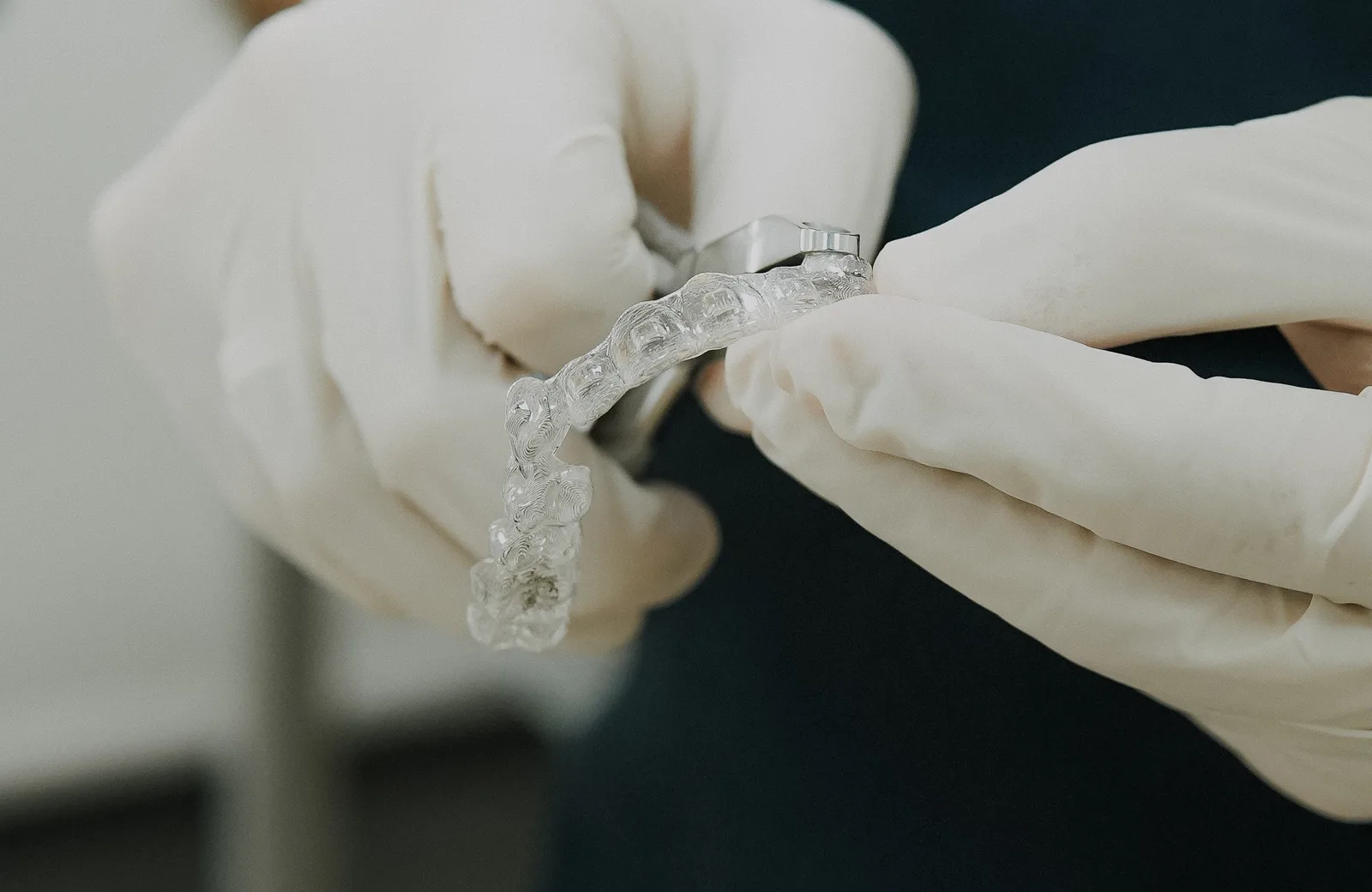
Angel Aligner and Invisalign are both FDA 510(k) cleared clear aligner systems from listed companies, but they have not been compared in a randomised trial. The one patient study that sets the two materials side by side, a retrospective cohort of 29 patients treated with first premolar extractions, found no statistically significant difference in how far upper incisor retraction deviated from the plan (P = 0.145), with each material doing better on different movements (PubMed 42189428). The rest of the head-to-head evidence is laboratory work on fit, ageing and staining. Disclosure: Mosdent, which publishes this article, works with Invisalign.
- 01Scale differs widely: Angelalign reported approximately 532,400 cases for the year ended December 31, 2025, an increase of 48.1% (HKEXnews annual results announcement), while Align Technology reported a clear aligner case volume of 2,611.3 thousand for the same year (Form 10-K).
- 02The only direct patient comparison is small: in a retrospective cohort of 29 patients treated with first premolar extractions, SmartTrack and MasterControl S did not differ significantly in upper incisor retraction deviation (P = 0.145), and both showed a roller-coaster effect (PubMed 42189428).
- 03Each material controlled different movements better in that cohort: MasterControl S was closer to plan for second premolar root position (difference: 1.07 mm), SmartTrack for second premolar torque (difference: 3.04°) (PubMed 42189428).
- 04Laboratory data are mixed: in a micro-CT pilot of nine aligners the mean gap was 186.96 ± 81.86 μm for Invisalign and 254.89 ± 133.21 μm for Angelalign, a difference that was not statistically significant (PubMed 42260482).
- 05Both brands share the limits of aligners as a category: with Angelalign, lower front tooth intrusion in twenty adult deep-bite patients was less than predicted (PubMed 41957764); with Invisalign, mean accuracy for all tooth movements was 50% in 38 patients (PubMed 32620479).
- 06Both are FDA 510(k) cleared (Angelalign K203688 and K223517, Align K981095), and the two companies have been in patent litigation in the United States, Europe and China since August 2025, with proceedings still open (Align Form 10-K; Angelalign annual results announcement).
/ Two listed companies of very different size
Angelalign is the company behind Angel Aligner, and it is a listed clear aligner manufacturer rather than a clinic label or a generic tray. This article is published by Mosdent, a clinic that works with Invisalign, so that position is stated before the comparison begins. The point here is to separate manufacturer filings, FDA records and published studies from brand claims. Case volume can show scale, but it cannot prove that one aligner system gives better clinical results.
Angelalign Technology Inc. is incorporated in the Cayman Islands and has been listed on the Main Board of the Hong Kong Stock Exchange under stock code 6699 since 16 June 2021, according to its listed-company filings. In its annual results announcement for the year ended 31 December 2025, Angelalign reported total clear aligner case volume rising from approximately 359,400 in FY2024 to approximately 532,400 in FY2025. In the same filing, the company reported approximately 256,200 cases outside the Chinese mainland and approximately 276,200 cases in the Chinese mainland, and described delivery across over 60 countries. In its interim results for the six months ended 30 June 2026, Angelalign reported 316,609 total clear aligner cases, with 168,001 cases outside the Chinese mainland.
The manufacturer states that it has worked on clear aligners since 2003 and that cumulative case volume has exceeded 2 million cases; we could not find an independent audit of that cumulative number. Align Technology, the maker of Invisalign, reported 2,611.3 thousand clear aligner case shipments for the year ended 31 December 2025 in its Form 10-K, and stated that over 22 million people worldwide had been treated with the Invisalign System by the end of 2025. Align also stated that it sells directly or through authorised distributors in more than 100 countries.
/ Materials and built-in features as the manufacturers describe them
Angel Aligner vs Invisalign pros and cons start with material design, because both manufacturers describe proprietary plastics and built-in features as part of the treatment system. The manufacturer states that Angel Aligner uses masterControl S, a multilayer material with a firm layer and a flexible layer intended to deliver sustained, gentle forces, and masterControl, a single-layer material intended for movements such as bodily translation, torque, extraction cases or deep bite correction. The manufacturer also states that Angel Aligner Pro uses a '7+3' dual-aligner sequence in each stage, with a masterControl S aligner worn for 7 days followed by a more rigid masterControl aligner worn for 3 days. Align Technology describes SmartTrack, the Invisalign material, as a patented, custom-engineered material that maintains more constant force over a longer period than conventional aligner materials; this is the manufacturer’s own description in its Form 10-K.
Angelalign also promotes angelButton, which the manufacturer states is an anchorage point for elastics manufactured directly into the aligner tray, so elastics can be worn without bonded buttons or cutting the aligner. The manufacturer states that it has shipped more than 100 million angelButtons. The FDA 510(k) summary for Angelalign’s Clear Aligner describes the traction accessory called 'Angel Button' as thermoplastic polyurethane and states that it was tested according to the company’s internal specifications.
The independent evidence is narrower. The only PubMed-indexed study of the angel button that we found is a finite element computer model of upper molar distalisation with clear aligners, mini-implants and the angel button; it reported reduced labial tipping of the front teeth and reduced stress as elastic force increased, but it was a simulation rather than a patient study (PubMed 36939836). No published clinical trial was found that compares the integrated angelButton with bonded buttons or Invisalign precision cuts in patients.
/ The one patient study and the laboratory studies that compare the two brands
Angel Aligner vs Invisalign has been tested directly in one small patient study that we found, and the result was mixed by tooth movement rather than a win for either brand. The retrospective cohort included 29 patients, or 58 dental sides, treated with first premolar extractions, with 15 patients treated using SmartTrack and 14 using MasterControl S. It found no statistically significant difference in how far upper central incisor retraction deviated from the plan, with P = 0.145 (PubMed 42189428). In the same cohort, MasterControl S showed smaller deviation in sagittal root position for the upper second premolar and first molar, while SmartTrack showed better control of second premolar axial inclination and torque (PubMed 42189428).
The same cohort found that both systems showed a consistent 'roller-coaster effect' in extraction cases, with no significant difference in unplanned extrusion of the upper central incisor (PubMed 42189428). That matters because the comparison was made in a demanding extraction setting, not in every type of orthodontic case.
The laboratory evidence should be read as laboratory evidence. In an in vitro pilot study of nine aligners scanned with micro-CT, mean aligner-to-tooth gap widths were 186.96 ± 81.86 μm for Invisalign and 254.89 ± 133.21 μm for Angelalign, but the difference did not reach statistical significance after Bonferroni correction; the authors described a non-significant trend toward larger gaps with Angelalign that warrants further investigation (PubMed 42260482). Another in vitro study aged 80 aligners from five brands in a thermocycler and ranked Angel as the most flexible among the tested brands; Invisalign’s mechanical properties were not affected by ageing, while yield strength and maximum elastic stress of Angel aligners were reduced from day 5 (PubMed 39540439). Staining results conflict by staining agent, with one in vitro study finding higher colour change for Invisalign in coffee, black tea and red wine, while a later curcumin study found more pronounced colour alteration for Angelalign after 12 hours (PubMed 27660048) (PubMed 40993680). A systematic review of ageing in clear aligner materials found force decay of 40 to 90% typically within 48 hours across materials, showing that material ageing is a category issue (PubMed 42709287). No randomised trial or prospective comparative study was found that compares finished outcomes, treatment time, comfort or relapse between Angel Aligner and Invisalign.
/ Predictability limits that both brands share
Are Angel aligners as good as Invisalign cannot be answered as a brand verdict from the published evidence. The available studies support a more limited answer, which is that both brands belong to a treatment category where some movements are less predictable than planned. Lower front tooth intrusion and extraction-space control are examples where the published literature points to limits in aligner biomechanics. Those limits are one reason an orthodontist may add attachments, elastics, refinement aligners or a different appliance plan.
In a study of 20 adult deep-bite patients treated with Angelalign, using 74 mandibular incisors and 24 mandibular canines measured on CBCT and scan models, the actual intrusion of the lower front teeth was less than predicted, and the authors concluded that efficacy of lower front tooth intrusion with Angelalign was limited (PubMed 41957764). In a separate prospective study of 38 Invisalign patients, mean accuracy for all tooth movements was 50%, with mandibular incisor intrusion particularly low at 35% (PubMed 32620479). These studies used different methods, so they should not be subtracted from each other or used to rank the two brands.
The category-level evidence points in the same direction. A systematic review and meta-analysis of 20 studies of premolar extraction treatment with clear aligners found under-retraction of the upper incisors against the plan and inferior root control compared with fixed appliances (PubMed 41195763). An overview of 18 systematic reviews concluded that clear aligner treatment is effective for mild to moderate malocclusions and is associated with inferior outcomes in severe cases or for specific tooth movements, with the level of evidence graded as moderate (PubMed 34993617). A pilot study also found that virtual plans differed significantly between aligner companies in aligner number and attachments, although Angel Aligner was not one of the companies tested (PubMed 41128735). For a wider overview of clear aligner brands, the brand name should still be separated from the movement being planned.
/ Mandibular advancement for growing patients with A6 and with Invisalign
Angel aligners reviews for growing patients should be read through the published A6 evidence, not through forum posts or star ratings. The manufacturer states that A6 Mandibular Advancement uses occlusal blocks with inclined planes built into the aligners to guide the lower jaw forward while the teeth are aligned. The manufacturer also states that it is designed for growing patients with Class II malocclusions and that the company has offered aligner-based mandibular advancement since 2015. Those statements describe the product design; they do not replace clinical outcome studies.
The independent literature that names the Angelalign A6 appliance in PubMed is a single case report of a 12-year-old boy with a skeletal Class II deep bite. The Class II relationship was corrected, but the authors also recorded unplanned movement of the back teeth and a posterior open bite that had to be corrected in a refinement phase (PubMed 37167899). A case report can describe what happened in one patient; it cannot establish average performance for a group.
There is broader evidence for aligner-based mandibular advancement as a category. A systematic review and meta-analysis of nine studies, including 465 participants, found that clear aligner mandibular advancement achieved skeletal effects comparable to traditional Twin Block and Herbst appliances in growing Class II patients, with less lower incisor proclination than Twin Block; the evidence was predominantly retrospective and the review did not separate results by aligner brand (PubMed 41923072). The FDA 510(k) database also lists the Invisalign System with Mandibular Advancement Feature, with a decision date of 26 October 2018. That means both companies market an aligner-based mandibular advancement option, but the brand-specific A6 evidence remains limited.
/ Regulatory status and the patent dispute between Align and Angelalign
Are Angel aligners FDA approved is better worded as whether they are FDA 510(k) cleared, because the FDA database lists clearances rather than an approval of clinical superiority. The FDA 510(k) database lists two clearances for Angelalign’s manufacturing subsidiary Wuxi EA Medical Instruments Technologies Limited under the device name 'Clear Aligner', with decision dates of 8 October 2021 and 13 June 2023. The indication is aligning teeth during orthodontic treatment of malocclusion in patients with permanent dentition. A 510(k) clearance is a finding of substantial equivalence; it does not mean that the FDA has approved one clear aligner brand as clinically superior.
The FDA database lists the first clearance of Align Technology’s aligner system, the 'Align System', with a decision date of 8 September 1998. That places Invisalign’s first listed clearance more than two decades before Angelalign’s first listed clearance under its current manufacturer. The European regulatory status of Angel Aligner could not be confirmed from a primary public database. Made-to-order aligners are generally handled as custom-made devices in the European Union and are not listed product by product in a public register, so this article does not state a CE claim for either brand.
There is also a patent dispute, and it should be read as ongoing legal proceedings rather than a clinical comparison. Align Technology’s Form 10-K for 2025 reports that it initiated patent actions against Angelalign entities in the European Unified Patent Court on 15 August 2025, in the U.S. District Court for the Eastern District of Texas on 18 August 2025, and in Chinese courts, and that the U.S. International Trade Commission instituted an investigation on 19 December 2025. The same Form 10-K reports that on 12 February 2026 the Unified Patent Court issued a preliminary injunction concerning Angel’s 'Live Now' treatment planning interface feature, and that Angelalign entities challenged the validity of the asserted patents and filed their own patent action against Align in the Beijing Intellectual Property Court. Angelalign’s FY2025 results announcement confirms that cases initiated by Align in the United States, Europe and China were not yet concluded, and Angelalign’s later announcement says it will appeal a first-instance Chinese judgment about two software systems for A7 premolar extraction solutions.
/ What decides the cost of either system, and where this clinic stands
Angel Aligner vs Invisalign cost is decided less by the brand name alone than by case complexity, aligner count, refinements and clinician time. Align Technology’s Form 10-K describes lower-priced, non-comprehensive Invisalign packages for less complex cases, including Invisalign Express, Invisalign Lite and Invisalign Moderate, alongside comprehensive treatment. That shows that the manufacturer’s fee to the clinic can change with the complexity tier of the case. The same logic applies clinically when a case needs many stages, additional scans or refinement aligners.
Published Invisalign data also show why the first plan is not always the final aligner set. In a study of 355 Invisalign patients, treatment duration increased as the number of refinements increased, and most patients achieved improvement after the first refinement, with 64.5% for PAR <22 and 78.5% for PAR ≥22 (PubMed 35868952). Angelalign makes a similar cost-driver point from the manufacturer side, stating in its 2025 results release that a case can run to up to a hundred aligners and that difficult-to-finish cases oblige the supplier to keep shipping aligners at a cost. That is a manufacturer acknowledgement that aligner count and refinements matter for the final fee.
Mosdent, the clinic publishing this article, provides clear aligner treatment with Invisalign. Its orthodontist Dr Ahmet Murat Artuç received Align Technology’s award for the highest number of Invisalign treatments completed among corporate customers during 2025. This disclosure is given so the reader can weigh the article’s standpoint. If you are comparing treatment quotes rather than brands in the abstract, ask what package tier is being used, how refinements are handled, who plans tooth movements and what happens if the planned result is not reached. For a separate page on fees, see Invisalign cost in Turkey, and for the treatment itself see Invisalign treatment.
Let’s plan the right treatment together.
Free Assessment→- 1.Cui J, Yao C, Zhang Z, Zhang T, Cao Y, Liu T, et al. Maxillary molar distalization treated with clear aligners combined with mini-implants and angel button using different traction force: a finite element study. Comput Methods Biomech Biomed Engin 2024;27(3):296-305.
- 2.Xie J, Zheng Y, Wu J. Three-dimensional dentoskeletal effects of the Angelalign A6 clear aligners in a skeletal Class II growing patient: A case report. Int Orthod 2023;21(2):100756.
- 3.Huang X, Tao Y, Huang Z, Zhao Z, Cen X. Comparative efficacy of clear aligner mandibular advancement versus traditional functional appliances for skeletal Class II malocclusion: a systematic review and meta-analysis. BMC Oral Health 2026;26(1):833.
- 4.Qu L, Fang R, Li R, Yang Z, Li Y, Chen X, et al. Three-dimensional crown-root movement in first premolar extraction cases treated with two clear aligner systems based on different materials: a retrospective cohort study. Prog Orthod 2026;27(1):20.
- 5.Liu S, Lv M, Li J, Zhou M, Zhang Y. Automated micro-CT quantification of clear aligner fit: a pilot comparison of manufacturing processes. BMC Oral Health 2026;26(1):1718.
- 6.Kuntz L, Aranda L, Rapin C, Canceill T, Vande Vannet B, Fawaz P. Effects of aging on the tensile strength and surface condition of orthodontic aligners: a comparative study of five models. Eur J Orthod 2024;46(6):cjae063.
- 7.Liu CL, Sun WT, Liao W, Lu WX, Li QW, Jeong Y, et al. Colour stabilities of three types of orthodontic clear aligners exposed to staining agents. Int J Oral Sci 2016;8(4):246-253.
- 8.He K, Xu M, Liao W, Yao Y. Evaluation of color stability and material surface stability of different types of clear aligners under curcumin staining in vitro. BMC Oral Health 2025;25(1):1424.
- 9.Almotairy N, Aleisa F, Alshammari AK. Ageing effects on chemical, physical, mechanical, and morphological properties of clear aligners - a systematic review. Prog Orthod 2026;27(1):40.
- 10.Xiang Y, Liang Y, Zheng Z, Deng W, Peng J, Zheng R. Three-dimensional study of mandibular anterior intrusion with clear aligners for adult deep-bite correction. BMC Oral Health 2026;26(1):975.
- 11.Haouili N, Kravitz ND, Vaid NR, Ferguson DJ, Makki L. Has Invisalign improved? A prospective follow-up study on the efficacy of tooth movement with Invisalign. Am J Orthod Dentofacial Orthop 2020;158(3):420-425.
- 12.Abu Arqub S, Chheda H, Crumpton J, Yang X, Farha P, Upadhyay M. Clear Aligners in Extraction-Based Orthodontic Treatment: A Systematic Review and Meta-Analysis. Orthod Craniofac Res 2026;29(1):12-29.
- 13.Yassir YA, Nabbat SA, McIntyre GT, Bearn DR. Clinical effectiveness of clear aligner treatment compared to fixed appliance treatment: an overview of systematic reviews. Clin Oral Investig 2022;26(3):2353-2370.
- 14.Telles V, Mattos CT, Copello F, Doughan MB. A pilot study comparing virtual treatment setups among clear aligner companies. Dental Press J Orthod 2025;30(3):e2524243.
- 15.Arqub SA, Banankhah S, Sharma R, Da Cunha Godoy L, Kuo CL, Ahmed M, et al. Association between initial complexity, frequency of refinements, treatment duration, and outcome in Invisalign orthodontic treatment. Am J Orthod Dentofacial Orthop 2022;162(3):e141-e155.
- 16.Angelalign Technology Inc. Annual results announcement for the year ended December 31, 2025 (HKEXnews, 27 March 2026).
- 17.Angelalign Technology Inc. Interim results announcement for the six months ended 30 June 2026 (HKEXnews, 31 August 2026).
- 18.Align Technology, Inc. Annual report on Form 10-K for the year ended December 31, 2025 (U.S. Securities and Exchange Commission).
- 19.Angelalign Technology. 2025 results press release (27 March 2026).
- 20.Angel Aligner. Advanced materials: masterControl and masterControl S (manufacturer page).
- 21.Angel Aligner. Angel Aligner Pro (manufacturer page).
- 22.Angel Aligner. angelButton (manufacturer page).
- 23.Angel Aligner. A6 Mandibular Advancement (manufacturer page).
- 24.Angelalign Technology. Announcement on the appeal of the Jinan first-instance judgment (12 August 2026).
- 25.U.S. Food and Drug Administration. 510(k) summary K203688, Clear Aligner, Wuxi EA Medical Instruments Technologies Limited.
- 26.U.S. Food and Drug Administration. 510(k) record K223517, Clear Aligner, Wuxi EA Medical Instruments Technologies Limited.
- 27.U.S. Food and Drug Administration. 510(k) record K981095, Align System, Align Technology.
- 28.U.S. Food and Drug Administration. 510(k) record K181739, Invisalign System with Mandibular Advancement Feature, Align Technology, Inc.