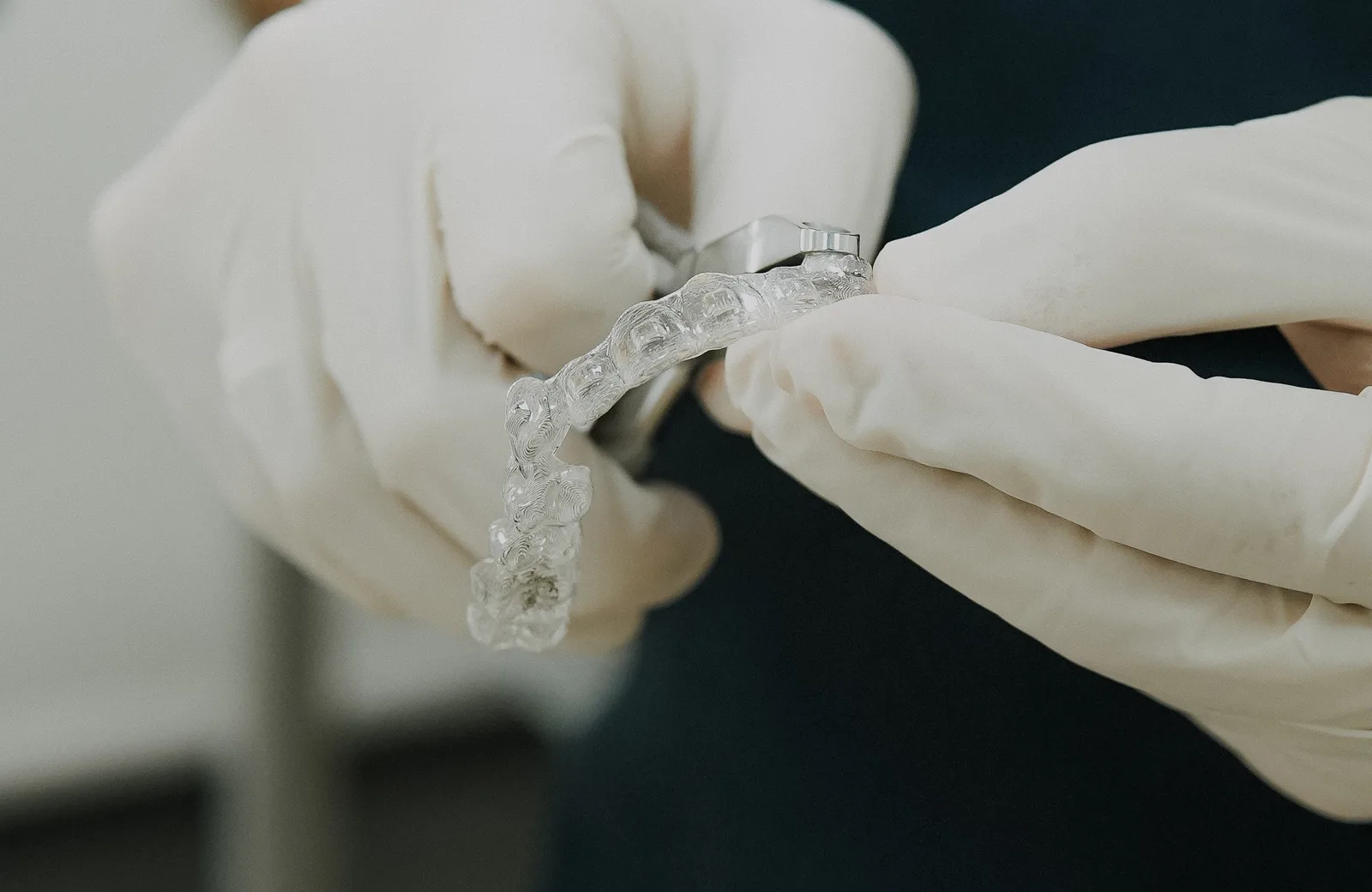
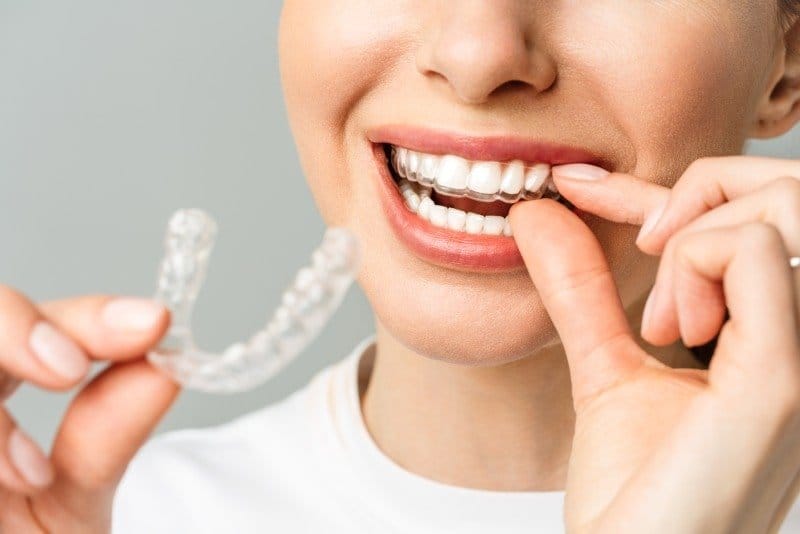
No published clinical study compares SureSmile aligners with Invisalign head to head. Invisalign carries most of the aligner literature; in a prospective study of 38 patients its mean accuracy across all tooth movements was 50% (PubMed 32620479). The one accuracy study of SureSmile aligners covers 21 dental arches from 14 patients and found front tooth translation within 0.5 mm but rotation off by a mean of 4.50 ± 2.12° (PubMed 42345961). The shorter treatment times often quoted for SureSmile come from its robot-bent archwires, not from its aligners.
- 01SureSmile began as archwire planning software from OraMetrix, which Dentsply Sirona agreed to acquire on 26 March 2018; Invisalign's maker, Align Technology, holds an FDA aligner clearance dated 8 September 1998 (company press release; FDA 510(k) K981095).
- 02The favourable SureSmile studies concern wires on fixed braces: in 12,335 patient histories the median treatment time was 15 months against 23 months, in a study whose lead author worked for the developer (PubMed 22567618).
- 03For SureSmile aligners, one retrospective study of 21 dental arches from 14 patients found mean discrepancies of 3.42 ± 1.50° for angulation and 4.50 ± 2.12° for axial rotation, above the 2° threshold, while translation stayed below 0.5 mm (PubMed 42345961).
- 04Invisalign is not exact either: a prospective study of 38 patients measured a mean accuracy of 50% across all tooth movements and 46% for rotation (PubMed 32620479).
- 05The manufacturer states that SureSmile aligners use its Essix plastic, which the FDA summary lists as PET-G; in a laboratory ageing test of 80 aligners from five brands the mechanical properties of both Suresmile and Invisalign were not affected by ageing (PubMed 39540439).
- 06Planning software changes the plan: the same movements from twenty-five Invisalign patients produced significantly different numbers of upper aligners and attachments in ClinCheck Pro and SureSmile (PubMed 36142998).
/ Two companies and two very different starting points
SureSmile vs Invisalign is not a comparison between two clear aligner brands with the same published history. Invisalign began as a sequential aligner made by Align Technology, with its first FDA 510(k) clearance for the Align System dated 8 September 1998. SureSmile began in a different place, as OraMetrix technology for digital diagnosis, treatment planning, monitoring and customised archwires. Mosdent in Istanbul treats clear aligner patients with Invisalign, and Mosdent's orthodontist received Align Technology's award for the highest number of Invisalign treatments among corporate customers during 2025.
Dentsply Sirona announced on 26 March 2018 that it had signed a definitive agreement to acquire OraMetrix, describing SureSmile as a system linked to digital orthodontic tools and archwire customisation. The same announcement said the deal would help Dentsply Sirona offer a full arch clear aligner solution. Dentsply Sirona's company history lists SureSmile aligners among the products introduced in 2018.
That starting point matters when reading evidence. The first SureSmile entry in the FDA 510(k) database was cleared on 16 November 2000 under an operative dental unit product code, and it relates to the archwire planning system rather than an aligner. Invisalign's first clearance, by contrast, was for a sequential aligner. If you are comparing clear aligner brands compared, the brand names alone do not tell you whether the supporting evidence comes from aligners, fixed braces, software or laboratory tests.
/ What the SureSmile archwire studies found, and why they do not transfer to the aligners
SureSmile aligners reviews often borrow figures from SureSmile archwire studies, but those studies were about robot-bent wires on fixed braces, not removable aligners. They can show that the earlier SureSmile wire system was studied clinically. They cannot show that SureSmile aligners move teeth faster, need fewer refinements or produce the same outcomes. For a patient comparing quoted aligner treatment, this distinction is central.
Several SureSmile wire papers reported favourable findings for fixed-appliance treatment. One retrospective comparison of consecutive patients found about 7 months less treatment time with SureSmile robot-bent archwires than with manual wire bending by the same orthodontist, along with better scores for rotation and space closure; the SureSmile cases were also less complex on average and root angulation was inferior (PubMed 21261488). Another analysis of 12,335 completed patient histories reported a median treatment time of 15 months for SureSmile archwires against 23 months for conventional braces, while also noting that the lead author was affiliated with OraMetrix and calling for prospective studies (PubMed 22567618). A blinded study-cast assessment found lower American Board of Orthodontics scores for SureSmile archwire cases, where lower is better, and treatment time of 14.7 months versus 20.0 months (PubMed 20209172).
Other archwire studies focused on accuracy and root resorption. In 23 SureSmile archwire patients, tooth position was within 0.5 mm for most teeth when final models were compared with the virtual plan, while crown torque, tip and rotation exceeded the 2° limit for almost all teeth (PubMed 23181776). In 26 consecutive SureSmile custom archwire patients, median deviation was 0.19 to 0.21 mm for translational movements and 1.77° to 3.04° for rotational movements (PubMed 26753550). A cone beam CT study found no statistically significant difference in incisor root resorption between SureSmile and edgewise groups, with mean resorption under 1 mm per tooth in both groups (PubMed 22567621). None of these findings should be treated as SureSmile aligner results.
/ Clinical evidence on SureSmile aligners next to the Invisalign record
SureSmile vs Invisalign has not been tested in a published head-to-head clinical patient study found in PubMed. A PubMed search on 20 September 2026 found no published clinical study comparing SureSmile aligners directly with Invisalign in patients; the records that mention both brands are laboratory material tests and software comparisons. That leaves readers comparing separate evidence streams, not a direct trial. The practical conclusion is limited: there is published clinical evidence on Invisalign and a much smaller clinical record on SureSmile aligners, but no patient study that proves equivalence between the two.
The only clinical accuracy study of SureSmile aligners found in PubMed was a retrospective analysis of 21 dental arches from 14 patients treated with aligners fabricated in the practice. Mean discrepancies between the plan and the result were 3.42 ± 1.50° for angulation and 4.50 ± 2.12° for axial rotation, both above the 2° threshold set by the authors (PubMed 42345961). In the same study, translational discrepancies of the front teeth stayed below the 0.5 mm threshold, with mean values of 0.17 ± 0.11 mm mesiodistally, 0.27 ± 0.16 mm labiolingually and 0.38 ± 0.17 mm vertically (PubMed 42345961).
For Invisalign, one prospective clinical study of 38 patients reported mean accuracy of 50% across all tooth movements, with the highest value for buccal-lingual crown tip at 56% and the lowest for rotation at 46% (PubMed 32620479). These Invisalign percentages should not be numerically compared with the SureSmile degree and millimetre discrepancies, because the studies used different methods and thresholds. A 2026 scoping review of 119 studies described the clear aligner evidence base as heterogeneous and Invisalign-focused, excluded in-office aligner systems, and reported from limited studies that refinements were required in over 50% of cases and that 17.2% needed conversion to fixed appliances (PubMed 42516363).
/ Aligner material: Essix PET-G and SmartTrack in laboratory tests
SureSmile aligners reviews should separate material claims from clinical outcomes in patients. The manufacturer states that SureSmile aligners are made from Essix plastic, and the FDA 510(k) summary for the SureSmile Aligner lists thermoformed PET-G, naming Essix ACE and Essix Plus. The manufacturer of Invisalign states that Invisalign aligners use a proprietary material called SmartTrack and that it delivers more predictable tooth movements, while its own footnote limits that comparison to earlier Invisalign aligners made from a single-layer material. Laboratory tests can compare plastics, ageing, leaching and surface features, but they do not by themselves prove one brand will finish a case with fewer appointments or refinements.
In a laboratory ageing test of 80 aligners from five brands, the rigidity ranking from most rigid to most flexible was Accusmile, GRAPHY, Suresmile, Invisalign and Angel, and the mechanical properties of Suresmile and Invisalign were not affected by ageing (PubMed 39540439). An in vitro study soaking aligners from Invisalign, Eon, SureSmile and Clarity for 1 month at 37°C found no statistically significant difference in cytotoxicity among the four systems, although all showed slight to moderate toxicity to gum fibroblasts compared with the control (PubMed 35666210). A second in vitro study of ClearCorrect, Invisalign, Spark, SureSmile and Essix PLUS found the most pronounced cytotoxic effects on cell lines with Invisalign and Spark, but those cell culture findings did not measure effects in patients (PubMed 40762314).
Other material studies also remain laboratory evidence. An in vitro leaching study found that Invisalign, Eon, SureSmile and Clarity aligners did not leach detectable BPA, with the lowest amount of leached chemicals seen with Invisalign (PubMed 35200252). Another in vitro comparison found comparable hardness among Invisalign, Eon, SureSmile and Clarity, while microscopy showed Invisalign had a smoother surface than the other three (PubMed 35621526). The manufacturer states that the straight trimline of SureSmile aligners improves force transmission and helps reduce attachments; a systematic review found that straight and extended trimlines generally delivered higher forces and better retention than scalloped trimlines, without testing SureSmile specifically (PubMed 39707339).
/ Planning in the practice or at the manufacturer's lab
SureSmile vs Invisalign is also a planning comparison, because the same teeth can receive different aligner plans depending on the software and workflow. The manufacturer states that a dentist using SureSmile can rely on a company Digital Lab Specialist to prepare the treatment plan or can specify detailed treatment preferences, and that the dentist approves or modifies the plan before aligners are made. SureSmile aligners can also be fabricated inside the dental practice. That flexibility means a SureSmile quote may reflect a different workflow from an Invisalign quote.
The published SureSmile aligner accuracy study describes workflows ranging from outsourced design and manufacturing to in-office scanning, planning and fabrication; the 14 patients in that study wore aligners made in the practice (PubMed 42345961). This matters because in-office production is not automatically the same intervention as a centrally produced aligner system. The appliance name, the software, the plastic, the staging decisions and the clinician's modifications can all contribute to the final plan, but published evidence does not isolate every part of that chain.
Planning software itself has been tested. When the same planned tooth movements from 25 adult Invisalign patients were rebuilt in four planning programs, including ClinCheck Pro and SureSmile, the programs differed significantly in vertical and buccal-lingual movement, in the number of upper aligners and in the number of attachments (PubMed 36142998). A separate pilot study sent records for 10 patients with a standardised prescription to Invisalign, ClearCorrect, 3M Clarity and Spark; SureSmile was not included, and the returned plans differed significantly in aligner number, attachment number and final canine relationship (PubMed 41128735). As a benchmark for in-practice aligners using other software, a prospective study of 30 participants and 259 anterior teeth found overall accuracy of 56.18%, ranging from 72.33% for mesiodistal movement to 43.28% for intrusion (PubMed 34625386).
/ Regulatory status and availability in the United Kingdom
SureSmile aligners UK availability is supported by the manufacturer's United Kingdom professional page, but that page does not list practices. Dentsply Sirona's UK website has a SureSmile Clear Aligner page addressed to dental professionals and includes a Become a provider link. It does not name UK practices offering the system, so availability has to be checked with individual practices. This article does not state that Mosdent offers SureSmile, because Mosdent works with Invisalign.
For regulatory wording, the precise term in the available United States record is not approval. The FDA 510(k) database lists the SureSmile Aligner of Dentsply Sirona, number K260722, as a sequential aligner under product code NXC, Class II and prescription use, found substantially equivalent on 15 April 2026. The FDA summary says the device was originally cleared as the Sureclear Aligner System, K171860, and that no data from human clinical studies was included. The earlier Sureclear aligner record, K171860, carries a decision date of 5 January 2018 under the same sequential aligner product code.
Those records are useful for identifying the device category and clearance route, but they do not answer the clinical comparison by themselves. No CE or UKCA register entry is cited here because no primary register entry was opened for this article. If a UK dentist proposes SureSmile, the evidence question remains separate from availability: ask whether the plan is being prepared by the manufacturer's lab, modified in the practice or fabricated in-house, and ask how refinements are handled.
/ What drives the fee for either system
SureSmile cost cannot be compared with Invisalign cost from published clinical studies, because no published PubMed study comparing the cost of SureSmile and Invisalign treatment was found. There is also no evidence here that one brand is consistently cheaper. A quote can differ because the plan may require a different number of aligners, attachments, appointments and refinement stages. For international patients comparing Istanbul with the United Kingdom or elsewhere in Europe, that means the written treatment plan matters more than the brand name alone.
The evidence does show that planning choices can alter treatment components. When the same planned tooth movements from 25 adult Invisalign patients were rebuilt in four planning programs, including ClinCheck Pro and SureSmile, the programs differed significantly in the number of upper aligners and in the number of attachments, as well as in vertical and buccal-lingual movement (PubMed 36142998). Those differences can feed into the clinical workload behind a fee, although the study did not measure patient charges.
Refinements are another cost driver. A 2026 scoping review of 119 studies described the clear aligner evidence base as heterogeneous and Invisalign-focused, and from limited studies reported that refinements were required in over 50% of cases and that 17.2% needed conversion to fixed appliances (PubMed 42516363). The manufacturer states, from an internal analysis of 109,273 SureSmile aligner cases completed between January 2021 and May 2025, that 75% of cases required 1 or no refinements; those data are on file with the company and no independent confirmation was found. If you want a fee discussion for Mosdent's system, read Invisalign cost in Turkey, but the evidence above should not be turned into a general price claim for SureSmile versus Invisalign.
Let’s plan the right treatment together.
Free Assessment→- 1.Georgi GM, Delfs J, Nottmeier C, Kahl-Nieke B, Eltz M, Sonnleitner M, Koehne T, Schmid-Herrmann CU. Predictability of In-Office SureSmile Clear Aligners: A Retrospective Analysis of Anterior Tooth Movements. Dent J (Basel) 2026;14(6):370.
- 2.Alford TJ, Roberts WE, Hartsfield JK Jr, Eckert GJ, Snyder RJ. Clinical outcomes for patients finished with the SureSmile method compared with conventional fixed orthodontic therapy. Angle Orthod 2011;81(3):383-8.
- 3.Sachdeva RC, Aranha SL, Egan ME, Gross HT, Sachdeva NS, Currier GF, Kadioglu O. Treatment time: SureSmile vs conventional. Orthodontics (Chic.) 2012;13(1):72-85.
- 4.Saxe AK, Louie LJ, Mah J. Efficiency and effectiveness of SureSmile. World J Orthod 2010;11(1):16-22.
- 5.Larson BE, Vaubel CJ, Grünheid T. Effectiveness of computer-assisted orthodontic treatment technology to achieve predicted outcomes. Angle Orthod 2013;83(4):557-62.
- 6.Müller-Hartwich R, Jost-Brinkmann PG, Schubert K. Precision of implementing virtual setups for orthodontic treatment using CAD/CAM-fabricated custom archwires. J Orofac Orthop 2016;77(1):1-8.
- 7.Patel N, Currier GF, Kadioglu O, Kierl JP, Skaggs VJ. A CBCT comparison of anterior root resorption in SureSmile and conventional edgewise treatments. Orthodontics (Chic.) 2012;13(1):100-9.
- 8.Kuntz L, Aranda L, Rapin C, Canceill T, Vande Vannet B, Fawaz P. Effects of aging on the tensile strength and surface condition of orthodontic aligners: a comparative study of five models. Eur J Orthod 2024;46(6):cjae063.
- 9.Alhendi A, Khounganian R, Almudhi A. Cytotoxicity assessment of different clear aligner systems: An in vitro study. Angle Orthod 2022;92(5):655-660.
- 10.Nunes C, Mestre C, Fernandes IP, Serra M, Marto CM, Gonçalves AC, Travassos R, Paula A, Botelho MF, Francisco I, Laranjo M, Vale F. Brand-Specific Differences in the Cytotoxicity of Clear Aligner Materials. Orthod Craniofac Res 2025; doi: 10.1111/ocr.70009.
- 11.Alhendi A, Khounganian R, Almudhi A, Ahamad SR. Leaching of Different Clear Aligner Systems: An In Vitro Study. Dent J (Basel) 2022;10(2):27.
- 12.Alhendi A, Khounganian R, Ali R, Syed SA, Almudhi A. Structural Conformation Comparison of Different Clear Aligner Systems: An In Vitro Study. Dent J (Basel) 2022;10(5):73.
- 13.Dhingra A, Palomo JM, Stefanovic N, Eliliwi M, Elshebiny T. Comparing 3D Tooth Movement When Implementing the Same Virtual Setup on Different Software Packages. J Clin Med 2022;11(18):5351.
- 14.Haouili N, Kravitz ND, Vaid NR, Ferguson DJ, Makki L. Has Invisalign improved? A prospective follow-up study on the efficacy of tooth movement with Invisalign. Am J Orthod Dentofacial Orthop 2020;158(3):420-425.
- 15.Borzabadi-Farahani A. Clear aligner therapy: a scoping review of treatment prediction, clinical effectiveness, and limitations. Front Dent Med 2026;7:1864529.
- 16.Sachdev S, Tantidhnazet S, Saengfai NN. Accuracy of Tooth Movement with In-House Clear Aligners. J World Fed Orthod 2021;10(4):177-182.
- 17.Telles V, Mattos CT, Copello F, Doughan MB. A pilot study comparing virtual treatment setups among clear aligner companies. Dental Press J Orthod 2025;30(3):e2524243.
- 18.Nakornnoi T, Srirodjanakul W, Chintavalakorn R, Santiwong P, Sipiyaruk K. The biomechanical effects of clear aligner trimline designs and extensions on orthodontic tooth movement: a systematic review. BMC Oral Health 2024;24(1):1523.
- 19.Dentsply Sirona. Dentsply Sirona Announces Acquisition of Technology Solutions Provider OraMetrix. Press release, 26 March 2018.
- 20.Dentsply Sirona. Company history.
- 21.US Food and Drug Administration. 510(k) summary K260722, SureSmile Aligner, Dentsply Sirona, decision date 15 April 2026.
- 22.US Food and Drug Administration. 510(k) database record K171860, Sureclear aligners, decision date 5 January 2018.
- 23.US Food and Drug Administration. 510(k) database record K002620, SureSmile System, Orametrix, decision date 16 November 2000.
- 24.US Food and Drug Administration. 510(k) database record K981095, Align System, Align Technology, decision date 8 September 1998.
- 25.Dentsply Sirona. SureSmile Aligner product brochure (material statement).
- 26.Dentsply Sirona UK. Value of SureSmile (planning workflow).
- 27.Dentsply Sirona. The SureSmile System (trimline statement).
- 28.Dentsply Sirona. SureSmile Clear Aligner (refinement statement, internal data).
- 29.Align Technology. Invisalign frequently asked questions, United Kingdom.