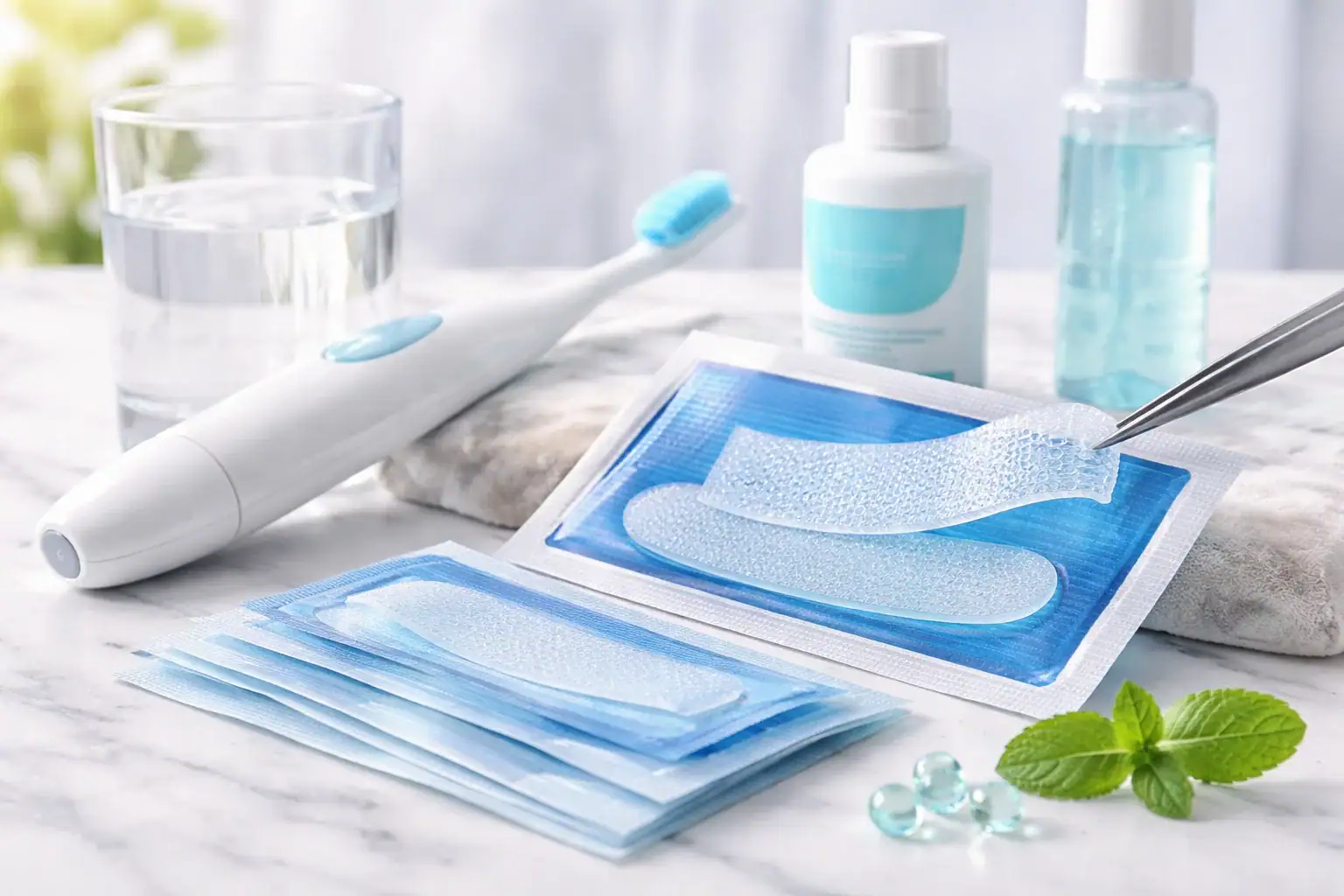
Teeth whitening strips are flexible plastic strips coated with a hydrogen peroxide or carbamide peroxide gel that is held against the enamel for a set contact time, usually 20 to 30 minutes a day over 7 to 14 days, so peroxide can oxidise the stain molecules inside the tooth. They work best on extrinsic stains from coffee, tea, wine and tobacco, give partial improvement on mild intrinsic discolouration and leave crowns, veneers and fillings unchanged. In a double-blind randomised trial with 75 volunteers, strip products were significantly more effective than paint-on products but significantly less effective than dentist-supervised home bleaching (PubMed 29513635).
- 01Strips act by peroxide oxidation on natural enamel only, so crowns, veneers and composite fillings keep their original shade and can end up visibly mismatched.
- 02In a double-blind randomised trial with 75 volunteers, 2.9 percent hydrogen peroxide strips outperformed paint-on products and placebo but stayed below dentist-supervised home bleaching, with gingival irritation and sensitivity described as mild and reversible (PubMed 29513635).
- 03Strips also work as maintenance: in a randomised trial with 60 participants, 6 percent hydrogen peroxide strips used after in-office bleaching preserved the lightness gain at four weeks, which the in-office only group lost (PubMed 39862914).
- 04Contact time is a safety variable alongside peroxide strength; 20 to 30 minutes per application over 7 to 14 days is the labelled range, and exceeding it raises sensitivity and gum irritation.
- 05Untreated decay, active gum disease, pregnancy and age under 16 are reasons to get assessed before starting.
How Whitening Strips Work on Enamel
Whitening strips are thin, flexible plastic strips coated on one side with a peroxide gel, either hydrogen peroxide or carbamide peroxide. Pressed against the front surfaces of the teeth, the strip holds the gel in place for a set contact time, usually 20 to 30 minutes a day over a course of 7 to 14 days. During that time the peroxide moves into the enamel and breaks down the pigment molecules that make a tooth look yellow or grey. The process is chemical oxidation. Nothing is scraped or polished away, and the colour change builds up gradually over the course.
Strips sit at the self-applied end of cosmetic dentistry. They are sold without a prescription, they need no trays or lights, and a person can use them at home on their own schedule. That convenience is the reason they are popular, and it is also the reason their limits deserve a clear explanation. The strip controls where the gel goes and for how long; it does not control whether the tooth underneath is healthy, whether the stain is one that peroxide can reach, or whether the front teeth carry restorations that will stay the colour they are.
The chemistry is the same one used in the other teeth whitening methods. What changes between strips, custom trays and in-office bleaching is the concentration of peroxide, how evenly it is held against the tooth, how long it stays there and whether a dentist checks the mouth first. Those four variables explain most of the differences in results and side effects covered below.
Which Stains Respond and Which Do Not
The type of discolouration decides how much a strip can achieve, so it is worth knowing which kind you have before buying a box. Extrinsic stains sit in and on the outer enamel. They come from coffee, tea, red wine and tobacco, and they are the stains that strips lift most reliably. Peroxide reaches them easily and the change is often visible within the first week of daily use.
Mild intrinsic discolouration sits deeper, inside the tooth structure, and is linked to ageing or to some medications. Strips give partial improvement here. The tooth usually becomes lighter, but the result is less even and it takes the full course to show. Deep intrinsic or genetic discolouration, such as dark bands or grey tones that were present from childhood, generally does not respond to over-the-counter strength. These cases need a dentist's assessment, because the options include supervised bleaching at higher strength or restorative work.
Restorations are a separate category. Peroxide acts on natural enamel, so ceramic crowns, zirconia, composite fillings and veneers or crowns on the front teeth keep the shade they were made in. When the natural teeth around them become lighter, the restoration can look darker by contrast. Where front teeth carry restorations, the usual sequence is to whiten the natural teeth first and then remake the restorations to match the new shade.
A realistic expectation with consistent use is a change of 2 to 6 shades on a shade guide. Anyone comparing strips with other routes can find the wider picture of whitening options, from toothpaste to in-office treatment, in a separate guide. The starting shade and the stain type matter more than the brand on the box.
What the Clinical Trials Measured
The clearest comparison of strips with other at-home products comes from a double-blind randomised trial of over-the-counter agents containing 2.9 percent hydrogen peroxide. In total, 75 volunteers were randomly assigned to five groups: a strip product, a paint-on product, two matching products without peroxide, and dentist-supervised home bleaching (PubMed 29513635). Shade was measured with a spectrophotometer and a Vita shade guide at baseline and again at 2 weeks and 4 weeks.
The ranking was consistent. Dentist-supervised home bleaching produced the greatest colour change, the strip product came second, the paint-on product third and the peroxide-free products last (PubMed 29513635). The strip was significantly more effective than the paint-on product and the placebo, and significantly less effective than supervised bleaching. Canines changed colour more than central and lateral incisors in every group, which is one reason results can look uneven along the arch.
On safety, some cases of gingival irritation and hypersensitivity were observed, and all were mild and reversible. Gingival index, plaque index and the cold sensitivity score did not change significantly (PubMed 29513635).
A second randomised trial looked at strips from a different angle. Sixty participants received in-office bleaching with 37.5 percent hydrogen peroxide, and half then used 6 percent hydrogen peroxide strips over the following two weeks (PubMed 39862914). The strip group kept its gain in lightness in the cervical and middle thirds of the tooth at four weeks, while the group without strips lost the lightness gain. This points to a second role for strips, as maintenance after a professional treatment, which matters for anyone aiming at the evenly light shade often described as perfect teeth. Neither trial ran long enough to say how results behave over many months.
Using Strips Correctly and Protecting the Gums
Most problems with strips come from how they are used. The packet instructions exist because contact time is a safety variable as well as a dose. The labelled range is 20 to 30 minutes per application, once a day for 7 to 14 days. Leaving a strip on longer, sleeping with it, or doubling up applications raises sensitivity and gum irritation without a matching gain in colour.
A typical application follows a simple order. Brush and dry the teeth, since saliva and plaque reduce contact between gel and enamel. Place the strip on the upper and lower teeth with the gel side against the enamel, press gently so it follows the shape of each tooth, and keep the edge away from the gum line as far as the strip allows. After the set time, remove the strip, rinse and brush away any gel left along the gums. Drinking and eating should wait until the strip is out.
Gum contact is where irritation starts. Gel that spreads onto the gum can leave it white, sore or tender for a day or two. Trimming the strip so it does not overlap the gum, pressing it flat on the tooth surface and wiping away excess gel all reduce this. If irritation keeps returning, spacing the applications out is a reasonable next step.
During the course, the same habits that cause staining work against the result. Coffee, tea, red wine and smoking deposit new pigment on enamel that the peroxide has just cleared. Using a straw for dark drinks, keeping up normal brushing and flossing and not smoking during the treatment all help the new shade settle. Results typically last three to six months, longer with good hygiene and shorter for smokers and people who drink a lot of coffee or red wine.
Sensitivity, Enamel and Other Side Effects
Sensitivity is the most common side effect of strips. Peroxide temporarily opens the pores of the enamel surface and dehydrates it, which exposes the dentinal tubules underneath. Those tubules carry hot and cold stimuli to the nerve, so a sharp twinge with cold drinks is the typical complaint. It usually settles within a few days of stopping.
Three adjustments reduce it. Using strips every other day instead of daily gives the tooth time to rehydrate between applications. A desensitising toothpaste used during the course lowers the response of the exposed tubules. Avoiding very hot or very cold food and drinks during the course removes the trigger itself. If sensitivity is severe or does not ease after a few days off, the course should stop until a dentist has looked at the teeth, because a cracked tooth or a leaking filling can produce the same symptom.
Enamel damage is the worry people raise most often. Used as directed, no permanent enamel damage has been demonstrated. The shade change is achieved chemically, and the controlled trial on 2.9 percent strips found only mild and reversible gingival irritation and sensitivity (PubMed 29513635). The risk rises with overuse, with contact times longer than the label states and with combining several whitening products at once, for example strips on top of a whitening gel and a high-abrasion toothpaste.
Gum irritation is the second common complaint and is closely linked to how the strip is placed. It shows as whitening or soreness of the gum edge and fades once the gel stops touching the tissue. People with active gum inflammation feel it more, which is one of the reasons gum disease should be treated before any whitening starts.
Strips Compared With Professional Whitening
Strips and professional treatment use the same active chemistry, and the trial data show where they separate. Dentist-supervised home bleaching produced a greater colour change than strips in the randomised comparison, with strips still ahead of paint-on products (PubMed 29513635). In-office whitening treatments go further in concentration and give a visible change in a single visit, with the gums protected by a barrier and the teeth checked beforehand.
Speed and control are the other differences. Strips work gradually over one to two weeks, and the user decides how carefully they are applied. Professional options such as Zoom whitening are carried out with isolation of the gums and a shade record before and after, so an uneven or disappointing result can be traced and corrected. Supervised trays sit in between, with custom-fitted trays holding the gel evenly at home.
Strips also sit above whitening toothpaste. A toothpaste marketed for whitening mainly removes surface stain through mild abrasion and short contact, while a strip holds peroxide against the enamel long enough to change the colour inside the tooth.
The choice depends on the stain and the goal. For light surface staining in a healthy mouth, strips are a reasonable first step. For deep or long-standing discolouration, for teeth next to front crowns or veneers, or for a result that needs to match a planned restoration, professional treatment gives a more controlled outcome. The maintenance trial also suggests the two can work together, with strips used after an in-office session to hold the lightness gained (PubMed 39862914).
When to Get Assessed Before Starting
Some situations are reasons to stop and get a dental check before opening the packet, so that problems are found before the course starts. Untreated decay is the first. Peroxide reaching the inside of a tooth through a cavity or a leaking filling causes strong sensitivity, and a whitened tooth next to an untreated lesion simply delays a repair that is needed anyway.
Active gum disease is the second. Inflamed gums react more to peroxide contact, bleed more easily and can recede as they heal after treatment, which changes where the strip should sit. Treating the gums first gives both a healthier mouth and a more even whitening result.
Pregnancy and breastfeeding are the third situation, and age under 16 the fourth. Both are listed among the reasons to avoid strips, and cosmetic whitening can wait until these periods are over.
The fifth is restorations on visible teeth. Crowns, veneers and composite fillings on the front teeth will not change colour, so the plan needs to decide in advance whether they will be replaced after whitening.
A short examination covers all of these points. The dentist checks for decay and leaking fillings, looks at gum health, records the starting shade and identifies the stain type. That record shows whether strips are likely to reach the expected result, whether sensitivity is likely, and whether a supervised option would serve the same goal with more control.
Let’s plan the right treatment together.
Free Assessment→- 1.Kim YM, Ha AN, Kim JW, Kim SJ. Double-blind randomized study to evaluate the safety and efficacy of over-the-counter tooth-whitening agents containing 2.9% hydrogen peroxide. Oper Dent. 2018;43(3):272-281. PMID 29513635
- 2.Gomez-Polo C, Lobato Carreno M, Martin Casado AM, Gonzalez Jimenez E, Portillo Munoz M. Randomised clinical trial to compare the efficacy of dental whitening with 37.5% hydrogen peroxide gel and 6% hydrogen peroxide whitening strips. J Dent. 2025;154:105589. PMID 39862914
- 3.Oliveira GM, Miguez PA, Oliveira GB, Swift EJ Jr, Farrell S, Anastasia MK, et al. Safety and efficacy of a high-adhesion whitening strip under extended wear regimen. J Dent. 2013;41 Suppl 3:e46-52. PMID 23228500