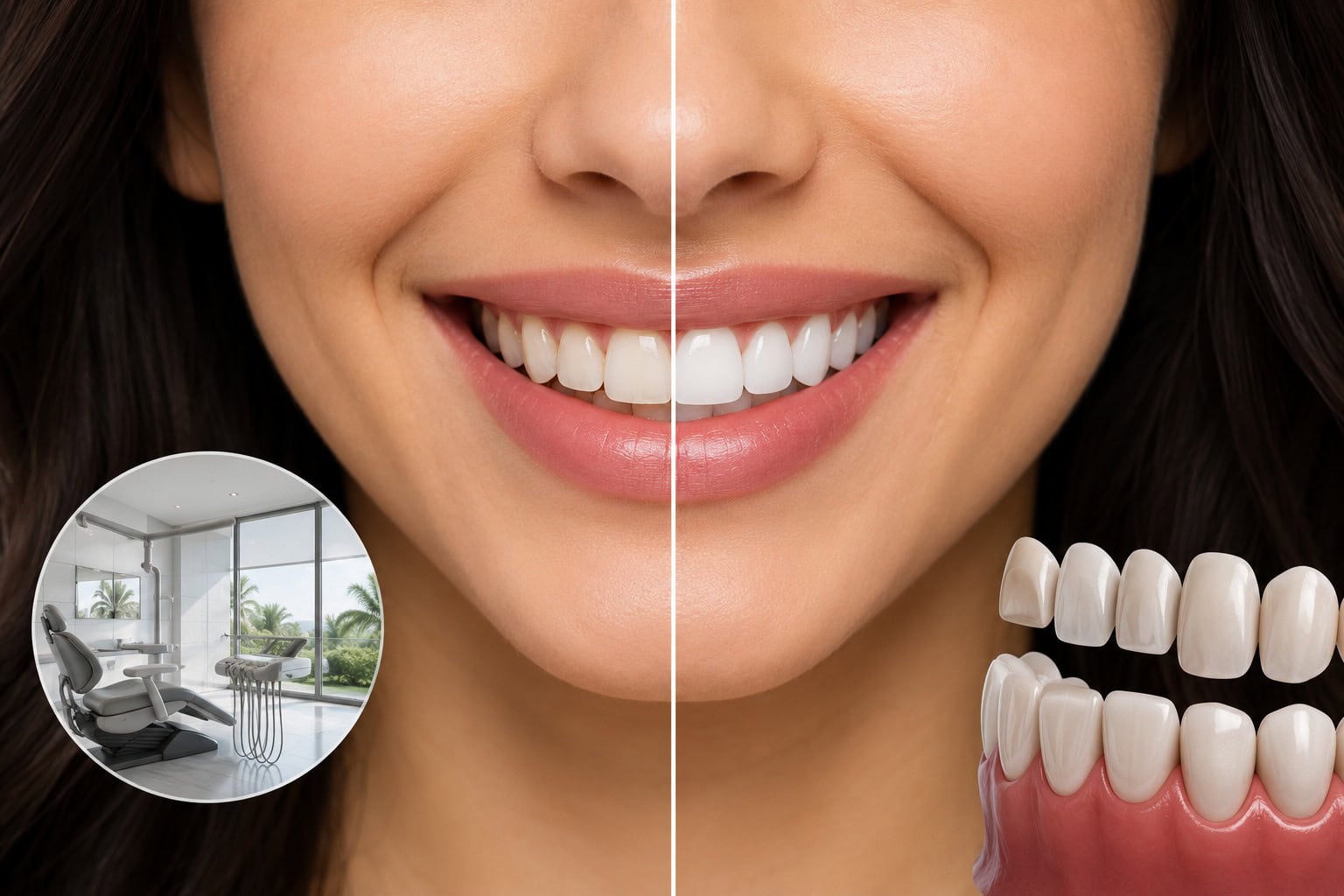
Composite bonding is the direct application of tooth-coloured resin composite to the tooth surface, shaped and cured in the mouth in a single visit. In the UK the same treatment is usually called composite bonding; in most other markets it is called composite veneers, and the difference is vocabulary rather than material. A systematic review and meta-analysis of resin composite laminate veneers reported a pooled survival of 88% (95% CI 81%-94%) across randomised controlled trials, with mean follow-up ranging from 24 to 97 months, and found direct application survived better than the indirect approach (PubMed 38035903). What separates composite from porcelain is not lifespan but two technical properties: it is usually additive and requires little or no tooth preparation, and a chipped composite can be repaired in the chair rather than replaced. Against that, surface roughness and staining are reported more often with composite than with ceramic. Which option suits your teeth depends on how much enamel is intact, how your bite loads the front teeth, and how far your target shade is from your natural one.
- 01Resin composite laminate veneers pooled 88% survival (95% CI 81%-94%) across randomised controlled trials, mean follow-up 24 to 97 months, with direct veneers outperforming indirect ones (PubMed 38035903, 7 studies).
- 02In a two-year randomised trial placing 60 direct composite and 60 IPS e.max Press ceramic veneers, survival did not differ significantly (93.4% versus 95%, p > 0.05), but staining and surface roughness were recorded more often in the composite group (PubMed 39063806).
- 03Direct composite used for diastema closure and recontouring survived at 90.3% over four years with annual failure rates of 0.9%-3.4%; counting repaired restorations as still in service raises that to 100% (PubMed 33354867, 216 restorations).
- 04Repairing a defective direct restoration showed no measurable difference in failure risk against replacing it (RR 1.21, 95% CI 0.51-2.83), yet only 31.3% of defective restorations are actually repaired in practice (PubMed 35362754, 41483821).
- 05Enamel is what adhesive restorations hold onto: veneers whose preparation stayed inside enamel survived at 99% over up to 12 years, while those bonded into dentine were roughly ten times more likely to fail (PubMed 23342345). This is the mechanical case for additive treatment.
/ Composite bonding and composite veneers: one material, two vocabularies
Composite bonding is the direct placement of tooth-coloured resin composite onto the tooth, built up in increments, light-cured and polished in the same appointment. Composite veneers describe the same material used to reface the whole labial surface of a tooth. In British usage bonding is the default word for both; in most other English-speaking markets the default is composite veneers. Clinicians tend to reserve bonding for freehand chairside work on part of a tooth and composite veneers for a fuller systematic build-up, but the line is genuinely blurred in practice, and pretending otherwise would be inventing a distinction the profession does not consistently apply.
The material itself is a family of products: a resin matrix loaded with inorganic filler particles, where particle size and filler load govern how well the surface polishes and how it wears. That is why two composite restorations placed by two clinicians with two different materials can look and behave differently after three years.
How the material performs in the mouth has been measured over long periods, though mostly in the posterior. A systematic review of posterior resin composite restorations in adults recorded 80 failures over 62,030 restoration-months and reported an overall incidence rate of 1.55 lost restorations per 100 restoration-years, with secondary caries and restoration fracture the main reasons and the quality of evidence rated low (PubMed 26003655). Those are fillings, not veneers, and the numbers do not transfer directly. They set a baseline. The anterior aesthetic evidence sits further down this page. For the full-coverage side of the category, our zirconia crowns profile sets out what a crown involves, and dental coverings explained maps the options.
/ Composite fillings, composite bonding and composite veneers are three different jobs
The single largest source of confusion around this material is that three distinct procedures share one name. The resin is the same in all three; what changes is the indication and how much of the tooth is covered.
| Procedure | What it does | Scope |
|---|---|---|
| Composite filling | Restores tooth structure lost to decay or fracture | Confined to the defect |
| Composite bonding | Corrects small shape, gap or shade problems | Part of a surface |
| Composite veneers | Refaces the entire labial surface of the tooth | Whole facial surface |
The reason this matters commercially as well as clinically is that quotes are written in these terms and patients cannot compare them. A price for "composite" tells you nothing until you know whether it covers one surface of one tooth or a full build-up across ten. Ask which of the three is being quoted, and ask how many teeth are included.
A fourth term completes the confusion: names such as "zirconium composite veneers" fuse two mutually exclusive materials into one label, and a treatment plan written that way cannot be decoded. If a plan lists more than one material, ask which teeth get which, and why. Our bonding treatment page covers the procedure itself, does dental bonding really improve your smile works through candidacy, and composite veneers in Istanbul covers how the treatment runs here. The crown-versus-veneer axis, which is a separate question again, is handled in our Turkey teeth guide.
/ What the survival data reports
The auditable evidence on how long composite bonding lasts begins with a systematic review and meta-analysis of resin composite laminate veneers covering randomised controlled trials and cohort studies with at least two years of follow-up, published between 1998 and May 2022. Of 827 screened articles, 7 were included: 3 randomised controlled trials and 4 cohort studies. Pooled survival across the randomised trials was 88% (95% CI 81%-94%), with mean follow-up ranging from 24 to 97 months. The most frequently reported complications were surface roughness, colour mismatch and marginal discolouration, and the authors concluded that direct composite veneers showed higher survival than the indirect approach, with most complications judged clinically acceptable with or without reintervention (PubMed 38035903).
A second dataset comes from the indication composite is most often used for. A four-year clinical evaluation of direct diastema closure and recontouring restorations in the maxillary anterior region assessed 216 restorations in 53 patients. Overall survival was 90.3% with a mean service time of 46.2 months, and annual failure rates ranged from 0.9% to 3.4%. Diastema closure and recontouring performed comparably, and no significant difference emerged between the three composite materials tested (PubMed 33354867).
Read together, the picture is a survival band around nine in ten over follow-up periods of roughly two to four years, with a meaningful share of the failures being surface and shade problems rather than loss of the restoration. For the ceramic alternative that sits alongside this in most treatment plans, our e.max veneers profile reports the equivalent figures for lithium disilicate.
/ Why the published lifespan range is so wide
Anyone comparing sources on composite longevity will find numbers that contradict each other, and the literature is open about the reason. A systematic review of direct anterior composite restorations pooled 25 studies covering 75,637 restorations and reported survival between 28.6% and 100%, with annual failure rates between 0% and 27.11%. Fracture was the main cause of failure, and the factors associated with failure were the adhesive technique used, the type of composite resin, whether the restoration replaced an earlier one, and the time taken to build it up (PubMed 35399771).
That spread is not evidence that the material is unpredictable. It is evidence that the outcome depends heavily on variables that have nothing to do with the brand of composite. A second review makes the same point with a useful distinction: pooling 1,821 anterior composite restorations across 17 studies, the total failure rate was 24.1% and annual failure rates ran from 0% to 4.1%. Fracture of tooth or restoration was the commonest reason for failure in functional restorations, while failures related to colour, anatomical form and surface staining predominated when the restorations had been placed for aesthetic reasons (PubMed 26303655).
Technique effects have been quantified in the posterior too. A meta-analysis of 5 randomised controlled trials covering 627 restorations in 279 patients, comparing direct against indirect composite in large Class II cavities with cusp coverage, reported annual failure rates of 0% to 5.4% for direct restorations against 0% to 15.5% for indirect ones, with a pooled risk ratio of 0.61 (95% CI 0.47-0.79). The authors classified the level of evidence as very low and the included studies as at high risk of bias (PubMed 39122602). Those are posterior fillings and the numbers do not transfer to anterior veneers; the finding is included here because two separate bodies of literature point the same way on direct versus indirect.
/ Composite versus porcelain veneers, measured head to head
Direct randomised comparisons between composite and ceramic veneers are scarce, but one exists and it is worth reading carefully. A two-year randomised clinical trial in multiple diastema closure cases placed 60 direct resin composite veneers and 60 indirect IPS e.max Press ceramic veneers across 28 patients, reviewed every six months against USPHS criteria. Survival was 93.4% for composite and 95% for ceramic, a difference that did not reach statistical significance (p > 0.05), and Kaplan-Meier overall survival was 94.2%. Staining was recorded in 11 restorations and roughness in 14, both more frequently in the composite group (PubMed 39063806).
The long-term ceramic evidence runs further out. A systematic review and meta-analysis of 13 clinical studies of feldspathic porcelain and glass-ceramic laminate veneers reported 89% cumulative survival (95% CI 84%-94%) at a median nine-year follow-up, with glass-ceramic at 94% (87%-100%) and feldspathic porcelain at 87% (82%-93%). Complications were debonding 2%, fracture or chipping 4%, secondary caries 1% and severe marginal discolouration 2% (PubMed 26757327).
Putting those side by side does not produce a ranking. At two years the direct comparison found no significant survival difference; beyond that, the nine-year ceramic dataset and the two-to-four-year composite dataset cover different follow-up windows and cannot be compared directly. So the question of composite or porcelain is not settled by longevity. It is settled on other axes: how much preparation is required, whether the restoration can be repaired, how the surface behaves over time, and how many visits you can commit to. Our porcelain veneers guide covers the ceramic route, how long veneers last sets expectations across both, and the laminate veneer treatment page explains what minimal preparation means in practice.
/ The repairable difference
The clearest practical separation between composite and ceramic is not how long each lasts but what happens after something goes wrong. A chipped composite can usually be repaired chairside in a single visit; a fractured ceramic veneer is generally remade. That difference has been measured.
In the four-year diastema closure evaluation, survival was 90.3% when only intact restorations counted as successful, and 100% when restorations that had been repaired and remained in service were included (PubMed 33354867). The restorations were not lost; their original condition was.
Whether repair is as good as replacement has been examined separately. A systematic review and meta-analysis comparing repair with replacement of defective direct restorations in permanent teeth found no difference in the risk of failure (RR 1.21, 95% CI 0.51-2.83), while rating the risk of bias as high and the certainty of evidence as very low (PubMed 35362754). An umbrella review published in 2026, synthesising seven systematic reviews, confirmed that risk ratio and added three points: a network meta-analysis of laboratory studies identified diamond bur roughening plus silane plus adhesive as the protocol producing the highest bond strength at a mean of 24.5 MPa; patient acceptance of repair exceeded 86%; and yet only 31.3% of defective restorations were actually repaired (PubMed 41483821).
That last figure is the one that matters to a patient. Repair is defensible, patients accept it, and it is still not the default. For anyone travelling for treatment the point is sharper still: a treatment that can be fixed in one short visit is easier to maintain at distance than one that has to be remade in a laboratory. Ask, before you book, whether repair is part of the plan when something chips.
/ What "no-prep" means, and why enamel is the whole argument
The reason composite occupies a defensible position in the current debate about cosmetic dentistry is preparation depth. Composite bonding is typically additive: the material is placed onto the tooth, and in most cases little or no enamel is removed. A full-coverage crown does the opposite, reducing the tooth all the way around, and that reduction is permanent.
No-prep is not universal, however. Where the tooth is already bulky, where the bite is tight, or where the planned form sits inside the existing contour, some surface adjustment is needed for composite too. How much depends on the case and cannot be stated without an examination. A clinic promising zero preparation for every tooth before seeing your mouth is promising something it cannot know.
Why preserving enamel matters has been quantified in ceramic veneers, which makes the finding one about bonding substrate rather than material. Following 580 porcelain laminate veneers in 66 patients for up to 12 years, survival was 99% where the preparation remained entirely within enamel and 94% where enamel remained only at the margins, with 86% overall cumulative survival. Veneers bonded into dentine, with preparation margins in dentine, were approximately ten times more likely to fail (PubMed 23342345). Adhesive restorations hold onto enamel; once the enamel is gone, that advantage cannot be recovered, whatever material is bonded on top.
The clinical problem behind that debate is over-preparation, not geography. Where a patient with intact teeth and a shade complaint is offered full-coverage crowns, sound structure is removed that whitening or additive composite could have addressed. The correct order of escalation is whitening first, additive composite second, and full coverage only where the tooth cannot carry load on its own. Our Turkey teeth analysis covers the reputational side of that argument, what to do after tooth reduction covers patients who have already been prepared, and prepless laminate treatment covers the ceramic version of minimal preparation.
/ Staining, surface roughness, and who maintains you 3,000 km from the clinic
The realistic expectation to set for composite is not about lifespan, it is about how the surface behaves over years. The literature is consistent here. The systematic review of composite laminate veneers lists surface roughness, colour mismatch and marginal discolouration as the three most frequently reported complications (PubMed 38035903). The two-year randomised comparison against ceramic recorded staining in 11 restorations and roughness in 14, both more common in the composite arm (PubMed 39063806). And the review of anterior composite restorations found that where restorations were placed for aesthetic reasons, colour, anatomical form and surface staining outranked fracture as the reason for failure (PubMed 26303655).
So composite veneers are typically renewed because they stop looking new, not because they break. That puts periodic polishing inside the treatment plan, where repolishing aims to reduce surface roughness and slow further staining. No verified clinical study quantifying how much repolishing frequency extends service life has been identified, so no evidence-based interval can be given. Coffee, tea, red wine and smoking are recognised accelerators of surface staining. Whitening agents do not change the shade of set composite, which is why shade is decided before placement rather than after; our teeth whitening guide covers the sequencing.
For an international patient this is the question that should decide the material. If your composite needs polishing every year and your dentist is in another country, who does it. There are three workable answers: plan review appointments alongside future travel, arrange maintenance polishing with a local dentist and share your records with them, or choose ceramic if neither is realistic for you. What is not a workable answer is not asking. We publish our clinical team with names and qualifications so that remote review has someone attached to it.
/ When composite is the wrong choice
Composite is indicated for a defined set of problems. Closing small spaces between teeth, repairing a chipped incisal edge, correcting form and length discrepancies, addressing limited enamel-level shade problems, and treating a patient who needs a result in one visit are its typical uses. The four-year diastema closure dataset reporting 90.3% survival comes from exactly this indication (PubMed 33354867). It is also used as an interim solution in younger patients whose gingival margins have not settled.
It is the wrong choice in several situations. In uncontrolled bruxism, or in an edge-to-edge or deep overbite where the anterior teeth carry heavy load, added composite sits in the path of that force and fracture risk rises; the bite and the need for a night guard have to be assessed before anything is bonded. Where the underlying discolouration is severe, as in heavy tetracycline staining, a thin layer of composite may not mask the substrate. Where a tooth has extensive structural loss, large existing restorations or root canal treatment, the problem is load-bearing rather than appearance, and full coverage is the relevant conversation. And no aesthetic restoration of any material lasts in the presence of active caries or untreated gum inflammation.
If you grind your teeth, a night guard is not an upsell but part of what protects the work; our bruxism guard guide covers it. Where full coverage genuinely is indicated, the material profiles for PFM crowns and temporary crowns set out what those stages involve, and our cosmetic dentistry overview places the whole set in order. Diastema cases specifically are covered in understanding diastema.
/ Is composite safe: the bisphenol A question
The main safety question about composite concerns bisphenol A, and it has a measured answer. A systematic review of bisphenol A release from resin composites and dental sealants evaluated 20 studies. Most studies showed an increase in bisphenol A levels one hour after treatment, with levels falling within one week. The authors recommend specific clinical precautions: rubber dam isolation, immediate polishing, application of glycerine gel, and limiting treatment to a maximum of four restorations per appointment, with additional caution in children, adolescents and pregnant patients (PubMed 31075949).
The conclusion points at protocol. Those precautions are standard practice, and a patient is entitled to ask how isolation will be managed, how many restorations are planned per visit and when polishing will be done. A clinic proposing twenty composite build-ups in one afternoon is worth questioning on this ground alone.
The second recurring question is whether composite damages the tooth. Placed additively, it removes little or no structure, so tissue loss from the material itself is not expected. The risk sits at the margin instead: a poorly adapted margin accumulates plaque and the tooth beneath it can decay. That is consistent with secondary caries being the commonest biological reason for failure in posterior composite restorations (PubMed 26003655). Marginal adaptation, isolation during placement and subsequent oral hygiene determine the outcome more than the choice of composite brand does.
/ Cost, and what actually moves the number
Quoted prices for composite bonding vary widely between clinics and between countries, and most of the variation is not exchange rate or margin. It is that different procedures are being priced under one word. Current figures sit on the treatment pages rather than in an article, because a number written into editorial text goes stale.
The variables that move the number are these. First, which of the three procedures is quoted, since a composite filling, a bonding correction and a full composite veneer are different amounts of work. Second, the number of teeth, because pricing is per tooth and a smile line can be six teeth or twelve. Third, in filling work, the number of surfaces involved. Fourth, preparatory treatment: active caries, periodontal therapy or whitening are separate items and are not included in a bonding fee. Fifth, chair time and the number of review appointments, which for a full anterior build-up is substantial. Sixth, what maintenance is included afterwards, specifically whether polishing visits and repair are covered.
For anyone comparing an international quote, two questions turn an incomparable price into a comparable one. Ask which procedure and how many teeth the figure covers, and ask what is excluded. A quote for a full set of composite veneers that omits the gum treatment those teeth need is not cheaper, it is incomplete. Our veneer cost guide walks through the same arithmetic across materials, the aesthetic dentistry section lists what we offer, and you can raise a specific plan through our contact page.
Let’s plan the right treatment together.
Free Assessment→- 1.Lim TW, Tan SK, Li KY, Burrow MF. Survival and Complication Rates of Resin Composite Laminate Veneers: A Systematic Review and Meta-Analysis. J Evid Based Dent Pract. 2023;23(4):101911. doi:10.1016/j.jebdp.2023.101911
- 2.Korkut B, Türkmen C. Longevity of direct diastema closure and recontouring restorations with resin composites in maxillary anterior teeth: A 4-year clinical evaluation. J Esthet Restor Dent. 2021;33(4):590-604. doi:10.1111/jerd.12697
- 3.Elkaffas AA, Alshehri A, Alqahtani AR, et al. Randomized Clinical Trial on Direct Composite and Indirect Ceramic Laminate Veneers in Multiple Diastema Closure Cases: Two-Year Follow-Up. Materials (Basel). 2024;17(14):3514. doi:10.3390/ma17143514
- 4.Demarco FF, Collares K, Coelho-de-Souza FH, Correa MB, Cenci MS, Moraes RR, Opdam NJM. Anterior composite restorations: A systematic review on long-term survival and reasons for failure. Dent Mater. 2015;31(10):1214-1224. doi:10.1016/j.dental.2015.07.005
- 5.Shah YR, Shiraguppi VL, Deosarkar BA, Shelke UR. Long-term survival and reasons for failure in direct anterior composite restorations: A systematic review. J Conserv Dent. 2021;24(5):415-420. doi:10.4103/jcd.jcd_527_21
- 6.Ástvaldsdóttir Á, Dagerhamn J, van Dijken JWV, Naimi-Akbar A, Sandborgh-Englund G, Tranæus S, Nilsson M. Longevity of posterior resin composite restorations in adults, A systematic review. J Dent. 2015;43(8):934-954. doi:10.1016/j.jdent.2015.05.001
- 7.Tennert C, Maliakal C, Suarèz Machado L, Jaeggi T, Meyer-Lueckel H, Wierichs RJ. Longevity of posterior direct versus indirect composite restorations: A systematic review and meta-analysis. Dent Mater. 2024;40(11):e95-e101. doi:10.1016/j.dental.2024.07.033
- 8.Mendes LT, Pedrotti D, Casagrande L, Lenzi TL. Risk of failure of repaired versus replaced defective direct restorations in permanent teeth: a systematic review and meta-analysis. Clin Oral Investig. 2022;26(7):4917-4927. doi:10.1007/s00784-022-04459-0
- 9.Fernández E, Martín J, Angel P, Caviedes R, Díaz L, Bersezio C. Repair of Resin Composite Restorations: An Umbrella Review of Systematic Reviews. Oper Dent. 2026;50(5):477-490. doi:10.2341/25-072-LIT
- 10.Morimoto S, Albanesi RB, Sesma N, Agra CM, Braga MM. Main Clinical Outcomes of Feldspathic Porcelain and Glass-Ceramic Laminate Veneers: A Systematic Review and Meta-Analysis of Survival and Complication Rates. Int J Prosthodont. 2016;29(1):38-49. doi:10.11607/ijp.4315
- 11.Gurel G, Sesma N, Calamita MA, Coachman C, Morimoto S. Influence of enamel preservation on failure rates of porcelain laminate veneers. Int J Periodontics Restorative Dent. 2013;33(1):31-39. doi:10.11607/prd.1488
- 12.Paula AB, Toste D, Marinho A, Amaro I, Marto CM, Coelho A, Marques-Ferreira M, Carrilho E. Once Resin Composites and Dental Sealants Release Bisphenol-A, How Might This Affect Our Clinical Management? A Systematic Review. Int J Environ Res Public Health. 2019;16(9):1627. doi:10.3390/ijerph16091627