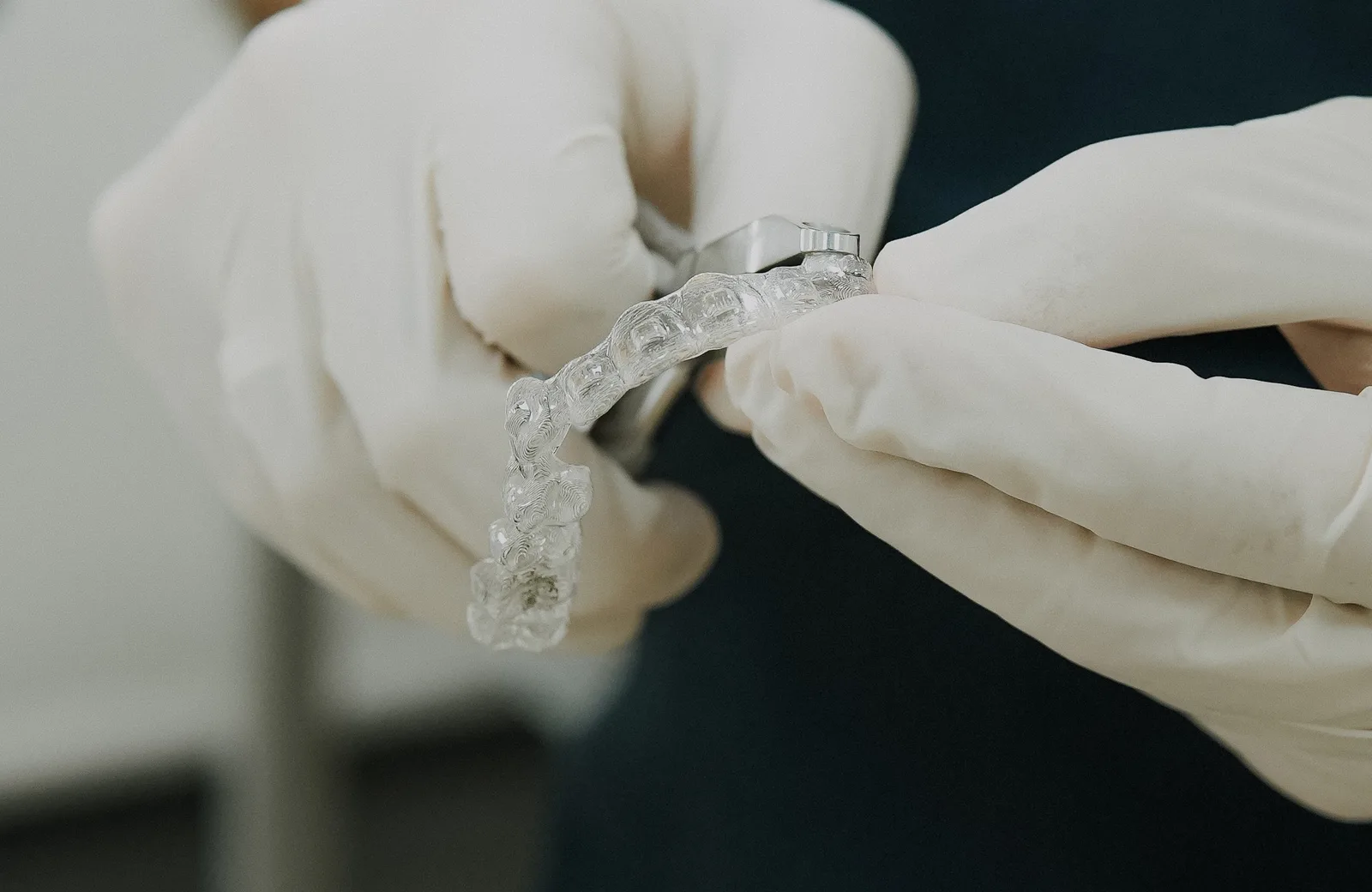

Teeth affect speech because several consonants are formed by directing airflow against the upper incisors, so missing front teeth, gaps, crowding and an anterior open bite all change how clearly those sounds land. Across 105 children compared directly, the 61 with speech sound disorders showed poorer orofacial function and a higher prevalence of malocclusion than the 44 with typical speech development (PubMed 35723352). Dental treatment is not an instant fix either: speech needs a period of adaptation after the mouth changes, and its length varies with the treatment and the person.
- 01Speech is produced by a tongue-lip-teeth triad, and a change in any one of the three alters how consonants are shaped, which is why tooth position is not a purely cosmetic variable.
- 02In 105 children compared directly, the 61 with speech sound disorders had both poorer orofacial function and more malocclusion than the 44 with typical speech development (PubMed 35723352).
- 03Orthodontic appliances can make speech worse before they make it better: a review that screened 4853 records and included 7 studies on rapid maxillary expansion found speech deterioration during treatment in two studies, with recovery after appliance removal (PubMed 37786950).
- 04Speech needs a period of adaptation after dental treatment; slight distortion at first is expected while the tongue recalibrates, and how long it lasts varies with the treatment and the person.
- 05Aesthetic work is not phonetically neutral, because crown length, alignment and position change airflow, so speech function belongs in smile design planning rather than after it.
How Teeth Shape Speech
Teeth do affect speech. Speaking starts when air from the lungs passes through the vocal cords and makes them vibrate, and that sound is then shaped inside the mouth by the tongue, the lips and the teeth working together. Several consonants depend directly on the teeth. Sounds such as s, z, f, v and th are formed by pressing the lip or the tongue against the upper front teeth or by channelling a narrow stream of air across their edges.
Because the three structures work as a unit, a change in any one of them alters how sounds come out. If a front tooth is missing, tilted or spaced, the air escapes in the wrong place, the tongue loses the surface it normally touches and a clear sound becomes blurred, muffled or whistled. Listeners may hear this as a lisp or as unclear speech, even when the person speaking has no problem with language itself.
Clarity is also tied to confidence. People who feel their speech is unclear, or who dislike how their teeth look while they talk, often speak less, cover their mouth or avoid talking in groups. For that reason tooth position is more than a cosmetic detail. It is part of how a person communicates, and it is worth considering whenever teeth are replaced, moved or reshaped. The good news is that most of the structural causes described below can be treated, and speech usually adapts well once they are.
Dental Problems That Blur Sounds
Missing teeth, especially at the front, are an obvious cause. Without the tooth, air leaks through the gap and the tongue cannot find its usual contact point, so sibilant and dental sounds lose their sharpness.
Crowded or overlapping teeth disturb the space inside the mouth. They can restrict how freely the tongue moves, and some sounds then run together or come out incompletely. Gaps between the front teeth, even when no tooth is missing, create a similar effect to a missing tooth and can produce a lisp-like quality.
An anterior open bite, where the upper and lower front teeth do not meet when the mouth is closed, makes it hard to direct the airstream. Speech may sound less natural and some words slurred. A broader malocclusion, where the upper and lower jaws do not close together properly, disrupts sound formation in the same way. In children this kind of structural problem can delay speech development or make certain sounds harder to learn.
The tongue matters too. An unusually large tongue, called macroglossia, can push the teeth out of alignment over time and create a malocclusion, which in turn affects the rhythm of speech and how clearly sounds are produced. In these cases the teeth and the tongue need to be assessed together, because correcting one without the other may not hold.
What the Research Shows
The link between the mouth and speech has been measured in children. In a study that compared 105 children and adolescents directly, the 61 with speech sound disorders had both poorer orofacial function and a greater prevalence of malocclusion than the 44 with typical speech development (PubMed 35723352). Within the group with speech sound disorders, poorer orofacial function was associated with a greater risk of malocclusion (PubMed 35723352).
This does not prove that crooked teeth cause speech problems. Weak or poorly coordinated oral muscles, the bite and speech all develop together, and each can influence the others. The practical message from the authors is that children with speech difficulties benefit from having their mouth and bite assessed as well, and that speech therapists and dentists work better together than separately.
Lisping illustrates the connection well. A lisp is a speech pattern that often reflects an imbalance in the oral structures. When the teeth are poorly aligned or the bite does not close properly, the tongue cannot direct sounds cleanly, and words may come out blurred, rounded or incomplete. If nothing is done, such patterns can persist into adulthood, because the tongue learns to compensate and that compensation becomes habit. Early assessment makes it easier to correct both the structure and the habit before they become fixed.
Speech Concerns at Different Ages
The causes of tooth-related speech problems change with age. In children, the usual contributors are early loss of baby teeth, thumb sucking or long-term pacifier use, and crooked teeth combined with a narrow jaw. Because speech is still being learned, a structural problem at this age can shape how sounds are formed for years.
In adults, speech problems often follow an orthodontic need that was never addressed in childhood, or the loss of one or more teeth. Many adults also have aesthetic concerns about their teeth that make them self-conscious when talking. Teeth grinding ( bruxism ) and tension in the jaw muscles can wear teeth down and change how they meet, which subtly alters speech as well.
In older adults, the main factors are adjusting to dentures, loss of jawbone that makes a denture less stable, and gum recession that changes the space around the teeth. A new denture alters palate thickness and tooth position, so certain sounds can come out differently at first. A well-fitted, stable denture allows the natural speech pattern to return over time, and persistent difficulty usually points to a fit problem that the dentist can adjust.
At every age, the first step is the same. A dental examination looks at which teeth are missing or out of position, how the bite closes and how the tongue moves, and then links those findings to the sounds that are affected.
Treatments That Remove the Obstacle
Dental treatment can remove the physical cause of many speech problems. Orthodontic treatment with braces or clear aligners corrects crowding, spacing and bite problems and restores the surfaces the tongue and lips need. When it starts in childhood, it can support both speech development and self-confidence.
Appliances can make speech worse for a while before they make it better, because they change the shape of the mouth and the tongue needs time to adjust. A review of rapid maxillary expansion screened 4853 records and included 7 studies with 200 patients; two of those studies found speech deteriorated during treatment and improved after the appliance was removed (PubMed 37786950). The long-term effect of correcting an underlying malocclusion is generally clearer speech, but a temporary change is worth expecting.
Missing teeth can be replaced with implants or with fixed or removable dentures. Replacing the tooth closes the gap where air was escaping and gives the tongue its contact point back, which supports a return to a natural speech pattern. In severe jaw discrepancies, corrective jaw surgery, known as orthognathic surgery, can realign the jaws and bring both functional and aesthetic improvement.
Dental treatment alone does not always resolve speech problems. Structural correction removes the obstacle, but habits the tongue has learned over years stay in muscle memory until they are retrained. That is why orthodontic or prosthetic treatment combined with speech therapy produces the clearest results, particularly when the pattern started in childhood.
Adapting After Treatment
Speech usually goes through a period of adjustment after dental work, and knowing what to expect makes it easier. In the first week, the mouth is adapting to a new shape and slight distortion of some sounds is normal. Through the first month, muscle memory adjusts to the new structure and sounds become clearer. By the third month, articulation has largely settled and speech feels fluent again.
This timeline applies to braces, dentures, bridges, implants and veneers alike, although the amount of change varies with how much the shape of the mouth has been altered.
Practice speeds up the process. Reading aloud gives the tongue repeated contact with the new surfaces, and speaking in front of a mirror helps you see how the lips and tongue are moving. Tongue twisters that focus on the sounds that feel difficult can be helpful. Where indicated, a speech therapist can guide exercises for specific sounds.
If speech has not improved after the third month, or if a denture or appliance feels loose, rubs or clicks when you talk, tell your dentist. These are usually signs that the fit or shape needs adjusting, and small changes can make a noticeable difference to clarity.
Smile Design and Speech
Aesthetic dental work can change speech. A smile design made to improve dental aesthetics changes the length, alignment and position of the teeth, and each of those changes can alter how air flows and where the tongue lands. A front tooth made slightly longer or thicker, for example, can change how s and f sounds are produced.
For this reason, speech function belongs in smile design planning from the start. A careful plan considers how the new teeth will meet the lower lip during f and v sounds, how much space the tongue has for s sounds and how the edges of the upper teeth line up during speech. Temporary restorations are useful here, because they let the patient test both the look and the sound of the new smile before the final work is made.
The social side of speech is just as real. When people are unhappy with their teeth, they may avoid speaking, especially in crowded settings, and over time this can lead to reduced self-confidence and withdrawal from conversation. Treatment that improves both appearance and clarity can change how comfortable a person feels speaking in everyday life.
If you notice difficulty with certain sounds, a whistle or a lisp that appeared after tooth loss, or speech that changed after dental work, a dental assessment is a good first step. The dentist can identify which structural factors are involved and whether dental treatment, speech therapy or a combination of both is the right route.
Let's plan the right treatment together.
Free Assessment→- 1.Mogren Å, Sand A, Havner C, Sjögreen L, Westerlund A, Agholme MB, et al. Children and adolescents with speech sound disorders are more likely to have orofacial dysfunction and malocclusion. Clin Exp Dent Res 2022;8:1130-1141. PubMed 35723352
- 2.Sant'Anna LIDA, Miranda E Paulo D, Baião FCS, Lima IFP, Vieira WA, César CPHAR, et al. Can rapid maxillary expansion affect speech sound production in growing patients? A systematic review. Orthod Craniofac Res 2024;27:185-192. PubMed 37786950