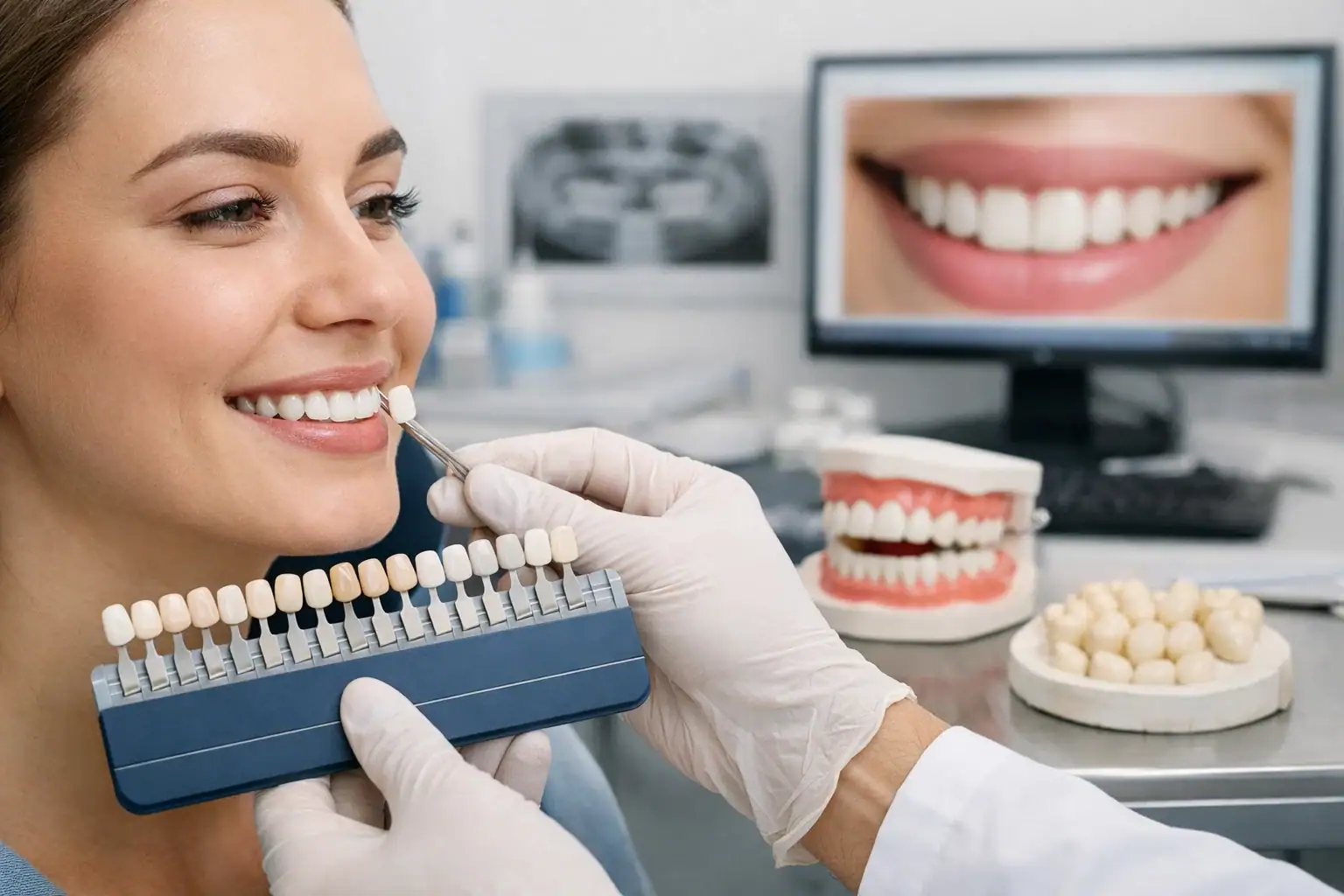
Tooth shade selection is the clinical step in which the colour of a veneer, crown or full-arch restoration is decided against the patient's own teeth, using shade guide tabs from the A, B, C and D families together with hue, chroma, value, translucency and surface texture. It is judged under more than one light source, because clinic lighting, daylight and camera flash each shift perception. In 107 patients, visual shade determination matched the reference instrument in 35.5 percent of cases for the dentist and 34.6 percent for the technician, while a digital intraoral scanner reached 43.9 percent (PubMed 28265772).
- 01Shade is five variables rather than one: hue (colour family), chroma (colour intensity), value (lightness), translucency and surface texture.
- 02Classic guides sort teeth into the A, B, C and D families, with B1 as the brightest common tab, but modern colour matching goes beyond the tab and analyses all five variables.
- 03Matching is difficult even for experts: visual determination agreed with the reference instrument in 35.5 percent of 107 cases for the dentist and 34.6 percent for the technician, digital measurement in 43.9 percent (PubMed 28265772).
- 04The brightest tab is not the target, because ultra-white shades read flat and opaque under natural light and lose the translucency that makes a restoration look like enamel.
- 05Material changes the decision: translucent zirconia is preferred for front teeth, high-strength zirconia for molars, and layered ceramics rebuild the depth of natural enamel.
/ Tooth Shade Selection and Natural Smile Aesthetics
How the Right Color Choice Defines a Natural, Confident Smile
In modern aesthetic dentistry, many patients focus on shape, alignment, and symmetry. However, one of the most critical yet underestimated factors is tooth shade selection.
Whether you are getting veneers, crowns, zirconia restorations, or a full smile makeover, tooth shade selection directly affects how natural, harmonious, and aesthetically pleasing your smile looks.
At Mosdent, we believe that successful smile design is not about making teeth simply “whiter.” It is about choosing the right color based on facial features, skin tone, age, personality, and functional harmony.
Shade selection becomes more predictable when it is carried out with digital dentistry tools.
What Is Tooth Shade Selection?
Tooth shade selection is the professional process of determining the most suitable color for dental restorations such as:
- Porcelain veneers
- Zirconia crowns
- Emax veneers
- Implant-supported crowns
- Full mouth reconstructions
In cosmetic dentistry, shade selection is not random. It is based on a scientific and artistic evaluation process known as cosmetic dentistry color matching.
Why Tooth Shade Selection Is So Important
Choosing the wrong shade can result in:
- Artificial-looking teeth
- Overly bright, unnatural appearance
- Gray or opaque restorations
- Mismatch with adjacent teeth
- Loss of facial harmony
Correct tooth shade selection ensures:
✔ Natural translucency
✔ Proper light reflection
✔ Age-appropriate brightness
✔ Balanced smile aesthetics
✔ Long-term patient satisfaction
At Mosdent, every tooth shade selection is customized rather than standardized.
/ Tooth Shade Selection Across Smile Makeovers and Restorations
Tooth Shade Selection vs “Whiter Is Better” Myth
Many patients request the “whitest shade possible.” However, in professional Smile Makeover, the goal is natural looking dental veneers, not extreme brightness.
Ultra-white shades may:
- Look artificial under natural light
- Appear flat and opaque
- Age the smile prematurely
- Draw attention for the wrong reasons
A successful tooth shade selection balances brightness with translucency and texture.
The Role of Smile Makeover Color Harmony
In advanced smile design, smile design color harmony is key.
Dentists evaluate:
- Skin tone
- Lip color
- Eye color
- Face shape
- Gum tone
- Age
- Personality
The correct tooth shade selection complements facial features rather than overpowering them.
At Mosdent, we use facial analysis during consultation to determine ideal shade.
Dental Veneer Shade Guide Explained
A dental veneer shade guide is a professional tool used to compare tooth colors.
Traditional shade guides include:
- A1, A2, A3
- B1 (very bright)
- C and D families
However, modern cosmetic dentistry color matching now goes beyond basic shade tabs.
We analyze:
- Hue (color family)
- Chroma (color intensity)
- Value (lightness)
- Translucency
- Surface texture
Advanced porcelain veneer shade selection often includes multi-layered ceramics to mimic natural enamel.
Tooth Shade Selection for Veneers
When veneers are placed, tooth shade selection becomes even more critical.
Factors influencing veneer shade:
- Underlying tooth color
- Thickness of veneer
- Material used (Emax vs zirconia)
- Cement shade
- Desired smile brightness
At Mosdent, we perform digital mock-ups before finalizing veneer color.
Zirconia Crown Color Matching
Zirconia crown color matching requires careful planning.
Zirconia can sometimes appear opaque if shade selection is incorrect. Therefore:
- Translucent zirconia is preferred for front teeth
- High-strength zirconia is used for molars
- Layered ceramics enhance natural look
Proper tooth shade selection prevents the “blocky crown” effect.
/ Hollywood Smile Shade and Personal Color Factors
Hollywood Smile Shade: Is Ultra White Always Ideal?
A Hollywood smile is usually associated with the brightest shades, but ultra white is not always the right choice.
Hollywood smile aesthetics typically involve:
- Brighter value
- Symmetrical shape
- Uniform color
However, even in Hollywood smile treatments, professional tooth shade selection maintains translucency and depth.
At Mosdent, we customize Hollywood smile shade according to facial harmony rather than using extreme white tones blindly.
Digital Tooth Shade Selection Technology
Modern clinics use digital tools for accurate tooth shade selection.
Technologies include:
- Digital smile design software
- Intraoral scanners
- High-resolution photography
- AI-supported shade mapping
Digital systems improve cosmetic dentistry color matching precision and predictability.
Choosing the Right Tooth Color Based on Age
Age significantly influences choosing the right tooth color.
Younger patients:
- Slight translucency
- Brighter value
Middle-aged patients:
- Natural warmth
- Balanced brightness
Older patients:
- Softer tone
- Less extreme white
Overly white restorations on mature patients may look unnatural.
Skin Tone and Tooth Shade Selection
Correct tooth shade selection should complement skin undertones.
Warm skin tones:
- Slightly warmer shades look natural
Cool skin tones:
- Neutral or bright shades may fit better
This is why aesthetic dentistry color matching requires experience and aesthetic sense.
/ Porcelain Veneer Shade and Full Mouth Planning
Porcelain Veneer Shade Selection Techniques
Professional porcelain veneer shade selection includes:
- Natural light evaluation
- Shade testing without lipstick
- Wet try-in technique
- Trial veneers
- Patient feedback
At Mosdent, we involve patients in shade selection discussions while guiding them professionally.
How Light Affects Tooth Shade
Lighting can dramatically change perception.
Under:
- Clinic lights
- Daylight
- Indoor lighting
- Photography flash
A shade may appear different.
That’s why expert tooth shade selection evaluates color under multiple lighting conditions.
Tooth Shade Selection in Full Mouth Rehabilitation
In full mouth reconstruction, shade selection is more complex.
Dentists must ensure:
- Consistency across all teeth
- Proper gradient effect
- Natural incisal translucency
- Harmonious smile design
At Mosdent, we plan full-mouth shade selection digitally before production.
Mistakes to Avoid in Tooth Shade Selection
Common errors:
- Choosing the brightest tab
- Ignoring translucency
- Not considering lip dynamics
- Skipping digital preview
- Not evaluating in natural light
Expert-guided tooth shade selection prevents these issues.
How Mosdent Personalizes Tooth Shade Selection
At Mosdent, our shade selection process includes:
✔ Facial proportion analysis
✔ Digital smile preview
✔ High-resolution photography
✔ Material-based shade planning
✔ Customized ceramic layering
✔ Patient-centered consultation
We believe that tooth shade selection is both science and art.
/ Frequently Asked Questions
How do dentists choose tooth color?
Through professional tooth shade selection using shade guides, facial analysis, and digital tools.
What is the best shade for veneers?
There is no universal “best.” It depends on smile design color harmony and facial features.
Is B1 too white?
For some patients, yes. Proper tooth shade selection ensures natural results.
Can tooth shade be changed later?
Minor adjustments are possible before final cementation, but after placement changes are limited.
Final Thoughts
Tooth shade selection is one of the most important steps in cosmetic dentistry.
A well-chosen shade creates:
✔ Natural aesthetics
✔ Facial harmony
✔ Youthful appearance
✔ Long-term satisfaction
At Mosdent, we combine advanced technology with artistic expertise to deliver personalized, natural-looking smiles through precise tooth shade selection.
Because a beautiful smile is not about being the whitest.
It is about being the most natural version of you.
Let’s plan the right treatment together.
Free Assessment→- 1.Brandt J, Nelson S, Lauer HC, von Hehn U, Brandt S. In vivo study for tooth colour determination-visual versus digital. Clin Oral Investig 2017;21:2863-2871. PubMed 28265772
- 2.Gonzalez-Chavez JA, Soto-Barreras U, Perez-Aguirre B, Nevarez-Rascon M, Villegas-Mercado CE, Dominguez-Perez RA. Reliability of Dental Shade Selection Methods: Agreement Among Spectrophotometer, Intraoral Scanner, and Cross-Polarization Photography. J Esthet Restor Dent 2025;37:1784-1790. PubMed 40070050