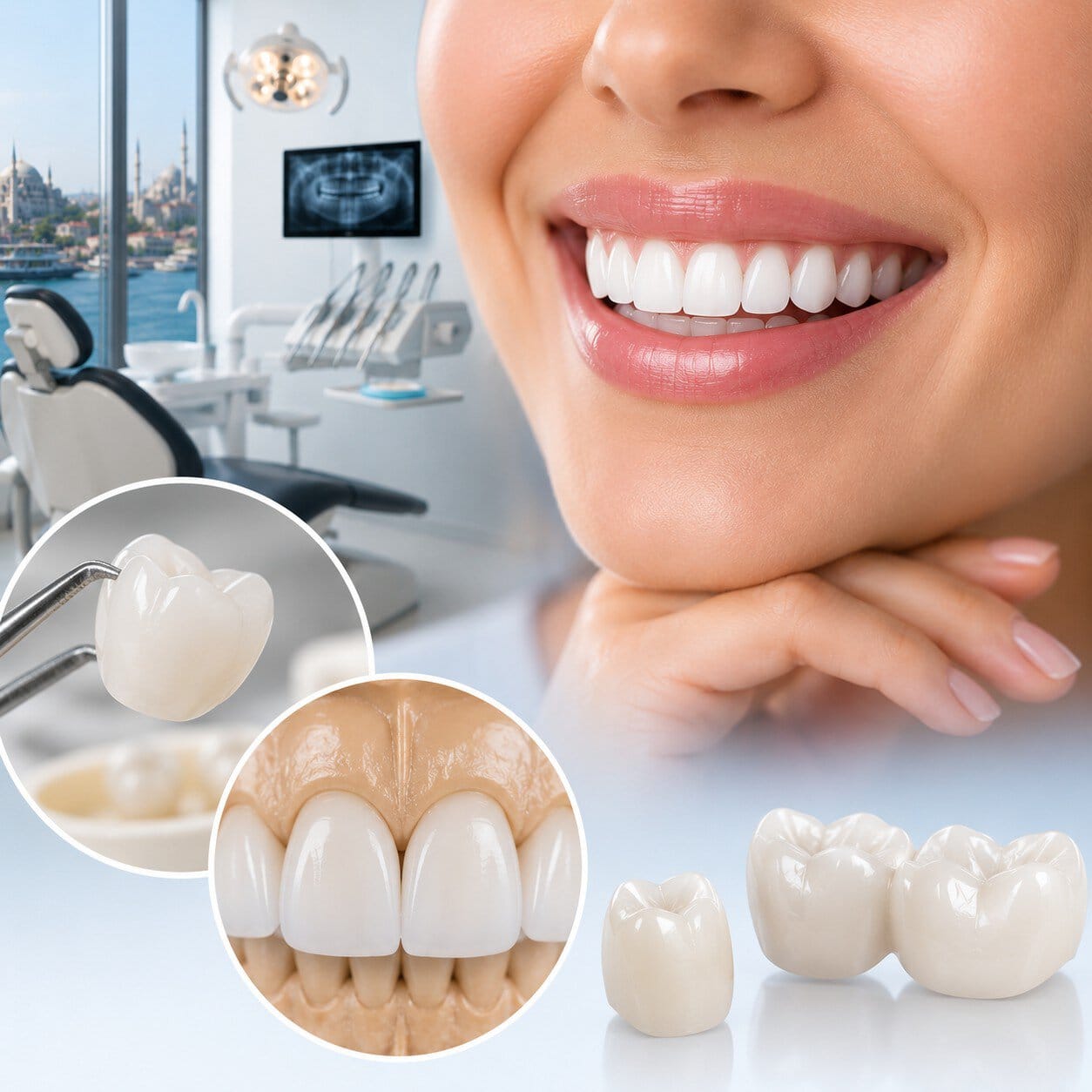
A zirconium front tooth crown is a full-coverage restoration milled from zirconia (zirconium dioxide) ceramic with no metal substructure, which is why its margin cannot expose a grey line as gum tissue recedes. In a meta-analysis of 64 studies covering 3,509 metal-ceramic and 8,051 all-ceramic tooth-supported single crowns, five-year survival was 96.8% for monolithic densely-sintered zirconia, 97.3% for veneered zirconia and 97.1% for metal-ceramic; apart from feldspathic and metal-ceramic crowns, material types performed similarly in anterior and posterior positions (PubMed 41489982). Shade and translucency matching decide how natural the finished crown reads.
- 01Zirconia is the material and the crown is the restoration type: high-translucency formulations raise yttria content to transmit more light, trading a measure of fracture resistance for optical depth in the smile zone.
- 02Five-year survival is close across the main crown materials: 96.8% for monolithic zirconia, 97.3% for veneered zirconia, 97.1% for metal-ceramic and 98.5% for monolithic lithium disilicate in a 64-study meta-analysis (PubMed 41489982).
- 03Position is not the deciding factor for zirconia. Except for feldspathic and metal-ceramic crowns, material and design types performed similarly in anterior and posterior regions in the same analysis (PubMed 41489982).
- 04Monolithic design is what reduces chipping: monolithic lithium disilicate and monolithic zirconia crowns showed significantly fewer ceramic fractures and chips than veneered alternatives (PubMed 41489982).
- 05Long-term monolithic data remain short: a review of 9 studies with 594 patients and 1,657 single-tooth restorations reported survival between 91% and 100%, but with a mean exposure time of only 1.07 years (PubMed 34615842).
What a Front Tooth Crown Has to Achieve
A crown on a back tooth is largely a functional decision. A crown on a front tooth is visible in every photograph, every conversation and every mirror, so the material chosen shapes how natural the smile looks and how the restoration ages. Zirconia, milled as a single metal-free ceramic, is now widely used for this job, although it was first valued for its strength in back teeth.
At Mosdent, anterior zirconium restorations are placed routinely as part of Hollywood smile treatments, smile makeovers and individual tooth restorations. Zirconium is the primary recommendation for front tooth crowns, and there are specific situations where another material is worth discussing.
A front tooth crown has four demands that a molar crown does not share to the same degree. The first is aesthetic precision: any difference in shade, shape or surface texture from the neighbouring teeth is visible at once, and the margin where the crown meets the gum should be hard to see. The second is light behaviour. Natural front teeth are not uniformly opaque; light passes into the enamel and scatters, which gives them depth, and a good crown has to reproduce that behaviour as well as the colour.
The third demand is the gum line over time. Gum tissue changes over the years, and a crown that looks right today but shows a dark line at the gum margin in ten years has not solved the problem. The fourth is strength without bulk. Front teeth must withstand biting and tearing, yet the restoration must stay thin enough to look proportionate, particularly where only a small amount of tooth was prepared.
Current high-translucency zirconia meets these demands in most front tooth cases. Where it does not, lithium disilicate is the usual alternative, and the published data on survival, chipping and colour stability help decide between them.
High-Translucency Zirconia and a Natural Appearance
The earliest zirconia crowns had a reputation for looking opaque and artificial on front teeth. That reputation still lingers among some patients, but it describes an older generation of material.
Current high-translucency zirconia, including ultra-high-translucency variants known as 5Y zirconia, transmits light in a way that approximates natural enamel. The change comes from the crystal structure of the material. Raising the yttria content increases translucency, and the trade-off is a measure of fracture resistance, which is why the most translucent grades are used where biting forces are lower, such as the front of the mouth.
The block alone does not decide the result. When the crown is finished by an experienced ceramist, with shade gradients from the neck to the edge, surface texture that copies the neighbouring teeth and a suitable glaze, a zirconia crown on a front tooth can blend with natural teeth to the point where a casual observer does not notice it. The pooled clinical data support anterior use. In a meta-analysis of 64 studies, material and design types performed similarly in anterior and posterior regions, except for feldspathic and metal-ceramic crowns (PubMed 41489982).
At Mosdent, the laboratory team selects the specific zirconia formulation based on the patient's shade, the translucency of the adjacent natural teeth and the position of the crown. A dark or discoloured tooth underneath, for example after root canal treatment, may need a more opaque layer to mask it, while a crown next to very translucent natural teeth calls for a more translucent grade.
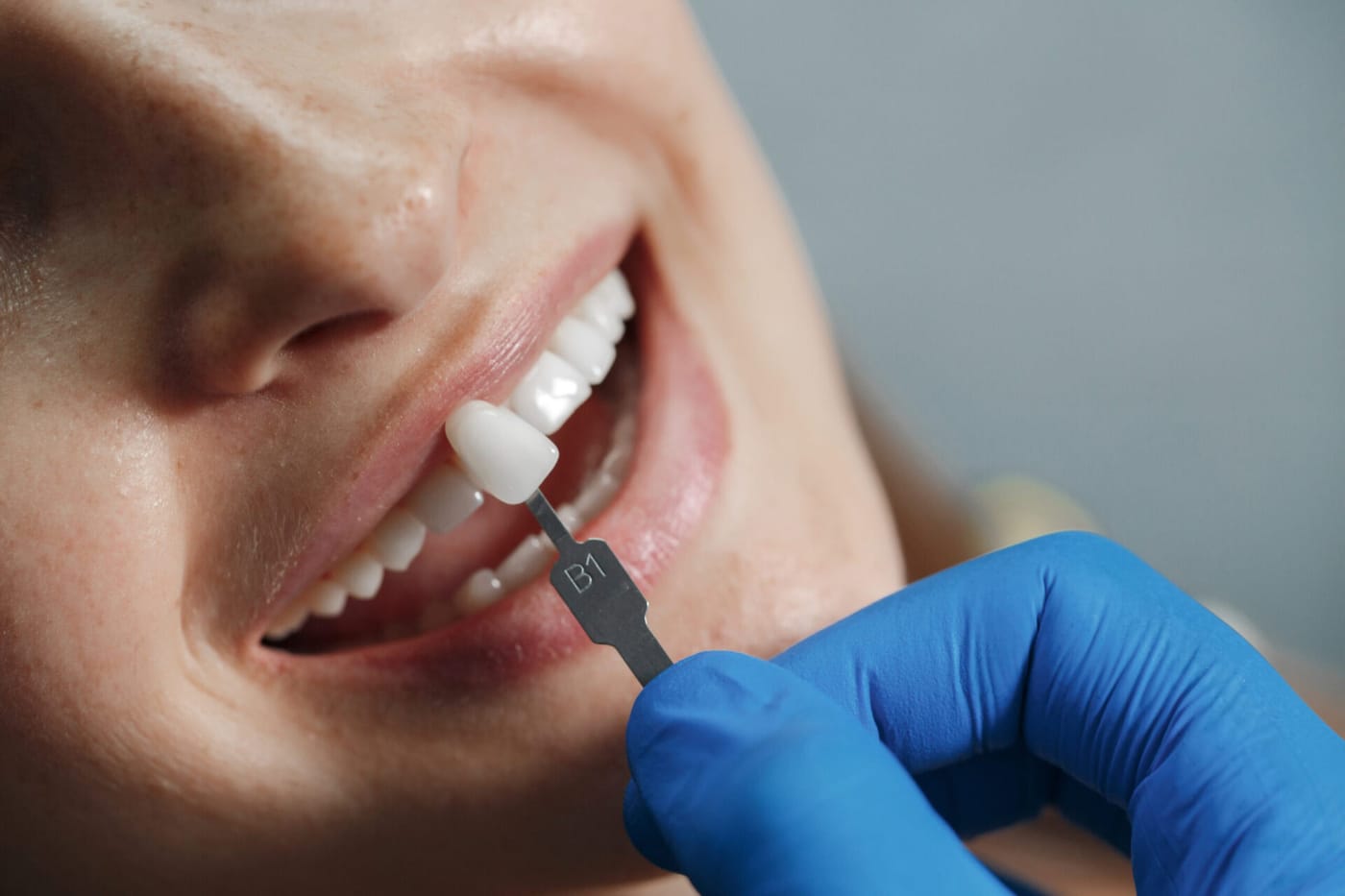
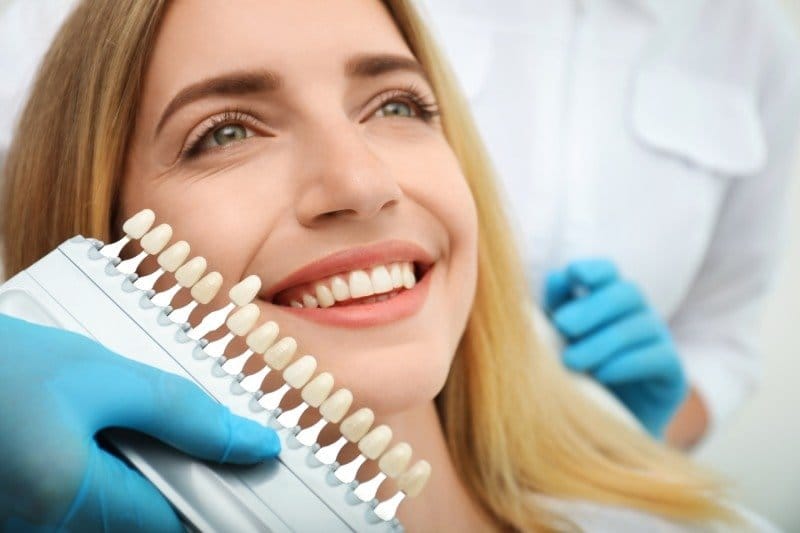
Photographs taken during the shade appointment, in daylight and under clinic lighting, give the ceramist the information needed to match the crown to your own teeth.
The Gum Line and the Absence of Metal
One of the most practical reasons to choose zirconia for a front tooth is that a receding gum cannot reveal a grey line at the margin.
Porcelain-fused-to-metal crowns carry a metal alloy substructure beneath the porcelain. As gum tissue recedes over the years, which becomes more common with age, the metal edge of such a crown can show as a dark or grey line at the gum. On a front tooth this is highly visible and hard to hide, and correcting it usually means replacing the crown.
Zirconia contains no metal and is uniformly white through its thickness. Even as the gum changes over the years, there is no metal to emerge at the margin, so the colour at the edge of the crown does not change when the gum level moves. For patients having front crowns placed in their thirties or forties, who can expect the crown to stay in place for many years, this matters a great deal.
The same meta-analysis found that metal-ceramic crowns behaved differently in anterior and posterior positions, which was not the case for most all-ceramic materials (PubMed 41489982).
Biocompatibility adds to this. Zirconium dioxide does not release metal ions, and there is no risk of the galvanic reactions that can occur between different metals in the mouth. In patients sensitive to metal, alloy substructures can contribute to local tissue reactions or discolouration of the gum next to the margin, and a metal-free crown removes that source. A well-fitted margin and good daily cleaning remain the conditions for healthy gums around any crown, whatever it is made of.
Gum Health Before and Around Anterior Crowns
The front teeth are where gum health and crown appearance meet most visibly. Healthy, pink, well-contoured gum tissue around an anterior crown is as important to the final result as the crown itself, and inflamed or uneven gums undo the work of even a well-made restoration.
This matters most in a smile makeover, where several front crowns are placed side by side. The margins of all the crowns sit along one visible line, so consistent gum health across every margin is needed for a unified, natural-looking result. One swollen or receding area stands out against the rest.
Before any crown placement, Mosdent's periodontology team assesses gum health to make sure the tissue can support a lasting result. Active gum disease is treated first. Crowns placed on inflamed gums sit at a gum line that shifts once the inflammation settles, and the margins may then become visible. Bleeding gums also make accurate scanning of the prepared teeth harder, which affects the fit.
Where the gum line itself is uneven, for instance where one front tooth looks longer than its neighbour or the gums cover too much of the teeth, pink dental aesthetics procedures can reshape it to frame the restorations correctly. Gum contouring is done before the final crowns are made, so that the crowns can be shaped to the new gum line and do not need to be remade later.
After the crowns are fitted, daily cleaning at the margins and regular professional check-ups keep the gums stable.
Survival and Chipping Data for Crown Materials
Five-year survival is the figure with the widest evidence for crowns, and it is close across the main materials. A meta-analysis of 64 studies covering 3,509 metal-ceramic and 8,051 all-ceramic single crowns reported five-year survival of 96.8% for monolithic densely-sintered zirconia, 97.3% for veneered densely-sintered zirconia, 97.1% for metal-ceramic and 98.5% for monolithic lithium-disilicate crowns (PubMed 41489982). The authors concluded that lithium-disilicate and zirconia-based all-ceramic crowns achieve five-year survival comparable to metal-ceramic crowns (PubMed 41489982).
Chipping is where design matters more than material. In the same analysis, monolithic lithium-disilicate and monolithic zirconia crowns showed significantly fewer ceramic fractures and chipping than veneered alternatives (PubMed 41489982). In a veneered crown, a layer of porcelain is fired onto the zirconia core, and that layer is the weak point. A monolithic crown is milled as one piece, so there is no separate layer to chip away. On front teeth, a veneered design is sometimes chosen for its layered appearance, and in that case the chipping risk is part of the decision.
Beyond five years the evidence thins. For monolithic zirconia made with CAD/CAM technology, a review of nine studies with 594 participants and 1,657 single-tooth restorations reported survival between 91% and 100%, with a mean exposure time of only 1.07 years (PubMed 34615842). Marginal integrity was high in most of those studies, except for one that included patients with bruxism, where the survival rate was 31.60% (PubMed 34615842).
These figures describe groups of patients. For an individual crown, the bite, oral hygiene and whether grinding is controlled have as much effect on lifespan as the material. A crown on a tooth that is cleaned well, checked regularly and protected from night-time grinding is likely to last longer than one that is not.
Strength, Bite and Grinding
A common concern about ceramic crowns on front teeth is fragility, particularly under edge-to-edge biting or in patients who grind their teeth. This concern applied to older and weaker all-ceramic systems, and it still applies in part to the most translucent grades of zirconia.
Even high-translucency zirconia keeps a fracture toughness above that of traditional feldspathic porcelain and earlier glass-ceramics. Biting forces on front teeth are lower than on molars, so this strength usually gives a comfortable margin against chipping and fracture during normal function. The feldspathic ceramic group, by comparison, had the lowest five-year survival of the crown materials in the meta-analysis, at 90.4% (PubMed 41489982).
The bite itself shapes the choice. A deep overbite, where the lower front teeth strike the back of the upper ones, or an edge-to-edge bite places more load on the incisal edge of a front crown. In these cases a stronger grade of zirconia, a monolithic design or a slightly thicker crown may be chosen, and the bite is checked carefully when the crown is fitted so that no single tooth takes an unusual load.
Grinding is the main mechanical risk outside normal function. For patients with bruxism, a custom night guard is recommended alongside the crowns to protect them from night-time loading. The guard is made after the final crowns are fitted so that it matches them. Many people who grind do not know it, and signs such as worn edges on other teeth, morning jaw tiredness or a partner hearing grinding at night are worth mentioning at the consultation.
Digital Design and Fit at the Margin
At Mosdent, every zirconium crown is designed digitally and milled from a zirconia block using CAD/CAM technology. The prepared tooth is scanned, the crown is designed in three dimensions on screen, and the milling machine cuts it from the block according to that design. The fit between the crown and the prepared tooth is controlled at the design stage and checked at try-in.
On front teeth, the margin of the crown is often placed at or slightly below the gum line so that the join cannot be seen. That position makes the fit more important. A close fit at the margin leaves less room for bacterial plaque to collect, which supports gum health at the edge of the crown and lowers the risk of new decay forming beneath it. A poor margin, by contrast, traps plaque in an area that is hard to clean and sits right where the gum is most visible.
Digital scanning also replaces traditional impression material for most patients, which many find more comfortable. The scan can be checked on screen immediately, and if an area has not been captured well it can be rescanned at once, without taking a new impression.
Several steps besides milling decide the fit. The quality of the tooth preparation, the accuracy of the scan, the design of the margin and the cementation all contribute, and the crown is checked with instruments and, where needed, with an x-ray before it is fixed permanently.
Once the crown is cemented, the margin is maintained by daily brushing and cleaning between the teeth, and checked at regular dental visits.
Colour Stability with Coffee, Tea and Acidic Drinks
A glazed zirconia surface does not absorb pigment the way composite resin does, and laboratory studies give a more exact picture than the common claim that zirconia never stains.
In one in vitro study, 80 specimens of polymer-infiltrated ceramic and extra translucent multilayer zirconia were immersed in coffee, tea, cola or distilled water for 28 days (PubMed 39364838). Staining beverages changed the colour of the polymer-infiltrated ceramic more than the zirconia; after 28 days in tea, the colour change measured 8.06 for the polymer-infiltrated ceramic and 3.0 for the zirconia (PubMed 39364838).
A second study tested CAD/CAM zirconia in an acidic drink and then in coffee. One week of immersion in the acidic drink did not cause a perceivable discoloration for any of the materials, but subsequent immersion in coffee affected the colour stability of all the zirconia samples, and the change varied between products (PubMed 29302281).
Taken together, zirconia resists staining and changes less than some other tooth-coloured materials, but it is not immune, and coffee still produces a measurable shift. Tea and coffee drinkers can expect a zirconia crown to hold its colour well with normal brushing and professional cleaning.
This also affects the order of treatment. A crown keeps the shade it was made in and will not lighten later, while natural teeth can be whitened. If you want lighter teeth overall, whitening is done first, the new shade is allowed to settle, and the crown is then matched to it. Whitening the natural teeth after the crown is fitted leaves the crown darker than its neighbours.
Choosing Between Zirconia and Emax
The main alternative to zirconia on front teeth is Emax (lithium disilicate glass-ceramic). Both perform well, and the choice is made per tooth.
Lithium disilicate has excellent optical properties. It transmits and scatters light in a way that some ceramists and patients prefer where maximum translucency is the goal, and in skilled hands it produces very lifelike front restorations. Its survival data are strong. In the 64-study meta-analysis, monolithic lithium disilicate reached 98.5% five-year survival against 96.8% for monolithic zirconia, and the survival of several other ceramics was significantly lower than that of monolithic lithium disilicate (PubMed 41489982). The same analysis found that most material types, lithium disilicate included, performed similarly in front and back teeth (PubMed 41489982).
Zirconia has higher fracture resistance and is more versatile. It suits patients with a heavy or edge-to-edge bite, patients who grind, bridges that span a gap and teeth where a dark core needs to be masked. Lithium disilicate is often preferred for a single front crown on a light, healthy-coloured tooth in a patient with a normal bite, and it is the usual material for thin veneers on healthy teeth.
In combination treatments, where some teeth receive crowns and others veneers, the laboratory coordinates the shades of both materials so that the finished smile reads as one. At Mosdent, the choice between zirconium and Emax for an anterior crown is made case by case, based on the bite, the colour of the prepared tooth, the neighbouring teeth and the aesthetic goal. In some cases, Emax veneers are recommended on healthy teeth alongside zirconium crowns on damaged teeth within the same smile design.
Crowns and Veneers in a Smile Design
In most smile design cases at Mosdent, the final result combines several types of restoration. Zirconium crowns are placed on teeth that need full coverage: root canal treated teeth, severely damaged teeth or teeth with large existing fillings. Porcelain veneers or laminate veneers are used on healthy teeth that need only a change to their front surface.
This mix preserves tooth structure. A crown requires preparation of the whole tooth, while a veneer needs only a thin layer of enamel removed from the front, or in some cases very little. Using crowns only where the tooth needs them keeps healthy teeth as intact as possible.
The key to a natural result in these combination cases is shade coordination between the zirconia crowns, the veneers and any natural teeth left untreated. Each unit is given shade gradients and surface characterisation so that the crowns sit within the overall smile without drawing attention.
For patients considering a complete Hollywood smile, the treatment plan sets out which teeth receive crowns, which receive veneers and whether other procedures are included. These can be teeth whitening of the remaining natural teeth, gum contouring or an implant restoration where a tooth is missing. An implant crown in the front of the mouth is often made in zirconia as well, so that it matches the neighbouring crowns.
Seeing the plan written tooth by tooth makes it easier to understand what will be done and why, and to ask about any tooth where a less invasive option might be possible.
Treatment Steps and Deciding on Your Front Crown
Treatment follows a clear sequence. It begins with consultation and digital planning, where photographs, shade assessment and digital smile design create a visual preview of the expected result before any treatment starts. The tooth is then shaped under local anaesthesia to make room for the crown, conservatively and according to the planned thickness, and a temporary crown protects it.
Next, a digital scan records the prepared tooth. The crown is designed in three dimensions, with shade gradients and surface texture specified for the ceramist, then milled from a high-translucency zirconia block and finished and characterised to match the neighbouring teeth. At the fitting appointment, the crown is tried in, adjusted if needed and permanently bonded. The result is checked in natural light and from several angles, and the bite is checked as you close and move the jaw.
Most single anterior crown cases can be completed within a 5 to 7 day visit to Istanbul, which suits international patients combining dental care with travel.
The decision for your own tooth rests on a few questions. How much of the tooth is left and whether it has had root canal treatment. How dark the tooth underneath is. How your bite meets and whether you grind. How translucent your neighbouring teeth are. Whether other teeth need crowns or veneers at the same time. The answers point toward zirconia, lithium disilicate or a combination.
If you are considering a zirconium dental crown for a front tooth, you can read about Mosdent's aesthetic dentistry services or contact our team to arrange a consultation and a treatment plan for your case.
Let’s plan the right treatment together.
Free Assessment→- 1.Pjetursson BE, Pitta J, Balet A, Bjarnadottir GR, Sailer I, Romandini P. A Systematic Review and Meta-analysis Evaluating the Survival, Failure, and Complication Rates of Metal-Ceramic, Veneered, and Monolithic All-Ceramic Tooth-Supported Single Crowns-Part 1. Int J Prosthodont 2026;39:308-324. PubMed 41489982
- 2.Leitão CIMB, Fernandes GVO, Azevedo LPP, Araújo FM, Donato H, Correia ARM. Clinical performance of monolithic CAD/CAM tooth-supported zirconia restorations: systematic review and meta-analysis. J Prosthodont Res 2022;66:374-384. PubMed 34615842
- 3.Abdelhafez MHA, Abu-Eittah MRH. Effect of Common Staining Beverages on Color Stability of Polymer-infiltrated Ceramics and Extra Translucent Zirconia: An In Vitro Study. J Contemp Dent Pract 2024;25:411-416. PubMed 39364838
- 4.Colombo M, Cavallo M, Miegge M, Dagna A, Beltrami R, Chiesa M, et al. Color stability of CAD/CAM Zirconia ceramics following exposure to acidic and staining drinks. J Clin Exp Dent 2017;9:e1297-e1303. PubMed 29302281