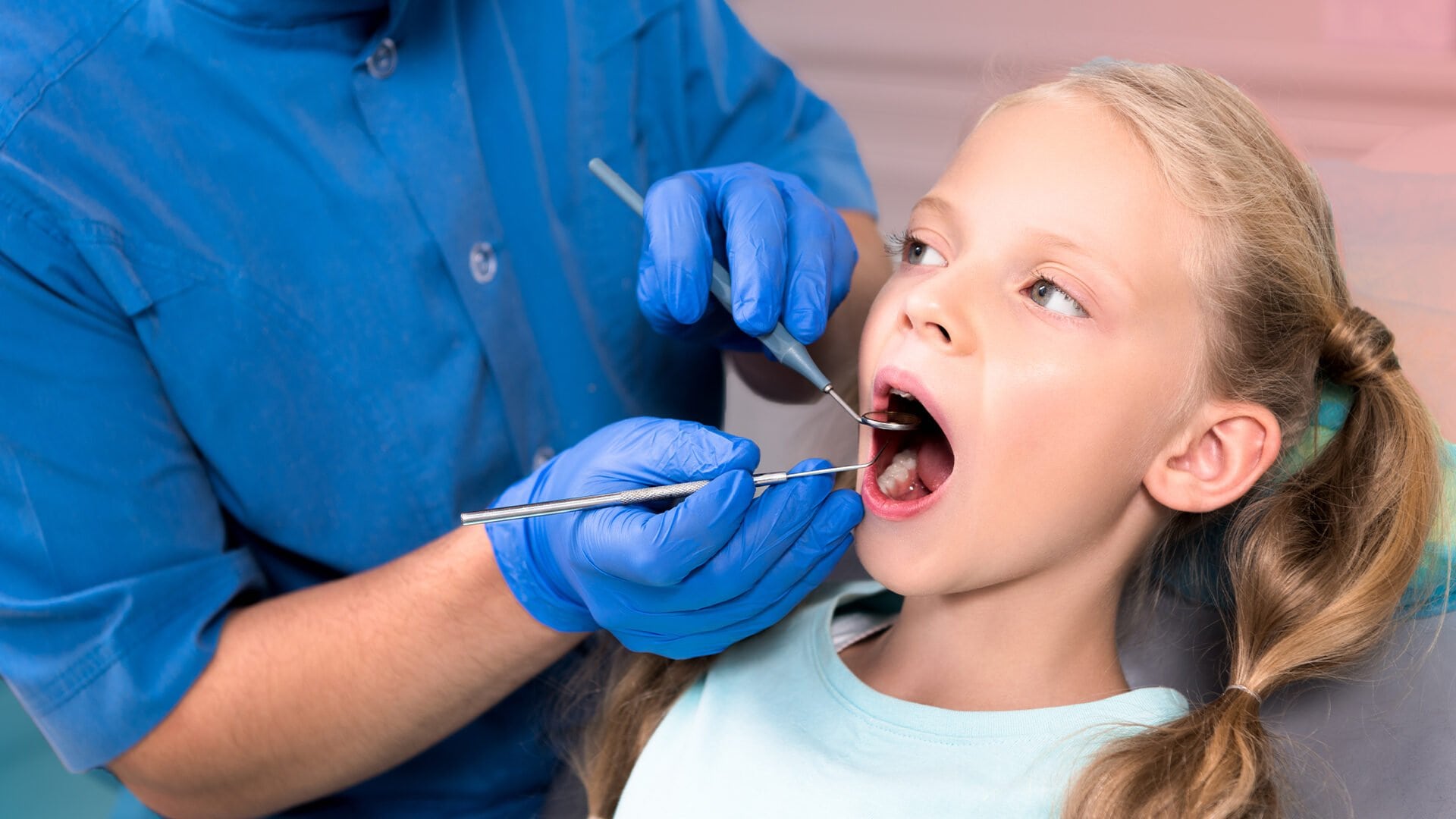
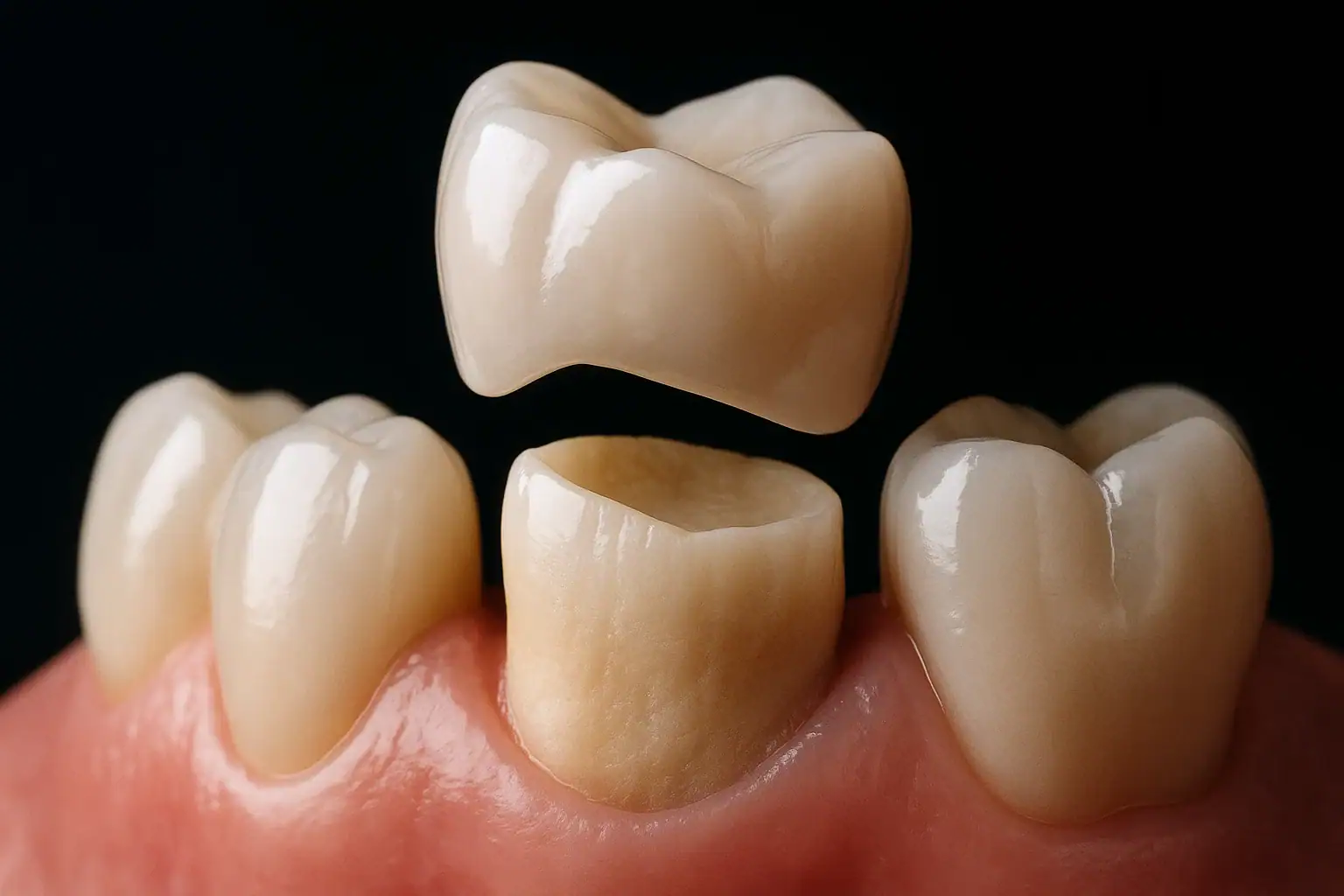
A porcelain crown is a tooth-shaped ceramic restoration that covers the entire visible part of a badly decayed, cracked or root canal treated tooth, and it is also used over implants and as a bridge abutment. How long one serves depends on hygiene at the margins, bite forces and gum health. In a meta-analysis of 64 studies reporting on 3,509 metal-ceramic and 8,051 all-ceramic single crowns, five-year survival was 98.5 percent for monolithic lithium disilicate, 97.1 percent for metal-ceramic and 96.8 percent for monolithic zirconia (PubMed 41489982). Crowns do not cause bad breath by themselves; rough or poorly sealed margins do.
- 01Material decides the trade-off: lithium disilicate and feldspathic porcelain lead on aesthetics, zirconia on strength for molars and grinders, and porcelain fused to metal on reliability at the cost of a dark line that can appear at the gum.
- 02Five-year survival of tooth-supported single crowns was 98.5 percent for monolithic lithium disilicate, 97.1 percent for metal-ceramic and 96.8 percent for monolithic zirconia across 64 studies (PubMed 41489982).
- 03No lifespan figure is measured beyond the five-year survival data; how long a crown serves after that depends on hygiene at the margins, bite forces and gum health.
- 04The crown itself cannot decay, but the tooth underneath it can, which is why the margin is the part that gets flossed daily and checked at every recall.
- 05Halitosis means chronic bad breath beyond normal morning odour; crowns contribute only when margins are rough, poorly sealed or neglected, and periodontitis carries about 1.8 times the risk of measurable oral malodour (PubMed 33661974).
/ Porcelain crown cost overview
At Mosdent in Istanbul, a single crown runs from €170 to €310 per tooth, and what moves it is the material: monolithic zirconia sits at the lower end, lithium disilicate (E-max) at the upper. That is a starting price, not a quote: the figure that applies to you is written down after a free examination.
A porcelain crown (also known as a ceramic crown or dental cap) is a restorative dental solution used to protect, strengthen, and beautify teeth that have been significantly damaged by decay, fractures, or large fillings. Porcelain crowns are also widely chosen for their excellent aesthetics, closely mimicking natural enamel.
However, one concern that often arises with crowns is their connection to halitosis (bad breath). While crowns themselves do not inherently cause odor, poorly fitting crowns, gum disease, or inadequate oral hygiene around them can contribute to halitosis. This makes understanding both crowns and bad breath management critical for long-term oral health.
What Is a Porcelain Crown?
A porcelain crown is a tooth-shaped restoration that covers the entire visible portion of a tooth. It restores function and appearance when a tooth is:
- Severely decayed
- Cracked or fractured
- Treated with a root canal
- Discolored or misshapen
- Serving as an implant crown or bridge abutment
Key benefits:
- Highly aesthetic and natural-looking
- Strong and durable with good care
- Restores chewing efficiency
- Protects weakened teeth from further damage
Historical Evolution of Porcelain Crowns
- 1900s: Porcelain jacket crowns were introduced, beautiful but fragile.
- Mid-20th century: Porcelain fused to metal crowns (PFM) improved strength.
- Late 20th century: New ceramics (lithium disilicate, zirconia) combined beauty with durability.
- Today: Digital CAD/CAM technology allows same-day all-porcelain crowns.
/ Porcelain crown types and procedure
Types of Porcelain Crowns
- All-Ceramic / All-Porcelain
- Best for aesthetics, especially in the front.
- Examples: lithium disilicate (e.max), feldspathic porcelain.
- Zirconia Crowns
- Extremely strong, suitable for molars or patients who grind their teeth.
- Modern translucent zirconias balance strength with beauty.
- Porcelain Fused to Metal (PFM) Crowns
- Reliable and strong.
- Downside: may show a dark line at the gum over time.
The Porcelain Crown Procedure
- Evaluation and planning – Exams, scans, and discussion of material and cost.
- Tooth preparation – Shaping and removing decay under anesthesia.
- Impression or digital scan – Captures details for the lab.
- Temporary crown – Protects the tooth until final placement.
- Final crown try-in – Checks fit, bite, and aesthetics.
- Permanent cementation – Crown is bonded securely.
- Follow-up – Dentist ensures comfort and function.
How Much Does a Porcelain Crown Cost?
Factors Affecting Cost
- Material (zirconia, e.max, PFM)
- Tooth location
- Dentist expertise and lab quality
- Imaging, temporaries, and aftercare
- Insurance coverage
Cost with Insurance
If medically necessary (e.g., due to decay or fracture), insurance may cover a percentage after deductibles, up to your annual maximum. Cosmetic-only crowns often have limited coverage.
Global Price Variation
- United States: Higher range, especially cosmetic specialists.
- Europe: Moderate pricing, widespread zirconia use.
- Turkey / Eastern Europe: Competitive dental tourism destinations.
- Asia: Affordable with quality care in countries like India and Thailand.
/ Porcelain crown longevity and care
Longevity: How Long Do Porcelain Crowns Last?
- Five-year survival (monolithic): 98.5 percent lithium disilicate, 96.8 percent zirconia; metal-ceramic 97.1 percent (PubMed 41489982)
- Beyond five years, data are sparse
Factors that affect longevity:
- Oral hygiene at margins
- Bite forces (grinding shortens lifespan)
- Material choice (zirconia strongest)
- Diet and habits (avoid chewing ice, pens)
- Gum health (recession exposes crown edges)
Maintenance and Care
- Brush twice daily with fluoride toothpaste.
- Floss or use interdental brushes around crown margins.
- Use alcohol-free rinses if prone to dry mouth.
- Regular dental cleanings (every 6 months).
- Nightguards for bruxism.
- Avoid habits like biting pens or opening packages with teeth.
Myths About Porcelain Crowns
- “Crowns last forever.” → They last long but not forever.
- “Crowns don’t get cavities.” → The crown itself doesn’t, but the tooth under it can.
- “Crowns always break.” → Modern ceramics are very durable.
- “Crowns cause halitosis.” → Only if poorly fitted or neglected.
Porcelain Crowns and Halitosis
Halitosis Meaning
Halitosis = chronic bad breath beyond normal morning odor.
Halitosis Causes
- Oral: tongue coating, gum disease, food traps, dry mouth.
- Crown-related: poor fit, rough margins, plaque buildup.
- Extra-oral: sinus infections, reflux, systemic conditions.
How Crowns Can Contribute to Halitosis
- Poorly sealed or rough crown edges trap bacteria.
- Gum inflammation around crowns encourages odor.
- Neglected cleaning leads to plaque buildup and halitosis breath .
How to Remove, Eliminate, Prevent, and Stop Halitosis
- Immediate fixes: Brush, floss, scrape tongue, rinse with antibacterial mouthwash, hydrate.
- Long-term elimination: Fix or replace poorly fitting crowns, treat gum disease.
- Prevention: Daily oral hygiene, professional cleanings, water flossers.
- Stopping halitosis permanently: Address oral AND systemic causes (ENT, reflux, diabetes).
Extra Lifestyle Tips for Crown Success and Fresh Breath
- Quit smoking (reduces staining and odor).
- Drink plenty of water (saliva neutralizes bacteria).
- Limit alcohol (prevents dry mouth).
- Eat crunchy fruits and vegetables to naturally clean teeth.
Red Flags to Watch For
- Persistent bad breath despite hygiene
- Food trapping around crown edges
- Pain when biting
- Red, swollen gums near the crown
These may signal a crown fit issue, gum disease, or the need for replacement.
/ FAQs
How much is a porcelain crown?
Costs vary by material, region, and insurance, request a written estimate.
How much does a porcelain crown cost with insurance?
Insurance may cover part if medically necessary. Pre-authorization is recommended.
How long do porcelain crowns last?
Five-year survival was 98.5 percent for monolithic lithium disilicate, 97.1 percent for metal-ceramic and 96.8 percent for monolithic zirconia across 64 studies (PubMed 41489982).
What is a porcelain fused to metal crown?
A crown with a metal base covered by porcelain; strong but less aesthetic than all-ceramic.
What is halitosis?
The medical term for chronic bad breath, usually caused by bacteria.
How to remove halitosis?
Brush, floss, tongue clean, rinse, hydrate, and get professional cleaning.
Conclusion
Porcelain crowns are an essential dental solution that combine function, durability, and aesthetics . While the cost of a porcelain dental crown varies worldwide, investing in quality materials and skilled dentistry pays off with a long-lasting result.
As for halitosis, crowns are not the enemy; poor hygiene and ill-fitting restorations are. With daily oral care, professional maintenance, and early treatment of gum disease, you can keep both your crowns and your breath fresh .
Let’s plan the right treatment together.
Free Assessment→- 1.Pjetursson BE, Pitta J, Balet A, Bjarnadottir GR, Sailer I, Romandini P. A Systematic Review and Meta-analysis Evaluating the Survival, Failure, and Complication Rates of Metal-Ceramic, Veneered, and Monolithic All-Ceramic Tooth-Supported Single Crowns-Part 1. Int J Prosthodont 2026;39:308-324. PubMed 41489982
- 2.Song Y, Ahn YB, Shin MS, Brennan D, Kim HD. Association of periodontitis with oral malodor in Korean adults. PLoS One 2021;16:e0247947. PubMed 33661974