A wisdom tooth extraction site heals on two clocks: the gum closes over the socket in roughly two to three weeks, while the bone underneath keeps remodelling for three to six months. The blood clot that forms in the first hours is what protects the bone and nerve endings, and losing it produces dry socket. In a daily diary study completed by 201 of 249 enrolled patients, the curve was clear: on day 1, 63.5 per cent rated their worst pain severe and 85 per cent had trouble chewing; by day 6 chewing trouble was down to 19 per cent, and swelling fell from 61 per cent on day 2 to 10 per cent by day 5 (PubMed 10555792).
- 01Soft tissue closes in about two to three weeks; full bone remodelling of the socket runs three to six months, which is why the site can feel normal long before it is structurally finished.
- 02The first week carries most of the discomfort: worst pain was rated severe by 63.5 per cent of the 201 patients who completed the diary on day 1 and by 15 per cent on day 7 (PubMed 10555792).
- 03Swelling peaks on day 2 at 61 per cent of patients and drops to 10 per cent by day 5, with most people back to a normal routine around day 5 (PubMed 10555792).
- 04How hard the surgery was predicts how long recovery takes: operations lasting 30 minutes or more, and teeth sitting entirely below the occlusal plane, prolonged it, while age did not (PubMed 10555792).
- 05Chlorhexidine gel reduced alveolar osteitis across 10 trials with 862 participants (RR 0.43), but a later scoping review of 63 studies favours saline irrigation instead because of anaphylaxis risk and finds no support for routine prophylactic antibiotics (PubMed 28526078, PubMed 34625985).
What Wisdom Tooth Extraction Involves
Wisdom tooth extraction is the removal of one or more third molars, the last teeth at the back of the mouth. These teeth erupt late, when the jaw may no longer have room for them. As a result they can become impacted, meaning trapped under the gum or bone, or they can grow at an angle toward the neighbouring tooth.
Extraction is usually recommended when a wisdom tooth is impacted, when it is pushing against the tooth in front, when there is not enough space in the jaw, when it causes pain, infection or damage to nearby teeth, or when a cyst forms around it. A tooth that has erupted fully, sits straight and can be cleaned well may simply be monitored.
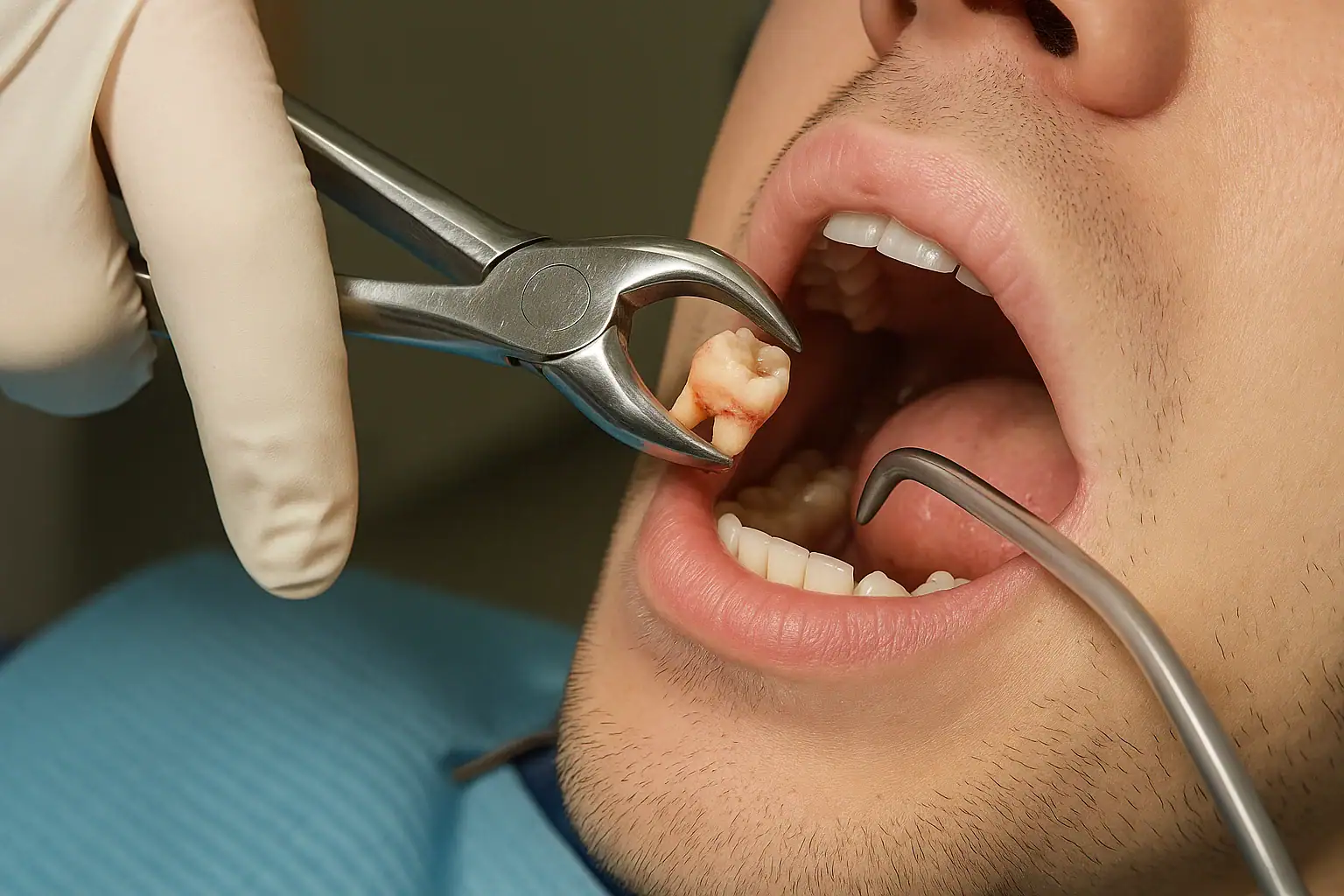
How the tooth comes out shapes how the site heals. A simple extraction is possible when the tooth has fully erupted; it is lifted out without cutting, and healing is usually quicker with less discomfort. A surgical extraction is needed when the tooth is impacted or sits below the gum line. The surgeon opens the gum, may remove a small amount of bone and sometimes divides the tooth into pieces. That approach means a longer healing time and more attention to aftercare.
Healing runs on two clocks. The gum closes over the socket in roughly two to three weeks, while the bone underneath keeps remodelling for three to six months. The site can therefore feel normal long before it is structurally finished, and recovery varies from person to person.
The First Day and the Blood Clot
Within the first hours after surgery a blood clot forms in the empty socket. This clot is the foundation of healing, because it covers the bone and nerve endings and becomes the framework on which new tissue grows. If it is dislodged or dissolves too early, the bone is left exposed and a painful condition called dry socket, or alveolar osteitis, can develop.
During the first 24 hours some bleeding and swelling are expected. Biting gently on gauze helps the clot settle, and pain can be managed with the medication the surgeon prescribes. Ice packs applied to the cheek in short intervals reduce swelling, and a soft, cool diet keeps pressure off the site. Rest with the head raised, and avoid rinsing, spitting and drinking through a straw, since each of these creates suction or pressure that can pull the clot loose.
Serious complications are uncommon. A far rarer one is a fracture of the lower jaw during or weeks after removal. A survey of surgeons in northern France recorded 37 such fractures in about 750,000 extractions, and 8 of the 10 late fractures occurred in men (PubMed 11815913). The risk of jaw fractures is one reason surgeons plan impacted lower wisdom tooth extractions with imaging. For most patients the first day is simply the start of a steady, predictable recovery.
Healing Stage by Stage
Healing after a wisdom tooth extraction follows a recognisable sequence. In the first 24 hours the blood clot forms, there is minor bleeding and swelling, and soft food with minimal activity is advised. On days 2 and 3 swelling reaches its peak and then begins to subside; discomfort continues but is usually manageable, and the clot stays in place.
From day 4 to day 7 new tissue starts to grow over the socket, the risk of infection falls and stitches, if used, dissolve or are removed. Many people return to their usual routine during this period, although chewing on that side still feels awkward.
In weeks 2 and 3 most of the discomfort fades. The gum grows over the socket and begins to close it, and the bone underneath starts remodelling. Food may still collect in the healing area, so gentle rinsing after meals remains useful.
After the third week the jawbone gradually fills and firms up. Complete bone healing can take several months, and in general terms the initial recovery takes 3 to 7 days, gum tissue closes in 2 to 3 weeks and full bone healing runs 3 to 6 months. Over this period the site slowly becomes indistinguishable from the surrounding gum. Surgical extractions usually sit at the longer end of these ranges.
The Recovery Curve in Numbers
Patient diaries give a clear picture of what the first two weeks feel like. In a prospective study, 249 patients recorded their symptoms every day for 14 days after third molar surgery, and 201 returned a completed diary (PubMed 10555792). On day 1, 63.5% rated their worst pain as severe, and by day 7 only 15% did (PubMed 10555792). Average pain was lower than worst pain throughout the period.
Oral function recovers more slowly than pain. On day 1, 85% of patients reported difficulty chewing and 78.5% difficulty opening the mouth, and by day 6 these figures had fallen to 19% and 15% (PubMed 10555792). Chewing is therefore the function that takes longest to return, which is why a soft diet is advised for the whole first week.
Swelling peaked on day 2 at 61% of patients and fell markedly to 10% by day 5, which was also the day most patients had resumed a more normal lifestyle (PubMed 10555792). Food collecting in the sockets was the most common complaint on day 9, reported by 20% (PubMed 10555792). Taken together, the curve shows most symptoms heading steadily downward through the first week. Pain that follows this downward path is normal. Pain that improves and then suddenly worsens a few days after surgery is the pattern that needs attention.
What a Healing Socket Looks Like
The appearance of the extraction site changes as it heals, and knowing the normal stages prevents unnecessary worry. In the first three days the blood clot is visible as a dark red or almost black plug, and the gum around it may look red and swollen.
Between days 4 and 7 the clot stabilises and a soft white or yellowish layer often forms over it. This is granulation tissue, the early building material of new gum, and it is a normal part of healing that many people mistake for infection. After about two weeks the gum looks pink and much less swollen, and the opening of the socket becomes smaller. After about a month the site blends into the surrounding tissue, although a slight dip may remain for longer while the bone fills in.
Some changes are not part of normal healing. Pus, a foul smell or taste, visible bone in the socket, severe pain that begins or worsens after day 3 and bleeding that does not stop with pressure are warning signs. A socket that looks empty, with greyish bone visible instead of a dark clot, together with pain spreading toward the ear or temple, is the typical picture of dry socket. These signs call for a phone call to the clinic, and they are usually easier to manage when caught early.
Factors That Change Healing Time
Several factors affect how quickly a wisdom tooth socket heals. In the diary study, the difficulty of the surgery predicted how long recovery took. Age did not predict a longer recovery, but surgery lasting 30 minutes or more and having all third molars below the occlusal plane did prolong it, and women reported a longer recovery period than men (PubMed 10555792).
Smoking affects both healing and complications. Across eleven studies in a systematic review, smokers had more than three times the odds of dry socket, with a combined incidence of about 13.2% in smokers against 3.8% in non-smokers (PubMed 35877395). Avoiding tobacco and vaping for the first days protects the clot.
General health plays a part. Chronic illnesses and a weakened immune response can slow recovery, and good oral hygiene lowers the risk of infection. Health includes the medicines you take. In a prospective study of women taking bisphosphonates for osteoporosis, bone filling of the socket and gum closure after a single extraction were similar to those of women on other osteoporosis treatments, without stopping the bisphosphonate (PubMed 32404281). Tell your surgeon about every medicine you take, including bone medications and blood thinners, so that the procedure and aftercare can be planned around them.
Care at Home in the First Week
Aftercare protects the healing process more than it speeds it up. Keep the clot in place by avoiding spitting, straws and smoking. Apply ice packs in the first 24 hours to limit swelling, sleep with the head raised and rest for the first day or two. Take the prescribed medication as directed, and avoid brushing directly on the extraction site for the first days while cleaning the rest of the mouth as usual.
A soft diet helps through the first week. Mashed potatoes, smoothies eaten with a spoon, soups that have cooled, yogurt, scrambled eggs and applesauce are easy choices. Crunchy or hard foods, spicy dishes, very hot drinks, acidic foods and alcohol should wait until the site has settled. After upper wisdom tooth removal, avoid blowing your nose forcefully, because pressure can reach the socket through the sinus.
Gentle saltwater rinses can start after the first 24 hours, especially after meals. Use antiseptic mouthwash only if it has been prescribed. Chlorhexidine gel reduced dry socket across 10 trials with 862 participants, with a relative risk of 0.43 (PubMed 28526078). A later scoping review of 63 studies recommended saline over chlorhexidine as the irrigant inside the socket because of the risk of a severe allergic reaction, and found no support for routine preventive antibiotics (PubMed 34625985). Stay well hydrated throughout recovery.
Complications and When to Call the Clinic
Most recoveries follow the steady downward curve described above, but a few complications are worth recognising. Dry socket shows itself by timing. Pain that was improving suddenly gets worse a few days after surgery, often spreading toward the ear, together with a bad taste or smell and a socket with visible bone. It is treated in the clinic by cleaning and dressing the socket, and pain usually eases quickly once this is done.
Infection shows as swelling that increases after the first few days instead of settling, pus, a bad taste and fever. Nerve irritation is rare; it shows as numbness or tingling in the lip, chin or tongue that lasts well beyond the local anaesthetic.
Call the clinic if pain worsens after day 3, if swelling increases, if fever develops, if bleeding does not stop with firm pressure on gauze, if a bad smell or pus appears, or if numbness persists. These are deviations from normal healing and they are easier to manage early.
Recovery also affects daily life for a short while. Sleep may be disturbed in the first nights, chewing and talking are limited, and many people plan a few days off work or school. Some feel self-conscious about swelling. These effects fade as the symptoms ease. Healing is a gradual process, and following the aftercare instructions, attending follow-up visits and contacting the clinic with any concern keep it on track.
Let's plan the right treatment together.
Free Assessment→- 1.Conrad SM, Blakey GH, Shugars DA, Marciani RD, Phillips C, White RP Jr. Patients' perception of recovery after third molar surgery. J Oral Maxillofac Surg 1999;57:1288-94; discussion 1295-6. PubMed 10555792
- 2.Teshome A. The efficacy of chlorhexidine gel in the prevention of alveolar osteitis after mandibular third molar extraction: a systematic review and meta-analysis. BMC Oral Health 2017;17:82. PubMed 28526078
- 3.Ghosh A, Aggarwal VR, Moore R. Aetiology, Prevention and Management of Alveolar Osteitis-A Scoping Review. J Oral Rehabil 2022;49:103-113. PubMed 34625985
- 4.Lesclous P, Cloitre A, Catros S, Devoize L, Louvet B, Châtel C, et al. Alendronate or Zoledronic acid do not impair wound healing after tooth extraction in postmenopausal women with osteoporosis. Bone. 2020;137:115412. PubMed 32404281
- 5.Libersa P, Roze D, Cachart T, Libersa JC. Immediate and late mandibular fractures after third molar removal. J Oral Maxillofac Surg. 2002;60(2):163-5; discussion 165-6. PubMed 11815913
- 6.Kuśnierek W, Brzezińska K, Nijakowski K, Surdacka A. Smoking as a Risk Factor for Dry Socket: A Systematic Review. Dent J (Basel) 2022;10. PubMed 35877395