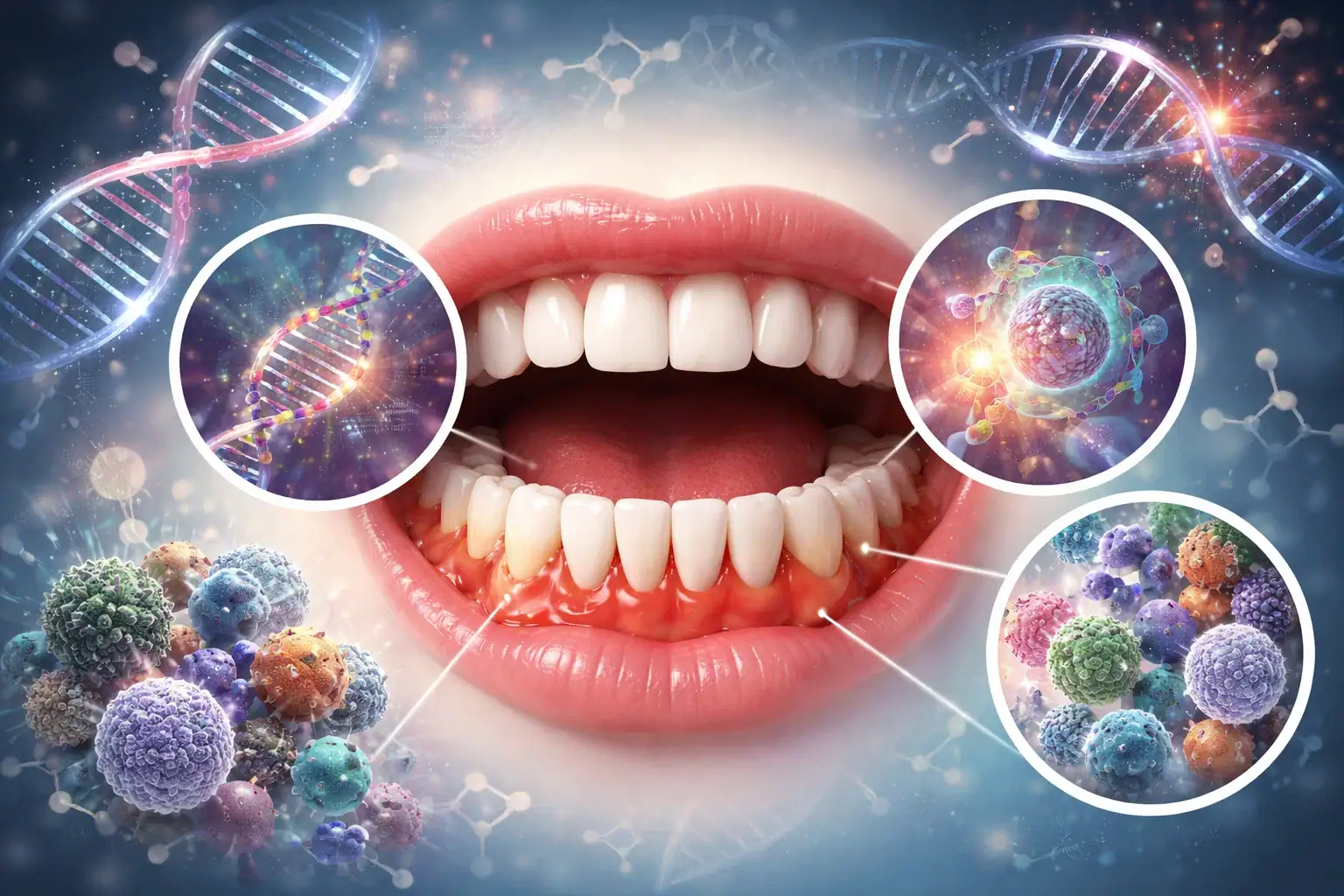
Susceptibility to gum disease is partly inherited, but inheritance sets risk rather than outcome. The measurement comes from twins: across 117 adult twin pairs, 64 monozygotic and 53 dizygotic, adult periodontitis showed approximately 50% heritability, and that estimate did not change after adjustment for smoking and dental attendance, while gingivitis showed no heritability once behaviour was accounted for (PubMed 11128917). What is inherited is the inflammatory response and the tissue biotype, not the plaque, so plaque control and smoking status still decide what actually happens.
- 01Heritability here was measured, not estimated informally: about 50% of the variance in adult periodontitis was attributed to genetic variance across 117 twin pairs (PubMed 11128917).
- 02Gingivitis behaved differently in the same study: identical twins resembled each other, but the resemblance disappeared once smoking and dental attendance entered the model (PubMed 11128917).
- 03The genetic signal runs through inflammation: polymorphisms in IL-1A, IL-1B, IL-6 and IL-10, and in MMP-3 and MMP-9 for the chronic form only, were significantly associated with periodontitis risk across 13 meta-analyses covering 71,531 participants (PubMed 28529526).
- 04Not every candidate gene held up: IL-4, IL-8, IL-18, Fc-gamma receptor, COX-2, MMP-2 and MMP-8 polymorphisms showed no significant association in the same synthesis (PubMed 28529526).
- 05The condition linked to inherited susceptibility is common: severe periodontitis has a global age-standardised prevalence of 11.2% and ranks sixth among prevalent conditions worldwide (PubMed 25261053).
How Much of Gum Disease Is Inherited

Susceptibility to gum disease is partly inherited, and twin studies have measured that share directly. Gum diseases are inflammatory conditions of the tissues that hold the teeth, ranging from mild inflammation of the gum margin to destruction of the gum attachment and the supporting bone.
A study of 117 adult twin pairs, 64 identical and 53 non-identical, examined probing depth, attachment loss, plaque and gingival inflammation on every tooth (PubMed 11128917). Identical twins were more similar than non-identical twins for all clinical measures, and adult periodontitis was estimated to have approximately 50% heritability (PubMed 11128917). That estimate did not change after the analysis was adjusted for behavioural factors, including smoking (PubMed 11128917). The authors concluded that about half of the variance in the disease in the population is attributable to genetic variance, and that the basis of this heritability appears to be biological rather than behavioural.
Heritability describes variation across a population. It does not predict the outcome for one person. Half of the variance being genetic also means that the other half sits elsewhere, in plaque control, smoking, diabetes control and access to care. Inherited risk sets how strongly the tissues react to bacterial plaque, and daily habits and professional care still decide much of what actually happens in the mouth.
Gingivitis and Periodontitis Behave Differently
Gum disease has two stages, and inheritance appears to act mainly on the second. Gingivitis is the early stage, with redness, swelling and bleeding of the gum margin and no loss of the attachment that holds the tooth. It is reversible when the plaque that causes it is removed. Periodontitis is the advanced stage, in which the attachment and the bone around the tooth are gradually destroyed, pockets form between the gum and the tooth, and gum recession can follow. Without treatment it can lead to tooth loss.
The twin study that put periodontitis heritability near 50% found a different pattern for gingivitis. Identical twins were again more alike than non-identical twins, but there was no evidence of heritability for gingivitis once dental care use and smoking were included in the analysis (PubMed 11128917). In practical terms, the stage where intervention works most directly is also the stage driven mainly by behaviour.
The condition linked to inherited susceptibility is common. A global analysis of 72 studies covering 291,170 people in 37 countries found severe periodontitis to be the sixth most prevalent condition in the world, with an age-standardised prevalence of 11.2% (PubMed 25261053). Prevalence rose steeply between the third and fourth decades of life (PubMed 25261053). Periodontitis has also been linked to systemic conditions such as diabetes and cardiovascular disease, which is one more reason to treat it early.
Genes Linked to Periodontitis Risk
The genes associated with periodontitis sit mainly in the pathways that control inflammation and tissue breakdown. A synthesis of 13 meta-analyses covering 25 polymorphisms and 71,531 participants examined variants in interleukins, cell receptors and tissue-degrading enzymes (PubMed 28529526). Polymorphisms in IL-1A, IL-1B, IL-6 and IL-10 were significantly associated with the risk of periodontitis, as were MMP-3 and MMP-9 in the chronic form of the disease (PubMed 28529526). Polymorphisms in IL-4, IL-8, IL-18, the Fc-gamma receptors, COX-2, MMP-2 and MMP-8 showed no significant association (PubMed 28529526).
This pattern matches how inherited risk seems to work. Some people produce a stronger inflammatory response to the same amount of bacterial plaque. In a susceptible person that exaggerated response can mean faster destruction of gum tissue, an earlier onset of periodontitis and more severe recession. Variation in how collagen is built and repaired may also make the tissues slower to heal after inflammation.
The shape of the gum is another inherited trait. People with a thin gum biotype have less tissue covering the root and bone, so they are more prone to recession and root exposure when inflammation, hard brushing or tooth movement puts the tissue under strain. Thin tissue is not a disease, but it lowers the margin for error, and it is part of what a periodontal examination assesses when judging gum health. A clear history of early or severe gum disease in parents or siblings is enough reason to start closer monitoring.
Why Gums Bleed Despite Daily Brushing
Gums bleed because bacterial biofilm stays on the teeth and keeps the tissue inflamed, and brushing alone often leaves some of it behind. Healthy gums do not bleed during brushing or flossing, so regular bleeding is a warning sign. It is often the first visible sign of gingivitis.
A toothbrush does not reach the surfaces between the teeth, and it cannot remove calculus that has already hardened on the tooth below the gum margin. Plaque that remains at the gumline or between the teeth keeps the inflammation going, so bleeding continues even in someone who brushes every day. The bleeding is a response to that biofilm. It is not caused by brushing too often.
Other factors can make bleeding worse or more likely. They include incorrect brushing technique, hormonal changes such as pregnancy, smoking, some vitamin deficiencies and systemic diseases such as diabetes.
A consensus working group on preventing periodontitis supports brushing twice a day for at least 2 minutes with a fluoride toothpaste, and notes that for patients with periodontitis 2 minutes is likely to be insufficient (PubMed 25639826). The same consensus recommends once-daily interdental cleaning for patients with gingivitis and names interdental brushes as the device of choice where they pass between the teeth without trauma (PubMed 25639826). Professionally administered plaque control significantly improved gum inflammation, with some evidence of further benefit from reinforcing oral hygiene (PubMed 25639826).
Gum Recession and Its Causes
Gum recession is the gradual movement of the gum margin away from the tooth, leaving part of the root exposed. It often develops silently and becomes noticeable only when it is already advanced. Typical signs are teeth that look longer, increased sensitivity to cold, visible root surfaces, new spaces between the teeth and tender or bleeding gums.
Recession has several causes, and more than one often acts together. Untreated periodontal disease destroys the attachment and bone beneath the gum. Aggressive brushing with a hard brush wears the tissue away mechanically. A thin gum biotype, which is largely inherited, gives less tissue to lose. Tooth grinding, known as bruxism, places heavy forces on the teeth and their supporting tissues. Orthodontic tooth movement or teeth positioned outside the bone can leave a thin layer of gum over the root.
Receding gums do not grow back on their own. Once gum tissue has been lost, the body does not regenerate it naturally. Three things remain possible. Recession can be stabilised by removing its cause, such as changing brushing technique or treating inflammation. Further tissue loss can be prevented through regular monitoring. Lost tissue can be restored surgically with gum grafting in suitable cases. Recession also does not always mean gum disease, since brushing habits, genetics or tooth position can cause it in an otherwise healthy mouth.
Dark Gums, Inherited Pigment and Nicotine
Dark or patchy gum colour is often inherited and harmless, and only some pigmentation points to a cause that needs attention. Melanin pigmentation of the gums is a normal inherited variation. Some people naturally have darker gums because of a higher melanin concentration in the tissue, in the same way that skin tone varies. This is not a disease, and it needs no treatment unless the patient wants a cosmetic change.
Other causes of dark gums are acquired. Nicotine-related pigmentation is common in smokers, and it may improve after stopping smoking and professional treatment. Chronic inflammation can darken the gum margin. Certain medications can cause pigmentation, and heavy metal exposure is a rare cause.
Telling inherited pigment apart from smoking-related or inflammatory change is a clinical examination finding. A photograph cannot settle it, because colour depends on lighting and because the pattern and texture of the tissue matter as much as the colour itself. The dentist looks at where the pigment sits, whether it is symmetrical, whether the gum is swollen or bleeds, and at the patient's smoking and medication history. A new dark patch that appears suddenly, grows or changes shape should be examined before it is assumed to be inherited.
Examination and Care With a Family History
With a family history of gum disease, the practical response is earlier and closer monitoring. A comprehensive periodontal care evaluation includes a clinical examination of gum colour, texture and bleeding, measurement of periodontal pockets around each tooth, dental X-rays to assess bone levels, a review of family history and general health, and an assessment of how the patient cleans their teeth.
Treatment follows the findings. Professional cleaning removes plaque and calculus above and below the gumline and is the foundation of gum health. Deep periodontal cleaning is a non-surgical therapy that cleans infected root surfaces and reduces inflammation. Localised antimicrobial agents can be used alongside it. Gum grafting surgery restores lost tissue in advanced recession. Risk factor management covers stopping smoking, controlling diabetes, reducing stress and managing bruxism with a night guard.
If gum disease runs in your family, shorter recall intervals, careful brushing and interdental cleaning, attention to early symptoms and avoiding smoking entirely are the levers that remain in your hands. It is worth seeing a periodontist when gum bleeding persists for more than a week, when recession becomes noticeable, when teeth feel loose or sensitive, when bad breath does not improve with cleaning, or when a close relative has had severe gum disease or lost teeth to it.
Let’s plan the right treatment together.
Free Assessment→- 1.Michalowicz BS, Diehl SR, Gunsolley JC, Sparks BS, Brooks CN, Koertge TE, et al. Evidence of a substantial genetic basis for risk of adult periodontitis. J Periodontol 2000;71:1699-707. PubMed 11128917
- 2.da Silva MK, de Carvalho ACG, Alves EHP, da Silva FRP, Pessoa LDS, Vasconcelos DFP. Genetic Factors and the Risk of Periodontitis Development: Findings from a Systematic Review Composed of 13 Studies of Meta-Analysis with 71,531 Participants. Int J Dent 2017;2017:1914073. PubMed 28529526
- 3.Kassebaum NJ, Bernabé E, Dahiya M, Bhandari B, Murray CJ, Marcenes W. Global burden of severe periodontitis in 1990-2010: a systematic review and meta-regression. J Dent Res 2014;93:1045-53. PubMed 25261053
- 4.Chapple IL, Van der Weijden F, Doerfer C, Herrera D, Shapira L, Polak D, et al. Primary prevention of periodontitis: managing gingivitis. J Clin Periodontol 2015;42 Suppl 16:S71-6. PubMed 25639826