A gum graft is periodontal surgery in which tissue, usually from the roof of the mouth, or a processed matrix is stitched over receding gum to cover the exposed root, thicken thin gum or widen the band of firm keratinised gum. The three main types are the free gingival graft, taken with its surface layer, the connective tissue graft, taken from underneath it, and matrices that need no donor tissue. In a Cochrane review of 48 randomised trials, connective tissue grafts gave a slight advantage when root coverage and extra keratinised tissue were both wanted (PubMed 30277568). The surface wound heals in 7-14 days (PubMed 24641001) and palate pain peaks in the first three days (PubMed 41466478).
- 01Across 68 studies of palatal donor sites, pain was most pronounced in the first three days and then eased; bleeding, a burning sensation, altered sensation and changes in eating were the other common complaints (PubMed 41466478).
- 02In a network meta-analysis of 105 randomised trials, every graft material thickened the gum compared with a flap alone, but tissue from your own palate came out ahead in every comparison for thickness and keratinised tissue (PubMed 32392401).
- 03For recession on several neighbouring teeth, a collagen matrix matched a connective tissue graft at 6 months across 10 randomised trials, but by 12 months results and complete root coverage favoured the connective tissue graft (PubMed 37898589).
- 04Left untreated, 78.1% of 1,647 recession sites got deeper during follow-up, even in people with good oral hygiene (PubMed 26878749).
- 05In people smoking 10 or more cigarettes a day, mean root coverage after a connective tissue graft was 22.04 percentage points lower than in non-smokers (PubMed 39138953).
What Is a Gum Graft and When Do You Need One
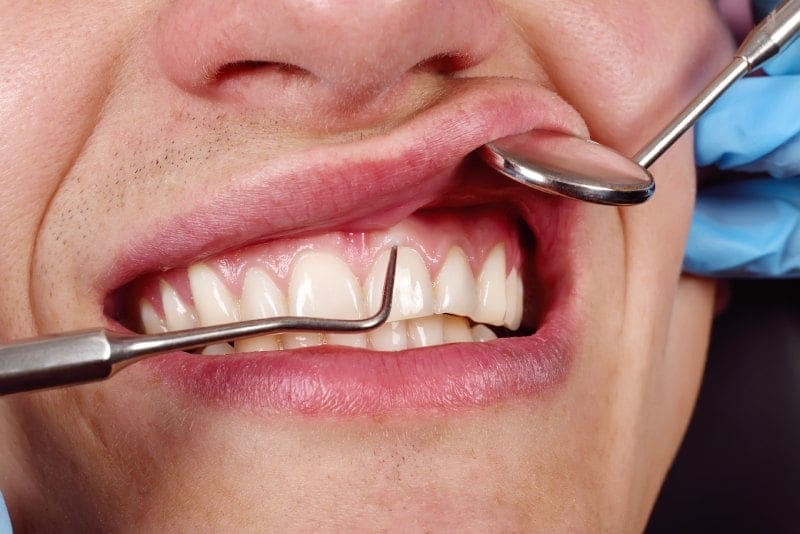
A gum graft is a periodontal procedure in which tissue from inside your mouth, or a processed tissue matrix, is stitched onto an area where the gum has receded, to cover the exposed root, thicken thin gum or widen the band of firm, keratinised gum around the tooth. Recession itself is defined in the Cochrane review as the gum margin slipping below the junction between enamel and root, leaving the root surface exposed, and it is regularly linked to a less attractive smile (PubMed 30277568).
Receding gums are common, so recession alone does not mean surgery. A meta-analysis of 15 population studies with 37,460 participants put the pooled prevalence at 78.16%, although the authors rated the certainty of that evidence as very low because the studies differed so much (PubMed 35735236). What usually tips the decision towards a graft is recession that is getting worse, a sensitive root, a cosmetic concern, or too little keratinised gum around the tooth to keep it stable.
Progression is easy to underestimate. A review of patients followed for at least 24 months without root coverage or gum augmentation found that 78.1% of 1,647 recession sites deepened over time, and the number of sites with recession rose by 79.3% as new ones appeared (PubMed 26878749). Those patients had good oral hygiene, so better brushing alone may not stop it. Causes and non-surgical options are covered in our guide to receding gums, and bleeding alongside recession in the article on gum bleeding and gum recession.
Types of Gum Graft: Free Gingival, Connective Tissue and Donor-Free Matrices
There are three main types of gum graft: the free gingival graft, cut from the palate together with its surface layer; the connective tissue graft, taken from the layer beneath; and donor-free matrices that replace your own tissue. The choice depends on whether the aim is root coverage or mainly a wider band of keratinised gum. A connective tissue graft is the usual choice when the root needs covering, while a free gingival graft is used mainly to widen the band of firm gum.
The free gingival graft is mostly used where the goal is more keratinised tissue rather than root coverage. In a network meta-analysis of 105 randomised trials, a free gingival graft with an apically positioned flap (the gum flap moved towards the root tip) produced significantly more keratinised tissue than the flap alone (PubMed 32392401). Its known drawback is shrinkage, one of the main disadvantages of the method according to the authors of a randomised trial (PubMed 40237912); in a series of 30 grafts shrinkage was more evident in the first month than between 1 and 3 months (PubMed 28955540). It also leaves an open wound on the palate.
The connective tissue graft is harvested from under the surface of the palate and tucked either beneath a flap moved up over the root or into a tunnel created under the gum. A systematic review prepared for the American Academy of Periodontology workshop screened 2,456 studies, included 234, and found that connective tissue based procedures gave the best mean and complete root coverage (PubMed 25644302). A meta-analysis of 14 articles comparing tunnel and flap approaches found better mean root coverage for the tunnel with a connective tissue graft in one comparison group (PubMed 39590391). A variant, the de-epithelialised free gingival graft, has its surface layer trimmed off outside the mouth; in 5 randomised trials its 12-month results matched the connective tissue graft (PubMed 40818139).
Donor-free options are the acellular dermal matrix, a donor skin layer with its cells removed, and the xenogeneic, meaning animal-derived, collagen matrix, and neither needs tissue from your palate. The Cochrane review reports weak evidence that the acellular dermal matrix is the substitute that comes closest to the connective tissue graft (PubMed 30277568). How these techniques are planned in practice is set out on our gum surgery treatment page.
Palate Tissue or a Matrix: How the Results Compare
Tissue from your own palate gives more predictable results, while a matrix spares you a second wound at the cost of falling behind on some measures. A network meta-analysis of 105 randomised trials covering 3,539 treated recessions found that acellular dermal matrix, collagen matrix and connective tissue graft all thickened the gum compared with a flap alone, but in root coverage procedures keratinised tissue increased significantly only with a connective tissue graft or acellular dermal matrix (PubMed 32392401). Your own tissue was superior in all comparisons for both outcomes (PubMed 32392401).
In 24 randomised trials comparing acellular dermal matrix with connective tissue graft, involving 587 patients and 1,315 recession sites, there was no significant difference in the percentage of root covered, but the connective tissue graft gained more keratinised tissue width (PubMed 35927781). For recession on several neighbouring teeth, 10 randomised trials comparing a xenogeneic collagen matrix with a connective tissue graft found no difference at 6 months; by 12 months the results favoured the connective tissue graft, and complete root coverage was more frequent with it at both time points (PubMed 37898589).
The case for a matrix is comfort. In a study of 228 patients, using acellular dermal matrix instead of your own tissue significantly reduced the probability of swelling and bleeding (PubMed 17209793). Root sensitivity, by contrast, did not separate the options: dentine hypersensitivity showed no significant difference between collagen matrix and connective tissue graft at 6 and 12 months (PubMed 37898589). Ways to manage sensitivity before and after surgery are covered in our article on tooth sensitivity.
Gum Graft Recovery Timeline: The First Days and Weeks
After a gum graft the surface wound heals in about 7-14 days, and the hardest stretch is usually the first three days on the palate (PubMed 24641001, 41466478). A review of soft tissue healing around teeth reports that epithelial healing after periodontal surgery is complete after 7-14 days, and that the bond between the root surface and the flap reaches structural integrity at around 14 days (PubMed 24641001).
A systematic review of 68 studies on palatal donor sites found that pain was most pronounced in the first three days and then eased progressively, with bleeding, a burning sensation, altered sensation and changes in eating also reported (PubMed 41466478). The type of graft matters here. In a series of 75 free gingival grafts and 256 connective tissue grafts, free graft patients were three times more likely to report pain or bleeding afterwards, and longer operations were linked to more pain and swelling (PubMed 17209793). A smaller comparison found palate pain at 3 days was more common after a free gingival graft, with no difference left between the groups at 3 weeks (PubMed 18315424).
Dressings and healing agents over the palate can make this period easier. A network meta-analysis drawing on 84 publications found that every agent assessed improved pain control and healing compared with leaving the wound to heal on its own, and that leucocyte- and platelet-rich fibrin (L-PRF) was the most effective for pain in every period analysed (PubMed 38315151). Your surgeon will give written instructions on dressings, stitches, food, drink and pain relief. If you are travelling for treatment, plan your stay around that first fortnight, and seek advice straight away if swelling increases or you notice pus.
Why Gum Grafts Fail and How Long They Last
Much of the improvement from a gum graft can hold for decades, but complete coverage tends to fall over time, and smoking and the size of the original recession are among the main factors behind a weaker result. In 102 people treated with connective tissue grafts between 1987 and 1996, 221 recession sites were followed for up to 27 years: complete root coverage was 88.7% at 1 year, 59.8% at 11 years, 44.4% at 21 years and 51.9% at 27 years (PubMed 37794814). The reduction in recession depth still stood at 81.7% at 27 years, and sites with a wider recession area at the start did worse (PubMed 37794814).
Smoking has a measurable effect. An updated review of 12 studies comparing 181 smokers with 162 non-smokers found that, in people smoking 10 or more cigarettes a day, mean root coverage after a connective tissue graft with a coronally advanced flap (the gum pulled up over the root) was 22.04 percentage points lower, and non-smokers were 4.12 times as likely to show complete root coverage (PubMed 39138953). Smokers were also three times more likely to have swelling after surgery (PubMed 17209793).
The graft type plays a part too: on several neighbouring teeth, complete root coverage was more frequent with a connective tissue graft than with a collagen matrix (PubMed 37898589). A result that does not cover the whole root is not automatically a failure, because the recession may still be shallower and the keratinised band wider than before. Any remaining recession is measured at review. If the look of your gum line in your smile is part of the goal, a graft can be planned together with pink aesthetic treatment.
Let's plan the right treatment together.
Free Assessment→- 1.Chambrone L, Salinas Ortega MA, Sukekava F, Rotundo R, Kalemaj Z, Buti J, et al. Root coverage procedures for treating localised and multiple recession-type defects. Cochrane Database Syst Rev 2018;10:CD007161. PubMed 30277568
- 2.Sculean A, Gruber R, Bosshardt DD. Soft tissue wound healing around teeth and dental implants. J Clin Periodontol 2014;41 Suppl 15:S6-22. PubMed 24641001
- 3.Chong WJ, Razali M, Baharin B, Nik Azis NM. Postoperative pain and morbidity at the donor site after palatal soft tissue harvesting: a systematic review. BMC Oral Health 2025;25:1960. PubMed 41466478
- 4.Barootchi S, Tavelli L, Zucchelli G, Giannobile WV, Wang HL. Gingival phenotype modification therapies on natural teeth: A network meta-analysis. J Periodontol 2020;91:1386-1399. PubMed 32392401
- 5.Zegarra-Caceres L, Orellano-Merluzzi A, Muniz FWMG, de Souza SLS, Faveri M, Meza-Mauricio J. Xenogeneic collagen matrix vs. connective tissue graft for the treatment of multiple gingival recession: a systematic review and meta-analysis. Odontology 2024;112:317-340. PubMed 37898589
- 6.Chambrone L, Tatakis DN. Long-Term Outcomes of Untreated Buccal Gingival Recessions: A Systematic Review and Meta-Analysis. J Periodontol 2016;87:796-808. PubMed 26878749
- 7.Chambrone L, Coccaro M, Montaño AJ, Lafaurie GI. The influence of tobacco smoking on the outcomes achieved by root coverage procedures: An updated systematic review. J Esthet Restor Dent 2025;37:187-200. PubMed 39138953
- 8.Yadav VS, Gumber B, Makker K, Gupta V, Tewari N, Khanduja P, et al. Global prevalence of gingival recession: A systematic review and meta-analysis. Oral Dis 2023;29:2993-3002. PubMed 35735236
- 9.Ganjehzadeh S, Shiezadeh F, Moeintaghavi A, Shooshtari Z. Free gingival graft shrinkage on periosteal bed and denuded alveolar bone recipient site: a randomized clinical trial. Oral Maxillofac Surg 2025;29:83. PubMed 40237912
- 10.Cifcibasi E, Karabey V, Koyuncuoglu C, Duzagac E, Genceli E, Kasali K, et al. Clinical evaluation of free gingival graft shrinkage in horizontal and vertical dimensions. J Istanb Univ Fac Dent 2015;49:11-16. PubMed 28955540
- 11.Chambrone L, Tatakis DN. Periodontal soft tissue root coverage procedures: a systematic review from the AAP Regeneration Workshop. J Periodontol 2015;86 Suppl 2:S8-51. PubMed 25644302
- 12.Chauca-Bajaña L, Pérez-Jardón A, Silva FFVE, Conde-Amboage M, Velásquez-Ron B, Padín-Iruegas E, et al. Root Coverage Techniques: Coronally Advancement Flap vs. Tunnel Technique: A Systematic Review and Meta-Analysis. Dent J (Basel) 2024;12:341. PubMed 39590391
- 13.Tejedo JR, Jara RA, Caceres LZ, Vergara-Buenaventura A, Muniz FW, Faveri M, et al. De-epithelialized free gingival graft versus subepithelial connective tissue graft in the treatment of gingival recession: a systematic review and meta-analysis. Med Oral Patol Oral Cir Bucal 2025;30:e690-e699. PubMed 40818139
- 14.Zhang M, Wang M, Zhang C. Efficacy and safety of acellular dermal matrix versus connective tissue graft for root coverage of Miller's Class I and II gingival recession: a systematic review and meta-analysis. Ann Palliat Med 2022;11:2478-2491. PubMed 35927781
- 15.Griffin TJ, Cheung WS, Zavras AI, Damoulis PD. Postoperative complications following gingival augmentation procedures. J Periodontol 2006;77:2070-9. PubMed 17209793
- 16.Wessel JR, Tatakis DN. Patient outcomes following subepithelial connective tissue graft and free gingival graft procedures. J Periodontol 2008;79:425-30. PubMed 18315424
- 17.Oliveira JA, da Silveira MI, Soares LFF, Alves RO, Carrera TMI, Azevedo MR, et al. Wound-healing agents for palatal donor area: A network meta-analysis. Clin Oral Implants Res 2024;35:359-376. PubMed 38315151
- 18.Bertoldi C, Consolo U, Lalla M, Zaffe D, Tanza D, Cairo F, et al. Long-term stability (21-30 years) of root coverage outcomes using sub-epithelial connective tissue grafts at single or multiple gingival recessions: A longitudinal case series. J Clin Periodontol 2024;51:2-13. PubMed 37794814