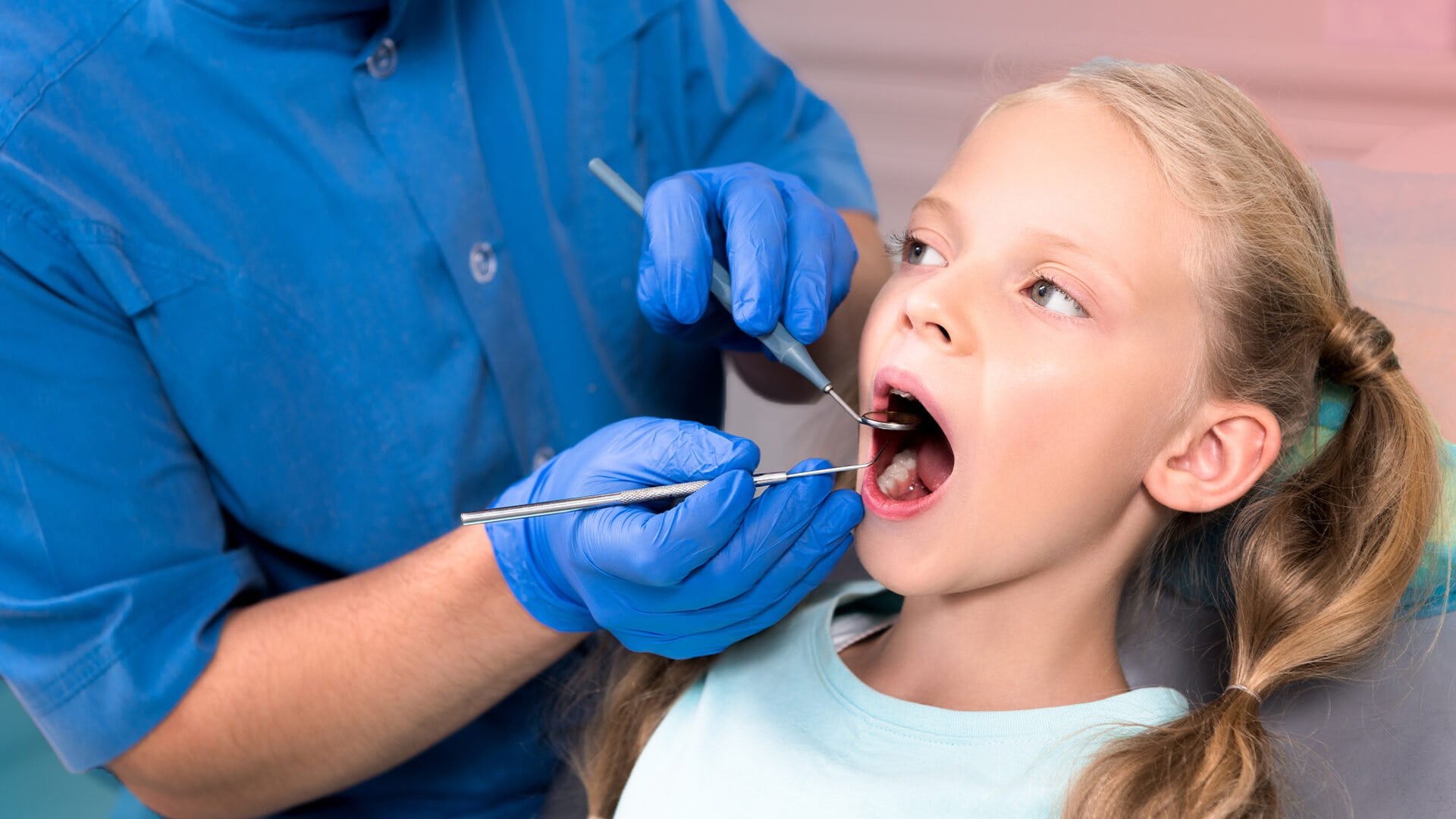
Pediatric dentistry is the dental specialty that manages oral health from the eruption of the first baby tooth through adolescence, built around prevention, monitoring of tooth and jaw development, and age-appropriate behaviour management rather than restorative work alone. Its central target is caries. A meta-analysis of 59,018 children across 29 countries, using WHO diagnostic criteria, put the pooled global prevalence of early childhood caries at 48 percent, 95 percent confidence interval 43 to 53 (PubMed 33735529). Preventive measures have measured effects: resin-based fissure sealants on permanent molars reduced caries by 11 to 51 percent at 24 months, an estimate drawn from 7 trials with 1,548 children in a Cochrane review of 38 trials (PubMed 28759120).
- 01Pediatric dentistry covers birth through the teenage years and is organised around prevention, eruption and bite monitoring, dental trauma, oral habits and behaviour management, not only fillings.
- 02Early childhood caries affects roughly half of preschool children: pooled prevalence 48 percent, 95 percent CI 43 to 53, measured with WHO dmft criteria in 59,018 children from 29 countries (PubMed 33735529).
- 03In a Cochrane review of 38 trials and 7,924 children, resin-based fissure sealants on permanent molars reduced caries by 11 to 51 percent at 24 months; that estimate comes from 7 trials with 1,548 children aged 5 to 10, odds ratio 0.12 with 95 percent CI 0.08 to 0.19 (PubMed 28759120).
- 04Fluoride varnish has a pooled prevented fraction of 43 percent, 95 percent CI 30 to 57, on permanent tooth surfaces and 37 percent, 95 percent CI 24 to 51, on primary tooth surfaces across 22 trials and 12,455 children (PubMed 23846772).
- 05Baby teeth are space maintainers as well as chewing surfaces: they hold the arch length for permanent teeth and guide them into position, which is why early loss is followed by crowding and bite problems.
Pediatric Dentistry as a Dental Specialty
Pediatric dentistry, also called children's dentistry, is the branch of dentistry that looks after the mouths of infants, children and adolescents. Its work starts with the eruption of the first baby tooth and continues until the permanent teeth are in place and the bite has settled in the teenage years. Dentists who specialise in this field are called pediatric dentists.
The specialty exists because a child's mouth keeps changing. Teeth erupt and fall out on a timetable, the jaws grow, the bite shifts from year to year, and a three-year-old cannot be treated with the expectations one has of an adult patient. A problem that looks minor in a baby tooth can also affect the permanent tooth forming beneath it.
For this reason the specialty is organised around growing teeth and jaws, child behaviour, treatment adapted to the child's age, and prevention with education for the family. Repairing damage is part of the job, but a larger share of the work is catching problems early and keeping them from starting. A routine appointment therefore spends much of its time on watching development and talking with parents about diet and brushing, with drilling and filling kept for the cases where prevention has already been outrun.
Areas the Specialty Covers
Many parents assume pediatric dentistry deals only with cavities. In practice it covers a wide range of oral health concerns, each handled according to the child's stage of development.
Care of the baby teeth is the starting point. The dentist monitors when teeth erupt, whether they come in aligned, and whether there will be room for the larger permanent teeth. Decay is diagnosed and treated, and children's cavities and fillings are planned with the remaining life of the baby tooth in mind: a molar that will stay for years is treated differently from a front tooth that will be lost within months.
Dental trauma is a second large area, since falls, playground accidents and sports injuries often involve the front teeth. Gum health is followed too, because gum inflammation can begin in childhood when plaque is left on the teeth.
Jaw growth and bite development are watched from an early age. Prolonged thumb sucking or pacifier use can influence how the front teeth and palate develop, and the dentist discusses with the family when to phase these habits out. The specialty also teaches brushing technique, toothpaste amount and diet to both child and parents, with the child's growth, nutrition, speech and emotional comfort kept in view.
Training and Daily Work of a Pediatric Dentist
A pediatric dentist is a licensed dentist who has completed further specialist training focused on children after dental school. That training covers child behaviour management, growth and development of the teeth and jaws, childhood oral diseases, the care of children with special healthcare needs, and methods for reducing dental anxiety. The general dentist and the pediatric dentist hold the same basic licence; the difference lies in this added training and in a practice built around children.
In daily work the pediatric dentist performs the child's first examination, follows tooth development at each visit and treats decay in baby teeth. When decay has reached the nerve of a primary tooth that still has years of service ahead, pediatric root canal treatments may be used to keep that tooth until its replacement is ready. Fluoride applications and fissure sealants are placed during routine visits, and dental injuries are managed when they occur.
A large share of the appointment goes to talking. Parents are shown how to brush a small child's teeth and which feeding habits raise the risk of decay, and older children learn to take over their own brushing. The dentist also works to build trust, because a child who feels safe in the chair comes back for check-ups, and check-ups are where most problems are caught while small.
Why Baby Teeth Matter
A widespread belief is that baby teeth do not matter because they will fall out anyway. The primary teeth carry several jobs during the years they are in the mouth, and some of those jobs shape the permanent dentition.
They allow the child to chew properly, which supports a varied diet. They take part in speech, since several sounds are formed with the tongue against the front teeth. They contribute to the shape of the lower face and to the child's appearance. And they act as space maintainers: each baby tooth holds the length of the dental arch for the permanent tooth developing beneath it and guides that tooth toward its position when it erupts.
This last role explains why early loss of a baby tooth has effects that outlast the tooth. When a primary molar is lost to decay well before its time, the neighbouring teeth tend to drift into the gap, and the permanent tooth that arrives later may find its space partly closed. Crowding, crooked permanent teeth and bite problems follow, and jaw development and speech can also be affected depending on which teeth are lost.
Untreated decay in a baby tooth can cause pain and infection, and an infection at the root of a primary tooth can damage the permanent tooth forming below. Cavities in baby teeth are therefore treated, with the treatment chosen according to how long the tooth is expected to remain.
Early Childhood Caries and Its Causes
Tooth decay is a common chronic disease of childhood, and in young children it is called early childhood caries. A systematic review with meta-analysis that used the WHO diagnostic criteria pooled data on 59,018 children from 29 countries and found a global prevalence of 48 percent, with a 95 percent confidence interval of 43 to 53 (PubMed 33735529). Prevalence varied widely by region, from 30 percent in Africa to 82 percent in Oceania (PubMed 33735529). The authors noted that results came from 29 of 195 countries, so the pooled figure describes the countries with usable data (PubMed 33735529).
The causes are well known in clinical practice. Frequent sugar intake feeds the bacteria that produce acid on the tooth surface, and frequent snacking gives enamel little time to recover between acid attacks. Night-time feeding and prolonged bottle use leave milk or sweet drinks around the teeth for hours while saliva flow is low. Brushing that is irregular, or left to a small child who cannot yet reach every surface, allows plaque to build up, and irregular check-ups mean early white spots are missed before they become cavities.
Because these causes are behavioural, most of them can be changed. The pediatric dentist identifies which of them apply to a particular child, explains them to the family without blame, and pairs home changes with professional preventive treatment.
Fluoride Varnish, Sealants and Home Care
Prevention is the core of pediatric dental care, and two professional measures have been studied in large Cochrane reviews.
Fluoride strengthens enamel against acid. Fluoride varnish is painted onto the teeth during a routine visit in a dose suited to the child's age. A Cochrane review of twenty-two trials with 12,455 randomised participants found a pooled prevented fraction of 43 percent on permanent tooth surfaces and 37 percent on primary tooth surfaces, both rated moderate quality evidence (PubMed 23846772). The same review found little information on possible adverse effects or acceptability of treatment (PubMed 23846772).
Fissure sealants are thin resin coatings placed over the deep grooves on the chewing surfaces of molars, where food and bacteria collect and brushing reaches poorly. The Cochrane review of sealants included 38 trials with 7,924 children (PubMed 28759120). Resin-based sealants on permanent molars reduced caries by between 11 and 51 percent compared with no sealant at 24 months, rated moderate quality evidence (PubMed 28759120). A similar benefit was seen up to 48 months, though the quantity and quality of evidence fell at longer follow-up (PubMed 28759120). Placing a sealant requires no drilling.
Home care completes the picture. Child and parents receive guidance on brushing technique, the toothpaste amount suited to the child's age, flossing once teeth are in contact, and food choices that reduce sugar exposure.
Dental Fear and Behaviour Management
Fear of the dentist often begins in childhood, and one unpleasant early visit can shape how a person feels about dental care for years. Preventing dental fear is therefore part of the treatment plan in pediatric dentistry.
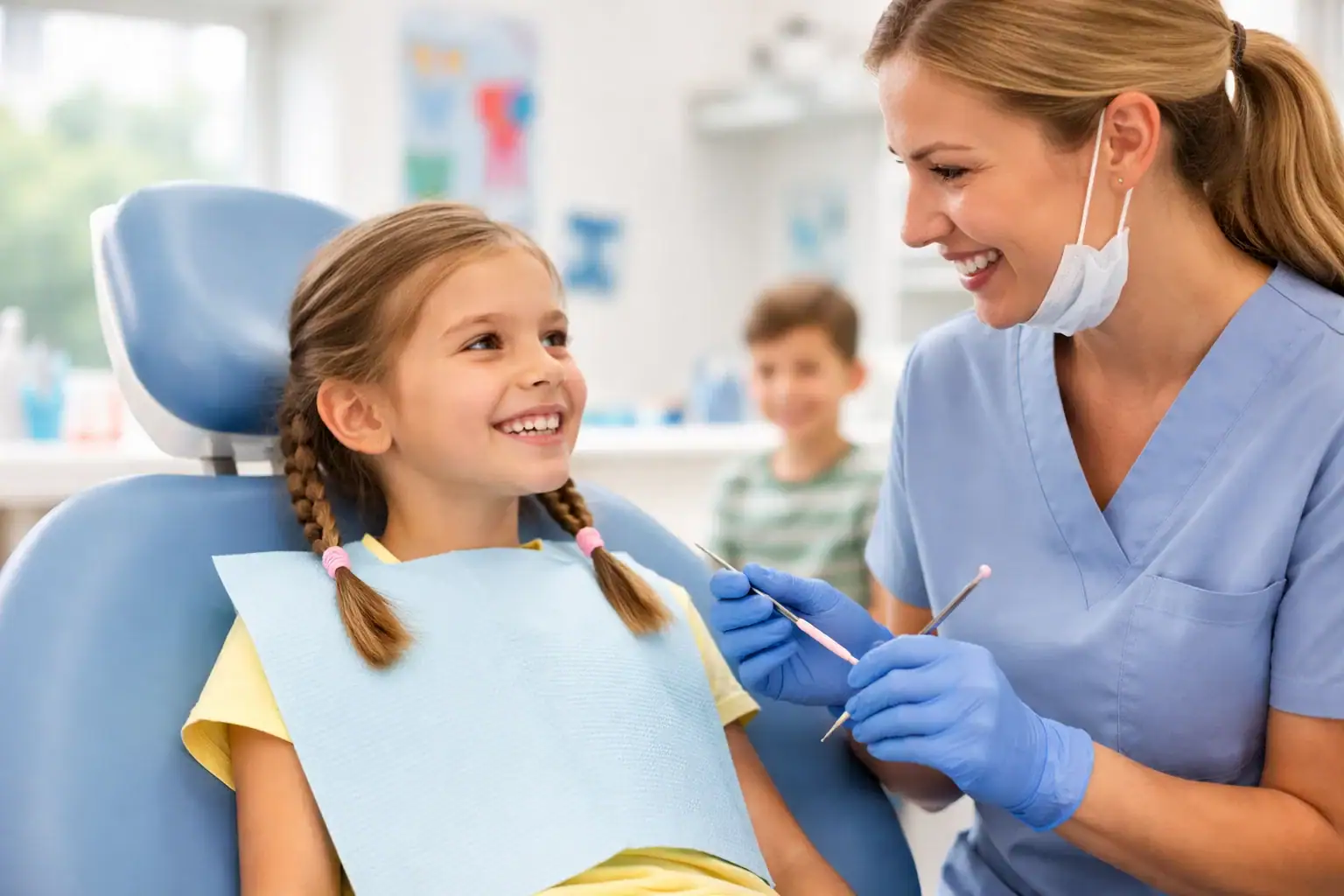
Pediatric dentists use behaviour management techniques learned in their specialist training. Language is adapted to the child's age, and instruments are described with familiar words. In the Tell-Show-Do method the dentist first explains what will happen, then shows the instrument or demonstrates the step on a finger or a toy, and only then performs it in the mouth. Positive reinforcement rewards cooperation, a calm setting helps the child settle, and procedures are introduced gradually, so that a first visit may consist only of sitting in the chair and counting teeth.
This gradual approach has a practical reason. A child who has learned that the dental chair is a predictable place cooperates more readily when treatment is needed, which makes that treatment shorter and more precise. Parents help by speaking about the visit in neutral terms, avoiding threats that link the dentist to punishment, and keeping appointments regular. When a child is very young, very anxious or needs extensive treatment, the dentist discusses further options with the family and adjusts the plan to that child.
First Visit, Recall Interval and Special Needs
International dental guidance places the first dental visit at the eruption of the first baby tooth or by the first birthday, whichever comes first. That appointment is for detection, parent education and familiarity with the dental setting. With early childhood caries affecting almost half of preschool children, the visit works as a screening step (PubMed 33735529). Brushing starts as soon as the first tooth erupts, with a brush and toothpaste amount suited to the child's age.
The usual recall interval afterwards is every six months, adjusted to caries risk. A child with active decay, frequent sugar intake, night-time bottle use or a history of trauma may be seen more often, a low-risk child on a stable routine less often. Recall visits are when fluoride varnish and sealants are applied and bite development is checked, so developing orthodontic problems can be noticed early.
Pediatric dentistry also serves children with autism spectrum disorder, developmental delays, medical conditions or physical disabilities, adapting pace, setting and treatment to the child's needs.
At the examination the questions that shape a child's plan are when the teeth erupted and whether they are aligned, whether there are early white spots or cavities, how feeding and brushing are handled at home, whether oral habits persist, and how the child responds to the dental setting.
Let’s plan the right treatment together.
Free Assessment→- 1.Uribe SE, Innes N, Maldupa I. The global prevalence of early childhood caries: A systematic review with meta-analysis using the WHO diagnostic criteria. Int J Paediatr Dent 2021;31:817-830. PubMed 33735529
- 2.Ahovuo-Saloranta A, Forss H, Walsh T, Nordblad A, Mäkelä M, Worthington HV. Pit and fissure sealants for preventing dental decay in permanent teeth. Cochrane Database Syst Rev 2017;7:CD001830. PubMed 28759120
- 3.Marinho VC, Worthington HV, Walsh T, Clarkson JE. Fluoride varnishes for preventing dental caries in children and adolescents. Cochrane Database Syst Rev 2013;2013:CD002279. PubMed 23846772