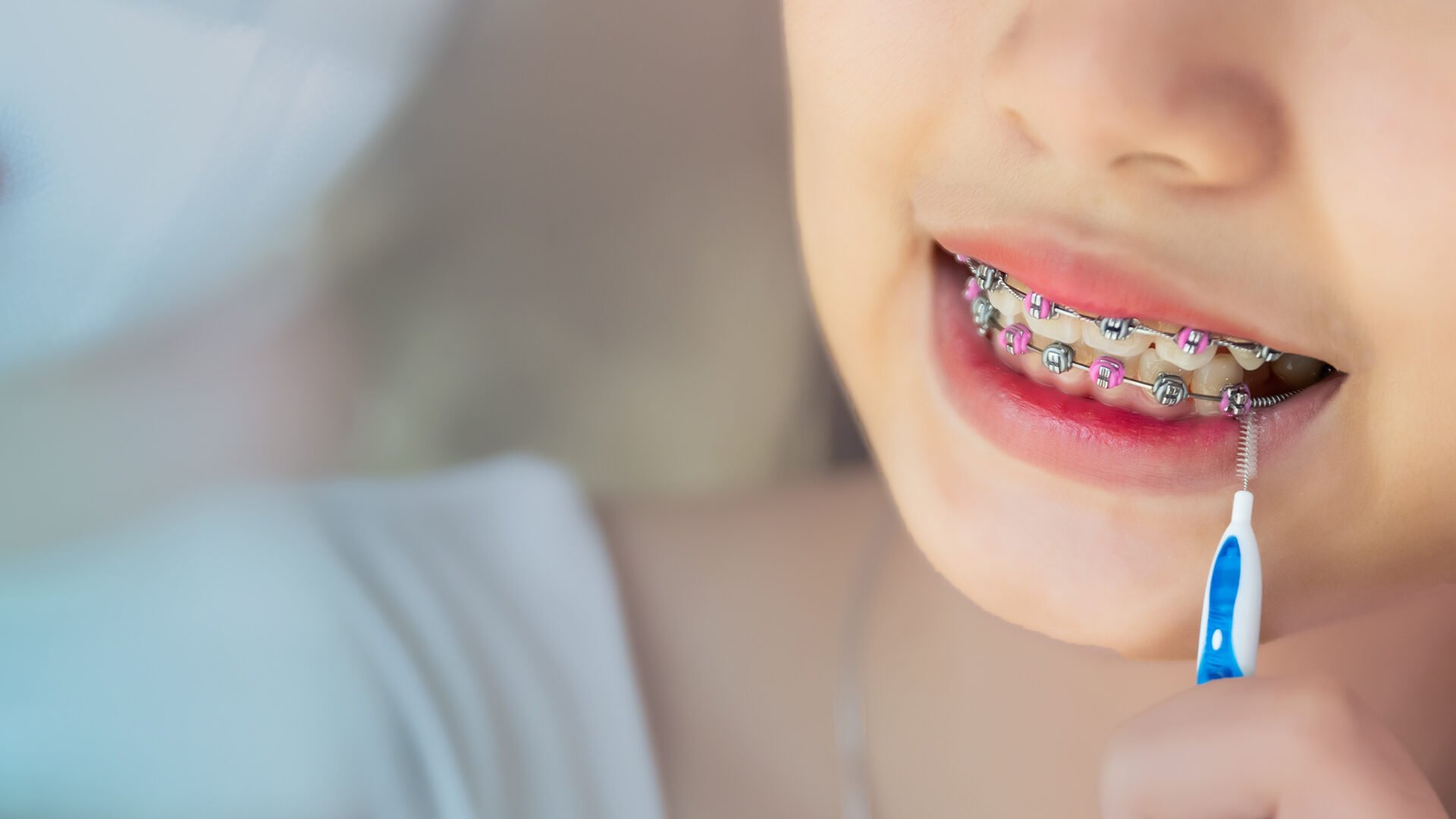
Oral care with fixed braces is the routine that keeps plaque off brackets, wires and the enamel around them, because those components create retention sites an ordinary brushing pattern misses. The risk is measurable: in a meta-analysis of 57 studies covering 9,101 orthodontic patients, pooled prevalence of white spot lesions was 55.06 percent and incidence during treatment 34.2 percent, against 29.1 percent in untreated patients (PubMed 39717964). The practical routine is brushing 2 to 3 times a day for at least 2 minutes, daily orthodontic floss or a water flosser, and a fluoride mouthwash.
- 01White spot lesions are the specific enamel risk of fixed appliances: pooled prevalence 55.06 percent among orthodontic patients against 29.1 percent in untreated patients, from 57 studies and 9,101 patients (PubMed 39717964).
- 02Odds of white spot lesions were about seven times higher with conventional fixed appliances than with no treatment, and prevalence rose with longer treatment duration (PubMed 39717964).
- 03The brushing target in this routine is 2 to 3 times a day for at least 2 minutes, with the area above and below each bracket cleaned as separate surfaces.
- 04A water flosser is the practical substitute where plain floss cannot pass the archwire; orthodontic floss threaders serve the same purpose and are used daily.
- 05Fluoride mouthrinse used during fixed appliance treatment reduced demineralisation around brackets in a systematic review of 5 randomized trials (PubMed 38784077).
Braces are a very effective orthodontic method for straightening teeth and achieving a healthy smile. However, the use of braces makes oral care even more important. Wires and brackets can easily cause food residue to accumulate, which increases the risk of cavities and gum disease.
/ Orthodontic Care and Oral Hygiene in Using Braces
Braces treatment is an important process for the proper alignment of the teeth as well as for jaw health, gum health and general oral health. Individuals who wear braces should have regular orthodontic check-ups. Here are the things to consider during the treatment process:
While braces help align teeth, they also require extra attention to oral hygiene. Bacteria and plaque can form more quickly in mouths with braces. Therefore, if regular and proper care is not taken, the following problems may occur:
- Tooth Decay: When food residue gets stuck between the wires, it paves the way for decay.
- Gum Disease: Bacteria accumulation can cause inflammation in the gums.
- Bad Breath: Bad breath can occur as a result of inadequate cleaning.
- White Spots: White spots can form on the teeth as a result of plaque accumulation around the wires.
For this reason, individuals who use braces should take extra care in their oral care. The soft tissues need attention as well: in a study of 60 young people wearing orthodontic appliances, mucosal lesions were more common than in children with untreated malocclusion, mostly gum inflammation, erosions and ulcers, and in people prone to canker sores, local trauma of this kind can trigger new ones. The soft tissues need attention as well: in a study of 60 young people wearing orthodontic appliances, mucosal lesions were more common than in children with untreated malocclusion, mostly gum inflammation, erosions and ulcers, and in people prone to canker sores, local trauma of this kind can trigger new ones.
/ Teeth Cleaning, Food Choices and Extra Care for Braces Users
Individuals who wear braces need to apply some special techniques for oral care. Below are the steps to take to ensure that teeth remain healthy.
Tooth Brushing Techniques
- Teeth should be brushed at least 2-3 times a day.
- Orthodontic toothbrushes or special toothbrushes with V-shaped bristles should be used.
- A soft-bristled brush should be preferred to clean around brackets and wires.
- Brushing should be done with circular movements and all tooth surfaces should be cleaned carefully.
- Brushing should be done for at least 2 minutes, focusing separately on the top and bottom of the brackets.
Flossing
- Flossing can be difficult due to wires, but special orthodontic floss or floss threaders can make this process easier.
- The floss should be gently placed between the teeth and plaque buildup should be cleaned with up and down movements.
- Avoid applying too much pressure to avoid damaging the gums.
Use of Oral Irrigator (Water Flosser)
- Oral irrigator cleans food residue between teeth and around brackets with water pressure.
- It is an effective alternative especially for individuals who have difficulty using dental floss.
- It is recommended to use daily.
Foods to Avoid While Wearing Braces
Some foods can damage braces and prolong the treatment. Foods that individuals with braces should avoid are:
- Hard foods (Nuts, almonds, ice, hard bread crusts)
- Sticky candies (Caramel, gum, Turkish delight, jelly beans)
- Very sugary foods (Sugary drinks, desserts, chocolate)
- Fibrous and stringy foods (Corn cobs, spinach, celery)
- Fizzy drinks (Can damage tooth enamel due to their acidic structure)
These types of foods can cause braces to break or brackets to come out of place. Therefore, softer and easily chewable foods should be preferred.
Mouthwash Use and Extra Care Precautions
For braces users, alcohol-free mouthwashes support oral hygiene and prevent bacterial growth. The following can be added to your daily oral care routine:
- Using a fluoride mouthwash strengthens tooth enamel.
- Regular dentist check-ups ensure that treatment progresses healthily.
- Using orthodontic wax prevents brackets from irritating the lips and inside of the cheeks.
/ Frequently Asked Questions for Braces Users
Can teeth be whitened with braces?
Teeth whitening is not recommended while braces are on. Professional whitening can be done after the braces are removed.
Do people with braces experience bleeding gums?
If brushing is not done correctly, the gums may become inflamed and bleed. This can be prevented with regular cleaning.
What should be done if the brackets break?
If there is a broken bracket or wire, an orthodontist should be consulted as soon as possible.
How often should braces be cleaned?
Teeth should be cleaned after every meal, and dental floss or mouthwash should be used regularly.
What should be done after braces are removed?
After braces are removed, the corrected state of the teeth should be preserved. The retainer recommended by the orthodontist should be used regularly.
Using braces requires extra care for oral care. A healthy and beautiful smile can be achieved with regular dental cleaning, proper eating habits and orthodontist check-ups. You can complete the treatment process without any problems by keeping your braces clean!
Let’s plan the right treatment together.
Free Assessment→- 1.Hussain U, Wahab A, Kamran MA et al. Prevalence, Incidence and Risk Factors of White Spot Lesions Associated With Orthodontic Treatment: A Systematic Review and Meta-Analysis. Orthod Craniofac Res. 2025;28(2):379-399. doi:10.1111/ocr.12888
- 2.Jha AK, Mahuli AV, Verma SK et al. Effectiveness of fluoride mouthrinse in prevention of demineralization during fixed orthodontic treatment: A systematic review and meta-analysis. J Orthod Sci. 2024;13:22. doi:10.4103/jos.jos_116_23
- 3.Baricevic M, Mravak-Stipetic M, Majstorovic M, Baranovic M, Baricevic D, Loncar B. Oral mucosal lesions during orthodontic treatment. Int J Paediatr Dent. 2011;21(2):96-102.
- 4.Staines K, Greenwood M. Aphthous ulcers (recurrent). BMJ Clin Evid. 2015;2015:1303.