
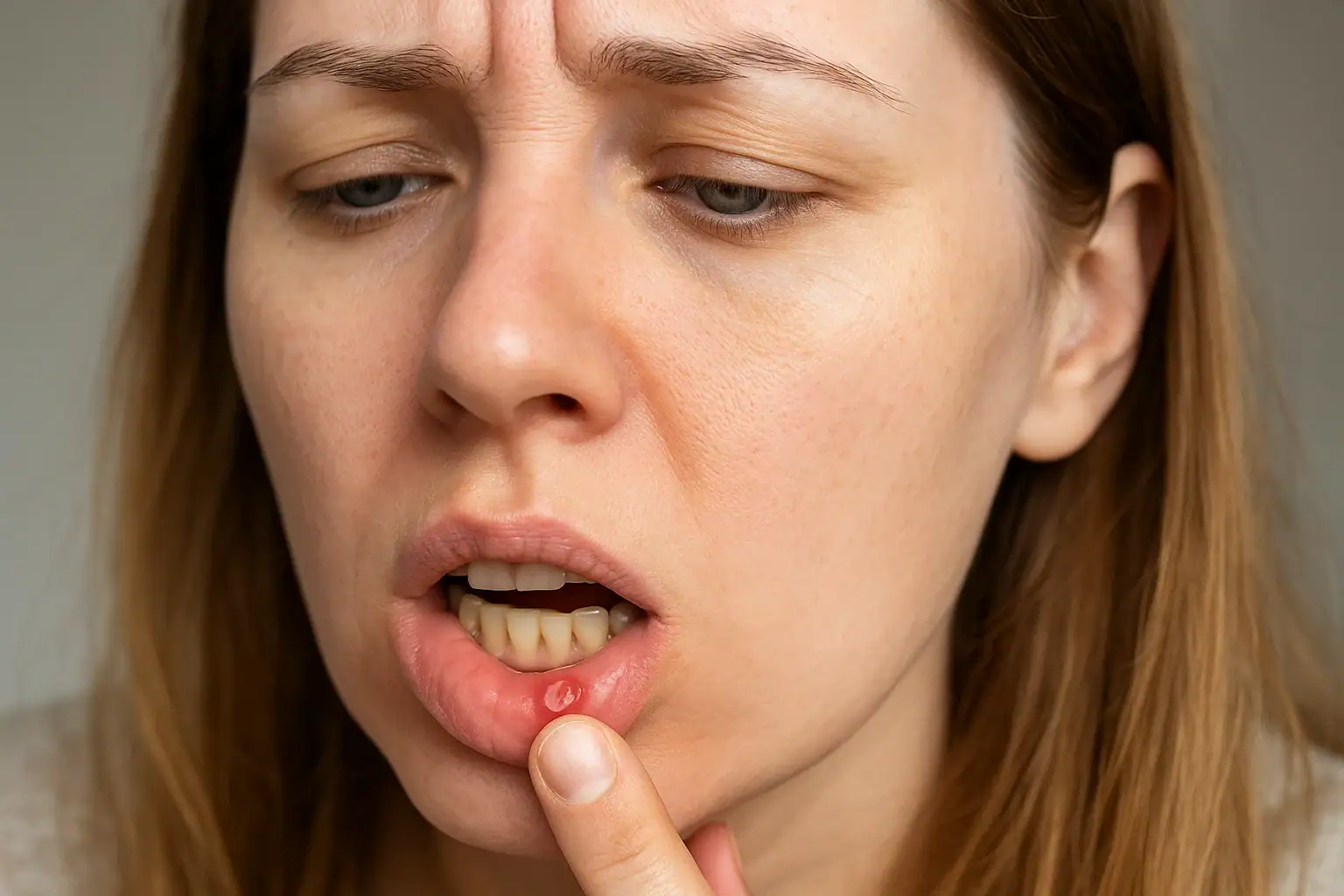
Canker sores are not contagious. They are aphthous ulcers, small round or oval lesions on the lining inside the mouth that come from an immune-related reaction rather than a virus, so kissing, sharing utensils and close contact carry no risk of passing them on. The lesion people confuse them with is the cold sore, which is caused by herpes simplex virus, appears outside the mouth on the lips as fluid-filled blisters and is highly contagious. Most canker sores heal on their own within one to two weeks (PubMed 42562675), and recurrent aphthous stomatitis affects between 5 and 25 per cent of the general population (PubMed 37357066).
- 01Not contagious means there is no transmissible agent: canker sores are a localised immune response in the mouth lining, which is why kissing, shared cutlery and close contact do not spread them.
- 02The lookalike is the contagious one: cold sores come from herpes simplex virus, sit outside the mouth on the lips and appear as fluid-filled blisters rather than an ulcer with a white or yellow centre and a red border.
- 03Recurrent aphthous stomatitis is the most common disease of the oral mucosa, with prevalence in the general population reported between 5 and 25 per cent and a peak in the second decade of life (PubMed 37357066).
- 04Most canker sores heal on their own within one to two weeks (PubMed 42562675). A mouth ulcer that is still present after three weeks should be examined, because an oral ulcer lasting more than three weeks is an indication for biopsy (PubMed 11293995).
- 05Several sores at once are not one sore spreading; they are separate ulcers triggered at the same time, which is what makes people think the lesion has moved.
Canker sores are a common oral condition that many people experience at some point in their lives. While these small, painful ulcers can be bothersome, a common question arises: are canker sores contagious? In this comprehensive blog post, we will explore the causes, symptoms, treatment options, and, most importantly, the contagiousness of canker sores. We’ll also address questions like “are canker sores contagious by kissing?” and “are canker sores on the tongue contagious?” to give you a complete understanding.
/ Canker Sores, Symptoms and Cold Sores
What Are Canker Sores?
Canker sores, also known as aphthous ulcers, are small, round or oval lesions that develop inside the mouth. They often appear on the:
- Inner cheeks
- Lips
- Tongue
- Soft palate
- Gums
These ulcers are usually white or yellow with a red border and can cause a burning or tingling sensation, especially when eating spicy or acidic foods.
Common Symptoms of Canker Sores
- Small, round, painful ulcers inside the mouth
- Redness and swelling around the sore
- Burning or tingling sensation before the sore appears
- Pain while eating, drinking, or speaking
Are Canker Sores and Cold Sores the Same?
No, canker sores and cold sores are not the same.
| Feature | Canker Sores | Cold Sores |
|---|---|---|
| Location | Inside the mouth | Outside the mouth (usually lips) |
| Cause | Non-viral (immune-related, stress) | Herpes simplex virus (HSV-1) |
| Contagious | ❌ Not contagious | ✅ Highly contagious |
| Appearance | Ulcers with white/yellow centers | Blisters filled with fluid |
This distinction is crucial when asking, "Are canker sores contagious?"
Are Canker Sores Contagious?
The short answer is no. Canker sores are not contagious . Unlike cold sores, they are not caused by a virus and cannot be passed from one person to another through kissing, sharing utensils, or close contact.
/ Canker Sore Locations, Kissing and Triggers
Are Canker Sores on the Tongue Contagious?
Some people worry more when canker sores appear in different parts of the mouth, such as the tongue. But even then, canker sores on the tongue are not contagious . They are a localized immune response and not caused by a transmissible agent.
Are Canker Sores Contagious by Kissing?
No. Even though kissing involves close contact and exchange of saliva, canker sores are not infectious, so there is no need to worry about passing them to your partner.
Common Misconception : Many people confuse canker sores with cold sores, which are caused by the herpes simplex virus and are contagious through kissing.
What Causes Canker Sores?
Canker sores have several potential triggers, although the exact cause is often unknown. Common factors include:
- Stress and anxiety
- Minor mouth injuries (e.g., from braces, biting the cheek)
- Acidic or spicy foods
- Vitamin deficiencies (especially B12, iron, and folate)
- Hormonal changes
- Autoimmune responses
- Certain medications
- Toothpaste with sodium lauryl sulfate (SLS)
Can You Get Canker Sores from Stress?
Stress is a well-documented trigger for canker sores. While stress itself isn’t contagious, it can lead to immune system changes that make the body more vulnerable to developing ulcers. Chronic stress may also delay healing once a sore has formed.
Helpful Tip: Practice relaxation techniques like meditation, deep breathing, and adequate sleep to reduce stress-induced outbreaks.
/ Canker Sores in Children, Risk Groups and Care
Are Canker Sores Contagious in Children?
Canker sores can affect people of all ages, including children. Parents often worry: are canker sores contagious in children? They are not. However, young children may have more frequent occurrences due to dietary factors, injuries from rough brushing, or stress related to school or social interactions.
Parenting Tip: Teach your child gentle brushing techniques and encourage a balanced diet rich in iron and B vitamins.
Who Is More Likely to Get Canker Sores?
- Teenagers and young adults
- Women (due to hormonal fluctuations)
- Individuals with a family history of canker sores
- People with compromised immune systems
Are There Any Risks Associated with Canker Sores?
While most canker sores heal on their own within one to two weeks (PubMed 42562675), there are situations where medical advice is needed:
- Sores larger than a centimeter, the major type, which heals more slowly and often scars (PubMed 18593062)
- Recurring outbreaks
- Ulcers lasting more than 3 weeks
- Difficulty eating or drinking
- High fever or fatigue
In rare cases, persistent or severe sores could indicate an underlying condition such as:
- Celiac disease
- Behçet's disease
- HIV/AIDS
- Inflammatory bowel disease
How to Treat Canker Sores
1. Home Remedies
- Saltwater rinses : Helps reduce bacteria and inflammation
- Baking soda paste : Neutralizes acids
- Honey : Natural antibacterial and healing properties
- Coconut oil : Anti-inflammatory and soothing
2. Over-the-Counter Products
- Topical gels like benzocaine
- Antiseptic mouthwashes
- Oral pain relievers such as ibuprofen
3. Prescription Treatments
For severe cases, doctors may recommend:
- Corticosteroid rinses or gels
- Immune-modulating drugs
/ Preventing Noncontagious Canker Sores
Can You Prevent Canker Sores?
While you may not always be able to prevent canker sores, here are a few strategies to reduce the risk:
- Maintain good oral hygiene
- Avoid foods that irritate your mouth
- Use a soft-bristled toothbrush
- Avoid toothpaste with SLS
- Manage stress effectively
- Take a multivitamin if deficient
Are Canker Sores Contagious If You Kiss?
No, canker sores are not contagious if you kiss someone.
Kissing does not transmit canker sores. These sores are caused by internal factors like immune response or stress, not viruses or bacteria. You can kiss without worry, just be cautious if kissing causes discomfort due to the sore itself.
Do Canker Sores Spread Inside the Mouth?
No, a single canker sore does not spread to other areas like a virus. However, multiple sores can appear at once, especially if the trigger (e.g., stress, acidic food) affects several regions of the mouth at the same time. This leads some people to mistakenly believe the sore has "spread," when in fact, they are multiple individual ulcers forming simultaneously.
Is There a Genetic Link to Canker Sores?
Yes, genetics can play a role. If a close family member, like a parent or sibling, suffers from recurrent canker sores, you're more likely to experience them too. This doesn’t make them contagious; it simply means your immune system may be more prone to triggering an inflammatory response in the oral tissues.
/ Canker Sore Deficiencies, Healing Timeline and Medical Evaluation
Nutritional Deficiencies and Canker Sores
Lack of essential nutrients is a hidden trigger for recurrent canker sores. Key nutrients involved:
- Vitamin B12
- Iron
- Folic Acid
- Zinc
If you're experiencing frequent sores, your doctor may recommend a blood test to check for deficiencies. Supplementation can significantly reduce outbreaks.
Canker Sore Healing Timeline: What to Expect
The published figure is simpler than the day-by-day charts found online: minor aphthous ulcers heal on their own within one to two weeks (PubMed 42562675). A sore that has not healed after three weeks needs a clinical examination, because an oral ulcer present for more than three weeks is an indication for biopsy (PubMed 11293995).
Are Recurrent Canker Sores a Sign of an Autoimmune Condition?
While occasional canker sores are harmless, frequent or severe outbreaks could be linked to underlying autoimmune diseases such as:
- Behçet’s disease
- Lupus (SLE)
- Celiac disease
- Crohn’s disease
Frequent or severe outbreaks are a reason to be evaluated, because recurrent ulcers can be secondary to conditions such as Behçet disease or inflammatory bowel disease (PubMed 42562675).
The Role of Oral Microbiome in Canker Sores
New research is exploring how an imbalance in the oral microbiome, the community of bacteria in your mouth, might contribute to the development of canker sores. While the science is still evolving, maintaining a healthy oral environment with good hygiene and probiotic-rich foods could offer protective benefits.
When to See a Doctor
Consult a healthcare provider if:
- Your sores are unusually large or painful
- They keep recurring or are severe
- You develop high fever, swollen lymph nodes, or extreme fatigue
- Over-the-counter remedies do not relieve symptoms
In the clinic the first job is to rule out a mechanical cause: a sharp cusp, a rough filling edge or a denture rim keeping the same spot open. That check is done during gum and oral mucosa treatment, which our periodontology pages describe step by step.
/ Frequently Asked Questions (FAQs)
Are canker sores contagious?
No, canker sores are not contagious.
Are canker sore contagious?
The correct grammar would be “are canker sores contagious?” Either way, the answer is still no .
Are canker sores on tongue contagious?
No, canker sores on the tongue are also not contagious.
Are canker sores contagious by kissing?
No, you cannot catch or transmit canker sores through kissing.
Are canker sores contagious if you kiss?
Still no, they are not spread through kissing or any oral contact.
Summary and Conclusion
Summary: Key Takeaways
- Canker sores are not contagious
- They are different from cold sores (which are contagious)
- You can’t get them from kissing, sharing utensils, or close contact
- Most heal on their own within 1–2 weeks
- Seek medical advice if sores are severe, recurrent, or long-lasting
Conclusion
So, are canker sores contagious? The answer is a confident no . Understanding the difference between canker sores and cold sores can ease a lot of unnecessary worry. While canker sores can be painful and annoying, they pose no risk to those around you. By managing stress, eating a balanced diet, and practicing good oral hygiene, you can reduce the frequency and severity of outbreaks.
For persistent issues, don’t hesitate to speak with a dental or medical professional.
Let’s plan the right treatment together.
Free Assessment→- 1.Conejero Del Mazo R, García Forcén L, Navarro Aguilar ME. Recurrent aphthous stomatitis. Med Clin (Barc) 2023;161:251-259. PubMed 37357066
- 2.Stoopler ET, Villa A, Bindakhil M, Díaz DLO, Sollecito TP. Common Oral Conditions: A Review. JAMA 2024;331:1045-1054. PubMed 38530258
- 3.Le Joncour A, Mirouse A, Cacoub P, Saadoun D, Rochefort J. Idiopathic and secondary recurrent aphthous stomatitis: A narrative review. Rev Med Interne 2026 (online ahead of print; in French with English abstract). doi:10.1016/j.revmed.2026.07.009. PubMed 42562675
- 4.Tan IB, Roodenburg JL, Copper MP, Coebergh JW, van der Waal I. [Early diagnosis and prevention of malignant tumors in the head and neck region]. Ned Tijdschr Geneeskd 2001;145:567-72. PubMed 11293995
- 5.Boldo A. Major recurrent aphthous ulceration: case report and review of the literature. Conn Med 2008;72:271-3. PubMed 18593062
- 6.Natah SS, Konttinen YT, Enattah NS, Ashammakhi N, Sharkey KA, Häyrinen-Immonen R. Recurrent aphthous ulcers today: a review of the growing knowledge. Int J Oral Maxillofac Surg 2004;33:221-34. PubMed 15287304