
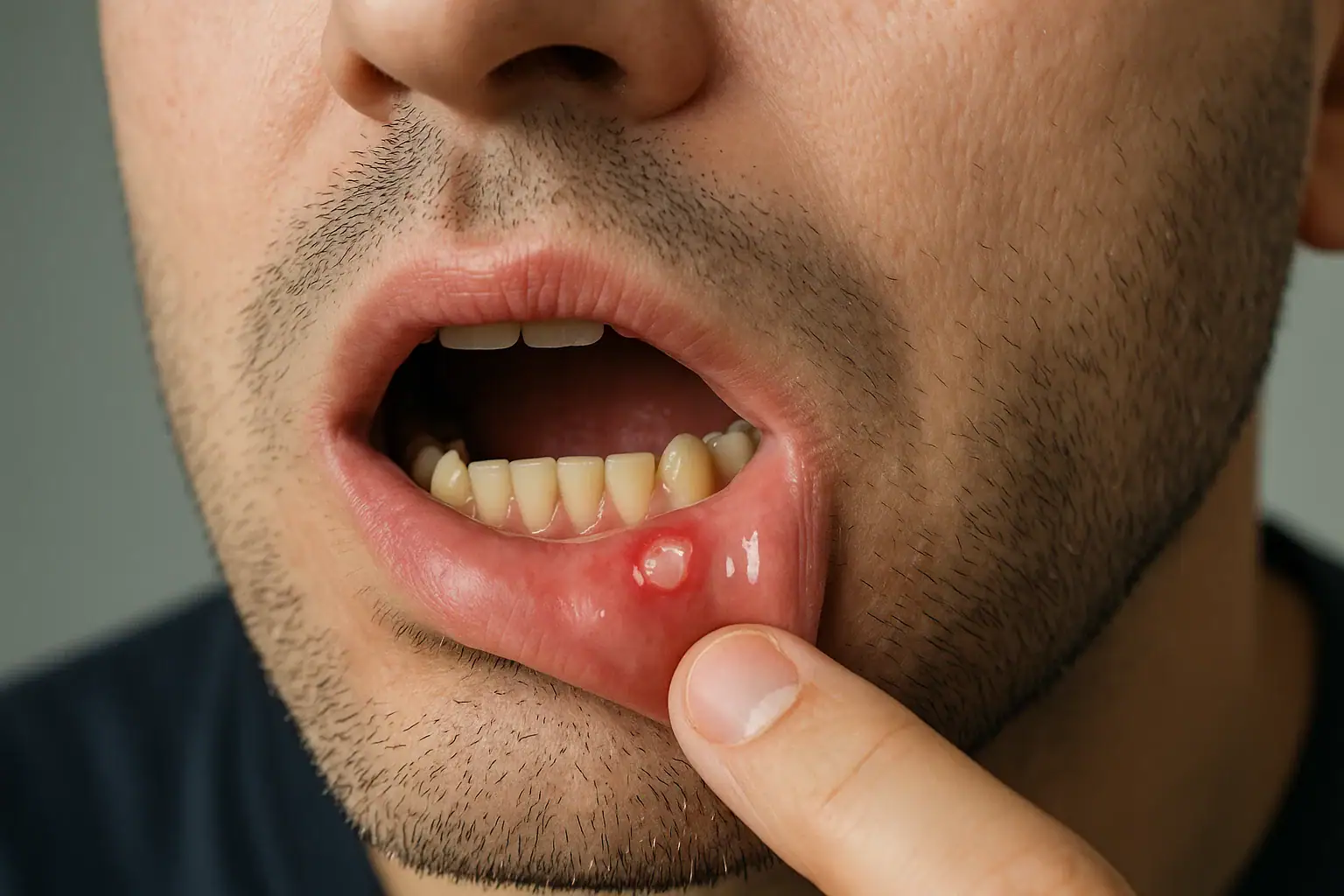
A canker sore, or aphthous ulcer, is a round ulcer with a white or yellow centre and a red border that forms on the soft tissue inside the mouth. It is not caused by a virus and it is not contagious, which is what separates it from a cold sore. Most heal on their own within one to two weeks. Ulcers rarely have a single cause; they appear when triggers overlap, typically minor trauma, stress, and a nutritional gap. Iron, ferritin, folate and vitamin B12 deficiency all measurably raise the odds of recurrence.
- 01A canker sore forms inside the mouth only; a sore on the outer lip is a cold sore and a different condition.
- 02In a meta-analysis, low vitamin B12 raised the odds of recurrent ulcers 2.9-fold and low ferritin 2.5-fold.
- 03A systematic review of crossover trials found that toothpaste without sodium lauryl sulfate reduced ulcer number, duration, episodes and pain.
- 04Most ulcers resolve in one to two weeks without treatment; the point of treatment is to shorten pain, not to cure.
- 05An ulcer lasting beyond three weeks, or one that keeps returning in the same place, should be examined rather than waited out.
/ Canker Sores and Aphthous Ulcers Guide
A canker sore, medically known as an aphthous ulcer, is a small, painful sore that forms inside the mouth. It is not contagious and usually heals on its own, but knowing the causes, treatment options, and prevention steps can shorten the pain and reduce how often it comes back.
This guide covers everything from the exact triggers behind canker sores to when a sore stops being a minor annoyance and becomes something worth having a dentist look at.
A canker sore is a round or oval ulcer with a white or yellow center and a red, inflamed border that forms on the soft tissue inside the mouth, the inner cheeks, lips, tongue, or base of the gums. Unlike cold sores, canker sores never appear on the outer lips or skin and are not caused by a virus.
Because canker sores affect the gum line and surrounding soft tissue, they're often assessed as part of general periodontology care rather than treated in isolation.
Estimates of how many people ever have aphthous ulcers vary with the population and the method: 8.3% of 10,520 adults in northern Iran (PubMed 33030579) and 40.18% of US children and adolescents in a recall-based survey (PubMed 15357677). It remains one of the most prevalent ulcerative conditions of the mouth (PubMed 33030579).
/ Canker Sore Causes, Symptoms and Types
Canker sores don't have one single cause; they develop when several triggers combine, such as minor mouth injury, stress, or nutritional gaps. Most cases are not linked to a serious underlying illness.
Common triggers and contributing factors include:
- Nutritional deficiencies, low iron, folate, vitamin B12, or zinc
- Stress and fatigue, a well-documented trigger for flare-ups
- Hormonal changes, some people notice a pattern tied to their menstrual cycle
- Minor trauma, accidental cheek bites, aggressive brushing, or dental work
- Trigger foods, acidic fruits, citrus, chocolate, and spicy foods
- Underlying conditions, celiac disease, Crohn's disease, Behçet's disease, or HIV in recurrent, severe cases
- Genetic predisposition, a family history of canker sores raises the likelihood
- SLS-containing toothpaste, sodium lauryl sulfate has been linked to more frequent outbreaks in some studies
In most people, canker sores appear when two or more of these factors overlap at the same time, for example, a stressful week combined with a diet low in iron or a minor cheek bite. This is why prevention works best when it targets more than one trigger at once, rather than a single cause.
Canker Sore Symptoms and Types
The first sign is usually a tingling or burning feeling a day before the sore appears, followed by a painful white-or-yellow-centered ulcer with a red halo. Eating, drinking, or talking can become uncomfortable while the sore is active.
In more severe or multiple outbreaks, additional symptoms can include mild fever, sluggishness, or swollen lymph nodes, a sign that a doctor's evaluation is worth scheduling.
Canker sores fall into three types based on size and healing time; most people only ever experience the minor type. Identifying which type you have helps set the right expectations for healing.
| Type | Size | Share of Cases | Typical Healing Time |
|---|---|---|---|
| Minor | Under 1 cm | About 80% | 7-14 days, no scarring |
| Major | Over 1 cm | Less common | Several weeks, sometimes 6 weeks or longer; may scar |
| Herpetiform | Many small clustered ulcers | Least common | About 1-2 weeks |
This classification is consistent with clinical literature on recurrent aphthous stomatitis ( Recurrent Aphthous Stomatitis: Treatment and Management, PMC ).
/ Canker Sore Treatment and Prevention
Most canker sores heal on their own, but topical treatments can reduce pain and speed up recovery. Dentists typically recommend starting with over-the-counter options before moving to prescription treatment for severe or recurring cases.
- Over-the-counter options, benzocaine gels (e.g., Orajel), protective pastes (Orabase), and chlorhexidine mouth rinses
- Prescription options for severe cases, topical corticosteroids (triamcinolone, clobetasol), and, rarely, systemic medication (colchicine, dapsone) for recalcitrant cases
- Home remedies, warm saltwater rinses, a baking soda rinse, diluted honey, aloe vera gel, or chamomile tea rinses
Evidence-based reviews support topical corticosteroids as a reliable first-line option for short-term symptom control ( Treatment of Recurrent Aphthous Stomatitis: A Literature Review, PMC ).
Which option is right for you depends on frequency and severity: an occasional minor sore usually responds well to OTC gels and home remedies, while sores that recur often, grow larger than 1 cm, or take longer than 3 weeks to heal are better managed with a prescription-strength treatment from a dentist or doctor.
Prevention focuses on avoiding your personal triggers and supporting general oral and nutritional health. No method guarantees canker sores will never return, but consistent habits reduce how often they appear.
- Avoid known trigger foods (acidic, spicy, or heavily citrus items)
- Switch to an SLS-free toothpaste if outbreaks are frequent
- Manage stress through sleep, exercise, or relaxation routines
- Address any nutritional deficiency (iron, B12, folate, zinc) with your doctor
- Keep up with regular dental check-ups to catch irritation sources early (e.g., a sharp tooth edge or ill-fitting appliance)
Most people find that combining two or three of these habits, rather than relying on just one, makes the biggest difference in how often canker sores return.
/ Canker Sores vs. Cold Sores and When to Seek Care
Canker sores and cold sores are often confused, but they differ in location, cause, and contagiousness. The clearest sign is where the sore appears: canker sores form inside the mouth, while cold sores form on or around the outer lips.
| Canker Sore (Aphthous Ulcer) | Cold Sore (Fever Blister) | |
|---|---|---|
| Location | Inside the mouth (cheeks, tongue, gum base) | Outer lips, around the mouth |
| Cause | Internal triggers (stress, diet, minor trauma) | Herpes simplex virus (HSV-1) |
| Contagious? | No | Yes, through direct contact |
| Appearance | White/yellow center, red halo | Fluid-filled blister that crusts over |
Because canker sores are not caused by a virus, they cannot be spread to another person by kissing, sharing utensils, or other direct contact, unlike cold sores, which are contagious from the moment symptoms start.
Most canker sores resolve without treatment within two weeks, so persistence beyond that is the main warning sign. Contact your dentist or doctor if you notice any of the following.
- The sore lasts longer than 2-3 weeks
- You develop canker sores more than 3-4 times a year
- It's accompanied by fever, joint pain, or eye inflammation
- You have difficulty swallowing
- Pain cannot be managed with over-the-counter treatment
These signs can point to an underlying condition that needs its own diagnosis and treatment plan. If the pain seems centered on the gum tissue itself rather than a discrete ulcer, it's worth comparing your symptoms with our guide on painful gums, and if you notice a persistent lump rather than an open sore, it may be worth ruling out a dental cyst instead.
/ Frequently Asked Questions
Are canker sores the same as cold sores? No. Canker sores form inside the mouth and are not contagious, while cold sores appear on the outer lips, are caused by the herpes simplex virus, and are contagious.
How long does a canker sore usually last? A minor canker sore typically heals in 7-14 days without treatment; major canker sores can take several weeks and may leave a scar.
What is the fastest way to get rid of a canker sore? A combination of a protective paste (like Orabase), a chlorhexidine or saltwater rinse, and avoiding trigger foods gives the fastest relief; severe cases respond best to a prescription topical corticosteroid.
Can stress really cause canker sores? Yes, stress is one of the most consistently reported triggers for canker sore flare-ups, likely through its effect on immune response.
Are canker sores a sign of a vitamin deficiency? They can be. Recurrent canker sores are sometimes linked to low iron, vitamin B12, folate, or zinc, so frequent outbreaks are worth discussing with a doctor.
Can children get canker sores? Yes, canker sores can appear at any age, including in children, though frequent recurrence in a child is worth a pediatric dental evaluation.
Does toothpaste cause canker sores? Regular toothpaste doesn't cause canker sores directly, but toothpaste containing sodium lauryl sulfate (SLS) has been associated with more frequent outbreaks in some people; switching to an SLS-free formula is a simple, low-risk step worth trying if flare-ups are frequent.
If canker sores keep coming back or aren't healing, our dental team can help identify the underlying cause and the right treatment plan. Recurrent sores are assessed as part of gum and oral mucosa treatment, inside our periodontology service.
Let’s plan the right treatment together.
Free Assessment→- 1.Mousavi T, Jalali H, Moosazadeh M. Hematological parameters in patients with recurrent Aphthous Stomatitis: a systematic review and meta-analysis. BMC Oral Health 2024;24:339. PubMed 38493289
- 2.Alli BY, Erinoso OA, Olawuyi AB. Effect of sodium lauryl sulfate on recurrent aphthous stomatitis: A systematic review. J Oral Pathol Med 2019;48:358-364. PubMed 30839136
- 3.Darjani A, Joukar F, Naghipour M, Asgharnezhad M, Mansour-Ghanaei F. Lifetime prevalence of recurrent aphthous stomatitis and its related factors in Northern Iranian population: The PERSIAN Guilan Cohort Study. Clin Oral Investig 2021;25:711-718. PubMed 33030579
- 4.Shulman JD. An exploration of point, annual, and lifetime prevalence in characterizing recurrent aphthous stomatitis in USA children and youths. J Oral Pathol Med 2004;33:558-66. PubMed 15357677