
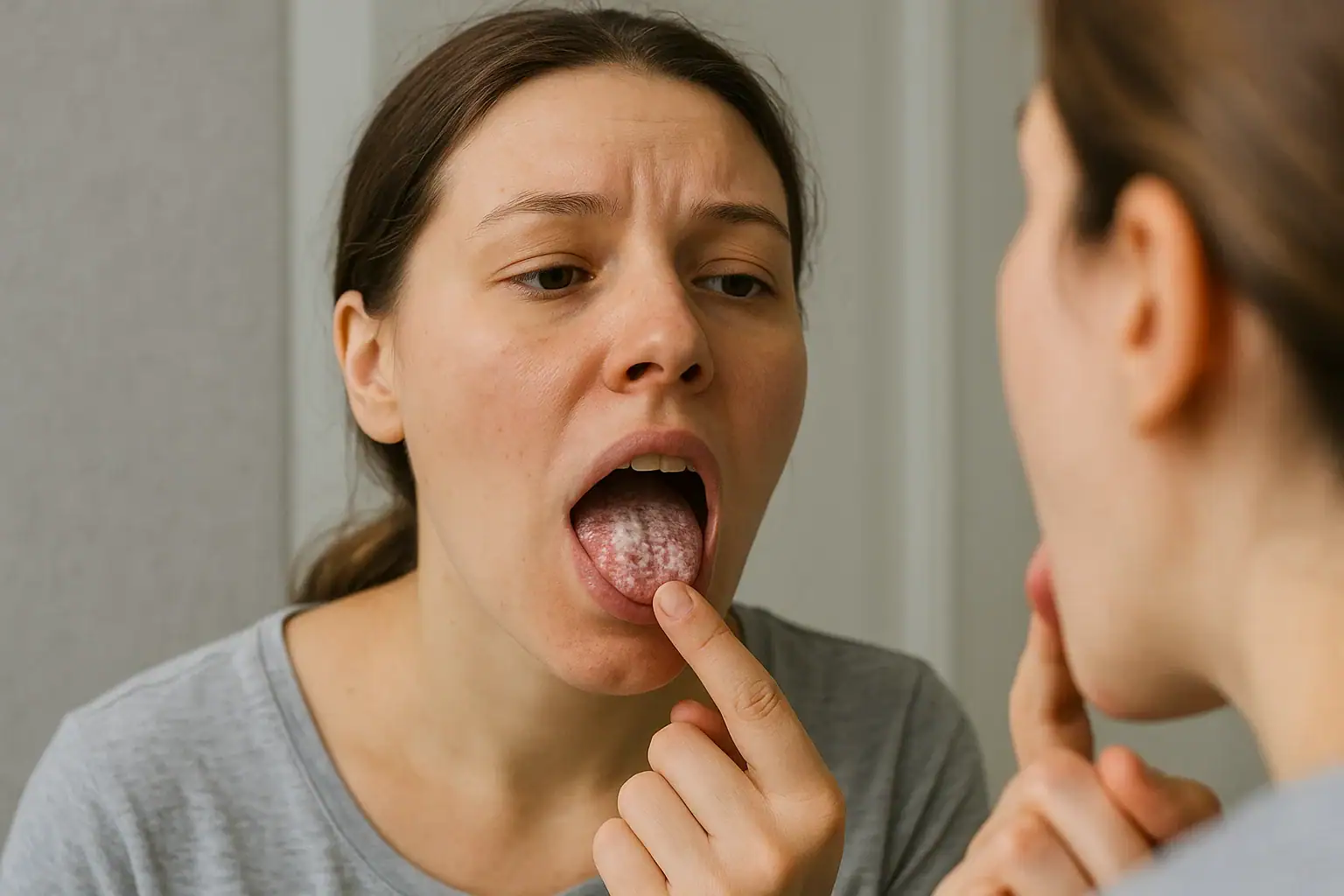
Oral thrush, or oral candidiasis, is an opportunistic fungal infection of the mouth caused by overgrowth of Candida, typically seen as white creamy plaques on the tongue, cheeks and palate with redness underneath. Treatment is antifungal, not antibiotic: in a meta-analysis of randomised trials, fluconazole gave a better clinical response than clotrimazole in adults (risk ratio 1.14) with a comparable mycological cure rate (risk ratio 1.03), while miconazole was recommended for infants (PubMed 34924340). Mild cases in healthy adults may settle in one to two weeks, but dentures, diabetes, inhaled steroids and dry mouth keep it recurring until the underlying cause is addressed.
- 01Oral thrush is Candida overgrowth rather than a bacterial infection, so antibiotics do not treat it and are in fact one of the triggers, because they disturb the normal oral flora.
- 02In adults, a meta-analysis of randomised trials favoured fluconazole over clotrimazole for clinical response (risk ratio 1.14, P = 0.001) with no difference in mycological cure (risk ratio 1.03) (PubMed 34924340).
- 03In infants, miconazole and nystatin gave similar clinical response (risk ratio 1.23) but miconazole reached a higher mycological cure rate (risk ratio 4.03, P = 0.03) (PubMed 34924340).
- 04Formulation and dose change the result with nystatin: pastilles at 400,000 IU produced a significantly higher mycological cure rate than 200,000 IU, and four weeks of pastilles performed better than two weeks (PubMed 27042008).
- 05Nystatin pastilles were significantly superior to placebo in denture stomatitis, which is why denture cleaning and overnight removal are treated as part of the therapy rather than as advice added on the end (PubMed 27042008).
/ What Oral Thrush Is and How It Appears
Oral thrush, or oral candidiasis, is an overgrowth of Candida yeast on the lining of the mouth. Candida already lives in most healthy mouths without causing anything at all; thrush starts when something tips the balance in its favour, which is why it is better understood as an opportunist taking its chance than as a germ caught from someone else. That distinction decides the whole treatment: clearing the yeast without removing what let it grow is how the same infection comes back a month later.
The familiar form is creamy white plaques on the tongue, inner cheeks and palate that can be wiped off, leaving a red and sometimes bleeding surface underneath. It does not always look like that. In denture wearers the commonest presentation is not white at all but a flat red patch covering exactly the area the plate sits on, and in some people the only sign is cracking and soreness at the corners of the mouth (angular cheilitis).
The symptoms patients describe most often are a burning tongue, a cotton-wool feeling, a dulled or metallic sense of taste, soreness under a denture, and in more advanced cases discomfort on swallowing.
One point is worth separating out, because it changes what should happen next: a white patch that does not wipe away is not thrush. A lesion that stays put when rubbed needs a proper examination rather than an antifungal, and that is a different assessment entirely.
/ How Long Oral Thrush Lasts Without Treatment
A mild case in an otherwise healthy adult often settles within one to two weeks once whatever triggered it is removed, and that is the honest upper limit of what can be claimed. No randomised trial has followed untreated oral thrush to its natural end, because trial participants are treated the moment they get worse, so any confident figure you read for the untreated course is an estimate rather than a measurement. What the trial literature does measure is the opposite side of the same question: how long treatment has to run before the yeast is actually gone.
That answer is longer than most people expect. In the nystatin meta-analysis, four weeks of pastilles performed better than shorter courses, and a 400,000 IU pastille produced a significantly higher mycological cure rate than 200,000 IU (PubMed 27042008). Stopping when the white patches disappear is therefore the single commonest reason thrush returns: the plaques clear well before the culture does.
Where risk factors are present the picture changes completely. A denture worn overnight, uncontrolled diabetes, a steroid inhaler used without rinsing, a dry mouth from medication, or immune suppression will all keep feeding the infection, and in those situations thrush can sit in the mouth for weeks or months and simply recur each time it seems to have gone.
The case that should not be left to run its course is spread beyond the mouth. When thrush extends into the oesophagus, swallowing becomes painful or difficult, and treatment moves from a topical agent to a systemic one.
/ Why Oral Thrush Develops: The Risk Factors That Have Actually Been Measured
Almost every list of thrush causes is written from clinical impression, and the measured evidence is narrower and more specific than those lists suggest. Two risk factors have been quantified properly, and knowing which is which changes what you do about them.
Inhaled corticosteroids are the clearest. A meta-analysis covering 23 studies and 59 drug arms found that a metered-dose inhaler carried roughly five times the odds of oral candidiasis compared with placebo (odds ratio 5.40), and a dry-powder inhaler about three times (odds ratio 3.24); the incidence rose with dose at every level tested, whatever the device (PubMed 17378253). The same review concluded that rinsing the mouth after each dose or using a spacer reduces those events, which is why that instruction belongs to the treatment rather than to general advice.
Diabetes is listed as a cause everywhere, and here the measurement is more interesting than the list. A systematic review comparing diabetic with non-diabetic patients found no significant difference in oral candidiasis overall (odds ratio 1.40, confidence interval 0.96 to 2.04, p = 0.08) but a clear difference in denture stomatitis (odds ratio 1.92, confidence interval 1.42 to 2.59, p < 0.0001), with the certainty of the evidence rated very low (PubMed 32965459). Read carefully, that says the denture and the diabetes together are the problem rather than blood sugar on its own.
The remaining triggers are mechanical or ecological: a course of antibiotics that clears the competing bacteria, a denture left in overnight, a mouth that has stopped producing enough saliva, smoking, and the two ends of life where immune defence is weakest. A red, inflamed palate under a plate is assessed as part of gum and oral mucosa treatment within the periodontology service.
/ Oral Thrush Treatment in Adults: What the Trials Show
Oral thrush is treated with an antifungal, never with an antibiotic; antibiotics are one of the things that cause it. For adults the first step is usually a topical agent held in the mouth, with a systemic tablet reserved for infections that resist it, recur, or extend beyond the mouth.
The comparison between agents has been meta-analysed. In adults, fluconazole gave a better clinical response than clotrimazole (risk ratio 1.14, p = 0.001) while the mycological cure rates were comparable (risk ratio 1.06). In infants the ranking runs differently: miconazole and nystatin produced a similar clinical response (risk ratio 1.23), but miconazole reached a markedly higher mycological cure rate (risk ratio 4.03, p = 0.03) (PubMed 34924340).
Those two endpoints deserve separating, because they explain why thrush recurs. Clinical response means the plaques have gone and the mouth feels normal. Mycological cure means the culture comes back negative. A drug can achieve the first without the second, and when it does, the infection is waiting rather than finished. It is the gap between those two numbers, not the choice of brand, that decides whether you are back in the chair in six weeks.
Formulation and dose matter as much as the molecule. Nystatin pastilles at 400,000 IU outperformed 200,000 IU on mycological cure, and pastilles given for four weeks beat shorter courses; against placebo in denture stomatitis, nystatin pastilles were significantly superior (PubMed 27042008). That last finding is the reason denture cleaning and overnight removal are written into the prescription rather than mentioned afterwards.
/ Over-the-Counter Oral Thrush Treatment: What You Can and Cannot Buy
What is available without a prescription depends entirely on the country, and in most of them the antifungals with trial evidence behind them are prescription-only. The products sold over the counter for thrush are, with one exception, comfort measures: they make the mouth feel better while the infection continues.
The exception is miconazole oral gel, sold without prescription in a number of countries and the same agent that reached the higher mycological cure rate in the infant comparison above. Where it is available it is a genuine antifungal, not a soothing product. Nystatin suspension, clotrimazole troches and fluconazole tablets generally are not.
The rest of the shelf does something real but narrower. Chlorhexidine and other antiseptic rinses lower the microbial load, pain-relief gels make eating tolerable, saliva substitutes address the dry mouth that often caused the problem in the first place, and antifungal creams for the corners of the mouth treat angular cheilitis specifically. None of these has been shown to clear established oral candidiasis.
The practical rule is a time limit rather than a product list. If you have been managing symptoms with anything bought over the counter for a week and the plaques are still there, the question has stopped being which product and become why the infection is persisting.
/ Home Remedies for Oral Thrush: What Helps and What Only Soothes
Nothing that can be made at home has been shown in a randomised trial to clear oral thrush, and that is worth stating plainly because the searches around this topic are dominated by remedy lists that imply otherwise. The useful division is not between natural and pharmaceutical: it is between measures that remove the conditions Candida needs and measures that simply make the mouth feel better while the infection carries on.
Salt water and baking soda rinses fall into the second group and are reasonable for comfort. Yoghurt and probiotics are frequently recommended on the basis that they restore competing bacteria; the evidence for that in established oral candidiasis is not there. Coconut oil, tea tree oil and apple cider vinegar are cited for antifungal activity that has been observed in laboratory conditions, and a dish is not a mouth, where saliva, proteins and the few seconds a rinse actually touches the tissue blunt almost everything that works in vitro.
Two of them carry a cost worth knowing. Undiluted tea tree oil irritates the oral mucosa, and apple cider vinegar is acidic enough to erode enamel when it is swilled around the teeth repeatedly. A remedy that softens the symptom while dissolving the tooth surface is a poor trade.
What genuinely shifts the odds at home is unglamorous and works: take the denture out at night and clean it properly rather than rinsing it, rinse the mouth with water after every inhaler dose, treat a dry mouth instead of tolerating it, keep blood sugar controlled, and stop smoking. These do not clear an active infection, but they are the measures that stop the next one.
/ Hydrogen Peroxide and Oral Thrush
No published clinical trial shows that rinsing with hydrogen peroxide clears oral thrush, and it appears in no antifungal treatment protocol. The idea circulates because peroxide kills Candida readily in laboratory conditions, which is a different question from whether a rinse held in a living mouth for thirty seconds does anything to an established infection.
What has been documented is the safety side, and it is concentration-dependent. A review of hydrogen peroxide in dentistry concluded that the low concentrations used daily in toothpastes and mouthrinses damage neither the soft tissues nor the hard tissues of the mouth, while the higher concentrations used for bleaching can chemically irritate the oral soft tissues when volume and contact time are not controlled (PubMed 11225528).
Put together, that gives a narrow answer. A dilute peroxide rinse is unlikely to hurt you, and it may reduce the general microbial load in the mouth. Using it as the treatment means leaving a fungal infection to grow while you rinse, and doing so with a bleaching-strength solution adds a chemical burn to a mouth that is already sore. If peroxide has a place here at all, it is as a comfort rinse alongside a prescribed antifungal, never in place of one.
/ When Oral Thrush Needs to Be Seen
Thrush becomes a clinical problem rather than a nuisance when it persists, spreads, or keeps returning, and each of those signals something different. Persistence points at a cause that has not been removed; spread points at an immune system that is not containing it; recurrence points at a denture, an inhaler or a dry mouth that nobody has addressed.
Arrange an appointment if the plaques are still present after seven to ten days of home measures, if swallowing has become painful or difficult, if the infection has come back more than once in a few months, or if you notice it spreading towards the throat alongside symptoms such as fever. Anyone with diabetes, an inhaled steroid, a history of head and neck radiotherapy, cancer treatment or immune suppression should be seen earlier rather than waiting out the ten days.
Left untreated in the wrong patient, oral candidiasis can extend into the oesophagus, make eating difficult enough to cause weight loss and nutritional deficiency, and in immunocompromised people become systemic. None of that is common, and all of it is avoidable by treating the infection properly and then removing the thing that produced it.
Let’s plan the right treatment together.
Free Assessment→- 1.Xiao Y, Yuan P, Sun Y, Xu Y, Deng X, Wang X, et al. Comparison of topical antifungal agents for oral candidiasis treatment: a systematic review and meta-analysis. Oral Surg Oral Med Oral Pathol Oral Radiol 2022;133(3):282-91. PubMed 34924340
- 2.Lyu X, Zhao C, Yan ZM, Hua H. Efficacy of nystatin for the treatment of oral candidiasis: a systematic review and meta-analysis. Drug Des Devel Ther 2016;10:1161-71. PubMed 27042008
- 3.Rachelefsky GS, Liao Y, Faruqi R. Impact of inhaled corticosteroid-induced oropharyngeal adverse events: results from a meta-analysis. Ann Allergy Asthma Immunol 2007;98(3):225-38. PubMed 17378253
- 4.Martorano-Fernandes L, Dornelas-Figueira LM, Marcello-Machado RM, Silva RB, Magno MB, Maia LC, et al. Oral candidiasis and denture stomatitis in diabetic patients: systematic review and meta-analysis. Braz Oral Res 2020;34:e113. PubMed 32965459
- 5.Walsh LJ. Safety issues relating to the use of hydrogen peroxide in dentistry. Aust Dent J 2000;45(4):257-69. PubMed 11225528