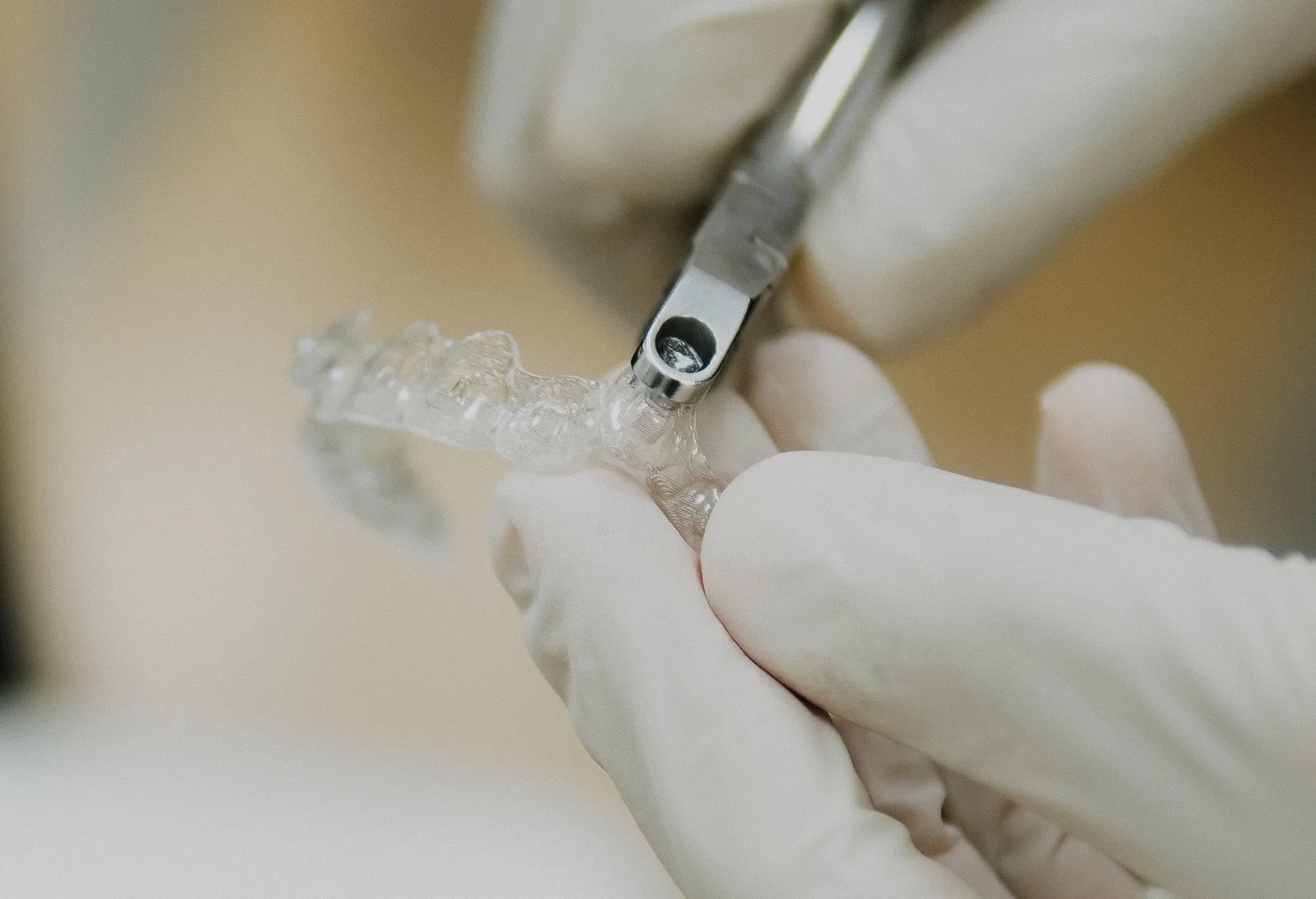
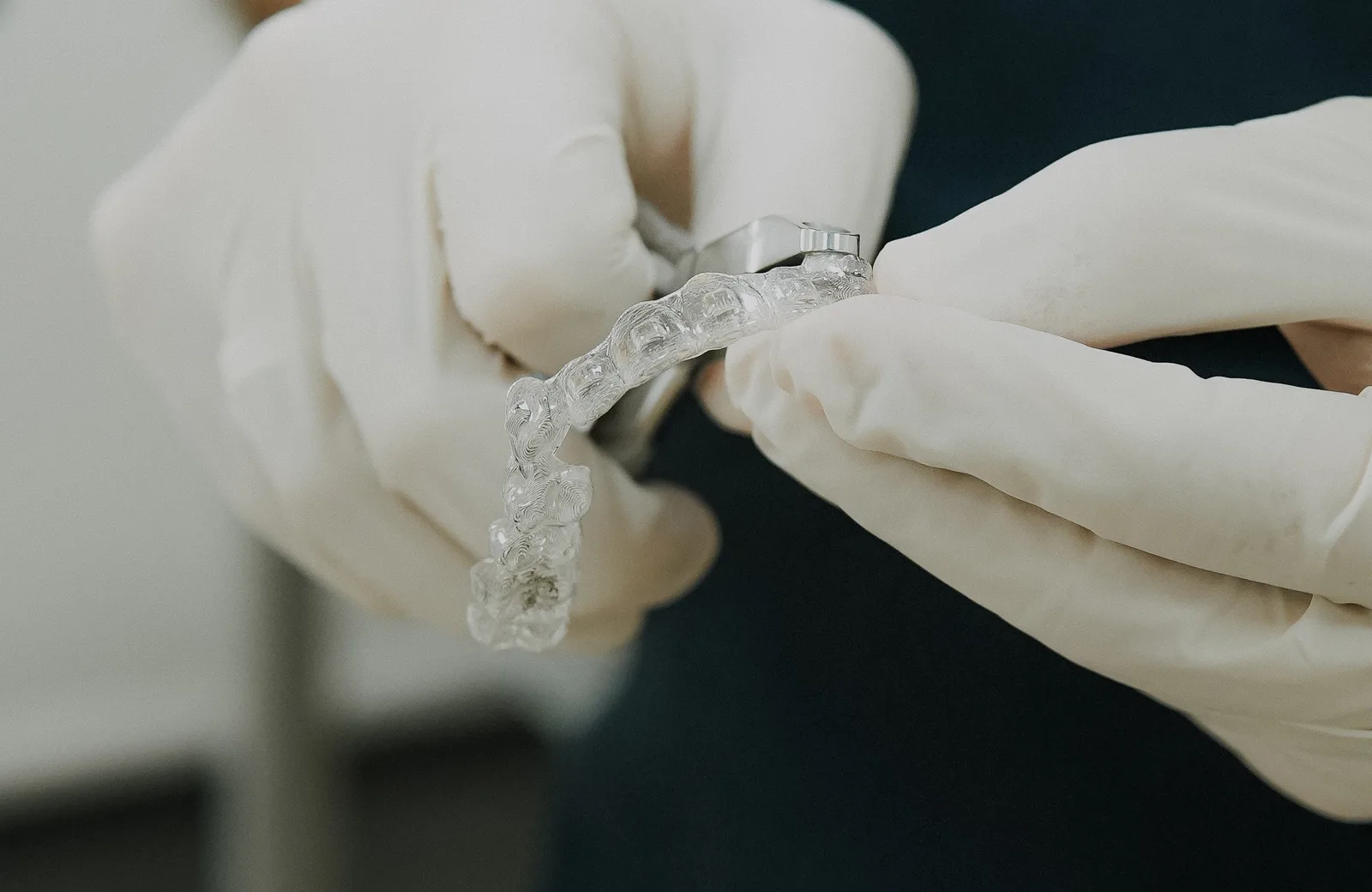
Spark is the clear aligner system of Ormco, part of Envista Holdings, and Invisalign is made by Align Technology; both are FDA-cleared sequential aligners made from the same broad family of polyurethane-based plastic. No published clinical study compares the two on results, treatment time or refinements, so neither can be called the more effective system on evidence. Independent laboratory data are mixed: in a study of 120 aligners, Invisalign shifted to another colour in coffee after 12 hours and after 7 days, while Spark was the brand that changed noticeably in water after 7 days (PubMed 39348237). Mosdent provides Invisalign, and this comparison is written with that disclosed.
- 01No published clinical study was found that compares Spark with Invisalign on outcome, predictability, treatment time or refinements; the claim that either system works better is not supported by trial data.
- 02Each manufacturer states that its material holds force longer and is clearer or more comfortable; Ormco's page footnotes its comparative claims to 'Data on file', which means the data have not been published (ormco.be, Spark product page).
- 03In a laboratory study of 120 aligners (40 Invisalign, 40 Spark and 40 QuickSmile), Invisalign shifted to another colour in coffee after 12 hours and after 7 days, while Spark showed a noticeable change in water after 7 days (PubMed 39348237).
- 04Force loss is a property of aligner plastics in general: a systematic review of ageing studies reported that force decay of 40-90% typically occurred within 48 h, with polyurethane-based aligners generally more susceptible than PETG-based ones (PubMed 42709287).
- 05The 510(k) summary for Spark (K203737) names the Invisalign System (K143630) as its predicate device and states that clinical testing has not been conducted on the product, so FDA clearance is not evidence that one system outperforms the other.
- 06The fee follows the case and not the logo: in a cohort of 404 Invisalign patients, the features of the starting malocclusion predicted both the number of aligners and the treatment duration (PubMed 42464015).
/ The companies behind Spark and Invisalign
Spark vs Invisalign starts with two different companies and two different commercial histories, rather than two products sold directly to patients. Spark clear aligners are a product of Ormco, which belongs to Envista Holdings Corporation; Envista's annual report says its orthodontic products are marketed under the Ormco, Damon, Insignia, AOA and Spark brands, and that the customers of this business are primarily orthodontists. Invisalign is made by Align Technology, Inc.; the manufacturer states that it was founded in 1997, and Align's annual report gives its headquarters as Tempe, Arizona.
This matters because both systems are planned through a clinic. The annual reports describe treatment plans sold to the clinic, with refinement aligners handled inside each company's plan structure rather than as a retail product chosen from a shelf. Envista says its aligner treatment plans consist of the initial shipment and optional refinement shipments at no additional charge, while Align says that in certain regions it offers streamlined configurations with limited or no additional aligners and the option to purchase additional aligners separately.
The size of the published company records is also different. Envista reports that it has expanded Spark manufacturing capacity since 2020 and shipped its one millionth Spark case in 2025. Align states that over the past 28 years doctors have treated over 22 million patients with the Invisalign System. Mosdent, a dental hospital in Bahçelievler, Istanbul, provides clear aligner treatment with Invisalign in its orthodontics department, so this comparison is written by a clinic that works with Invisalign.
/ TruGEN and SmartTrack aligner material claims
Aligner material claims for TruGEN and SmartTrack should be read as manufacturer statements unless they have been tested in published independent studies. Envista states that Spark is designed for mild to complex malocclusion and is made with TruGEN and TruGEN XR materials. The same annual report says Spark is designed to deliver higher sustained force retention and a high level of transparency, with polished, scalloped edges intended to enhance patient comfort. Those are design statements from the manufacturer.
Ormco's own product page goes further. It states that TruGEN provides sustained force retention, better tooth contact area, and advantages in clarity, comfort and stain resistance; the footnote attached to these claims reads "Data on file", meaning the supporting data are held by the company and have not been published for independent scrutiny. Ormco also states that Spark reduces refinements by over 20%, but the footnote gives a DentalMonitoring data analysis dated April 2023, which is company data analysis rather than a peer-reviewed publication.
Align Technology makes a similar category of material claim for Invisalign. Its annual report states that SmartTrack is a patented, custom-engineered Invisalign material that provides gentle, more constant force, and that it maintains more constant force over a longer period of time than conventional aligner materials. The Invisalign manufacturer states that SmartTrack aligners are made of thermoplastic polyurethane and co-polyester, and that no other clear aligner uses SmartTrack material. The FDA 510(k) summary for Spark describes Spark material as a thermoplastic polyurethane-polyester composite resin and lists the same broad material type for its Invisalign predicate device, so the regulatory record places both systems in the same broad family of plastic. No independent published study of force retention, stress relaxation or surface roughness of Spark TruGEN material was found in PubMed.
/ Independent laboratory studies of Spark aligners vs Invisalign
Spark aligners vs Invisalign has been studied in laboratories for staining, surface behaviour and cell culture outcomes, but these studies do not measure treatment speed, comfort or tooth movement in patients. In one laboratory study of 120 aligners, with 40 Invisalign, 40 Spark and 40 QuickSmile samples immersed in coffee or distilled water, Invisalign shifted to another colour in coffee after 12 hours and after 7 days, while Spark in coffee was barely noticeable at 12 hours and appreciable after 7 days (PubMed 39348237). In the same study, Spark was the brand that showed a noticeable colour change after 7 days in distilled water, while Invisalign and QuickSmile changed only slightly in water, so the staining findings cut both ways (PubMed 39348237).
Other laboratory evidence is broader than this two-brand comparison. An in vitro study using curcumin solutions found that after 12 h in the 10 µg/ml solution all aligner samples had at least an appreciable colour change, and after 7 days most materials had changed extremely markedly; polyurethane-based aligners were more susceptible to surface morphology changes than PET-G-based aligners (PubMed 40993680). A systematic review of 95 studies on aligner ageing reported that force decay of 40-90% typically occurred within 48 h, while findings on hardness, roughness and stiffness were inconsistent (PubMed 42709287). The same review found the greatest colour change with coffee, with a weighted mean ΔE of 70.9, compared with tea at 18.4 and red wine at 11.5 (PubMed 42709287).
Surface and cell-culture studies also need narrow reading. A comparative in vitro study found Spark had a more water-attracting surface than Invisalign, bacterial colony counts were minimal for all tested aligners, and cytocompatibility was above 70% for all three brands tested (PubMed 41007143). Another laboratory study found pronounced cytotoxic effects in vitro for Invisalign and Spark, while a different study that did not include Spark found high biocompatibility for Invisalign, showing that cell-culture results vary with the test method and do not measure patient effects (PubMed 40762314) (PubMed 42146859).
/ Clinical results for treatment duration and effectiveness
Comparing clear aligner providers based on treatment duration and effectiveness is limited by one central gap: no published clinical study was found that directly compares Spark with Invisalign on outcome, predictability of tooth movement, treatment time or number of refinements. The clinical evidence can show what has been measured for Invisalign and what has been measured in digital planning studies, but it cannot prove that one of these two systems gives better results than the other. The absence of a Spark head-to-head clinical trial is a gap in the published record, not evidence that Spark performs worse.
One pilot study submitted the records of 10 patients with standardised prescriptions to four aligner companies, including Invisalign and Spark. The virtual treatment plans differed significantly in the number of aligners, number of attachments and final canine relationship, and ClearCorrect and Spark showed deficiencies in planning a bilateral canine Class I relationship; the study compared digital plans, not treated patients (PubMed 41128735). That makes it useful for seeing how software outputs can differ, but it does not tell a patient which brand finishes treatment faster.
The Invisalign clinical record is larger. In a prospective clinical study of 38 Invisalign patients, the mean accuracy across all tooth movements was 50%, with the highest accuracy for buccal-lingual crown tip at 56% and the lowest for rotation at 46%; no equivalent published accuracy study exists for Spark (PubMed 32620479). In a separate study, changing from the previous Invisalign material to SmartTrack did not significantly change Peer Assessment Rating score reduction (PubMed 34334270). A survey of 72 Invisalign patients who changed materials during treatment rated SmartTrack as causing less maximum pain, 2.8 versus 3.8 on a 0 to 10 scale, while the authors stated that clinical effectiveness still needed investigation (PubMed 27778051).
/ FDA clearance and Spark aligners reviews
Spark aligners reviews should not treat FDA clearance as proof that Spark or Invisalign performs better. The FDA database records the first 510(k) clearance of Spark as K182826, the Ormco Spark Aligner System, with a decision date of 10/11/2018. It also records later Spark Clear Aligner System clearances K203737, K240501 and K250487, all under product code NXC, sequential aligner.
The FDA database also records the first clearance of the Align Technology aligner as K981095, the Align System, with a decision date of 09/08/1998. A recent Invisalign System clearance is recorded as K252380 with a decision date of 08/29/2025, under the same product code NXC as Spark. These entries show that both systems sit in the same regulatory product category, but a product code is not a clinical comparison.
The Spark 510(k) summary explains the limit clearly. It names the Invisalign System K143630 as Spark's primary predicate device and states that clinical testing was not conducted on the product, because 510(k) clearance rests on substantial equivalence to an existing device shown through non-clinical testing. That means FDA clearance is a regulatory pathway for market access, rather than evidence that one system gives shorter treatment, fewer refinements or better tooth movement than the other. Patient reviews can describe individual experience, but they cannot replace a controlled clinical comparison that has not been published.
/ What decides Spark aligners cost and Invisalign fees
Spark aligners cost and Invisalign fees are mainly driven by case complexity, the number of aligners, refinements and retention, rather than by a single brand name alone. The Invisalign manufacturer states that the doctor determines treatment cost based on how complex the case is and how many aligners are needed. Published Invisalign studies support that structure, because starting malocclusion and refinement needs are linked to aligner numbers and treatment duration. No price figure or cheaper-brand claim follows from the published evidence here.
In a retrospective cohort of 404 Invisalign patients from one practice, the mean number of prescribed aligners was 72.21 and the mean number of used aligners was 65.63; starting features such as molar and canine relationships, maxillary crowding, overjet, overbite and missing or extracted posterior teeth predicted both the number of aligners and treatment duration (PubMed 42464015). In another study of 355 Invisalign patients, treatment duration increased as the number of refinements increased, most patients improved after the first refinement, and no patient improved further when refinements were continued after 3 (PubMed 35868952).
A systematic review of 20 clinical studies found that refinement after the first aligner series was associated with malocclusion complexity, extraction treatment, interproximal reduction strategies, severe spacing and tooth movements with reduced predictability, such as rotations, intrusion and transverse expansion (PubMed 42442043). Retention also belongs in the total treatment plan. A Cochrane review of retention included 47 studies with 4377 participants and rated the evidence comparing retainer types as low to very low certainty; retention follows active treatment with any aligner brand, so the retainer plan is part of the overall fee (PubMed 37219527). For a separate discussion of fee structure in Türkiye, see Invisalign cost in Turkey.
/ Choosing between clear aligner brands in Türkiye
Choosing between clear aligner brands in Türkiye should start with diagnosis, case complexity and the orthodontist's plan, rather than a claim that Spark or Invisalign is the universal winner. A systematic review and meta-analysis of 15 trials involving 1084 patients found no significant differences in treatment quality or duration between clear aligners and fixed appliances in non-extraction cases, found fixed appliances superior in extraction cases, and concluded that case complexity and patient compliance should guide appliance choice (PubMed 41127933). That evidence concerns clear aligners as a category, so it does not settle Spark versus Invisalign.
Availability is a separate question from evidence. Align Technology runs an official Turkish-language Invisalign website for Türkiye that includes a doctor locator. For Spark, no primary source, meaning a manufacturer page, company filing or official register, was found that states whether Spark is supplied to clinics in Türkiye, so availability has to be confirmed with the individual orthodontist.
For a patient comparing brands, the practical question is whether the proposed plan explains the diagnosis, planned tooth movements, attachment strategy, likely refinement process and retention phase. If two orthodontists propose different brands, asking each to explain the same points may be more useful than comparing material slogans. Readers comparing wider clear aligner options can also use clear aligner brands compared, or the Türkiye-focused comparison of Invisalign, Orthero and ClearCorrect compared.
Let’s plan the right treatment together.
Free Assessment→- 1.Domingo-Jiménez T, González-Olmo MJ, Nieto-Moraleda C, Pérez-Chicharro M, Romero-Maroto M. Colourimetric changes experienced in three types of aligners according to the L'Eclairage Commission. Eur J Orthod 2024;46(5):cjae047.
- 2.He K, Xu M, Liao W, Yao Y. Evaluation of color stability and material surface stability of different types of clear aligners under curcumin staining in vitro. BMC Oral Health 2025;25(1):1424.
- 3.Almotairy N, Aleisa F, Alshammari AK. Ageing effects on chemical, physical, mechanical, and morphological properties of clear aligners - a systematic review. Prog Orthod 2026;27(1):40.
- 4.Srinivasan B, Padmanabhan S, Srinivasan S. Comparative evaluation of physical and mechanical properties of clear aligners - a systematic review. Evid Based Dent 2024;25(1):53.
- 5.Martínez Gil-Ortega A, Paz-Cortés MM, Viñas MJ, Cintora-López P, Martín-Vacas A, Gil J, et al. Effect of Surface Wettability and Energy on Bacterial Adhesion to Dental Aligners: A Comparative In Vitro Study. Bioengineering (Basel) 2025;12(9):898.
- 6.Nunes C, Mestre C, Fernandes IP, Serra M, Marto CM, Gonçalves AC, et al. Brand-Specific Differences in the Cytotoxicity of Clear Aligner Materials. Orthod Craniofac Res 2025. doi:10.1111/ocr.70009 (online ahead of print).
- 7.Das RP, Gangurde PV, Ranjan A, Gaikwad SS, Sawant HR, Karia M. Cytotoxicity evaluation of different clear aligner systems on human primary gingival fibroblasts: an in vitro study. Biomater Investig Dent 2026;13:46006.
- 8.Telles V, Mattos CT, Copello F, Doughan MB. A pilot study comparing virtual treatment setups among clear aligner companies. Dental Press J Orthod 2025;30(3):e2524243.
- 9.Haouili N, Kravitz ND, Vaid NR, Ferguson DJ, Makki L. Has Invisalign improved? A prospective follow-up study on the efficacy of tooth movement with Invisalign. Am J Orthod Dentofacial Orthop 2020;158(3):420-425.
- 10.Griffith M, Fields HW, Ni A, Guo X, Lee DJ, Deguchi T. Comparison of 2 Invisalign tray generations using the Peer Assessment Rating index. Am J Orthod Dentofacial Orthop 2021;160(5):718-724.
- 11.Bräscher AK, Zuran D, Feldmann RE Jr, Benrath J. Patient survey on Invisalign treatment comparing the SmartTrack material to the previously used aligner material. J Orofac Orthop 2016;77(6):432-438.
- 12.Gkinosati AA, Durgnat C, Koumpia E, Pandis N, Laspos C, Papadopoulou AK. The Impact of Malocclusion Severity on the Number of Prescribed, Used Aligners and Treatment Duration; A Retrospective, Singe-Centre, Cohort Study. Orthod Craniofac Res 2026. doi:10.1111/ocr.70167 (online ahead of print).
- 13.Arqub SA, Banankhah S, Sharma R, Da Cunha Godoy L, Kuo CL, Ahmed M, et al. Association between initial complexity, frequency of refinements, treatment duration, and outcome in Invisalign orthodontic treatment. Am J Orthod Dentofacial Orthop 2022;162(3):e141-e155.
- 14.Nogueira Matos K, Belline da Silva T, Matos de Faria Almeida L, de Faria Almeida M, Dos Santos Dantas Guimarães HH. Clinical, biomechanical, and digital factors associated with refinement after the first series of clear aligners: A systematic review. Int Orthod 2026;24(4):101211.
- 15.Martin C, Littlewood SJ, Millett DT, Doubleday B, Bearn D, Worthington HV, et al. Retention procedures for stabilising tooth position after treatment with orthodontic braces. Cochrane Database Syst Rev 2023;5(5):CD002283.
- 16.Alhafi ZM, Hajeer MY, Alam MK, Jaber ST. Quality and stability of orthodontic treatment outcomes with clear aligners versus fixed appliances: a systematic review and meta-analysis. Eur J Orthod 2025;47(6):cjaf091.
- 17.Envista Holdings Corporation. Annual Report on Form 10-K for the fiscal year ended December 31, 2025. U.S. Securities and Exchange Commission.
- 18.Align Technology, Inc. Annual Report on Form 10-K for the fiscal year ended December 31, 2025. U.S. Securities and Exchange Commission.
- 19.U.S. Food and Drug Administration. 510(k) Summary K203737, Spark Clear Aligner System, Ormco Corporation.
- 20.U.S. Food and Drug Administration. 510(k) Premarket Notification database, record K182826, Ormco Spark Aligner System.
- 21.U.S. Food and Drug Administration. 510(k) Premarket Notification database, record K981095, Align System.
- 22.Ormco. Spark clear aligner product page (manufacturer statements, footnoted 'Data on file').
- 23.Align Technology. Invisalign frequently asked questions (manufacturer statements on SmartTrack composition, company founding and cost).