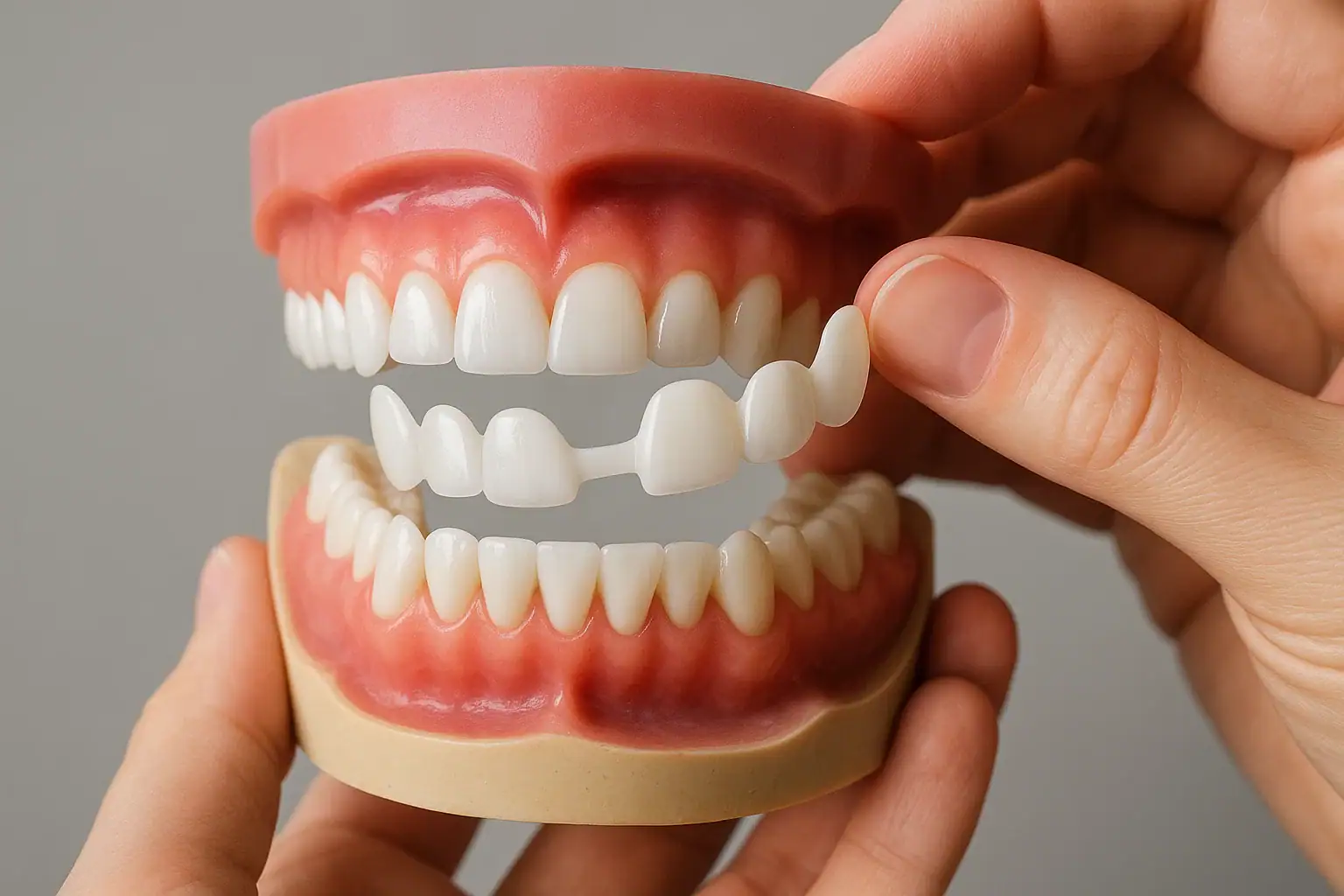
Clip-on veneers, also sold as snap-on veneers, are removable resin or plastic shells that sit over the existing teeth with no drilling, no anaesthesia and no bonding, so they change appearance only and treat nothing underneath. They are made from an impression taken either with a mail-order kit or at a clinic, and their service life has not been measured in clinical studies, whereas bonded ceramic laminate veneers pooled 93.70% to 96.81% survival at 10.4 years (PubMed 39523553). In a survey of 466 people about snap-on veneers, most users reported discomfort and did not recommend them (PubMed 39463474). Decay, gum disease and alignment problems remain untreated beneath the shell.
- 01A clip-on veneer is a removable appliance, not a restoration: nothing is cut from the tooth and nothing is cemented, which makes it fully reversible and also purely cosmetic.
- 02Durability separates the two categories clearly. Clip-on service life has not been measured clinically, while bonded ceramic veneers have about ten years of pooled survival data; turnaround is 1 to 3 weeks against 2 to 4 weeks.
- 03User experience is not uniformly positive: in a 466-participant survey on snap-on veneers, most respondents were reluctant to use them because of concerns about dental damage and appearance, and most who had used them reported discomfort and would not recommend them (PubMed 39463474).
- 04Price tracks how the appliance is made, from about 100 to 300 US dollars for prefabricated models, 400 to 800 for custom-made, and 800 to 1,500 for lab-made dentist-quality versions.
- 05They are not eating appliances. Hard and sticky food should be avoided while wearing them, they need daily cleaning with a soft brush, and they must not be washed in hot water because the material can warp.
Clip-on veneers have become a popular alternative for those seeking a quick and non-invasive way to achieve a perfect smile . Unlike traditional veneers, clip-ons do not require tooth reduction or dental procedures, making them a convenient and affordable option.
What Are Clip-On Veneers?
Clip-on veneers, also known as snap-on veneers or removable dental veneers, are custom-made shells that fit over your existing teeth. They are designed to improve the appearance of your smile by covering imperfections such as gaps, stains, or misalignment.
Key Features:
- Made from dental resin or plastic
- Removable and reusable
- Custom-molded to fit your teeth
- No drilling or anesthesia required
- Instant aesthetic enhancement
- Ideal for people with dental phobia or time constraints
/ How Clip-On Veneers Work and Their Types
Clip-on veneer types differ by fit, fabrication, coverage, and intended duration.
1. Standard Clip-On Veneers
Pre-fabricated models that offer general sizing and quick delivery but may lack a perfect fit.
2. Custom Clip-On Veneers
Created using a mold of your teeth for better accuracy, comfort, and appearance.
3. Dentist-Quality Clip-On Veneers
Professionally fabricated by dental labs using higher-grade materials for a natural look and durability.
4. Upper vs. Lower Veneers
Some products are available as upper-only, lower-only, or full sets depending on the desired coverage.
5. Temporary Clip-On Veneers
Designed for short-term use during specific events or photo sessions.
How Do Clip-On Veneers Work?
- Impression: Users take an impression of their teeth using a DIY kit or visit a dental clinic.
- Fabrication: The veneer is crafted based on the mold.
- Fitting: Once delivered, the veneer is clipped onto the teeth without any adhesives.
They can be worn daily or occasionally, depending on the user's needs.
Benefits of Clip-On Veneers
- Instant transformation of smile
- No dental procedure required
- Affordable compared to permanent veneers
- Pain-free and non-invasive
- Removable and reusable
- Suitable for special occasions or daily use
- Boosts confidence in social and professional settings
/ Practical Considerations for Clip-On Veneers
Clip-on veneers have practical limits, pricing factors, care needs, suitability considerations, and safety guidance.
Limitations of Clip-On Veneers
- May feel bulky at first
- Not suitable for eating hard or sticky foods
- Less durable than permanent veneers
- May not look as natural up close
- Require regular cleaning to avoid staining and plaque buildup
- Not suitable for underlying oral health issues
Clip-On Veneers vs. Traditional Veneers
| Feature | Clip-On Veneers | Traditional Veneers |
|---|---|---|
| Procedure | Non-invasive | Involves tooth reshaping |
| Cost | Lower | Higher |
| Durability | Not measured | Long-term data |
| Appearance | Cosmetic improvement | Natural, long-term aesthetics |
| Reversible | Yes | No |
| Customization | Moderate to High | Very High |
| Turnaround Time | 1–3 weeks | 2–4 weeks |
Cost of Clip-On Veneers
The price of clip-on veneers depends on the brand, customization, and materials:
- Standard Models: $100 – $300
- Custom-Made Veneers: $400 – $800
- Dentist-Quality Clip-Ons: $800 – $1,500
Factors Influencing Price:
- Material quality
- Whether it’s a full or partial arch
- Type of delivery (DIY vs. dentist)
- Additional features like color customization
Care and Maintenance Tips
- Clean them daily with a soft brush and mild soap
- Avoid eating hard or sticky foods while wearing
- Store in a protective case when not in use
- Do not use hot water for cleaning, as it may warp the material
- Avoid chemical-based mouthwashes that can damage the finish
- Regularly inspect for cracks or discoloration
Who Should Consider Clip-On Veneers?
Ideal for individuals who:
- Want a temporary aesthetic solution
- Have stained, chipped, or misaligned teeth
- Are not ready for permanent dental work
- Need an affordable smile enhancement
- Want to test the look of veneers before committing permanently
- Work in performance or appearance-based industries
Are Clip-On Veneers Safe?
Yes, when used as directed and made from biocompatible materials. However, it’s important to:
- Avoid prolonged wear beyond recommended hours
- Ensure proper fit to avoid gum irritation
- Regularly clean and inspect for wear and tear
- Consult your dentist if you experience discomfort or oral changes
/ Clip-On Veneer Questions and Conclusion
Frequently Asked Questions (FAQs)
Can you eat with clip-on veneers?
It’s not recommended to eat with them on, especially hard or chewy foods, as this can damage the veneers.
How much are clip-on veneers?
Prices range from $100 to $1,500 depending on the quality and customization.
Are clip-on veneers any good?
They’re a good temporary solution for enhancing your smile, but they do not replace professional dental treatments.
Are clip-on veneers bad for your teeth?
Not if used properly and cleaned regularly. Poor hygiene or improper fit may lead to gum irritation.
Are clip-on veneers good for everyday use?
They can be, but many users prefer them for special occasions due to comfort and practicality.
How long do clip-on veneers last?
No clinical study has measured this; it depends on care and material quality.
Can clip-on veneers fix all dental issues?
No. They are purely cosmetic and do not treat decay, gum disease, or severe alignment problems.
Do clip-on veneers look natural?
High-quality and custom-made veneers tend to look more natural, but pre-fabricated ones may appear artificial.
Can children use clip-on veneers?
They are not recommended for children due to size and fit concerns unless specifically designed by a dental professional.
What colors do clip-on veneers come in?
Most brands offer shades from bright white to natural ivory to better match your existing teeth or preferences.
Conclusion
Clip-on veneers offer a convenient and affordable way to enhance your smile without permanent dental work. Ideal for temporary or cosmetic purposes, they provide a reversible solution for improving aesthetics. Whether you're preparing for a special event or exploring a new smile, clip-on veneers may be the right choice for you.
Let’s plan the right treatment together.
Free Assessment→- 1.Samman M, Tashkandi A, Alsharif M, Ashi H, Bahanan L. User Insights into Fake Snap-on Veneers: Perceptions and Experiences. Clin Cosmet Investig Dent 2024;16:419-429. PubMed 39463474
- 2.Klein P, Spitznagel FA, Zembic A, Prott LS, Pieralli S, Bongaerts B, et al. Survival and Complication Rates of Feldspathic, Leucite-Reinforced, Lithium Disilicate and Zirconia Ceramic Laminate Veneers: A Systematic Review and Meta-Analysis. J Esthet Restor Dent 2025;37:601-619. PubMed 39523553