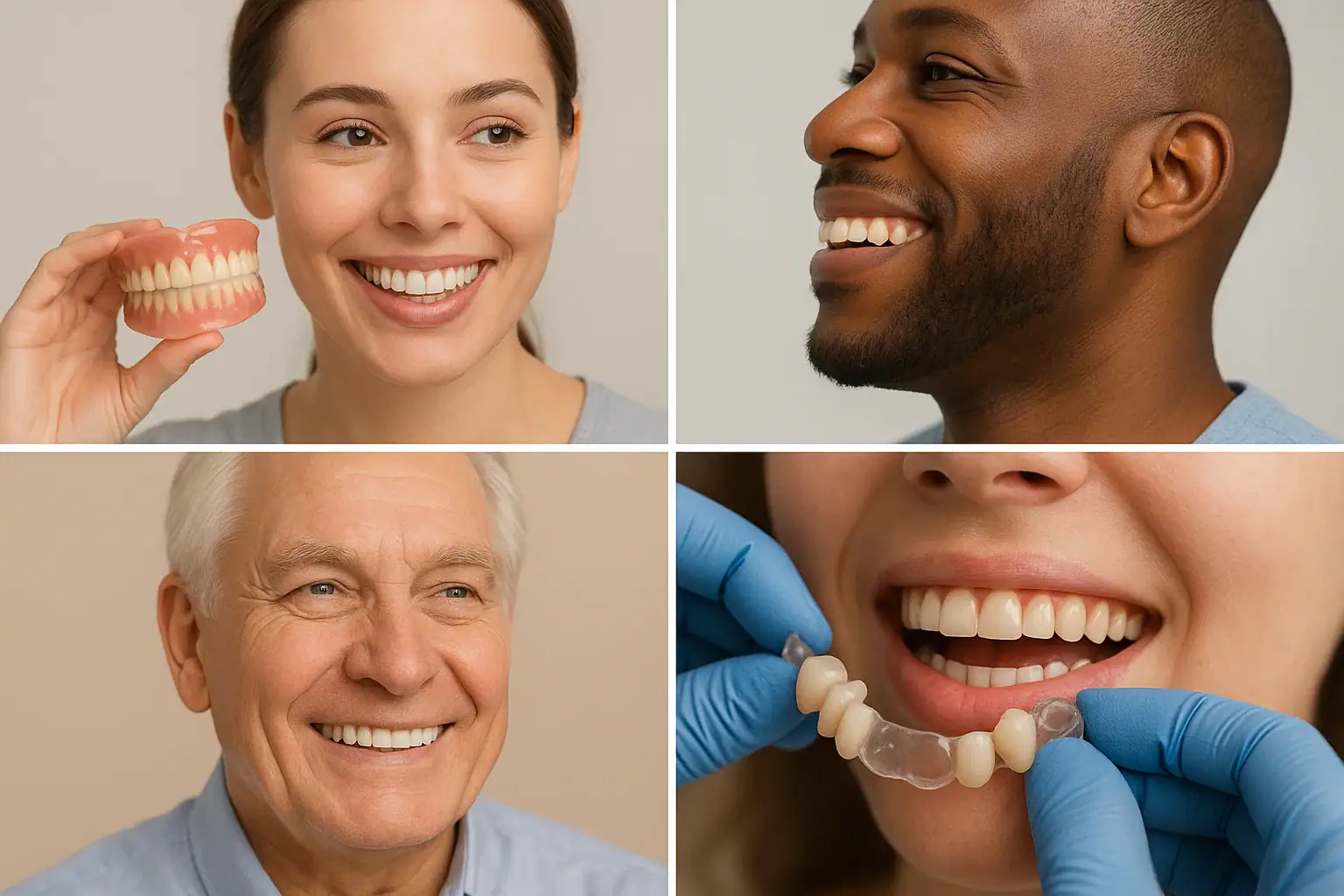
Fake teeth is an umbrella term covering removable dentures, fixed bridges, implant-supported crowns and veneers, and the four are not interchangeable: dentures and implants replace missing teeth, while veneers only resurface teeth that are still present. What you are eligible for is set by how much bone and tooth structure remains. At the fixed end the medium-term data is strong: across 35 studies, implant-supported single crowns showed an estimated 5-year survival of 98.3% for metal-ceramic (n = 4,363) and 97.6% for zirconia (n = 912) (PubMed 30328190). Cost, lifespan and daily maintenance differ sharply between the options.
- 01Replacement and resurfacing are different jobs: implants and dentures replace a missing tooth, while a veneer bonds to the front of a tooth that is still there and restores nothing structurally.
- 02Implant-supported crowns carry the strongest medium-term numbers: across 35 studies, estimated 5-year survival was 98.3% for metal-ceramic (n = 4,363) and 97.6% for zirconia single crowns (n = 912) (PubMed 30328190).
- 03Ceramic veneers hold up past a decade: a meta-analysis of 29 studies pooled survival at 96.13% for feldspathic, 93.70% for leucite-reinforced and 96.81% for lithium disilicate laminate veneers at 10.4 years (PubMed 39523553).
- 04The cost order is stable even where the figures move: full dentures $500-2,500 per arch, porcelain veneers $900-2,500 per tooth, single implants $3,000-6,000, full-arch implant work $15,000-30,000 and above.
- 05Dentures rest on tissue rather than in bone, so ridge resorption continues underneath them and a reline or replacement is expected every five to eight years.
Smiling with confidence is a universal desire, but missing teeth can often hinder that. Beyond self-consciousness, gaps in the smile can disrupt everyday activities, challenging your ability to speak clearly, eat comfortably, or laugh without hesitation.
At Mosdent in Istanbul, a single implant with its placement starts from €300. That is a starting price, not a quote: the figure that applies to you is written down after a free examination.
In today’s dental landscape, “fake teeth” is an umbrella term for a variety of prosthetic solutions ranging from dentures and bridges to veneers and dental implants. Dentures, bridges and implants are designed to restore both appearance and function, while veneers primarily address surface aesthetics. These restorative and cosmetic options naturally integrate into modern dentistry, helping individuals reclaim not just their smiles but also their overall quality of life.
Why it matters : A complete smile does more than boost aesthetic appeal, it is vital for proper jaw structure, nutrition, speech, and emotional well-being. Tooth loss can accelerate bone deterioration, alter facial fullness, and diminish bite function, affecting overall health. Conversely, well-chosen prosthetics support facial symmetry, maintain bone integrity, and instill self-confidence empowering people to live, laugh, and dine without hesitation.
Whether you're restoring lost teeth or enhancing a natural smile, understanding your options is the first step toward reclaiming your confidence and oral health.
/ Explore Dentures and Dental Implants for Fake Teeth
For replacing missing or damaged teeth, there are several key options, each with its own advantages, limitations, and use cases.
Dentures
- Full Dentures: These are complete sets of removable prosthetic teeth that replace all the teeth in either the upper or lower jaw, sometimes both. Held in place by suction or adhesive, full dentures restore chewing ability and aesthetics. However, they often require an adjustment period and regular maintenance.
- Partial Dentures: Designed for those missing just a few teeth, partial dentures fit around the remaining natural teeth and are supported by clasps or precision attachments. They help prevent adjacent teeth from drifting and are more affordable than implants, although they may offer less stability.
Dental Implants
- Single Tooth Implants: This solution replaces one missing tooth by inserting a titanium (or zirconia) post into the jawbone, allowing a dental crown to be attached later. Implants mimic a natural tooth root, preserving bone structure and offering excellent stability. Survival rates for single implants range very high, around 93–98% over five years.
- All-on-4/All-on-6 Implants: Ideal for full-arch replacements, this method utilizes four (or six) implants to support an entire upper or lower set of prosthetic teeth. Often performed with immediate loading, this technique offers patients a fixed, non-removable solution that feels and functions like natural teeth.
/ Veneers and Clinical Selection in Fake Teeth Options
Veneers
- Porcelain Veneers: These are ultra-thin ceramic shells custom-made in a lab and bonded to the front surfaces of teeth to enhance appearance. Known for their durability, stain resistance, and lifelike aesthetics, porcelain veneers showed pooled survival of 96.13% for feldspathic and 96.81% for lithium disilicate designs at 10.4 years in a meta-analysis of 29 studies (PubMed 39523553).
- Composite Resin Veneers: Applied directly in the dental office using resin material, these veneers offer a cost effective, usually one visit solution. They are less durable, with 88% pooled survival over 24 to 97 months in randomized trials (PubMed 38035903), but they are easier to repair and involve minimal tooth preparation.
Each option offers a different balance of cost, function, appearance, and maintenance, whether you need to replace every tooth, just one, or enhance the look of your existing smile.
Which one you end up with is a clinical decision rather than a shopping choice: it depends on how much bone and tooth structure is left. Removable and fixed replacements are grouped under prosthodontics, and where a root has to be replaced first we start with dental implants and restore afterwards.
/ Fake Teeth Cost Breakdown by Type
1. Dentures (Full & Partial)
Cost:
- Full Dentures : $500–$2,500 per arch (can go higher for premium materials)
- Partial Dentures : $300–$1,500 depending on complexity and materials
✅ Pros:
- Most affordable solution for full-tooth loss
- Quick to fabricate (often 1–2 weeks)
- Non-invasive (no surgery)
- Can improve facial appearance and restore basic function
❌ Cons:
- Can shift or slip if not fitted properly
- Requires daily removal and cleaning
- Bone loss in the jaw may continue since there's no root stimulation
- May need replacement every 5–8 years
Best For:
- Elderly patients or those on a tight budget
- People with significant bone loss or poor bone quality
- Patients who need a fast, non-surgical solution
2. Dental Implants (Single Tooth & All-on-4/6)
Cost:
- Single Tooth Implant : $3,000–$6,000 (includes implant + crown)
- All-on-4/6 Implants : $15,000–$30,000+ per arch
✅ Pros:
- Permanent, secure, and stable
- Prevents bone loss by mimicking the natural tooth root
- Functions almost identically to real teeth
- No impact on adjacent healthy teeth
❌ Cons:
- High upfront cost
- Requires surgery and healing time (3–6 months for full osseointegration)
- Not suitable for patients with uncontrolled diabetes, smokers, or poor bone density without grafting
Best For:
- Patients wanting a long-term, natural-feeling solution
- Those who can afford a higher initial investment
- Healthy individuals with sufficient jawbone structure (or candidates for grafting)
3. Veneers (Porcelain & Composite)
Cost:
- Porcelain Veneers : $900–$2,500 per tooth
- Composite Veneers : $250–$1,000 per tooth
✅ Pros:
- Instantly improves appearance (whiteness, alignment, shape)
- Porcelain is highly durable and stain-resistant
- Composite veneers are cost-effective and can be fixed in one visit
❌ Cons:
- Only cosmetic, doesn't replace missing teeth
- May require enamel removal (irreversible for porcelain)
- Composite veneers stain more easily and are less durable
Best For:
- People with discolored, chipped, or slightly misaligned teeth
- Those looking for a smile makeover without orthodontics
- Patients who already have healthy teeth and gums
/ Quick Recap Table
| Type | Cost (Approx) | Pros | Cons | Best For |
|---|---|---|---|---|
| Full Dentures | $500–$2,500/arch | Affordable, fast, non-invasive | May slip; bone loss continues underneath | Full tooth loss, tight budget |
| Partial Dentures | $300–$1,500 | Affordable, removable, replaces several teeth | Clasps are visible, not as stable as implants | Several missing teeth, healthy surrounding teeth |
| Single Implants | $3,000–$6,000/tooth | Natural function prevents bone loss | Expensive, surgical, long healing | Missing one or few teeth, healthy gums/jaw |
| All-on-4/6 Implants | $15,000–$30,000/arch | Fixed, long-lasting, stable | Very costly, surgery required | Full arch replacement with durability |
| Porcelain Veneers | $900–$2,500/tooth | Aesthetic, durable, lifelike appearance | Irreversible, costly | Smile makeover, healthy existing teeth |
| Composite Veneers | $250–$1,000/tooth | Budget-friendly, reversible | Stains more easily, less durable | Minor aesthetic issues, limited budget |
Key Cost Insights
- Dentures are the most affordable way to restore multiple teeth, with significant variance based on material and customization.
- Implants offer long-term durability and improved bone health, but come with a much higher initial investment.
- Veneers are strictly cosmetic, and the cost varies widely by material. Porcelain offers better longevity and aesthetic appeal, while composite is more budget-friendly.
What Affects the Final Cost?
- Material quality : High-end acrylic, custom shading, metal frameworks, or premium ceramics all increase cost.
- Additional procedures : Tooth extraction, bone grafts, sinus lifts, anesthesia, or X-rays add substantial expense, anywhere from a few hundred to several thousand dollars.
- Location & Provider expertise : Urban clinics, accredited labs, and specialist providers tend to cost more.
- Insurance & financing :
- Implants may be partially covered (up to ~50%) depending on policy.
- Many clinics offer financing plans: CareCredit, HSAs, and in-house options.
/ Veneers and Fake Teeth: The Real Difference
Veneers are not replacements for missing teeth. Instead, they're ultra thin shells made of porcelain or composite resin that are custom fitted and bonded to the front of natural teeth. Their purpose is to enhance aesthetics rather than restore function like traditional prosthetics.
Purpose
Designed to mask cosmetic imperfections such as chips, cracks, discoloration, gaps, or slightly misaligned teeth, veneers offer a transformative " smile makeover " in a minimally invasive way. By preserving existing, structurally sound teeth and only enhancing their appearance, veneers align with both cosmetic and conservative dental goals.
Misconception
A common misconception is to label veneers as "fake teeth," but this doesn’t hold up under scrutiny. Unlike dentures or implants that replace missing teeth and, in the case of implants, replace tooth roots, veneers work with your natural dentition. While they dramatically improve aesthetics, veneers do not restore the underlying structure or function of a lost tooth. Rather, they conceal flaws on teeth already in place.
/ Choosing Fake Teeth for Your Goals
When selecting the best fake teeth solution, it's essential to weigh several key factors to ensure the choice aligns with your goals, budget, and oral health needs.
Consideration 1: Budget
- Dentures : The most affordable initial option. Costs range from a few hundred to a few thousand dollars, depending on material and customization.
- Veneers : Mid-range in cost, depending on material composite veneers are more affordable than porcelain, but often not covered by insurance if purely cosmetic.
- Implants : The highest upfront investment. Single tooth implants can range from $3,000–7,000, while full-arch “ All-on-4 /6” systems can cost $15,000–30,000 or more.
Tip : Consider long-term value. Implants typically require less follow-up work and can stay in function for many years, potentially making them more economical over time compared to dentures or veneers.
Consideration 2: Aesthetic Goals
- Dentures : Provide a complete smile restoration, but may not look or feel as natural as permanent solutions.
- Veneers : Ideal for cosmetic enhancement, covering stains, gaps, chips, and minor misalignments with minimal invasiveness.
- Implants : Offer the most realistic appearance and function, naturally mimicking natural teeth.
Tip : For a primarily cosmetic upgrade, veneers may suffice. If lost teeth need replacing, implants deliver the best aesthetic without sacrificing authenticity.
Consideration 3: Functionality Needs
- Dentures : Can restore general chewing and speaking ability, but might shift and provide reduced bite force.
- Veneers : Don’t restore teeth; purely aesthetic.
- Implants : Provide full chewing strength, stability, and preserve jawbone health through osseointegration.
Tip : If you enjoy a wide variety of foods or speak professionally, implants provide the most durable and natural-feeling solution.
/ Choosing Fake Teeth Safely
Fake teeth selection depends on health, lifestyle, and dental consultation.
Consideration 4: Health and Dental Suitability
- Dentures : Minimal health requirements; suitable even with poor bone density.
- Veneers : Need healthy teeth and gums; not suitable if dental decay or structural issues exist.
- Implants : Require adequate bone structure and good general health; smokers, uncontrolled diabetics, or those needing bone grafting may have complications.
Tip : Try bone grafting for implants if needed. Otherwise, dentures or bridges might be more practical.
Consideration 5: Lifestyle and Maintenance
- Dentures : Require nightly removal, daily cleaning, and occasional relining.
- Veneers : Oral hygiene similar to natural teeth; avoid biting hard foods and protect against grinding.
- Implants : Care is identical to natural teeth, regular brushing, flossing, and check-ups.
Tip : If you'd prefer less daily hassle and desire a permanent solution, implants offer ease akin to natural teeth.
Consideration 6: Consultation with a Dental Professional
Your dentist plays a crucial role in guiding this decision. Expect:
- Comprehensive Evaluation : Examining oral health, X-rays, and bone density.
- Treatment Planning : Discussing options to match your budget, aesthetics, and functionality goals.
- Transparency on Risks & Timeline : Explaining procedures (e.g., enamel removal for veneers, surgical steps for implants).
- Insurance & Financing Guidance : Sharing what costs may be covered and payment options.
Crucial : Only a licensed dentist or prosthodontist can give personalized advice based on your unique oral anatomy and medical history
Choosing the right type of fake teeth depends on balancing your budget, cosmetic goals, functional needs, oral health, and lifestyle preferences, and getting tailored advice from your dental provider.
/ Frequently Asked Questions (FAQs)
Q1. What are fake teeth called?
Fake teeth are a general term that refers to several types of dental prosthetics:
- Dentures (full or partial, removable sets)
- Dental Implants (permanent, surgically placed fixtures that support replacement teeth)
- Veneers (thin covers for front-facing teeth)
Each serves a different purpose, some restore function, while others improve appearance.
Q2. How much do fake teeth cost?
The cost depends on the type, materials used, and your location :
- Dentures : $500–$2,500 per arch
- Veneers : $250–$2,500 per tooth
- Dental Implants : $1,500–$6,000 per tooth, or $15,000+ for full-arch options
Q3. Are veneers considered fake teeth?
No. Veneers are not fake teeth in the replacement sense.
They are thin cosmetic shells placed over your existing teeth to:
- Mask discoloration
- Fix chips, gaps, or minor misalignments
They improve appearance, not function or structure, and are best for those with healthy teeth looking for a smile upgrade.
Q4. How much are fake teeth implants?
Single dental implants typically range from $3000 to $6,000, depending on:
- Implant material (titanium or zirconia)
- Crown type (ceramic, porcelain)
- Any additional surgical work (e.g., bone grafts)
Q5. Which fake teeth option is best for me?
There’s no one-size-fits-all. The best option depends on:
- Your budget
- Aesthetic goals
- Oral health condition
- Functionality needs
Pro Tip : Schedule a consultation with a dental professional. They’ll evaluate your gums, bone structure, and bite to recommend the ideal prosthetic, be it dentures, implants, or veneers.
/ Final Thoughts: Finding the Right Smile Solution for You
Fake teeth are no longer a one-size-fits-all solution. Thanks to modern dentistry, you have a wide array of restorative and cosmetic options, from full and partial dentures to permanent dental implants and aesthetic veneers.
Choosing the right type of fake teeth depends on several personal factors:
- Your budget
- The condition of your oral health
- The level of aesthetic enhancement you’re looking for
- Your need for functionality in speaking and chewing
If you're missing teeth or unhappy with your smile, know that solutions exist for virtually every need and price range. Whether you're aiming for a full-mouth restoration with implants or just looking to correct a few cosmetic imperfections with veneers, the first step is always the same:
Consult with a qualified dental professional. They can assess your unique situation and guide you toward a treatment that fits your goals, lifestyle, and long-term health.
A complete, confident smile isn't just possible, it's more achievable than ever.
Let’s plan the right treatment together.
Free Assessment→- 1.Pjetursson BE, Valente NA, Strasding M, Zwahlen M, Liu S, Sailer I. A systematic review of the survival and complication rates of zirconia-ceramic and metal-ceramic single crowns. Clin Oral Implants Res 2018;29 Suppl 16:199-214. PubMed 30328190
- 2.Klein P, Spitznagel FA, Zembic A, Prott LS, Pieralli S, Bongaerts B, et al. Survival and Complication Rates of Feldspathic, Leucite-Reinforced, Lithium Disilicate and Zirconia Ceramic Laminate Veneers: A Systematic Review and Meta-Analysis. J Esthet Restor Dent 2025;37:601-619. PubMed 39523553
- 3.Lim TW, Tan SK, Li KY, Burrow MF. SURVIVAL AND COMPLICATION RATES OF RESIN COMPOSITE LAMINATE VENEERS: A SYSTEMATIC REVIEW AND META-ANALYSIS. J Evid Based Dent Pract 2023;23:101911. PubMed 38035903
- 4.Taylor M, Masood M, Mnatzaganian G. Complete denture replacement: a 20-year retrospective study of adults receiving publicly funded dental care. J Prosthodont Res 2022;66:452-458. PubMed 34645719