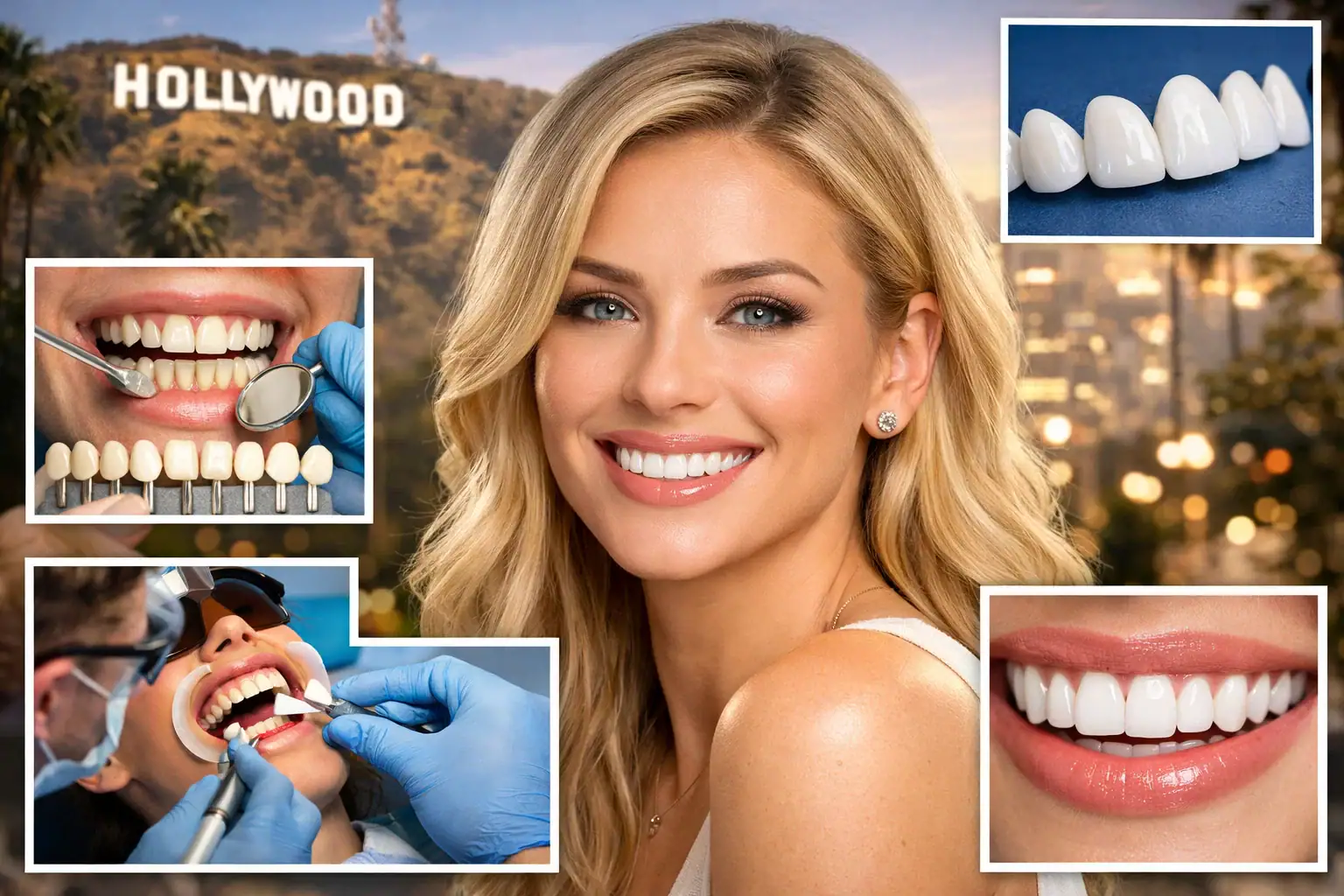
A Hollywood smile is a cosmetic dental makeover that redesigns colour, symmetry, proportion and gum line together rather than whitening teeth alone, and it is usually built from porcelain veneers, zirconia crowns, whitening, orthodontics and gum contouring. For durability, a meta-analysis of 29 clinical studies put ceramic laminate veneer survival at 96.13% for feldspathic, 93.70% for leucite-reinforced glass ceramic and 96.81% for lithium disilicate at 10.4 years (PubMed 39523553). Preparation removes enamel and is irreversible, so candidacy is assessed tooth by tooth.
- 01A Hollywood smile is a design decision rather than one procedure: veneers, crowns, whitening, orthodontics and gum contouring are combined around facial balance, lip support and gum line.
- 02Ceramic laminate veneers survive well at 10.4 years: 96.13% feldspathic, 93.70% leucite-reinforced glass ceramic and 96.81% lithium disilicate across 29 studies (PubMed 39523553).
- 03Complication rates separate the materials far more than survival does: at 10.4 years technical complications were 41.48% for feldspathic and 6.1% for lithium disilicate (PubMed 39523553).
- 04An earlier meta-analysis of 13 studies put overall porcelain and glass-ceramic veneer survival at 89% (95% CI 84-94) at a median 9 years, with fracture or chipping the most frequent failure at 4% (PubMed 26757327).
- 05Veneers and crowns answer different problems: a veneer covers the front surface of a structurally sound tooth, a crown covers the whole tooth when it is weakened.
What a Hollywood Smile Means
A Hollywood smile is a cosmetic dental makeover that redesigns the colour, symmetry, proportion and gum line of the smile together, and it is more than whitening. The Hollywood smile aims for bright teeth, proper alignment, balanced tooth proportions and a harmonious gum line. A well planned result also takes facial balance, lip support, natural translucency and healthy gums into account, because a white but flat row of teeth rarely looks natural in a face.
The name comes from the smiles of well-known actors and public figures, many of whom have had cosmetic dental work to keep a camera-ready appearance. Many people who admire those ideal-looking teeth assume the result comes from one treatment. In practice, the smiles described in coverage of celebrities with veneers are usually the outcome of several procedures planned together around one face.
This is why a Hollywood smile is a design decision before it is a procedure. The dentist first decides what needs to change, such as colour, shape, position or gum level, and only then chooses which treatments will make that change with the least loss of healthy tooth structure. Two patients who ask for the same look may therefore end up with quite different treatment plans. One may need only whitening and a few veneers, while another needs orthodontic alignment first and crowns on weakened teeth afterwards. The plan also has to consider how the new teeth will meet when the patient bites and chews, since a smile that looks right but bites badly will not last.
Treatments Combined in a Hollywood Smile
A Hollywood smile is usually built from a combination of five treatment groups, chosen according to what each tooth needs. Porcelain veneers are thin ceramic shells bonded to the front surface of the teeth. They are used for gaps, discoloration, slight misalignment and worn edges on teeth that are otherwise structurally sound. Zirconia crowns cover the whole tooth and are used when a tooth is heavily filled, fractured or root-treated. They are metal-free and can be made with natural translucency.
Teeth whitening lightens the natural teeth. It is often done before veneers or crowns, so that the ceramic shade can be matched to the whitened teeth that remain untreated. Orthodontic treatment straightens teeth that are too far out of line to be corrected by veneers alone, using fixed braces or clear aligners such as Invisalign. Moving the teeth first often means less tooth structure has to be removed later. Gum contouring reshapes an uneven gum line or reduces a gummy appearance so that the teeth show in balanced proportions.
A full smile makeover combines these steps in a planned order. The broader field of cosmetic dentistry offers further options such as composite bonding for small corrections. Each smile is custom-designed around the patient's facial features, lip line and the condition of each tooth, so the list of treatments differs from one patient to the next. What stays constant is the order of priorities, which starts with healthy gums and sound teeth and moves to colour and shape only afterwards.
Measured Durability of Ceramic Veneers
Ceramic veneers, which carry most Hollywood smiles, have measured long-term survival that depends on the material. A meta-analysis of 29 clinical studies put ceramic laminate veneer survival at 96.13% for feldspathic porcelain, 93.70% for leucite-reinforced glass ceramic and 96.81% for lithium disilicate at 10.4 years (PubMed 39523553). The analysis found no difference in survival between these materials (PubMed 39523553).
Complication rates separate the materials far more than survival does. At 10.4 years, technical complications were reported in 41.48% of feldspathic veneers, 29.87% of leucite-reinforced veneers and 6.1% of lithium disilicate veneers (PubMed 39523553). Aesthetic complications followed the same order, at 19.64%, 17.89% and 1.9% respectively (PubMed 39523553). A complication is an event that needs attention, such as a repair or a polish, and it does not mean the veneer was lost. Zirconia veneers showed 100% survival with no complications, but only over 2.6 years, so no long-term figure exists for them yet (PubMed 39523553).
An earlier meta-analysis of 13 studies put overall porcelain and glass-ceramic veneer survival at 89% at a median follow-up of 9 years (PubMed 26757327). In that analysis, fracture or chipping was the most frequent complication at 4%, and debonding occurred in 2% (PubMed 26757327). These figures describe veneers placed under study conditions. How long a particular smile lasts also depends on the patient's bite, grinding habits and daily care.
Veneers and Crowns Serve Different Teeth
Veneers and crowns are not interchangeable, and the choice between them is made from the condition of each tooth. A veneer covers only the front surface. It is chosen when the tooth is structurally sound and the problem is colour, shape, small gaps or slight misalignment. Because it covers a smaller area, a veneer usually requires less reduction of the tooth.
A crown covers the whole tooth, including its biting surface. It is chosen when the tooth is heavily filled, fractured, weakened after root canal treatment or too damaged for a thin shell to be supported. In these cases a veneer would be bonded to too little healthy structure, and a crown protects the remaining tooth from breaking.
Many Hollywood smiles therefore use both. Sound front teeth may receive veneers while a heavily restored tooth next to them receives a crown, and the two are made in matching shades so that the row reads as one smile. The dentist weighs the look the patient wants against the remaining tooth structure, the bite and the gum condition. A patient who asks for the same material on every tooth may be advised otherwise for individual teeth, and the reason lies in the condition of that tooth.
Tooth Preparation, Sensitivity and Risks
Veneer and crown preparation removes enamel, and this is irreversible, which is the trade-off a patient accepts with a Hollywood smile. Once enamel has been reduced, the tooth needs a covering from then on. This is why candidacy is assessed tooth by tooth, and why orthodontic alignment or whitening is considered first wherever it could reduce the amount of preparation needed.
The biological consequences have been measured. At 10.4 years, biological complications were reported in 6.51% of feldspathic veneers, 4.4% of leucite-reinforced veneers and 0.45% of lithium disilicate veneers (PubMed 39523553). The earlier meta-analysis recorded secondary caries in 1% and endodontic problems in 2% of veneered teeth (PubMed 26757327).
Treatment is carried out under local anaesthesia, and most patients report pressure rather than pain. Temporary sensitivity to cold after preparation is a recognised and usually short-lived effect. Sensitivity that increases over time, or pain on biting, is a reason for a check-up, because it can point to a problem at the margin of the restoration. Veneers and crowns may also need replacement in the future as they age, so a Hollywood smile is a long-term commitment to maintenance as well as a single course of treatment.
Planning With Digital Smile Design
A Hollywood smile looks artificial when shade and proportion are chosen without reference to the face, and careful planning is what prevents that. The steps that keep the result natural are facial analysis, assessment of the lip line, natural translucency in the ceramic and a harmonious gum line. Very white shades and identical tooth shapes are the usual reasons a smile looks fake.
Digital smile design uses digital dental technology such as 3D scans, facial photographs and smile simulation to preview the planned shape and shade before any tooth is prepared. This is the stage where an unnatural result can be caught and changed, since adjusting a design on screen removes no tooth structure. Patients can also choose the tooth shape they prefer within what their bite and face allow.
Treatment then follows a typical sequence. It starts with a consultation and examination, continues with the digital design, and moves on to preparation and temporary teeth that let the patient test the new shape in daily life. The final ceramic restorations are bonded once the design has been confirmed. Design also takes individual features into account, including face shape, lip line, personality and feminine or masculine aesthetics, because a tooth shape that suits one face can look out of place in another.
Candidacy and Long-Term Care
A patient is usually a candidate when the problems are aesthetic and the gums and supporting bone are healthy. Stained teeth, gaps, crooked teeth, uneven tooth sizes, old discoloured fillings and chipped or cracked teeth are common reasons to consider the treatment. Active gum disease, untreated decay or heavy grinding are treated or controlled first, because they shorten the life of any veneer or crown placed on top of them.
The examination answers specific questions. It checks how much healthy enamel each tooth has, whether any tooth needs a crown instead of a veneer, whether alignment should be corrected first, and whether the gum line is even enough or needs contouring. Questions about candidacy and the treatment sequence can be discussed with the Mosdent team during that examination.
Long-term care decides how much of the measured durability a patient actually gets. It involves brushing twice a day, cleaning between the teeth, avoiding biting on very hard objects and keeping regular check-ups so that small problems at the margins are found early. Patients who grind or clench their teeth at night are usually advised to wear a night guard, which protects the ceramic from the heavy forces that cause chipping and fracture.
Let’s plan the right treatment together.
Free Assessment→- 1.Klein P, Spitznagel FA, Zembic A, et al. Survival and complication rates of feldspathic, leucite-reinforced, lithium disilicate and zirconia ceramic laminate veneers: a systematic review and meta-analysis. J Esthet Restor Dent. 2025;37(3):601-619. PMID 39523553
- 2.Morimoto S, Albanesi RB, Sesma N, Agra CM, Braga MM. Main clinical outcomes of feldspathic porcelain and glass-ceramic laminate veneers: a systematic review and meta-analysis of survival and complication rates. Int J Prosthodont. 2016;29(1):38-49. PMID 26757327