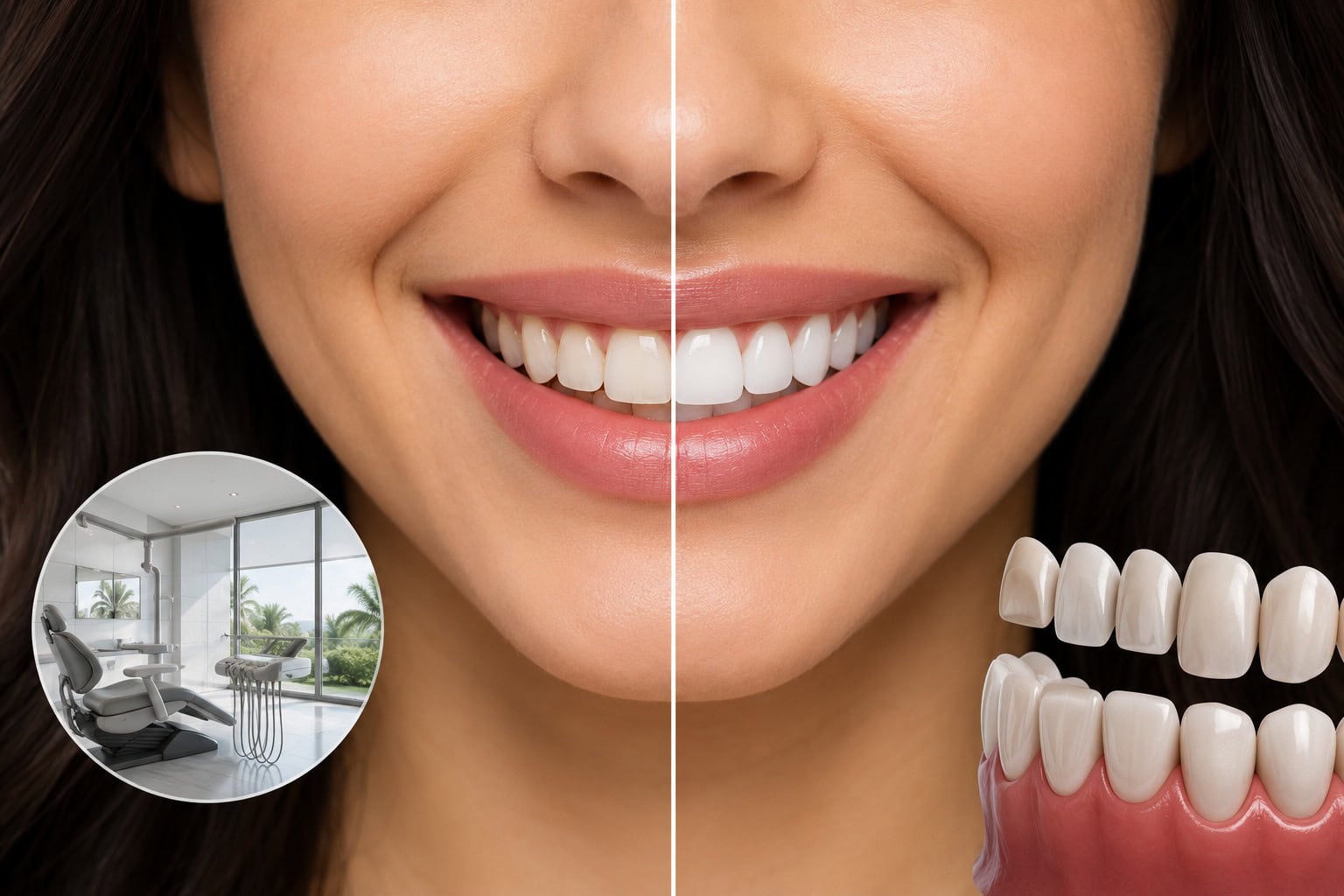

Celebrity-style smiles are usually created through a treatment sequence, not one product. The process may include digital smile design, a mock-up, gum or orthodontic treatment, whitening, bonding, veneers, or crowns. The appropriate combination depends on each patient's teeth, bite, gum health, facial proportions, and goals. The safest plan uses the least invasive suitable option for each tooth.
The teeth seen on television, in films, and across social media are not always naturally that even or bright. In many cases, the visible result comes from a planned sequence of dental treatments. It may begin with assessment and design, continue with preparation such as orthodontics, gum treatment, fillings, or root canal treatment, and finish with the visible layer, such as whitening, bonding, veneers, or crowns.
The useful question is not, "Which product did that celebrity have?" It is, "Which treatments were combined, and in what order?" The same appearance can be created in several ways, but the effect on natural tooth tissue can be very different. A result may involve whitening alone, bonding on a few teeth, a set of laminate veneers, or a more extensive crown-based reconstruction.
The definition of that wider package, and who it suits, is set out on the Hollywood Smile page.
Step one: smile design and the mock-up
The main secret is usually not the restorative material. It is the planning process. At Mosdent, our dentists may assess photographs, video, digital scans, tooth position, the lip line, the amount of tooth and gum showing during a smile, and the relationship between the teeth and the face.
Digital smile design can be used to develop a proposed appearance on screen. A mock-up, which is a temporary trial version of the proposed smile, can then allow the patient to see the design in their own mouth before tooth preparation begins. If the shape, length, or overall appearance does not feel right, changes can be made at this stage. Once healthy tooth tissue has been removed, it cannot be put back.
A systematic review of seven studies found that design-supported approaches consistently improved reported patient satisfaction, communication, treatment acceptance, and the perceived predictability of treatment, although the authors noted limitations caused by differences between the studies (PubMed 41473620). You can read more about the clinical process on our smile design page.
Does face shape determine the right tooth shape?
A popular rule matches round faces with round teeth and angular faces with square teeth. This idea comes from an old theory in denture tooth selection, but research has not confirmed it as a reliable rule. In a study of 160 people from four racial groups, agreement between facial form and the shape of the upper central incisors was only 23.75%. The three prosthodontists who classified the tooth shapes also agreed with one another in only 30.62% of cases at the first session and 24.37% at the second, when they followed Williams' classification method (PubMed 17078274).
A study involving 200 people in India also found limited agreement with one of the methods tested, and the authors concluded that there was no strong, clearly defined correlation (PubMed 23047039).
The same caution applies to the so-called golden proportion. A recent review found no supporting study or systematic review establishing it as a rule for natural teeth. It also found that many prefabricated tooth forms in digital crown libraries did not follow the proportion consistently (PubMed 41102042).
This does not mean the face is irrelevant. Facial proportions, the lip line, age, sex, skin tone, and the amount of tooth visible during speech and smiling can all inform the design. They are inputs, not a rigid template. The aim is to create a form that belongs to the individual rather than selecting identical teeth from a catalogue.
The preparation that is not visible in photographs
Before veneers or crowns are considered, the foundations need to be assessed. Decay, defective fillings, and necessary root canal treatment may need to be addressed first. A cosmetic layer should not be used to cover untreated disease.
The gum line is also part of the design. If too much gum shows when smiling, or if the gum margins are uneven, gum treatment may be considered before restorative work. A healthy and balanced pink frame can affect how natural the final teeth look. More information is available on our gum treatment page.
Tooth alignment is another important consideration. With pronounced crowding, one option is to align the teeth first and then complete treatment with a more conservative cosmetic restoration. Another is to disguise the crowding by removing tooth tissue and placing restorations. The second route may be faster, but it can cost more in healthy enamel. Where time allows, orthodontic treatment should be assessed first. For adults, this may involve clear aligners.
Which treatments may be combined?
Once the foundations are healthy, the visible part of the smile may involve several different treatments.
Whitening changes colour without removing tooth tissue. It may provide part or all of the desired shade change. A recent systematic review and meta-analysis of 32 studies found no difference in colour-scale effectiveness between home and in-office whitening, while sensitivity intensity was lower with home whitening in the analysis (PubMed 40485133). The methods are described in more detail on the teeth whitening page.
Bonding uses composite resin to address small chips, edge irregularities, and limited shape changes, often without cutting the tooth. The technique is described on the bonding treatment page.
Laminate veneers are thin ceramic restorations used when both colour and shape need to be changed. When bonding is largely supported by enamel, the outlook can be strong. Lithium disilicate laminate veneers showed a reported 10.4-year survival rate of 96.81% in one study (PubMed 39523553). The process is described in more detail in the laminate veneer guide.
Crowns cover the tooth all the way around. They may be appropriate for teeth that have already lost substantial structure, have large fillings, or have received root canal treatment. They are not automatically the right choice for a healthy tooth that mainly needs a colour or minor shape change.
One person may therefore have whitening on some teeth, bonding on another, veneers on the front teeth, and a crown on a heavily restored molar. From the outside, this may look like one complete set. Clinically, it may be several treatments selected for different reasons.
Natural appearance and healthy tooth preservation
The goal should not be teeth that are as white and straight as possible. Natural teeth are not one flat colour. They may have subtle translucency at the incisal edge and a warmer tone near the gum. Natural alignment also includes small variations rather than perfect ruler-straight symmetry.
Age matters as well. Younger teeth often have longer, slightly more varied incisal edges. With age, these edges may wear and become flatter, making the visible teeth appear shorter. A design that looks natural on a person in their twenties may look artificial on someone in their fifties.
A photograph of a smile can be useful during consultation, but it should be a reference rather than a template. The design needs to be adapted to the patient's face, lips, speech, smile, and existing teeth. The mock-up is where that proposed appearance can be tested.
A request for a celebrity-style smile should not automatically lead to crowns on many healthy teeth. Removing enamel is irreversible, and teeth that have been extensively prepared may depend on restorations for the long term.
Research supports the importance of enamel preservation. Laminate veneers with preparation remaining entirely within enamel had a reported survival rate of 99% for up to 12 years. When the preparation extended into dentine, the risk of failure increased by approximately tenfold (PubMed 23342345).
If a crown is proposed for a healthy tooth, ask for the clinical reason in writing. If whitening could address colour, bonding could address a small shape issue, or a veneer could meet the indication, the reason for choosing a crown should be explained clearly. The concern often described internationally as "Turkey teeth" is not about a nationality. It is about unnecessary tooth preparation. This is discussed in more detail on the Turkey teeth and cosmetic dentistry page.
Cost factors and treatment sequence planning
The cost of treatment depends on the number of teeth involved, the treatments needed before cosmetic work, the condition of the gums and existing restorations, whether orthodontics is required, the type and number of restorations, laboratory processes, and the complexity of the bite and smile design.
International patients should also consider the number of visits, the timing of mock-up approval, any temporary restorations, and the follow-up arrangements needed after treatment. A plan based on different treatments for different teeth may not be priced in the same way as a single restoration type across the whole smile. For an outline of treatment fees, see the price list.
The usual sequence is assessment and radiographic review, photographs and digital scans, smile design and mock-up, completion of gum or restorative preparation, and then the visible treatment followed by reviews. At Mosdent, our dentists assess which option is appropriate for each tooth rather than assuming that every tooth needs the same restoration.
You can learn more about the wider Hollywood Smile treatment process, meet our dentists, or contact the center through our contact page. The appearance seen on screen should not be copied mechanically. It should be redesigned for your teeth, facial features, oral health, and priorities.
Let's plan the right treatment together.
Free Assessment→- 1.Alwabel LK, Alabduljabar WM, Alawfi LK, et al. Digital Smile Design and Patient-Centered Outcomes in Esthetic Restorative Dentistry: A Systematic Review. Cureus 2025;17:e98084. PubMed 41473620 (accessed 6 September 2026)
- 2.Varjão FM, Nogueira SS, Russi S, Arioli Filho JN. Correlation between maxillary central incisor form and face form in 4 racial groups. Quintessence Int 2006;37:767-71. PubMed 17078274 (accessed 6 September 2026)
- 3.Koralakunte PR, Budihal DH. A clinical study to evaluate the correlation between maxillary central incisor tooth form and face form in an Indian population. J Oral Sci 2012;54:273-8. PubMed 23047039 (accessed 6 September 2026)
- 4.Goodacre C, Goldstein G. Should the golden ratio be used in CAD-CAM dentistry? J Prosthet Dent 2026;135:593.e1-593.e8. PubMed 41102042 (accessed 6 September 2026)
- 5.de Geus JL, Martins A, Reis A, Rezende M. At-home vs In-office Bleaching: An Updated Systematic Review and Meta-analysis. Oper Dent 2025;50:E47-E69. PubMed 40485133 (accessed 6 September 2026)
- 6.Klein P, Spitznagel FA, Zembic A, Prott LS, Pieralli S, Bongaerts B, et al. Survival and Complication Rates of Feldspathic, Leucite-Reinforced, Lithium Disilicate and Zirconia Ceramic Laminate Veneers: A Systematic Review and Meta-Analysis. J Esthet Restor Dent 2025;37:601-619. PubMed 39523553 (accessed 6 September 2026)
- 7.Gurel G, Sesma N, Calamita MA, Coachman C, Morimoto S. Influence of enamel preservation on failure rates of porcelain laminate veneers. Int J Periodontics Restorative Dent 2013;33:31-9. PubMed 23342345 (accessed 6 September 2026)