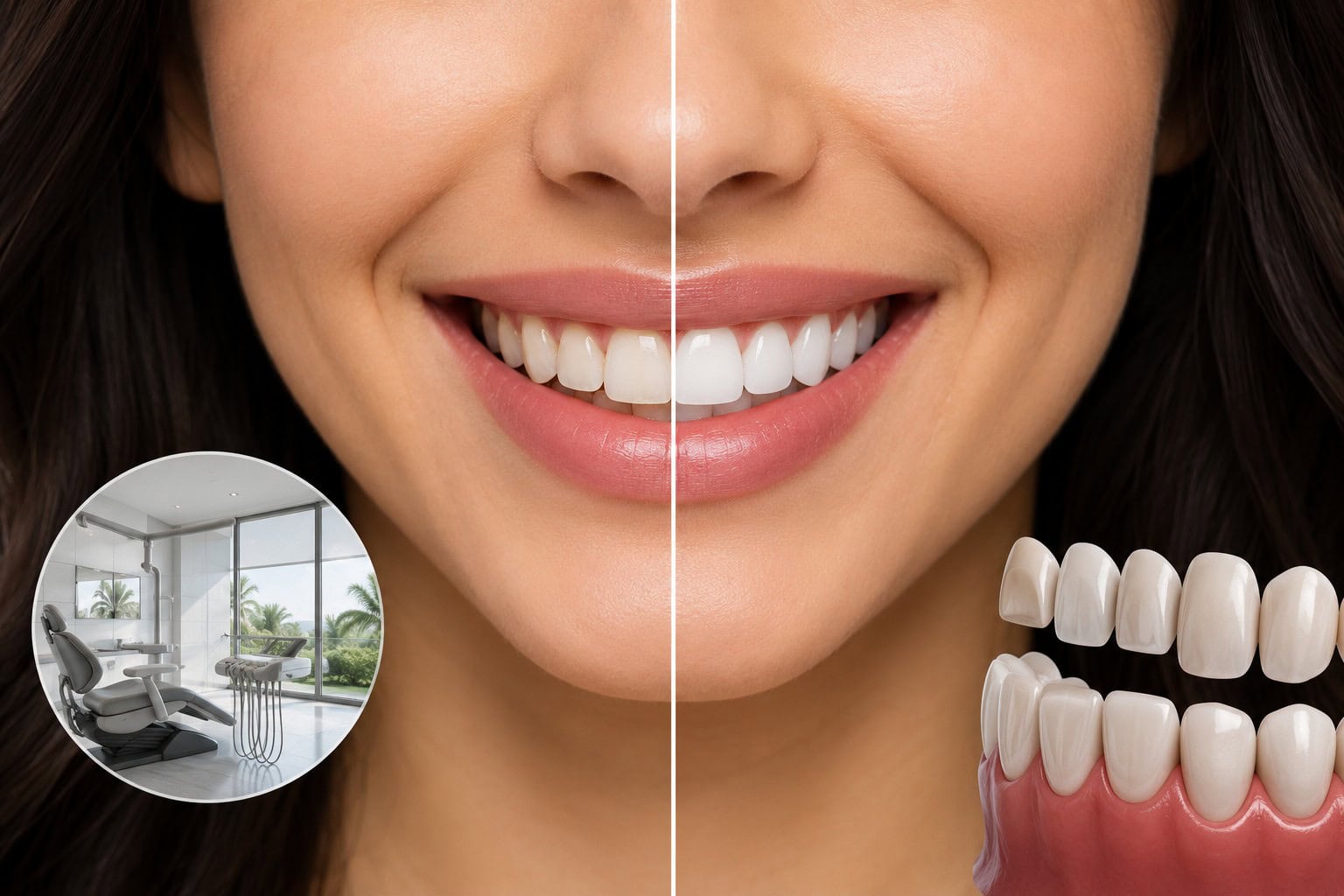
A Hollywood smile is a treatment concept, a planned redesign of the whole smile composition covering tooth shape, colour, proportion, symmetry and the gum line, while a veneer is one specific restoration: a shell roughly 0.3 to 0.7 mm thick bonded to the front surface of a tooth. Veneers are frequently the main tool inside a Hollywood smile plan, but the same plan may also require crowns on root-treated teeth, implants for missing teeth, gum contouring or orthodontics. The distinction is practical rather than semantic, because a veneer cannot replace a missing tooth or carry a structurally weakened one.
- 01Hollywood smile names an outcome and a planning process; veneer names a restoration roughly 0.3 to 0.7 mm thick bonded to the front of a tooth.
- 02A veneer-only case can be completed in about 5 to 7 days, while a plan involving implants, gum treatment or orthodontics runs over months rather than days.
- 03Ceramic veneers hold up well over time: pooled survival at 10.4 years was 96.13 percent for feldspathic, 93.70 percent for leucite-reinforced glass-ceramic and 96.81 percent for lithium disilicate across 29 studies (PubMed 39523553).
- 04The bonding substrate predicts longevity more than the label does: 99 percent survival when the preparation stays within enamel, against roughly ten times the failure risk once it reaches dentin, across 580 veneers followed up to 12 years (PubMed 23342345).
- 05Four situations take a case beyond veneers: root-treated teeth needing crown coverage, missing teeth needing implants, asymmetric gum levels and significant misalignment.
Two Terms That Describe Different Things
A Hollywood smile and veneers are two different things, even though the terms are often used as if they meant the same procedure. A Hollywood smile is a treatment concept, a planned redesign of the whole smile, covering tooth shape, colour, proportion, symmetry and the gum line that frames the teeth. A veneer is one specific restoration, a thin shell, roughly 0.3 to 0.7 mm thick, bonded to the front surface of a tooth. Veneers are often the main tool used inside a Hollywood smile plan, and in many cases they are the only one. In other cases the same plan also needs crowns, implants, gum treatment or orthodontics.
The difference has practical consequences. It shapes what kind of treatment plan you should expect, how many appointments the case needs and how long it takes. A veneer-only case can often be completed in about 5 to 7 days, while a plan that involves implants, gum treatment or orthodontics runs over months, because bone healing, tissue healing and tooth movement each set their own pace.
Patients who treat the two terms as synonyms can run into two kinds of surprise. Some expect veneers to solve problems that veneers cannot solve, such as a missing tooth or a tooth weakened by root canal treatment. Others are surprised when their treatment plan includes procedures they did not ask for, such as gum contouring before the veneers are made. Both surprises come from the same gap between the name of the result and the tools used to reach it. Looking at the two terms separately, what each covers and where each stops, makes the consultation easier to follow and the plan easier to judge.
What a Hollywood Smile Plan Covers
The defining feature of a Hollywood smile is the planning process that comes before any treatment. The analysis includes facial photography, a digital mock-up of the proposed smile, an assessment of gum health and an evaluation of the bite. The treatment that follows is built from what that analysis finds, and it can draw on several procedures.
Depending on the patient, the plan might include porcelain veneers on some or all visible teeth, laminate veneers for minimal-preparation correction, or emax ceramic restorations where high translucency is wanted at the front. Teeth that have had root canal treatment or significant structural damage usually need zirconium crowns that cover the whole tooth. Teeth that only need a lighter colour may be treated with professional teeth whitening alone. Pink dental aesthetics procedures, such as gum contouring, even out the gum line. Orthodontic treatment may move teeth into position before restorative work begins, and implant-supported crowns replace missing teeth in the smile zone.
No two plans are identical. A patient with healthy, well-aligned teeth and only colour concerns might need professional whitening combined with a few veneers. A patient with structural damage, missing teeth and uneven gums might need a combination of crowns, implants and gum recontouring. The number of teeth treated is not fixed either. Many patients need only the teeth visible when smiling, commonly the upper front six to ten, while the rest are left untouched or lightened with whitening. The count comes out of the smile analysis and the digital mock-up.
Veneer Types and How They Differ
A veneer changes the shape, size, colour or apparent alignment of a tooth by covering its front surface. It does not wrap the whole tooth the way a crown does, which is why it needs less removal of tooth structure and why it depends on the tooth underneath being sound.
Porcelain veneers
Porcelain veneers are the traditional option, valued for the way they let light through and for their resistance to staining. They are made in a laboratory and bonded to a tooth that has been lightly prepared.
Laminate veneers
Laminate veneers are a refined porcelain veneer technique with a thinner profile. They suit patients with healthy enamel who want minimal alteration of their natural teeth.
Prepless laminate veneers
Prepless laminates need no removal of enamel at all. They suit patients whose teeth already have enough room for a thin shell and whose concerns are minor, such as small gaps or slight irregularities of shape.
Emax veneers
Emax veneers are made from lithium disilicate glass-ceramic, which scatters light in a way close to natural enamel.
All of these share one limit. Veneers suit teeth that are structurally healthy but aesthetically imperfect: discoloured, slightly chipped, unevenly shaped or mildly misaligned. They are not designed to replace a missing tooth, restore a badly damaged one or correct a significant bite or gum problem on their own. The difference between the types lies in thickness, translucency and how much enamel is removed, and the right one depends on the tooth, the colour change needed and the patient's bite.
How Long Ceramic Veneers Last
Ceramic veneers have long-term survival data, and it is favourable. A systematic review and meta-analysis of 29 studies on anterior and premolar laminate veneers reported pooled survival at 10.4 years of 96.13% for feldspathic ceramic, 93.70% for leucite-reinforced glass-ceramic and 96.81% for lithium disilicate (PubMed 39523553). The review found no difference in survival between these materials.
The difference lay in complications. At 10.4 years, feldspathic veneers had technical, aesthetic and biological complication rates of 41.48%, 19.64% and 6.51%, while lithium disilicate veneers had 6.1%, 1.9% and 0.45% (PubMed 39523553). Leucite-reinforced glass-ceramic sat between them. The authors concluded that lithium disilicate slightly outperforms the other two materials because of its lower long-term complication rates. A complication is counted separately from failure, so a veneer can have a complication and still be in place at follow-up.
Zirconia veneers showed 100% survival with no complications at 2.6 years, but no long-term data was available for them (PubMed 39523553). For now, zirconia veneers cannot be compared with the other materials over a decade.
These figures apply to the veneers. The crowns and implants used within a broader Hollywood smile plan are also long-term solutions with their own survival data. Whitening, where it forms part of the plan, behaves differently. It fades over time and needs periodic maintenance to keep its effect, while the ceramic restorations hold their colour.
Why Enamel Decides Veneer Survival
The surface a veneer is bonded to predicts its longevity more strongly than its name or its material. A retrospective study followed 580 porcelain laminate veneers bonded in 66 patients for up to 12 years (PubMed 23342345). In that group, 42 veneers failed, 7.2% of the total, and overall cumulative survival was 86% (PubMed 23342345). Fracture was the most frequent type of failure.
The main factor behind failure was where the preparation ended. Veneers bonded to dentin, and veneers on teeth whose preparation margins reached dentin, were approximately 10 times more likely to fail than veneers bonded to enamel (PubMed 23342345). Survival was 99% when the preparation stayed within enamel and 94% when only the margins were in enamel (PubMed 23342345). Coronal crown lengthening increased the risk of failure by 2.3 times in the same study (PubMed 23342345).
This finding explains why careful veneer planning aims to keep preparation within enamel wherever possible. Enamel bonds more reliably than dentin, and a veneer that sits fully on enamel carries less risk over time. It also explains why a tooth that has lost much of its enamel, through decay, wear or previous large fillings, may be a better candidate for a crown. A thin shell bonded to a tooth with little enamel left is built on an unstable base.
For the patient, the practical question at the consultation is how much tooth will be removed and whether the preparation will stay in enamel. A digital mock-up can often show whether the desired shape needs reduction at all, or whether the veneer can be added on top of the existing tooth with little or no preparation.
Why the Two Terms Get Mixed Up
The overlap between the terms has a real basis. In many Hollywood smile cases, veneers are the primary restoration used, especially for patients whose teeth are largely healthy and whose main concerns are colour, shape or minor alignment. When such a patient has porcelain veneers placed on the ten or so teeth visible in the smile, the visible result and the procedure are the same thing, and the two words become interchangeable in that case.
Social media posts, before-and-after galleries and dental tourism marketing often use the two terms as synonyms because, in that specific scenario, the outcome looks identical. The picture shows a row of bright, even teeth, and the caption can call it either a Hollywood smile or a set of veneers without being wrong for that patient.
The problem arises when this language is applied to every patient. Someone with a missing tooth, a failed root canal or significant gum asymmetry cannot reach the same result with veneers alone, whatever a marketing image suggests. For that patient, a quote for a number of veneers describes only part of the treatment, and the rest of the plan appears later, at the examination.
The same confusion affects expectations about time. A patient who has read that a Hollywood smile takes a week may be surprised to hear that their plan runs over several months. The time frame belongs to the procedures the case needs. Veneers alone can be completed in about 5 to 7 days; implants, gum healing and orthodontic movement each add their own time. Asking the clinic which procedures the plan contains, and how long each one takes, gives a more accurate picture than the label.
How the Clinical Assessment Runs
The answer to which treatment you need comes from a clinical assessment. At Mosdent, the process for any cosmetic smile consultation begins the same way, whether the patient asks for veneers or for a Hollywood smile.
The first step is a full examination of tooth structure, existing restorations, root canal history, gum health and bite alignment. This is where teeth that cannot carry a veneer are identified, for example teeth weakened by large fillings or root canal treatment.
The second step is digital smile design. Facial photography and digital mock-up tools preview the expected outcome before any treatment decision is made, so the patient can see the proposed shape and proportions on their own face.
The third step is a periodontal assessment by the periodontology team. Active gum disease must be treated before any cosmetic restoration proceeds, because inflamed gums bleed, change shape as they heal and can recede around new restorations.
The fourth step is the presentation of the treatment plan. Based on the clinical findings, the plan may be entirely veneers, entirely crowns, a mix of both, or may include implants, whitening or gum contouring as needed.
The fifth step is treatment, carried out in the order the plan sets, with orthodontics and gum work usually coming before the final restorations.
The assessment protects the result. A patient who insists on veneers alone when the case requires a crown on a weakened tooth may end up with a restoration that fails early. Describing your aesthetic goals and letting the examination decide the combination of procedures gives the plan a sound base.
When Veneers Are Enough and When More Is Needed
Veneers are a frequent and effective part of Hollywood smile treatment, and for many patients they are the whole plan. They are the right choice when the underlying tooth structure is healthy, with no root canal treatment or major decay, when the main concerns are colour, shape, size or minor alignment, when the patient wants a minimally invasive approach and when the goals can be reached without replacing missing teeth or changing the gum line. For a patient who wants a brighter, more even and more symmetrical smile without underlying dental problems, veneers applied within a well-planned smile design can deliver the whole result.
A plan extends beyond veneers in five situations. Teeth that have had root canal treatment are structurally weakened and usually need zirconium or porcelain crown coverage. Missing teeth cannot be replaced by veneers; dental implants topped with crowns restore the gap. Asymmetric gum levels, including a gummy smile, need pink aesthetic procedures such as gingivectomy to frame the new restorations correctly. Significant crowding or rotation may need orthodontic treatment before veneers or crowns can be placed predictably. Active gum disease needs periodontal treatment first, and in some cases gum surgery, to create a stable foundation.
If you are unsure whether veneers alone will give you the smile you want, a clinical evaluation answers the question for your own teeth. You can contact Mosdent for a free consultation, or read about our smile makeover and aesthetic dentistry services to see the full range of options.
Let's plan the right treatment together.
Free Assessment→- 1.Klein P, Spitznagel FA, Zembic A, et al. Survival and complication rates of feldspathic, leucite-reinforced, lithium disilicate and zirconia ceramic laminate veneers: a systematic review and meta-analysis. J Esthet Restor Dent. 2025;37(3):601-619. PMID 39523553
- 2.Gurel G, Sesma N, Calamita MA, Coachman C, Morimoto S. Influence of enamel preservation on failure rates of porcelain laminate veneers. Int J Periodontics Restorative Dent. 2013;33(1):31-39. PMID 23342345