Smile design is the planned selection of tooth shape, proportion, colour and gum line so a restoration sits in harmony with the face, and face shape is one input into that plan rather than the rule that decides it. The familiar pairing of square faces with rounded teeth rests on thinner evidence than it sounds: in 160 subjects across four groups, tooth form corresponded to face form in only 23.75 percent of cases, and three prosthodontists agreed on the tooth form category just 30.62 percent of the time (PubMed 17078274). A later study of 90 people found face shape matched dental arch shape more reliably than it matched tooth shape (PubMed 38138245).
- 01Three basic forms carry the vocabulary: square teeth have straight edges and read as bold, oval teeth have rounded corners and read as soft, triangular teeth are wider at the incisal edge and narrow toward the gum.
- 02The face-to-tooth rule is a guideline, not a measurement. Across 160 subjects in four groups, tooth form matched face form in 23.75 percent of cases, and expert agreement on classifying tooth form was 30.62 percent then 24.37 percent in a second session (PubMed 17078274).
- 03The stronger correlation is between face and arch. In 90 subjects, the shape of the face matched the shape of the dental arch most often, while tooth-to-face matching was significantly weaker in men (p = 0.043) (PubMed 38138245).
- 04This is why Digital Smile Design exists: facial photos and 3D scans produce a simulation, tooth shape options are tested on your own face, and you approve the design before any irreversible step.
- 05Restorations chosen for shape have measured limits. In 66 patients with 580 porcelain laminate veneers followed up to 12 years, cumulative survival was 86 percent overall, 99 percent where the preparation stayed inside enamel, and failure risk was about ten times higher when bonded to dentine (PubMed 23342345).
A beautiful smile is not created by chance. It is carefully designed through facial analysis, dental proportions, and personalized treatment planning. Today, modern smile design combines art, science, and advanced technology to create natural, harmonious results tailored to each individual.
/ “What is the best tooth shape for my face?”
The answer lies in understanding the relationship between face shape and smile design.
What Is Smile Design?
Smile design is a personalized cosmetic dentistry approach that improves the appearance of teeth, gums, and overall facial harmony.
It combines:
- Dental proportions
- Facial symmetry
- Lip dynamics
- Tooth color and shape
- Gum aesthetics
Modern smile design is no longer guesswork it is digitally planned.
Why Tooth Shape Matters in Smile Aesthetics
Teeth play a major role in facial appearance. The wrong tooth shape can make the face appear:
- Older
- Tired
- Masculine or feminine incorrectly
- Asymmetrical
The right tooth shape can:
✔ Enhance facial harmony
✔ Improve confidence
✔ Create a youthful appearance
✔ Balance facial proportions
This is why choosing the best tooth shape for your face is crucial.
The Science Behind Tooth Shape Selection
Cosmetic dentists analyze several factors before designing a smile:
Facial proportions
Lip movement
Jaw structure
Age and gender
Personality and expectations
At Mosdent, this process is performed using Digital Smile Design technology.
/ Tooth Shape Selection for Your Face
The 3 Main Tooth Shapes in Cosmetic Dentistry
Understanding basic tooth forms is essential.
Square Tooth Shape
Characteristics:
- Straight edges
- Strong appearance
- Symmetrical form
Best for:
- Square face shapes
- Masculine smile design
Creates a bold, confident look.
Oval Tooth Shape
Characteristics:
- Rounded corners
- Soft appearance
- Natural elegance
Best for:
- Heart-shaped faces
- Feminine smile design
Creates a gentle, youthful smile.
Triangular Tooth Shape
Characteristics:
- Wider at the bottom
- Narrow at the top
- Slim appearance
Best for:
- Round faces
- Soft facial features
Creates balance and definition.
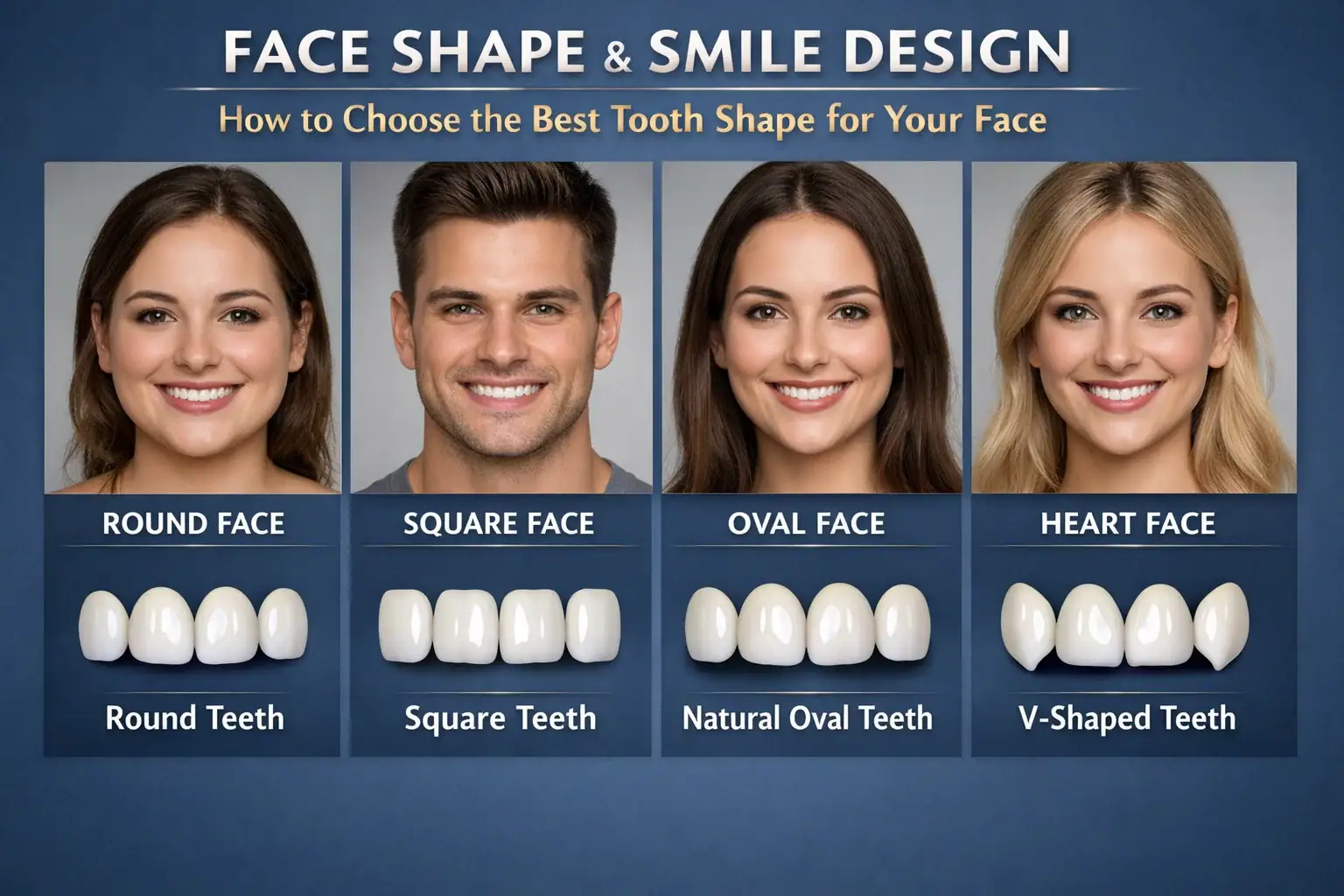
Face Shapes and Ideal Tooth Shapes
This is the core of facial smile design.
Square Face Shape
Features:
- Strong jawline
- Wide forehead
- Angular features
Best tooth shape:
✔ Oval or rounded teeth
Why?
Softens facial angles and adds harmony.
Round Face Shape
Features:
- Soft curves
- Full cheeks
- Balanced proportions
Best tooth shape:
✔ Square or rectangular teeth
Why?
Adds definition and contrast.
Heart Face Shape
Features:
- Wide forehead
- Narrow chin
Best tooth shape:
✔ Oval or rounded
Creates balance and softness.
Oval Face Shape
Most balanced face type.
Best tooth shape:
✔ Almost any shape works
Smile design focuses on proportions.
/ Personal Factors in Digital Smile Design
Gender Differences in Tooth Shape
Smile design also considers gender characteristics.
Feminine Smile
- Rounded edges
- Softer shapes
- Curved incisal edges
Masculine Smile
- Straighter edges
- More angular shapes
- Larger central incisors
Age and Smile Design
Teeth naturally change with age.
Young smiles:
- Longer front teeth
- More tooth display
Mature smiles:
- Slightly shorter teeth
- Less visible incisal edges
Smile design can restore youthful proportions.
The Role of Digital Smile Design
Modern Digital Smile Design (DSD) allows patients to preview their new smile before treatment begins.
Using facial photos and 3D scans:
- Smile simulations are created
- Tooth shape options are tested
- Patients approve the final design
Treatments Used in Smile Design
Veneers
Porcelain veneers reshape and enhance tooth form.
Crowns
Used for full smile transformations.
Teeth Whitening
Enhances overall brightness.
Hollywood Smile and Tooth Shape
The Hollywood smile is one of the most requested smile makeovers worldwide.
It combines:
- Ideal tooth shape
- Bright white shade
- Perfect symmetry
Smile Makeover Process at Mosdent
1️⃣ Consultation
2️⃣ Facial analysis
3️⃣ Digital planning
4️⃣ Trial smile
5️⃣ Final treatment
This ensures predictable and natural results.
Psychological Impact of Smile Design
Studies show smile improvement can:
✔ Increase confidence
✔ Improve social interactions
✔ Enhance professional opportunities
/ Frequently Asked Questions
Can tooth shape really change facial appearance?
Yes. Tooth proportions influence lip support and facial balance.
Is smile design permanent?
It depends on the restoration: veneers followed for up to 12 years showed 99 percent survival when the preparation stayed within enamel (PubMed 23342345).
How long does a smile makeover take?
Usually 5–10 days depending on treatment plan.
Final Thoughts
Choosing the right tooth shape is not about trends. It is about harmony between teeth and facial features.
With modern smile design, achieving a natural, personalized smile has never been more predictable.
At Mosdent, smile design combines artistry, technology, and experience to create confident, natural-looking smiles.
Let’s plan the right treatment together.
Free Assessment→- 1.Varjão FM, Nogueira SS, Russi S, Arioli Filho JN. Correlation between maxillary central incisor form and face form in 4 racial groups. Quintessence Int. 2006;37(10):767-771.
- 2.Kostić M, Đorđević NS, Gligorijević N, et al. Correlation theory of the maxillary central incisor, face and dental arch shape in the Serbian population. Medicina (Kaunas). 2023;59(12):2142. doi:10.3390/medicina59122142
- 3.Gurel G, Sesma N, Calamita MA, Coachman C, Morimoto S. Influence of enamel preservation on failure rates of porcelain laminate veneers. Int J Periodontics Restorative Dent. 2013;33(1):31-39. doi:10.11607/prd.1488