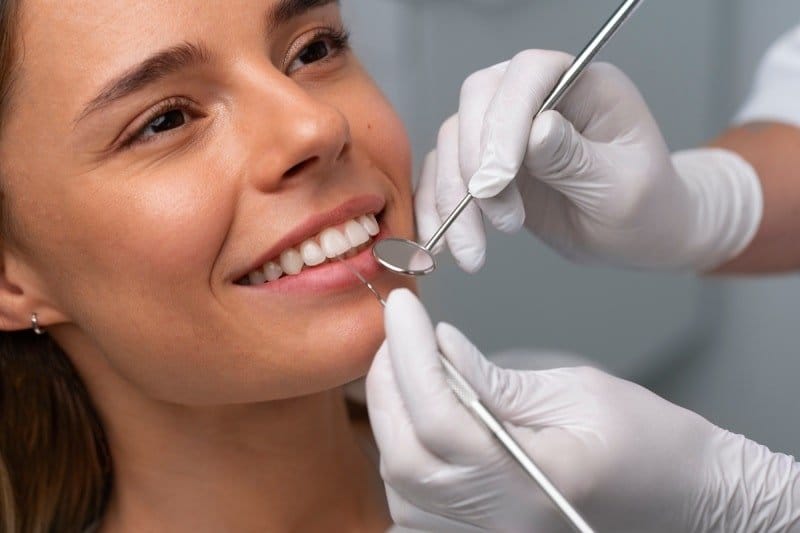
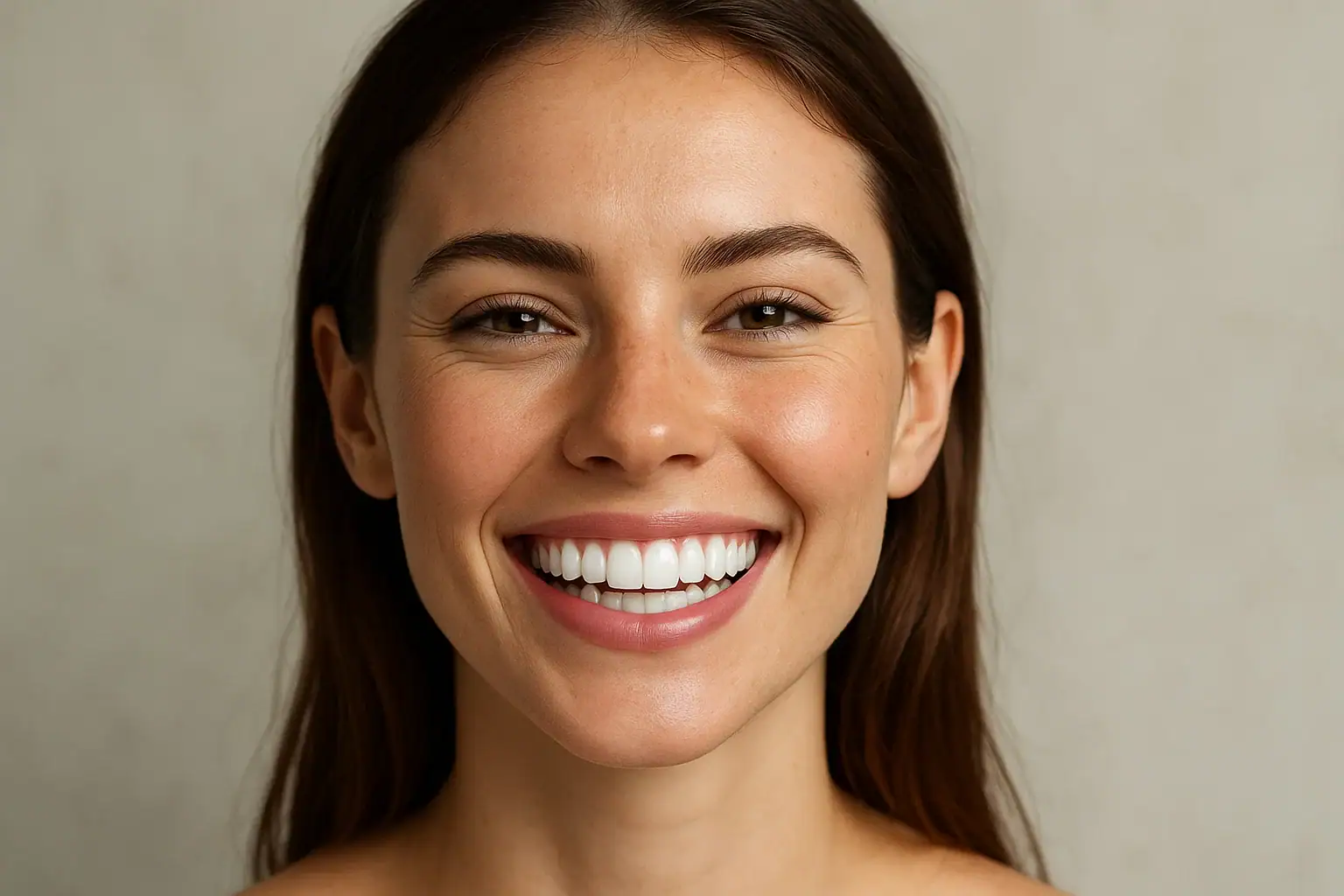
Perfect teeth is an aesthetic description covering alignment without crowding or gaps, an even shade across the arch, symmetrical crown shape and size, upper and lower teeth that meet correctly, and gums that are pink and free of inflammation. A smile that reads as perfect is often the result of treatment such as orthodontics, whitening, bonding, gum contouring or ceramic veneers. In a meta-analysis of 29 clinical studies, ceramic laminate veneers survived at 96.81 percent for lithium disilicate, 96.13 percent for feldspathic and 93.70 percent for leucite-reinforced glass ceramic at 10.4 years (PubMed 39523553).
- 01Perfect teeth describes five separate things at once: alignment, shade, symmetry, occlusion and gum health, and a smile can fail on any one of them while passing the rest.
- 02Ceramic laminate veneers pooled at 96.81 percent survival for lithium disilicate, 96.13 percent for feldspathic and 93.70 percent for leucite-reinforced glass ceramic at 10.4 years across 29 studies (PubMed 39523553).
- 03Resin composite veneers pooled at 88 percent survival over follow-ups of 24 to 97 months, with surface roughness and colour mismatch the most reported complications (PubMed 38035903).
- 04Tooth size, jaw structure and gum thickness are largely genetic, so hygiene maintains a smile but does not straighten one.
- 05Whiter is not healthier: shade says nothing about decay between the contact points, and repeated whitening can leave teeth sensitive.
The concept of "perfect teeth" has fascinated people for centuries, from ancient civilizations to today's Hollywood red carpets. But what exactly defines perfect teeth? Is it their color, shape, alignment, or a combination of all these features?
Perfect teeth appearance and treatment options
What Do Perfect Teeth Look Like
Perfect teeth are often characterized by:
- Straight alignment with no crowding or gaps
- An even shade across the arch, free from stains
- Symmetrical shape and size
- Proper bite alignment (occlusion)
- Healthy gums with no inflammation
These features enhance aesthetics and also contribute to better oral function and overall health. A smile can fall short on any one of them while passing the rest, which is why treatment is chosen for the specific problem.
How to Get Perfect Teeth: Top Methods
Orthodontic Treatment
- Braces: Traditional metal or ceramic options to gradually shift teeth.
- Invisalign: Clear aligners suited to adults and teens seeking discretion.
- Lingual Braces: Hidden behind the teeth for invisible straightening.
Teeth Whitening
- Laser Whitening: In-clinic procedures for immediate results.
- At-Home Kits: Custom trays or strips for gradual whitening.
- Natural Remedies: Baking soda, oil pulling (limited effect).
Veneers and Crowns
- Porcelain Veneers: Cover surface imperfections and improve shape.
- Emax or Zirconium Crowns: Durable, aesthetic solutions for damaged teeth.
Ceramic veneers have long-term data behind them. In a meta-analysis of 29 studies, pooled survival at 10.4 years was 96.81% for lithium disilicate, 96.13% for feldspathic and 93.70% for leucite-reinforced glass-ceramic laminate veneers (PubMed 39523553). Resin composite veneers pooled at 88% survival in randomized trials with follow-up of 24 to 97 months, and surface roughness and color mismatch were among the most reported complications (PubMed 38035903).
Cosmetic Bonding
Bonding suits small chips, gaps, or misshapen teeth, where tooth-colored resin is added directly to the tooth in the chair.
Gum Contouring
Gum contouring reshapes the gum line to improve symmetry and reduce a "gummy smile".
Digital Smile Design: The Future of Aesthetic Dentistry
Digital Smile Design (DSD) uses 3D scans and digital imaging to plan your new smile. It allows both dentists and patients to visualize the expected results before treatment even begins. Its value lies in communication and predictability: the patient sees the target before committing, and the dentist works to a defined plan.
The benefits follow from that. Treatment is simulated for the individual face, the patient and dentist discuss the same picture, and the result can be reproduced from the plan.
Perfect Teeth in History: Ancient Civilizations
People were changing the look of their teeth long before modern dentistry. Archaeological finds show decorative and stabilizing work on teeth in several early cultures, some of it surprisingly skilled.
Did you know
- The Maya civilization used jade inlays for cosmetic dental purposes.
- Ancient Egyptians used gold wires to stabilize teeth.
- Many prehistoric skulls show well-aligned teeth with little crowding, which researchers link to unprocessed diets and minimal sugar.
What Do Celebrities Do for Perfect Teeth
Hollywood smiles are rarely natural. Many celebrities use a combination of:
- Veneers or crowns
- Whitening treatments
- Orthodontics (Invisalign or braces)
- Digital Smile Design (DSD) planning
The Role of Genetics
While some individuals are born with well-aligned teeth, most perfect smiles are enhanced with dental care. Genetics influences:
- Tooth size and shape
- Jaw structure
- Gum thickness
Because these are largely inherited, hygiene maintains a smile but does not straighten one.
How to Maintain Perfect Teeth
- Brush twice a day with fluoride toothpaste
- Floss daily to remove plaque between teeth
- Avoid staining foods and drinks (coffee, wine, tobacco)
- Visit your dentist every 6 months
- Wear a nightguard if prone to grinding
Common Myths About Perfect Teeth
"Only celebrities can afford perfect teeth." Cosmetic dentistry covers a wide range, from bonding a single chip to a full set of veneers, and the right option is decided by the problem at hand.
"Whiter means healthier." Not so. Shade and health are separate measures: naturally healthy enamel is not paper white, repeated whitening can leave teeth sensitive, and a bright tooth can still carry decay between the contact points.
"Braces are only for kids." Adults of all ages can benefit from orthodontics.
Perfect teeth may be subjective, but the pursuit of a healthy, natural-looking smile is universal. Modern dentistry offers braces, aligners, whitening, bonding and veneers, and an examination by a dentist shows which of them your own teeth, gums and bite actually call for.
Let’s plan the right treatment together.
Free Assessment→- 1.Klein P, Spitznagel FA, Zembic A, Prott LS, Pieralli S, Bongaerts B, et al. Survival and Complication Rates of Feldspathic, Leucite-Reinforced, Lithium Disilicate and Zirconia Ceramic Laminate Veneers: A Systematic Review and Meta-Analysis. J Esthet Restor Dent 2025;37:601-619. PubMed 39523553
- 2.Lim TW, Tan SK, Li KY, Burrow MF. SURVIVAL AND COMPLICATION RATES OF RESIN COMPOSITE LAMINATE VENEERS: A SYSTEMATIC REVIEW AND META-ANALYSIS. J Evid Based Dent Pract 2023;23:101911. PubMed 38035903