Flash whitening is an in-office bleaching procedure in which a hydrogen peroxide gel is applied to isolated teeth and worked through three to four 15-minute cycles, roughly 45 to 60 minutes of chair time in a single visit, with reported shade improvement of 6 to 8 shades. A take-home tray version uses a weaker gel worn for 7 to 14 days. Shade stability is usually described in the 12 to 24 month range and depends on coffee, tea, wine and tobacco exposure. Crowns, veneers and fillings do not change colour, so visible restorations are assessed before treatment.
- 01The in-office protocol runs as three to four 15-minute cycles, about 45 to 60 minutes of clinical time in a single appointment.
- 02Reported shade improvement after one in-office session is 6 to 8 shades; the express variant takes around 30 minutes and does less.
- 03Light activation is the contested part of the protocol: a meta-analysis of 21 randomised trials found no significant difference in colour change or in the risk and intensity of tooth sensitivity between light-activated and non-activated in-office gels (PubMed 29289725).
- 04Take-home trays use a lower-concentration gel worn for 7 to 14 days and are the usual maintenance route between in-office sessions.
- 05Whitening gel does not change the colour of crowns, veneers or composite fillings, so restorations in the smile line are planned separately.
/ Flash Whitening Basics and Treatment Types
Introduction to Flash Whitening
If you’re looking for a fast and effective way to brighten your teeth, Flash Whitening offers one of the most trusted solutions in cosmetic dentistry. This professional, in-office system delivers dramatic results in as little as 45 minutes, making it a popular choice for individuals preparing for weddings, events, or simply wanting a significantly whiter smile in a short time.
What Is Flash Teeth Whitening?
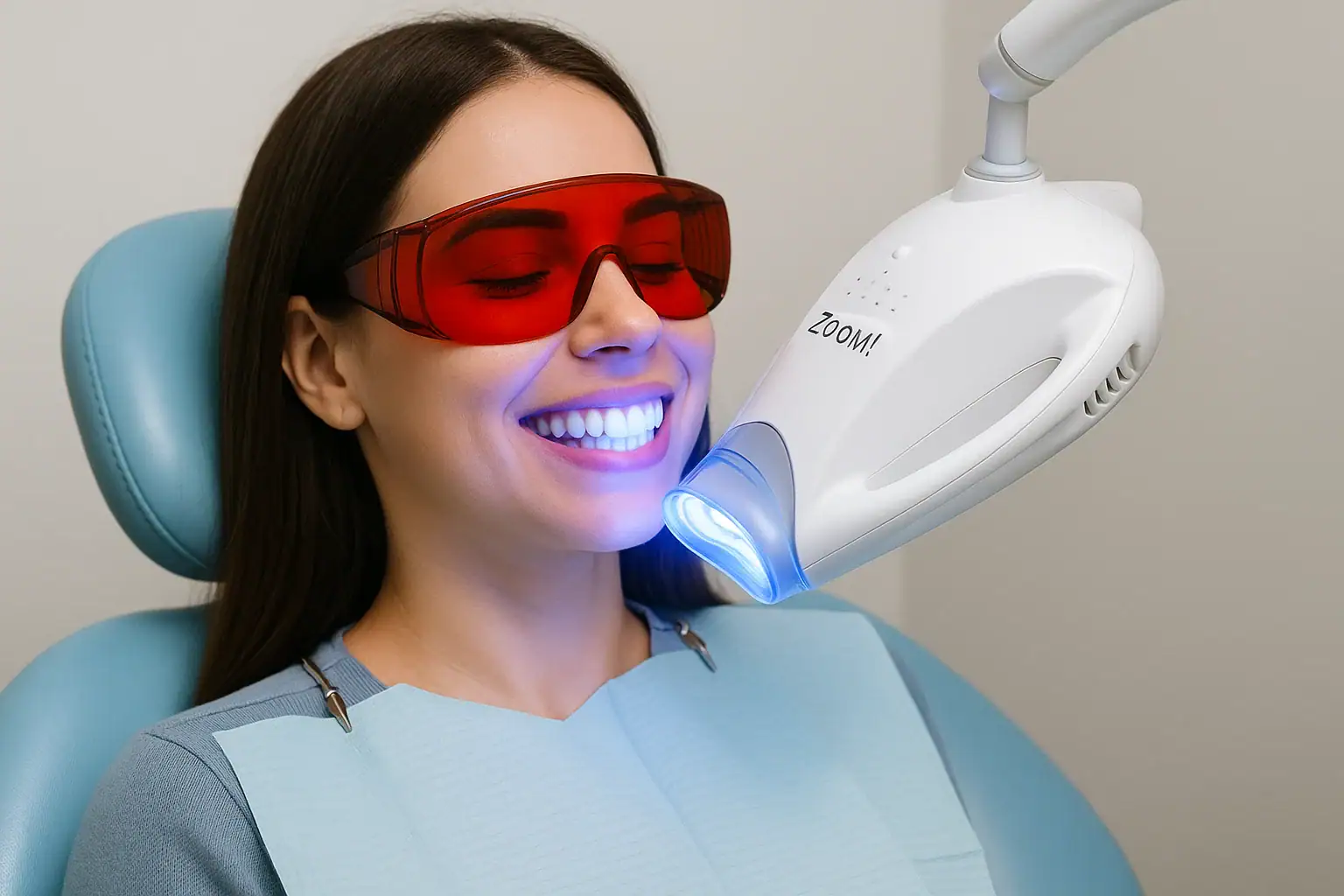
Flash Whitening is an advanced in-office bleaching procedure that uses a hydrogen peroxide-based whitening gel activated by a specially designed light system. This activation accelerates the whitening process by breaking down deep stains caused by:
- Coffee and tea
- Wine
- Tobacco
- Aging
- Pigmented foods
This combination provides fast, efficient, and reliable whitening results.
How Flash Whitening Works
- Gum and lip protection is applied to prevent irritation.
- A high-performance whitening gel is applied to the teeth.
- The Flash light technology is used in multiple 15-minute cycles (typically 3–4).
- Desensitizing or fluoride gel may be applied afterward to reduce sensitivity.
Types of Flash Whitening Treatments
1. Flash In-Office Whitening (Flash Power Bleaching)
- Performed entirely in the clinic
- Uses advanced light-activated technology
- Achieves up to 6–8 shades whiter in one visit
2. Flash Take-Home Whitening Kits
- Custom trays made by your dentist
- Whitening gel applied at home for 7–14 days
- Ideal for maintenance or individuals with sensitivity
3. Flash Express Whitening
- Affordable, fast in-office enhancement
- Takes around 30 minutes
- Great for patients who need a quick refresh
What Makes Flash Whitening Different?
- Clinically tested whitening performance
- Reduced sensitivity thanks to stabilized peroxide formulas
- Customizable treatment strength depending on patient needs
- Dentist-supervised application for optimal safety
- Quick results with long-term shade stability
/ Flash Whitening Candidates and Results
Who Is a Candidate for Flash Whitening?
Ideal candidates:
- Individuals with healthy gums and teeth
- Patients with external stains
- Anyone over age 13 (not pregnant or breastfeeding)
- Patients preparing for special events
Avoid Flash Whitening if:
- You have active gum disease
- You have untreated cavities
- You have numerous crowns, veneers, or fillings in visible areas (whitening does not change their color)
Flash Whitening Before & After: What to Expect
Most patients achieve 6–8 shades of improvement after a single session.
Results vary depending on:
- Type of stains
- Tooth structure
- Diet and habits
- Oral hygiene
How Long Do Flash Whitening Results Last?
Duration
Results typically last 12–24 months depending on lifestyle.
How to Maintain Results
- Avoid dark foods and beverages
- Use whitening toothpaste
- Schedule touch-ups every 6–12 months
- Use take-home kits for ongoing maintenance
How Much Does Flash Whitening Cost?
| Treatment Type | Average Cost (USD) |
|---|---|
| Flash In-Office Whitening | $500 – $800 |
| Flash Take-Home Kits | $300 – $500 |
| Flash Express Whitening | $200 – $350 |
Note: Cosmetic whitening is usually not covered by insurance.
Choosing a Clinic for Whitening
Before booking, check:
- Patient reviews
- Before/after photos
- Dentist certifications
- Clinic hygiene and equipment
/ Flash Whitening Compared With Other Methods
Flash Whitening vs. Other Whitening Methods
| Whitening Method | Results Time | Duration | Safety | Cost |
|---|---|---|---|---|
| Flash Whitening | 1 hour | 12–24 months | Dentist-supervised | $500 – $800 |
| OTC Whitening Strips | 1–2 weeks | 1–3 months | Moderate | $40–$100 |
| Custom Take-Home Kits | 1–2 weeks | 6–12 months | High | $200–$350 |
| Laser Whitening | 1 session | 6–12 months | Moderate–High | $600–$1200 |
Does Flash Whitening Hurt?
Some patients may experience mild, temporary sensitivity.
To reduce discomfort:
- Use desensitizing toothpaste
- Apply post-whitening fluoride gel
- Ask your dentist to adjust light intensity
Can Flash Whitening Whiten Crowns or Veneers?
No. Whitening gels only lighten natural enamel.
Restorations may need to be replaced or adjusted after whitening to match your new shade.
Flash Whitening for Special Events
Perfect for:
- Weddings
- Engagements
- Graduations
- Photoshoots
- Job interviews
- Holiday trips
For best results, schedule treatment at least one week before your event.
Can You Do Flash Whitening at Home?
Yes. Flash take-home kits provide:
- Custom whitening trays
- Controlled gel concentration
- Gradual and gentle whitening
- Maintenance after in-office sessions
How Often Can You Get Flash Whitening?
Dentists typically recommend:
- In-office Flash Whitening: Once per year
- Maintenance touch-ups: Every 6 months
Over-whitening may increase sensitivity. Always follow dentist guidance.
Flash Whitening and Smoking
Smokers benefit from Flash’s strong stain-removal power, but:
- Nicotine stains return faster
- Long-term results are harder to maintain
- Quitting smoking significantly improves whitening longevity
Pre-Treatment Tips
- Get a dental cleaning 1 week before treatment
- Avoid dark foods/drinks for 48 hours prior
- Use desensitizing toothpaste
- Notify dentist of sensitivity or gum issues
Post-Treatment Care Tips
- Avoid staining foods/drinks for 48 hours
- Brush with whitening toothpaste
- Drink with a straw
- Rinse after meals
- Maintain regular check-ups
Flash Whitening vs. Laser Whitening
| Feature | Flash Whitening | Laser Whitening |
|---|---|---|
| Light Source | Flash Whitening Light | Laser Energy |
| Cost | $500–$800 | $600–$1200 |
| Treatment Time | ~1 hour | 30–60 mins |
| Sensitivity Level | Low to Moderate | Moderate to High |
| Longevity | 12–24 months | 6–12 months |
/ Frequently Asked Questions (FAQ)
What is Flash Whitening?
A dentist-supervised, light-activated whitening system using advanced peroxide gel technology.
How long does Flash Whitening last?
Up to 24 months with proper care.
Is Flash Whitening safe?
Yes, when performed professionally. Sensitivity is possible but temporary.
Can I eat after Flash Whitening?
Yes, but avoid colorful or staining foods for 48 hours.
How much does Flash Whitening cost?
Between $200 and $800 depending on the option: in-office whitening $500 to $800, take-home kits $300 to $500, express whitening $200 to $350.
Conclusion: Is Flash Whitening Right for You?
Flash Whitening is ideal for anyone seeking fast, dramatic, and long-lasting whitening results . With its clinically supported technology, customizability, and reduced sensitivity, Flash stands out as one of the leading whitening systems available today.
Whether you want to prepare for a special occasion or simply enhance your everyday confidence, Flash Whitening is a safe and effective investment in your smile.
Let’s plan the right treatment together.
Free Assessment→- 1.Maran BM, Burey A, de Paris Matos T, Loguercio AD, Reis A. In-office dental bleaching with light vs. without light: A systematic review and meta-analysis. J Dent 2018;70:1-13. PubMed 29289725
- 2.Moran BM, Ziegelmann PK, Berger SB, Burey A, de Paris Matos T, Fernández E, et al. Evaluation of Tooth Sensitivity of In-office Bleaching with Different Light Activation Sources: A Systematic Review and a Network Meta-analysis. Oper Dent 2021;46:E199-E223. PubMed 35486507