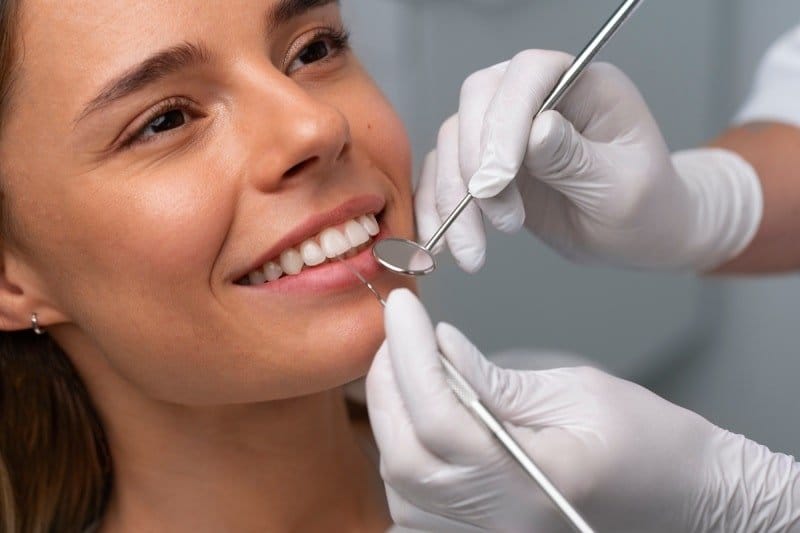
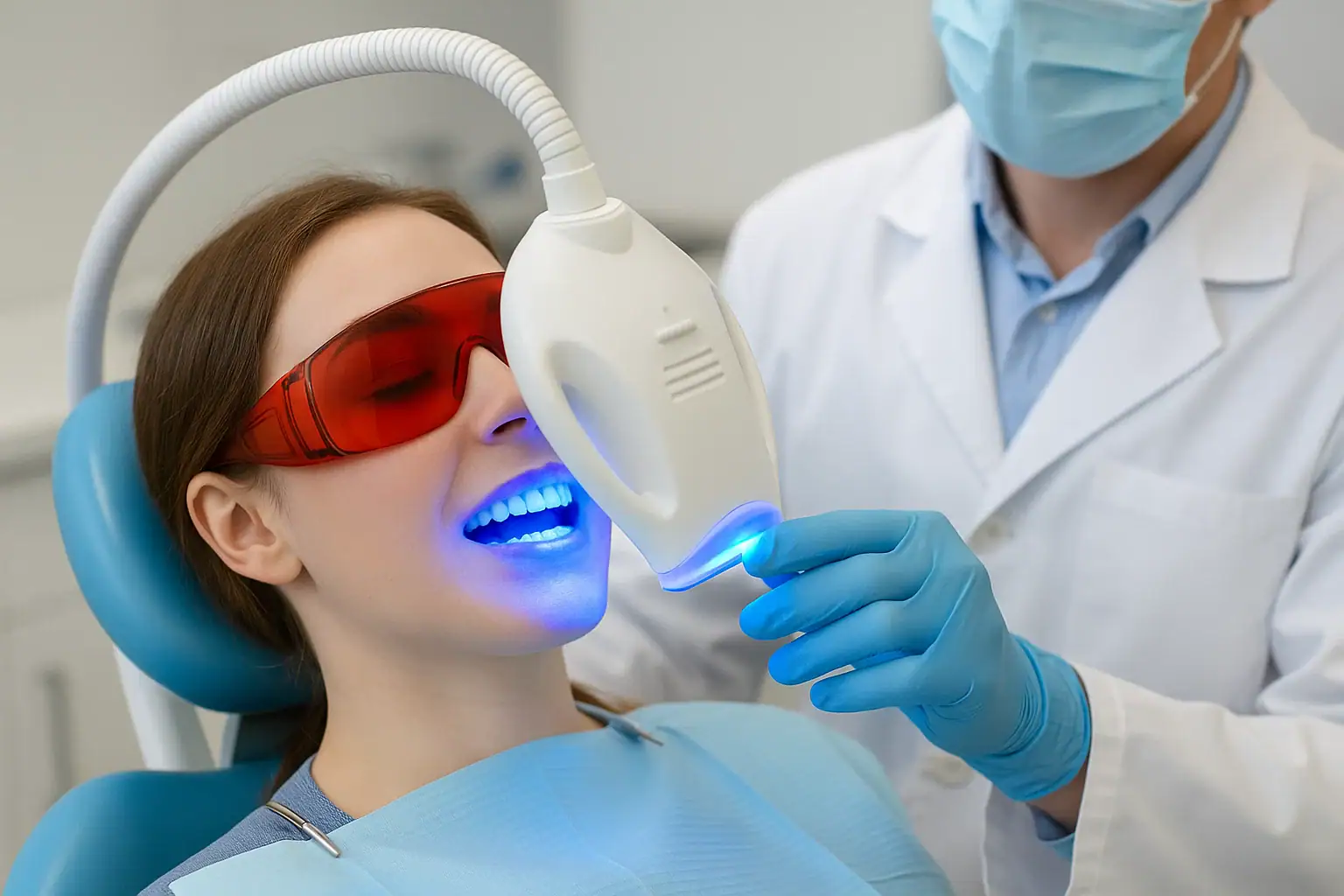
Laser teeth whitening is an in-office bleaching procedure in which a high-concentration peroxide gel is applied behind a protective gum barrier and then exposed to focused light, with the gel wiped off and the shade assessed in the same appointment. A meta-analysis of 21 randomised trials found that light activation did not improve colour change or affect tooth sensitivity with in-office gels (PubMed 29289725). It targets extrinsic stains from coffee, tea, wine and tobacco and age-related yellowing, but not fluorosis, tetracycline staining or existing crowns, veneers and fillings, which keep their original shade. At Mosdent in Istanbul, in-office whitening of both arches starts from €210; the figure that applies to you is written down after an examination.
- 01The appointment is a fixed sequence: gum and lip barrier, high-concentration hydrogen peroxide gel, light activation, gel removal and shade check.
- 02Results hold for 6 months to 2 years, and repeat treatment is generally kept to every 6 to 12 months because overuse can weaken enamel and prolong sensitivity.
- 03Bleaching changes natural enamel only: crowns, veneers, bonding and fillings on visible teeth keep their original shade and may need replacing to match.
- 04It works on extrinsic stains and age-related yellowing; intrinsic discoloration from fluorosis, tetracycline or trauma responds poorly and usually needs veneers instead.
- 05Temporary tooth sensitivity and mild gum irritation are the expected side effects and usually resolve within 48 hours.
What Is Laser Teeth Whitening
Laser teeth whitening is an in-office bleaching procedure in which a high-concentration peroxide gel is applied to the teeth and then activated with focused light. It is carried out by a dental professional in a single appointment, and the change in shade is assessed before the patient leaves. It is one form of professional whitening, alongside in-office bleaching without light and home-based bleaching with trays or strips.
The active ingredient is hydrogen peroxide. It penetrates the enamel and breaks down the pigment molecules that make teeth look yellow or stained. The protective barrier placed over the gums and lips before treatment allows a much higher concentration of peroxide than home products use, which is why the procedure is kept in the clinic and under supervision.
The treatment works on natural enamel. It lifts extrinsic stains from coffee, tea, red wine and tobacco, and it can lighten the yellowing that comes with age. It does not change the colour of crowns, veneers, bonding or fillings, which keep the shade they were made in. It also has a limited effect on intrinsic discoloration, such as fluorosis, tetracycline staining or darkening after trauma.
Because the result depends on the type of stain, the condition of the teeth and the restorations already in the mouth, the decision starts with an examination.
How Does Laser Teeth Whitening Work
The appointment follows a fixed sequence that takes place within a single visit.
It starts with a consultation and assessment. The dentist examines the teeth and gums, records the starting shade and checks for decay, cracked fillings, exposed roots or gum inflammation. Problems of this kind are treated before whitening, because peroxide on an open cavity or an inflamed gum causes pain and irritation.
A cleaning follows. Plaque and tartar are removed so that the gel reaches the enamel evenly. Surface deposits left in place can block the gel and leave the result patchy.
The soft tissues are then protected. A barrier is applied over the gums, and the lips and cheeks are held away from the teeth. Protective glasses are worn by the patient and the team during light activation.
The whitening gel is applied next. A high-concentration hydrogen peroxide gel is spread over the front surfaces of the teeth that show in the smile.
The light is then used. A laser or another light source is directed at the gel for a set period, and the gel may be refreshed and the light cycle repeated during the same visit.
Finally the gel is removed and the shade is checked. The gel is wiped and rinsed away, the barrier is taken off and the new shade is compared with the one recorded at the start.
Does the Laser Light Make Whitening Work Better
The light in laser whitening is marketed as the part that speeds up and strengthens bleaching, but the controlled evidence does not support that claim. A systematic review and meta-analysis of 21 randomised clinical trials compared in-office bleaching with and without light activation in adults (PubMed 29289725). It found no significant difference in colour change, and no significant difference in the risk or intensity of tooth sensitivity (PubMed 29289725).
The finding held across gel strengths. The review ran a subgroup analysis for low and high hydrogen peroxide concentrations, and the activation of in-office bleaching gel with light did not seem to improve colour change or affect sensitivity at either concentration (PubMed 29289725). The authors state that the commercial claim that light improves and accelerates colour change was not confirmed for gels with either high or low levels of hydrogen peroxide. The certainty of the evidence was graded moderate for colour change and for the risk of sensitivity (PubMed 29289725).
For a patient, this means the whitening effect comes from the peroxide gel, its concentration and the time it stays on the teeth. In the trials the light did not add to the effect, and the lightening itself comes from the peroxide. When you compare options, the useful questions are about the gel, the number of cycles, the protection of the gums and the supervision, more than about the light source.
This also answers a common question about laser whitening and Zoom whitening. Both are in-office procedures using a peroxide gel and they differ in the activation technology. Laser whitening uses focused light energy, while Zoom uses a specialised LED lamp. The gel chemistry, the protective barriers and the structure of the appointment are the same, and the choice usually depends on the system the clinic runs.
Who Is a Good Candidate for Laser Whitening
Laser whitening suits adults with healthy teeth whose discoloration comes from surface stains or ageing. Coffee, tea, wine and tobacco stains and general yellowing respond well, provided the teeth have no untreated decay and the front teeth carry no large restorations.
Some groups are not suitable for the procedure. Pregnant and breastfeeding people are advised to wait. People with veneers, crowns or fillings on visible teeth will see the natural teeth lighten while the restorations stay the same shade, which can leave an uneven smile. Those with intrinsic discoloration from trauma or medication usually see a limited change.
The type of stain decides how much whitening can do. Extrinsic stains sit on and just below the surface of the enamel and are caused by habits, so peroxide reaches them easily. Intrinsic stains form inside the tooth during development or after injury. Fluorosis, tetracycline staining and genetic discoloration respond poorly to bleaching, and in these cases veneers or other restorative options are usually discussed instead.
The health of the gums matters too. People with gum disease or hypersensitive teeth should be assessed before whitening, because inflamed gums and exposed roots react more strongly to peroxide. Treating the gum problem first protects the tissue and gives a more even result. Decay must also be treated before whitening, and old fillings on the front teeth may need replacing once the new shade has settled.
Coffee, Tea and Smoking Stains and What Removes Them
Stains from coffee, tea and smoking are extrinsic: they build up in the thin protein film that covers the enamel, the pellicle, rather than inside the tooth. A review of extrinsic discolouration described most tooth discolourations as extrinsic brown deposits, named smoking, tea or coffee consumption and increasing age as promoting factors, linked the stains to chemical changes in the pellicle and noted them frequently with antibacterial plaque-inhibiting mouthrinses (PubMed 363748). Not every habit weighs the same. In a survey of an English population, extrinsic staining was markedly influenced by smoking and age, men tended to have more staining than women, and the effect of tea and coffee was not pronounced (PubMed 264419).
Because these stains sit on the surface, the first step is often mechanical. A systematic review of 21 publications with 32 comparisons found that nearly all whitening toothpastes reduced natural extrinsic discolouration more than regular toothpaste over at least 6 weeks (PubMed 28573755). A professional clean removes heavier deposits, and bleaching then lightens the enamel underneath. In a study of 30 smokers and 30 non-smokers who bleached at home, the result stayed stable for one year in both groups as long as stains from diet and cigarette smoke were removed by professional prophylaxis; measured without that cleaning, a slight darkening was seen (PubMed 26303401).
Vaping has been studied far less. The only data we found come from a laboratory study on bovine enamel blocks, funded by a tobacco company: cigarette smoke discoloured the enamel significantly, while e-cigarette aerosol gave values comparable to the control samples (PubMed 30346667). No clinical study in people has confirmed this, so it is not evidence that vaping leaves teeth unstained.
Is Laser Teeth Whitening Safe
Laser whitening is considered safe when a licensed dental professional performs it with protective barriers on the gums and lips. The expected side effects are temporary tooth sensitivity and mild gum irritation, and they usually settle within 48 hours.
Sensitivity is linked to the peroxide itself, which is why the evidence on light matters here. In the review of in-office bleaching, adding light did not change the risk or intensity of tooth sensitivity (PubMed 29289725). The Cochrane review of home-based bleaching reported tooth sensitivity and oral irritation as the common side effects, more prevalent with higher concentrations of active agents, although the effects were mild and transient (PubMed 30562408). Higher concentration therefore brings a stronger bleaching agent and a higher chance of short-lived sensitivity.
Several steps reduce discomfort. A desensitising toothpaste can be used in the days before and after treatment. Very hot and very cold drinks should be avoided for the first day, and soft food with lukewarm drinks is easier in the first 24 hours. The aftercare instructions from the clinic should be followed closely, particularly the advice on food and drink in the first two days.
Gum irritation comes from contact between the gel and the soft tissue, and it is the reason for the barrier. Persistent pain, swelling or sensitivity lasting beyond a few days should be reported to the clinic.
Is Laser Whitening Better Than a Home Whitening Kit
Laser whitening and home kits use the same family of bleaching agents, and they differ in concentration, time and supervision. In-office whitening applies a high-concentration gel for a short time under professional control and shows a visible change in a single session. Home kits apply lower concentrations in trays, strips or paint-on gels over days or weeks.
The evidence on home-based bleaching is broad but not strong. A Cochrane review included 71 trials of home-based chemical whitening products in adults (PubMed 30562408). Across 26 studies with 1398 participants, bleaching agents whitened teeth compared with placebo over a short time period, from 2 weeks to 6 months, but the certainty of the evidence was low to very low (PubMed 30562408). The review could not draw reliable conclusions on which home composition, concentration, application method or duration works better (PubMed 30562408).
For the patient, in-office whitening gives a faster result, controls the gel on the gums and allows the dentist to stop or adjust the session if sensitivity rises. Home whitening is gradual and cheaper, and the result depends on how consistently the trays or strips are used. Over-the-counter products vary widely in strength, and wearing them for longer than advised raises the risk of irritation.
How Long Does Laser Teeth Whitening Last
Laser whitening results typically last from 6 months to 2 years. The range is wide because it depends on what happens after the appointment, where diet, smoking and oral hygiene decide how quickly stains return.
The first 48 hours need particular care. Enamel is more open to pigment straight after bleaching, so coloured food and drink are avoided during this period, an approach often called the white diet. After about a week the shade stabilises, sensitivity fades and normal eating can resume with some caution.
Longer term, the useful levers are the ones that slow re-staining. Limiting pigmented drinks, using a straw for iced coffee or tea, rinsing with water after coffee and keeping up daily brushing and cleaning between the teeth all help. Smoking brings stains back quickly.
Professional whitening is generally repeated no more often than every 6 to 12 months. More frequent treatment is discouraged, because repeated exposure to high-concentration peroxide can weaken enamel and cause longer-lasting sensitivity. Between appointments, professional cleaning removes surface stains without bleaching, and dentist-prescribed home trays can maintain the shade at a lower concentration.
Can I Combine Laser Whitening With Other Cosmetic Treatments
Whitening gels act only on natural enamel, so crowns, veneers and bonding keep the shade they were made in. If visible restorations are present, the natural teeth around them will lighten and the restorations will not, which can leave a mismatch.
The practical sequence is to whiten the natural teeth first, let the colour settle, and then replace visible restorations to match the new shade. The shade of a new crown or veneer is chosen after whitening, so the restoration matches the lighter teeth. For this reason whitening is often the first step in a wider smile makeover.
Whitening before other cosmetic work follows the same logic. Before veneers, whitening sets the shade of the neighbouring natural teeth. Before dental bonding, it allows the composite to be matched to the final colour. Before clear aligners, it can be planned so that the result is consistent once the teeth are in their new position.
How Much Does Laser Teeth Whitening Cost
At Mosdent in Istanbul, in-office whitening of both arches starts from €210 on the 2026 price list. That is a starting price, not a quote: the figure that applies to you is written down after a free examination. Elsewhere the cost of laser whitening varies with the clinic, the region, the system used and what the quoted fee includes. Whitening is a cosmetic procedure, so standard dental insurance generally does not cover it. Some dental discount plans offer partial coverage, and some dental tourism packages include whitening.
A written quote is more useful than an advertised figure. Ask whether the fee covers the examination, the cleaning before whitening, both arches, the number of gel cycles, any desensitising treatment and a follow-up check. Ask whether home trays for maintenance are included or charged separately.
When choosing a clinic, verified patient reviews and before-and-after photographs give an idea of the results, and the clinic should be able to name the whitening system and gel concentration it uses. Transparent pricing, with no additional fees added after treatment, and a consultation before any gel is applied are signs of a clinic that plans the treatment around the patient.
Patients who consider treatment in Turkey usually weigh modern clinics working to international standards, the level of fees, English-speaking staff and the packages available for visitors. Whether the treatment is done at home or abroad, the same checks apply to the equipment used, to what the quoted price covers and to who will carry out the procedure. Laser whitening produces a visible change in a single clinic session and costs more than home kits, and what the extra cost buys is speed and professional supervision.
Let’s plan the right treatment together.
Free Assessment→- 1.Maran BM, Burey A, de Paris Matos T, Loguercio AD, Reis A. In-office dental bleaching with light vs. without light: A systematic review and meta-analysis. J Dent 2018;70:1-13. PubMed 29289725
- 2.Eachempati P, Kumbargere Nagraj S, Kiran Kumar Krishanappa S, Gupta P, Yaylali IE. Home-based chemically-induced whitening (bleaching) of teeth in adults. Cochrane Database Syst Rev 2018;12:CD006202. PubMed 30562408
- 3.Eriksen HM, Nordbø H. Extrinsic discoloration of teeth. J Clin Periodontol 1978;5:229-36. PubMed 363748
- 4.Ness L, Rosekrans Dde L, Welford JF. An epidemiologic study of factors affecting extrinsic staining of teeth in an English population. Community Dent Oral Epidemiol 1977;5:55-60. PubMed 264419
- 5.Soeteman GD, Valkenburg C, Van der Weijden GA, Van Loveren C, Bakker E, Slot DE. Whitening dentifrice and tooth surface discoloration-a systematic review and meta-analysis. Int J Dent Hyg 2018;16:24-35. PubMed 28573755
- 6.de Geus JL, de Lara MB, Hanzen TA, Fernández E, Loguercio AD, Kossatz S, et al. One-year follow-up of at-home bleaching in smokers before and after dental prophylaxis. J Dent 2015;43:1346-51. PubMed 26303401
- 7.Dalrymple A, Badrock TC, Terry A, Barber M, Hall PJ, Thorne D, et al. Assessment of enamel discoloration in vitro following exposure to cigarette smoke and emissions from novel vapor and tobacco heating products. Am J Dent 2018;31:227-233. PubMed 30346667