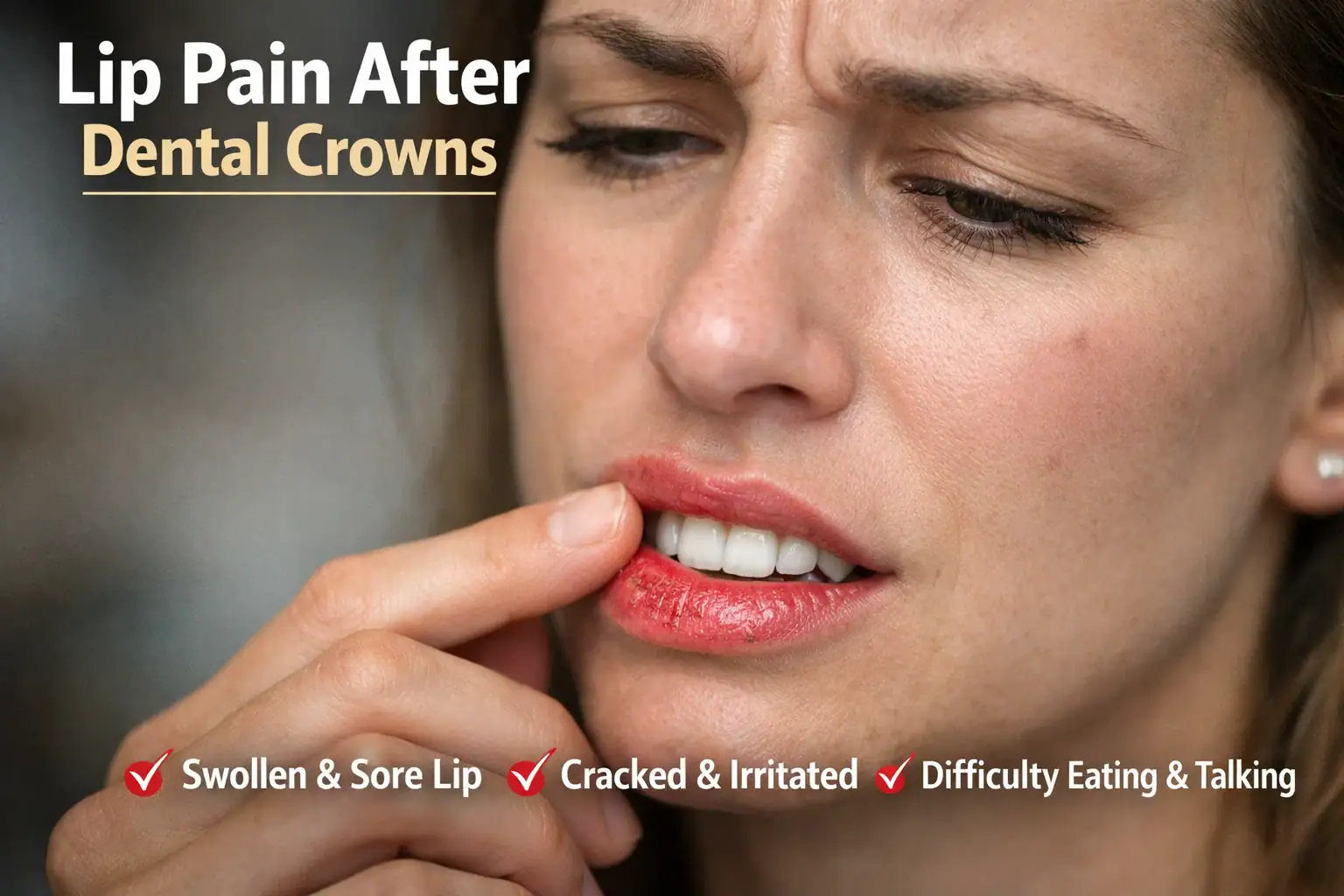
Lip pain after dental crowns is usually a soft tissue reaction and on its own says nothing about how the crown was made or fitted. The lips are stretched by retractors and instruments while the mouth stays open through a long crown appointment, and numb lips are easy to bite before the local anaesthetic wears off. The usual presentations are soreness, swelling, redness, a burning feeling and small cuts or ulcers, and in most cases they settle within a few days. Pain that persists beyond the first days or keeps increasing needs a dental review.
- 01The pain usually sits in the soft tissue of the lips: keeping the mouth open through a long crown appointment strains the lip muscles and produces micro-injuries.
- 02Soreness, swelling and small sores are expected to fade over the first days; pain that grows rather than fades is the pattern to report.
- 03Lip pain and tooth pain separate on behaviour: lip pain is tender to touch and improves quickly, while tooth pain is sensitive to biting pressure and persists.
- 04Numbness lasting more than 24 hours, pus or discharge, fever, spreading swelling or a rash are the signs that move this from routine healing to an urgent call.
- 05Standard measures are a cold compress for 10 to 15 minutes every hour on the first day, lip moisturiser, soft food, saltwater rinses and staying hydrated.
Why Lips Hurt After a Crown Appointment
Lip pain after dental crowns is a soft tissue reaction, and in most cases it says nothing about how the crown was made or fitted. It is common, it is usually temporary, and it comes from what happens to the lips during the appointment rather than from the crown itself.
A crown appointment can take 1 to 3 hours, and for most of that time the mouth stays wide open. Keeping it open that long strains the lip muscles and the thin skin at the corners of the mouth, and it produces small injuries in the tissue that are only noticed once the appointment is over. Retractors and other instruments that hold the lips away from the teeth press against the same tissue and can leave irritation, small cracks or minor wounds. Local anaesthetic adds a third factor, because numb lips are easy to bite or rub without feeling it.
The result is a familiar group of symptoms. Soreness, mild swelling, redness, a burning feeling and small cuts or ulcers on the inside of the lip are the usual presentations, and in most cases they settle within 24 to 72 hours. Dry lips, sensitive skin and long or repeated appointments make them more likely, since each of them adds to the strain on the lips.
None of these signs points to a problem with the tooth under the crown. They sit in the lips and the lining of the mouth, and they heal the way any small soft tissue injury does.
Numbness and Bitten Lips
The numbing injection used for crown preparation leaves the lip, and sometimes the tongue and cheek, without feeling for some hours after the appointment. Numbness normally wears off in about 2 to 6 hours. During that time it is easy to chew on the lip while eating, bite it while talking, or rub it against the teeth without noticing, and the soreness appears only when the feeling returns.
This kind of injury is well recorded in dentistry, particularly in children. In a school-based dental clinic that followed 923 visits in which local anaesthetic was given, the overall complication rate was 5.3%, all complications were mild or moderate, and the most frequent type was self-inflicted soft tissue injury (PubMed 23928444). The same study found that inferior alveolar nerve blocks, the injection that numbs half of the lower jaw and lip, were one of the factors that raised the rate of complications (PubMed 23928444).
Adults bite numb lips less often than children, but the mechanism is the same. The practical rules are to avoid eating until the numbness has worn off, to choose drinks that are lukewarm rather than hot, and to keep an eye on the lip rather than testing it with the teeth. A bitten lip usually shows as a swollen, tender area or a small ulcer the next day and heals within a few days with the same care as any other sore.
How Long Lip Soreness Lasts
Most lip soreness after a crown settles within 24 to 72 hours. The usual pattern runs from mild discomfort that lasts 1 to 2 days, through moderate soreness lasting 2 to 3 days, to small sores or ulcers that take 3 to 5 days to heal. Each of these should improve from one day to the next rather than stay the same or grow.
Swelling follows a similar course. Some puffiness of the lip after the appointment comes from tissue irritation or from the injection, and it normally subsides within 48 hours. A mild burning feeling in the lips is also common. It comes from stretched, irritated or slightly dried tissue and from the numbing injection, and it fades along with the soreness over the first days.
The useful measure is direction. Soreness that is clearly easing by the second or third day is ordinary healing, even if a small ulcer is still present. Pain that is still there beyond 5 days, or pain that keeps increasing rather than fading, should be checked by your dentist, because it no longer fits the normal course of a soft tissue injury.
Anxiety after dental work can make ordinary sensations feel stronger for a few days, especially when the mouth has changed. Knowing the expected timeline in advance makes it easier to tell which sensations belong to normal healing.
Home Care for Sore Lips
A few simple measures shorten the recovery. On the first day, apply a cold compress to the outside of the lip for 10 to 15 minutes every hour, which limits swelling and eases soreness. Keep the lips coated with a lip moisturiser or petroleum jelly so that stretched, dried skin does not crack, and reapply it through the day. Over-the-counter pain relievers are appropriate for the first days if they are needed.
Food and drink matter while the tissue heals. Soft, lukewarm food is easier on sore lips, while hot, spicy, acidic and hard foods sting open areas and can reopen small cuts. Staying hydrated supports healing and keeps the lips from drying further.
Small sores inside the lip are treated like any minor mouth ulcer. Rinsing or gargling with warm salt water keeps them clean and soothes the tissue, and an oral healing gel can make eating more comfortable. Most heal within a few days. Keeping them clean matters, because an open sore can become infected if food and plaque are left on it.
While the lips heal, it also helps to avoid smoking, limit alcohol, brush gently around the new crown and follow the specific instructions given at the clinic. A temporary crown in particular is worth treating carefully until the permanent crown is fitted.
Telling Lip Pain Apart From Tooth Pain
Lip pain and tooth pain after a crown separate on how they behave. Lip pain comes from soft tissue irritation, it is tender when the lip is touched, and it improves quickly. Tooth pain comes from the nerve of the tooth or from the way the teeth meet, it is sensitive to biting pressure, and it tends to persist. The first is part of normal recovery, while the second needs an appointment.
A crown problem presents in a recognisable way. The tooth is sensitive when you bite, the pain stays rather than fades, or the bite feels high when the teeth close together. These symptoms involve the tooth and the bite, and they are managed with an adjustment appointment rather than with lip care. A high spot can usually be adjusted in a short visit.
Crown edges can also play a part. A new crown feels unfamiliar, and in the first few days it may rub slightly against the inner lip. Temporary crowns are usually rougher than permanent ones, while permanent crowns are polished smooth and tend to be more comfortable against the lip. If a particular spot keeps rubbing and making the lip sore after the first days, the edge can be checked and smoothed.
Crown type rarely makes a difference to lip irritation in itself. The length of the appointment and the handling of the lips during it matter more than the material.
Signs That Need a Call to the Clinic
Most lip pain after crowns needs nothing more than home care, but some signs move it out of the routine. Contact the clinic for severe or increasing pain, pus or discharge from a sore, fever, swelling that is significant or spreading, numbness that lasts more than 24 hours, and an allergic pattern such as a rash and itching around the mouth. A sore that grows rather than shrinks over several days also needs a look.
Numbness that lasts well beyond the expected few hours deserves attention because the cause can sometimes be a nerve. Traumatic injuries to the nerves of the lower jaw during dental procedures can lead to reduced or absent sensation and to nerve pain (PubMed 38488908). A review of these injuries recommends immediate action where the cause is reversible and a careful examination of the injury and its effects, because the right treatment depends on the individual case (PubMed 38488908).
Burning that arrives with swelling, itching or a rash is a different picture from ordinary soreness and suggests a reaction to a dental material. Such reactions are rare but should always be reported.
The clinic side of prevention is part of the appointment itself. Dentists often reduce the risk of lip soreness by applying a protective gel to the lips, taking breaks during long procedures, using softer retractors and reminding patients not to bite numb lips on the way home.
Let’s plan the right treatment together.
Free Assessment→- 1.Espinosa MC, Hohman MH, Sivam S. Oral and Maxillofacial Surgery, Facial Laceration Repair. In: StatPearls. Treasure Island (FL): StatPearls Publishing; 2026. Bookshelf NBK570584
- 2.Brizuela M, Daley JO. Angular Cheilitis. In: StatPearls. Treasure Island (FL): StatPearls Publishing; 2026. Bookshelf NBK536929
- 3.Kämmerer PW, Heimes D, Hartmann A, et al. Clinical insights into traumatic injury of the inferior alveolar and lingual nerves: a comprehensive approach from diagnosis to therapeutic interventions. Clin Oral Investig 2024;28(4):216. doi:10.1007/s00784-024-05615-4. PubMed 38488908
- 4.Boynes SG, Riley AE, Milbee S, Bastin MR, Price ME, Ladson A. Evaluating complications of local anesthesia administration and reversal with phentolamine mesylate in a portable pediatric dental clinic. Gen Dent 2013;61:70-6. PubMed 23928444