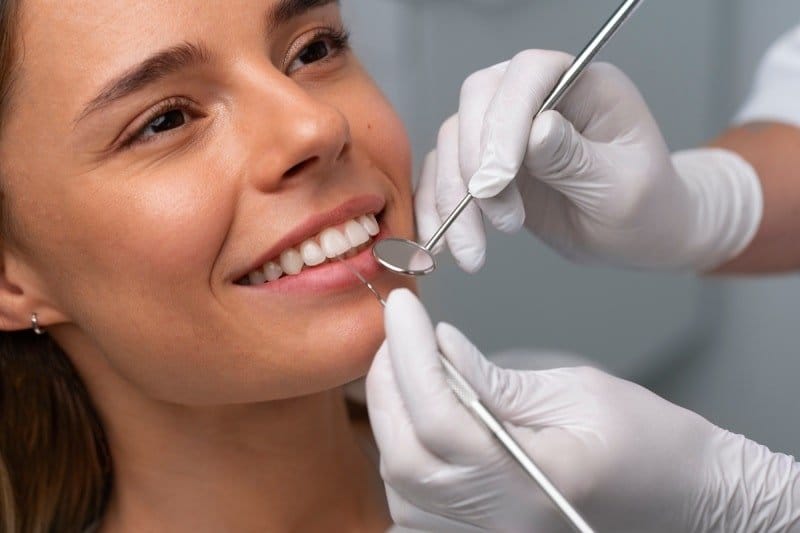
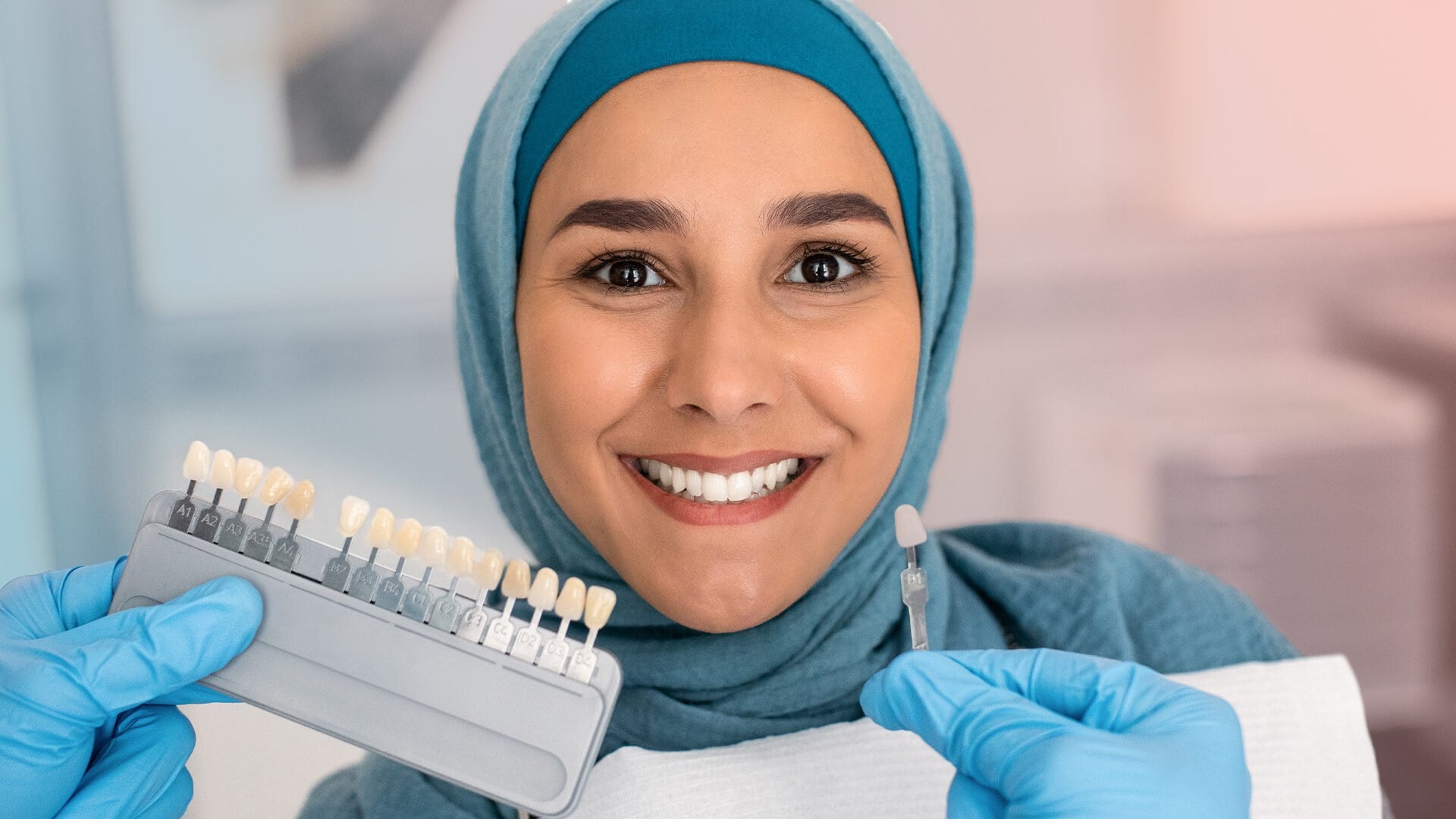
Teeth whitening is the removal of discoloration from enamel and dentine to lighten tooth shade, using peroxide-based gels applied either in the clinic or at home in dentist-supplied trays. An office session usually runs 30 to 60 minutes, while home protocols spread the same work over several weeks. A meta-analysis of eight randomized trials found no significant difference between in-office and at-home bleaching in whitening efficacy or in the risk and intensity of tooth sensitivity (PubMed 27045285). Candidates are over 18, free of active decay and gum disease, and not pregnant or breastfeeding.
- 01Whitening lightens the colour of existing teeth and nothing else; shape, alignment, gum level and lip framing belong to smile design, which is a different and broader intervention.
- 02In-office and at-home routes performed comparably: a meta-analysis of eight randomized trials found no significant difference in efficacy or in the risk and intensity of tooth sensitivity (PubMed 27045285).
- 03A clinical session runs 30 to 60 minutes and gives a visible result in one appointment; a second session can follow within a few weeks if the target shade is not reached.
- 04The psychosocial effect has been measured: across nine randomized trials with 489 participants, OHIP-14 and PIDAQ scores improved significantly 30 days after bleaching and dental self-confidence rose as the shade change grew (PubMed 39378962).
- 05Whitening is not performed during active caries or gum disease, in pregnancy and breastfeeding, under the age of 18, or on very thin or damaged enamel.
Smiling is our strongest personal image. However, yellowing, stains and discoloration of teeth over time can damage our self-confidence. Many people think that having white teeth is only for celebrities or those who spend a fortune on cosmetic surgery. However, today, thanks to technological advances, having white teeth is not a dream. Moreover, this process is much more comfortable, effective and accessible than it is thought.
/ Teeth Whitening Definition, Causes and Methods
What is Teeth Whitening?
Teeth whitening is the process of removing discoloration from teeth and giving them a lighter tone. This process targets different levels of tooth yellowing, from superficial stains to deep discoloration. Professional teeth whitening is a reliable and effective method for those who want to have snow-white teeth.
Why Do Teeth Turn Yellow?
- There are many reasons why teeth may change color over time:
- Frequent consumption of colored drinks such as coffee, tea, red wine
- Smoking
- Inadequate oral hygiene
- Aging
- Genetic factors
- Some medications used
Teeth Whitening Methods
Office Type Teeth Whitening (Clinical Application)
In this application performed in a professional clinical environment, special whitening gels and LED light systems are used. It is the most preferred method by those who want to have snow-white teeth because it provides visible results in a single session.
Home Type Teeth Whitening
This is a method applied at home with special trays and gels given by the dentist. It may take a little longer to get results.
Laser Teeth Whitening
A deeper whiteness is achieved with advanced laser technology. It is especially preferred for stubborn discolorations.
Natural Methods (Supportive But Insufficient)
Baking soda and activated charcoal are abrasives rather than bleaching agents, so at best they lift surface film and cannot change the colour inside the tooth. A review of charcoal and charcoal-based dentifrices found insufficient clinical and laboratory data to substantiate their safety and efficacy claims and advised caution (PubMed 28599961). In a laboratory test, brushing with charcoal toothpowder produced no colour change while it roughened the enamel surface and increased calcium loss (PubMed 39769703).
/ Teeth Whitening Technologies, Suitability and Application Process
Technologies Used in Teeth Whitening
Thanks to developing technology, teeth whitening methods have also evolved to a great extent. Today the options run from simple gels to LED-supported systems and laser technologies. These devices increase the effect of whitening gels and make the process quicker and more effective. Especially in recent years, the “cold light technology” offers both a comfortable and safe application.
How Long Does Teeth Whitening Take?
The duration of teeth whitening varies depending on the method chosen and the person's tooth structure. While office-type whitening procedures performed in a clinical setting are usually completed in 30-60 minutes, this process can take up to a few weeks in home-type applications. For individuals who want fast results, there are systems that can achieve effective results in a single session.
Who Can Get Teeth Whitening?
- Individuals over the age of 18
- Those with good general oral health
- Those who have had their teeth cleaned
- Individuals without excessive sensitivity
In Which Cases Can Teeth Whitening Not Be Performed?
Some situations are not suitable for teeth whitening:
- Individuals with active caries or gum disease
- Those with hypersensitivity
- Pregnant women and nursing mothers
- People under the age of 18
- Teeth with very thin or damaged enamel
These groups must definitely undergo a doctor's check-up.
How Does Teeth Whitening Work?
Initial Examination and Evaluation
The dentist analyzes the current condition of the teeth and decides which method is appropriate.
Application
Oral hygiene is provided according to the selected method and the whitening process is started. In clinical applications, the session duration is usually 30-60 minutes.
Result and Control
A visible color lightening is achieved after the procedure. If necessary, a second session can be applied within a few weeks.
/ Teeth Whitening Expectations and Smile Design
What is the Difference Between Teeth Whitening and Smile Design?
Many people think that teeth whitening and smile design are the same process. However, there are significant differences between them. Teeth whitening is simply the process of lightening the color of the teeth. Smile design, on the other hand, covers many aesthetic elements such as the shape, size, alignment, lip structure and gum levels of the teeth. In other words, smile design is a much more comprehensive and personalized aesthetic intervention. Not every individual who wants white teeth needs to have a smile design, but in some cases, their combined application provides more effective results.
Psychological Effects of Teeth Whitening
An aesthetic smile changes both how you look and how you feel. Individuals with white teeth feel more confident in social environments. Especially in professional groups that speak in front of the public or communicate frequently, a white smile also strengthens the professional stance. Even the way patients look in the mirror changes after teeth whitening; because even this small touch makes the person feel more valuable.
/ Teeth Whitening Misconceptions, Turkey Preference and Aftercare
Teeth whitening aftercare includes misconceptions, treatment preference and post-procedure habits.
Misconceptions About Teeth Whitening
- “Teeth whitening melts tooth enamel.”, False. Enamel is not damaged in procedures performed under the supervision of a specialist.
- “Natural methods done at home are better.”, False. Products such as baking soda and lemon can damage tooth enamel.
- “Whitened teeth decay more quickly.”, False. If oral hygiene is followed after the application, the risk of decay does not increase.
Teeth Whitening in Turkey: Why is it Preferred?
Turkey has become an important destination in health tourism in recent years. Teeth whitening procedures are also a part of this development. Affordable prices, high quality, expert dentists and applications performed with current equipment offer great advantages, especially for patients coming from Europe. Moreover, in cities like Istanbul, there is the opportunity to both vacation and benefit from aesthetic applications.
Things to Consider After Teeth Whitening
- Stay away from colorful foods and drinks for the first 48 hours
- Smoking should be avoided
- Routine tooth brushing and oral care should not be neglected
- Care gels recommended by the doctor should be used
/ Frequently Asked Questions
Is teeth whitening harmful?
No. Whitening procedures performed under the supervision of a specialist do not harm tooth enamel.
Is whiteness permanent?
Its permanence may vary depending on the person's habits. Permanence is achieved between 6 months and 2 years on average.
Will teeth be sensitive after the procedure?
Temporary sensitivity may be experienced in some individuals, but it passes within a few days.
Is home or clinic type more effective?
Clinic type whitening is much faster and more effective. Home type can be supportive.
Is teeth whitening suitable for everyone?
No. It may not be suitable for individuals with gum problems, cavities, cracks or serious sensitivity. A preliminary examination is required.
Not a Dream, but Reality!
Looking at yourself in the mirror with confidence, not hiding your teeth while smiling, and smiling freely in photos is no longer just a wish, it is a real possibility. Having snow-white teeth is not a dream. With the right method, the right specialist, and a personalized approach, this process has become comfortable and accessible.
Don't postpone your smile. It's time to take action now!
Author: DDS, PhD Alaaddin Kılıçaslan (Prosthodontics Specialist)
Let’s plan the right treatment together.
Free Assessment→- 1.de Geus JL, Wambier LM, Kossatz S, Loguercio AD, Reis A. At-home vs In-office Bleaching: A Systematic Review and Meta-analysis. Oper Dent. 2016;41(4):341-356. doi:10.2341/15-287-LIT
- 2.Maran BM, Bersezio C, Martin J et al. The influence of dental bleaching on patient's quality of life: A multistudy analysis of aesthetic and psychosocial outcomes. J Dent. 2024;151:105397. doi:10.1016/j.jdent.2024.105397
- 3.Brooks JK, Bashirelahi N, Reynolds MA. Charcoal and charcoal-based dentifrices: A literature review. J Am Dent Assoc 2017;148:661-670. PubMed 28599961
- 4.Cutrim EAC, Penha KJS, Silva PBD, Carvalho EM, Silva MG, Kugelmeier CL, et al. Optical, Mechanical, and Chemical Impact of Brushing with Activated Charcoal Toothpowder and Toothpaste on Dental Enamel: An In Vitro Evaluation. Materials (Basel) 2024;17. PubMed 39769703