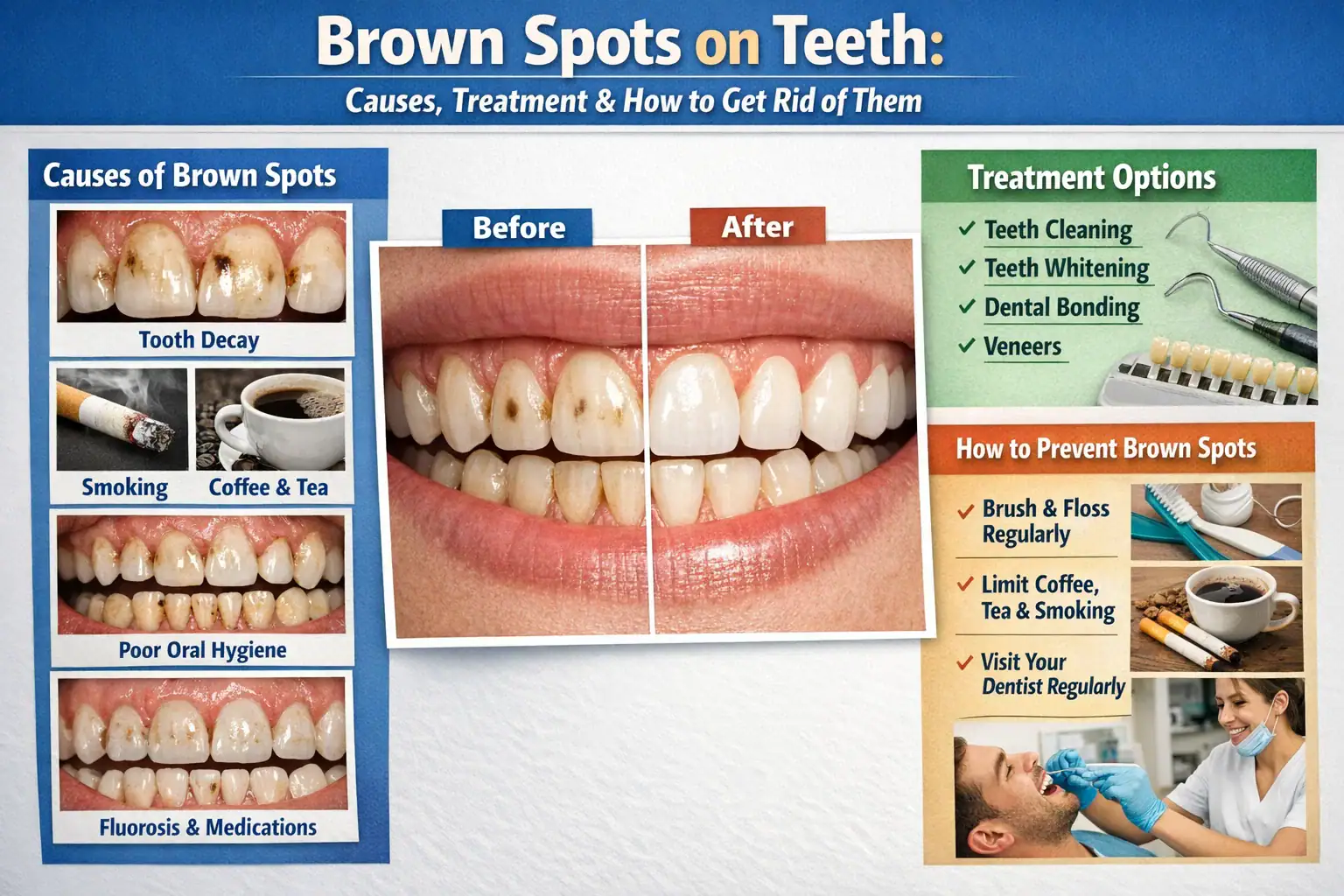
Brown spots on teeth are areas of discoloration ranging from light tan to deep chocolate brown, appearing as dots, patches or lines on the enamel, and they split into two clinically different groups: surface pigment left by food, drink, tobacco or tartar, and structural damage from decay, fluorosis, enamel hypoplasia, ageing restorations or trauma. The distinction decides the treatment, because whitening removes pigment but does nothing for decay. Decay is the cause that cannot wait: untreated caries in permanent teeth affected 2.03 billion people worldwide in 2019 (PubMed 36193522). A stain usually affects several teeth without pain; a cavity darkens a single tooth and brings sensitivity.
- 01Brown discoloration is not one condition: extrinsic pigment from coffee, tea, red wine, tobacco and tartar sits on the enamel, while intrinsic brown from decay, fluorosis, enamel hypoplasia or internal bleeding after trauma sits inside it.
- 02The self-check that matters: several teeth affected in a similar pattern, appearing gradually and painlessly, points to staining; a dark area on one tooth that is growing, feels rough or pitted to the tongue and is sensitive to hot, cold or sweet, points to a cavity.
- 03Whitening works only on the extrinsic group. Decay-related brown does not respond to bleaching agents and needs a composite filling or, when the lesion has reached the pulp, root canal treatment.
- 04Untreated caries in permanent teeth was prevalent in 2.03 billion people across 204 countries in 2019, which is why a single darkening tooth is examined rather than whitened (PubMed 36193522).
- 05Tartar is the one cause that cannot be reversed at home: it is a hardened, porous mineral deposit along the gum line that absorbs pigment and is removed only by professional cleaning.
Noticing brown spots on teeth can be alarming and confusing. Are they just surface stains from your morning coffee, or could they signal something more serious like tooth decay? The truth is that brown stains on teeth have a wide range of causes, from harmless lifestyle habits to underlying dental health conditions that require prompt attention. Understanding the difference is the first step toward protecting your smile.
/ Brown Spots on Teeth and Common External Causes
Brown spots on teeth are areas of discoloration that can range from light tan to deep chocolate brown. They may appear as small dots, irregular patches, or lines running across the enamel surface. Some affect a single tooth while others develop across multiple teeth simultaneously. They can show up on the front surface of teeth, near the gumline, or in the grooves between molars where they are harder to spot during brushing.
Not all brown stains on teeth are the same. Some are purely cosmetic surface-level pigmentation left behind by food, drink, or tobacco, while others are signs of structural damage to the enamel or active tooth discoloration caused by decay, infection, or systemic disease. Identifying which type you have is essential before choosing any treatment.
1. Food and Drink Staining
The most frequent cause of brown stains on teeth is the regular consumption of staining foods and beverages. Coffee, tea, red wine, cola, and dark berries all contain chromogens pigment molecules that adhere tightly to tooth enamel. Over time, these pigments accumulate and create visible brown spots on teeth, particularly along the edges and in enamel grooves.
2. Tobacco Use
Nicotine and tar from cigarettes and chewing tobacco are among the most aggressive causes of tooth discoloration. These compounds penetrate enamel deeply, producing stubborn brown or yellow-brown stains that cannot be removed by brushing alone. Tobacco-related brown stains on teeth also increase the risk of gum disease and oral cancer.
3. Tartar Buildup
When plaque is not removed regularly, it hardens into tartar a yellow to brown mineral deposit that forms along the gumline and between teeth. Tartar is porous and absorbs stains easily, making brown spots on teeth near the gum line one of its most visible signs. Unlike plaque, tartar cannot be removed at home; it requires a professional dental cleaning. Untreated tartar accumulation is also a leading driver of periodontology problems.
/ Dental and Developmental Causes of Brown Spots on Teeth
4. Tooth Decay (Cavities)
One of the more serious causes of brown spots on teeth is active decay. When bacteria in plaque produce acid, they erode the enamel layer. Early-stage decay appears as white spots, which gradually darken to brown and eventually black as the lesion deepens and the dentin beneath becomes exposed. Brown stains on teeth caused by decay will not respond to whitening treatments, they require restorative dental care such as fillings or, in advanced cases, a root canal treatment .
5. Fluorosis
Dental fluorosis occurs when children are exposed to excessive fluoride during the years when their permanent teeth are forming below the gumline. Mild fluorosis appears as white streaks; in more severe cases, the enamel becomes pitted and develops brown or grey patches. This type of tooth discoloration is cosmetic rather than functional, and the teeth remain structurally sound, but the appearance can cause significant self-consciousness.
6. Enamel Hypoplasia
Enamel hypoplasia is a developmental defect in which teeth form with less enamel than normal. It can be triggered by nutritional deficiencies, illness during pregnancy, or premature birth. The resulting brown spots on teeth often appear as rough-textured patches or bands and are permanent, they cannot be reversed by whitening. Restorative options such as composite filler or veneers are typically required.
7. Old Dental Restorations
Aging amalgam (metal) fillings can leach metallic pigment into surrounding enamel, causing greyish-brown discoloration around the restoration. Old white composite fillings can also absorb staining pigments over time, creating localised brown stains on teeth around the filling margins. Replacing deteriorated restorations with modern tooth-coloured materials resolves this type of tooth discoloration.
8. Trauma and Root Canal History
A tooth that has suffered physical trauma a sports injury, a fall, or a blow to the mouth may develop brown spots on teeth as internal bleeding within the pulp breaks down and stains the surrounding dentin. Similarly, a tooth that has undergone root canal treatment may darken over time as the nerve tissue is no longer present to maintain the tooth's vitality. This type of intrinsic tooth discoloration requires cosmetic intervention to correct.
/ Brown Spots on Teeth From Cavities or Stains
The difference between a cavity and a stain matters for brown spots on teeth.
This is one of the most common questions patients ask. Here is how to tell the difference:
It is likely a surface stain if:
- Multiple teeth are affected in a similar pattern
- The discoloration appeared gradually over months or years
- There is no accompanying pain or sensitivity
- It correlates with high coffee, tea, or tobacco use
It may be a cavity if:
- A single tooth has a darkening spot that appears to be growing
- There is increased sensitivity to hot, cold, or sweet foods
- The spot feels rough or has a visible pit when you run your tongue over it
- You notice persistent bad breath or a bad taste
When in doubt, always consult a dentist. Early detection of brown spots on teeth caused by decay prevents the need for more complex and costly treatment later.
Treatment for brown stains on teeth depends entirely on the underlying cause. At Mosdent Dental Hospital, every treatment plan begins with a thorough examination and, where needed, digital X-rays to determine whether the tooth discoloration is superficial or structural.
Professional Teeth Whitening
For surface-level brown stains on teeth caused by food, drink, or tobacco, professional teeth whitening is the fastest and most effective solution. Clinical-grade whitening agents penetrate the enamel to break down accumulated pigments, achieving significantly brighter results than any over-the-counter product. This treatment is not effective for intrinsic stains or decay-related tooth discoloration.
/ Restorative and Cosmetic Treatments for Brown Spots on Teeth
Dental Bonding
Bonding involves applying a tooth-coloured composite resin directly onto the stained surface, concealing brown spots on teeth in a single appointment. It is particularly suitable for small, localised areas of discoloration caused by enamel defects, minor chips, or fluorosis. Results are natural-looking and the procedure is entirely non-invasive.
Composite Filler
Where brown spots on teeth are caused by early-stage decay, a composite filler removes the damaged tissue and restores the tooth with a shade-matched material. Modern composite resins are highly aesthetic and durable, making them the preferred choice for addressing decay-related tooth discoloration in visible areas.
Porcelain Veneers
For more extensive or treatment resistant brown stains on teeth including fluorosis, enamel hypoplasia, or widespread surface staining porcelain veneers offer the most comprehensive cosmetic solution. Ultra-thin ceramic shells are bonded to the front surface of the teeth, completely masking the discoloration while simultaneously improving shape, size, and alignment. The result is a uniformly bright, natural-looking smile that is resistant to future staining.
Laminate Veneer
Laminate veneers work on the same principle as porcelain veneers but are even thinner often requiring no tooth preparation at all. They are an excellent choice for patients with brown spots on teeth who want to preserve as much of their natural enamel as possible while achieving a dramatic improvement in appearance.
/ Aesthetic Planning and Ongoing Care for Brown Spots on Teeth
Smile Makeover
When tooth discoloration is just one of several aesthetic concerns alongside alignment issues, worn teeth, or gum irregularities a comprehensive smile makeover combines multiple treatments into a single, coordinated plan. Mosdent's Digital Smile Design (DSD) technology allows patients to preview their results before treatment begins.
How to Prevent Brown Spots on Teeth
Preventing brown stains on teeth is largely a matter of consistent daily habits. Brush at least twice daily with fluoride toothpaste, floss every day, and limit your intake of staining foods and beverages. If you do consume coffee, tea, or red wine, rinse your mouth with water shortly afterwards. Attend professional dental cleanings every six months to remove tartar before it causes visible tooth discoloration, and avoid all tobacco products.
Brown Spots on Teeth? Mosdent Can Help
Whether your brown spots on teeth are a cosmetic concern or a sign of something that needs immediate attention, the team at Mosdent Dental Hospital in Istanbul is here to help. Depending on the cause, the answer may be teeth whitening, dental bonding or a wider smile makeover; which one applies is decided after examination. An appointment can be arranged through our contact page.
Let’s plan the right treatment together.
Free Assessment→