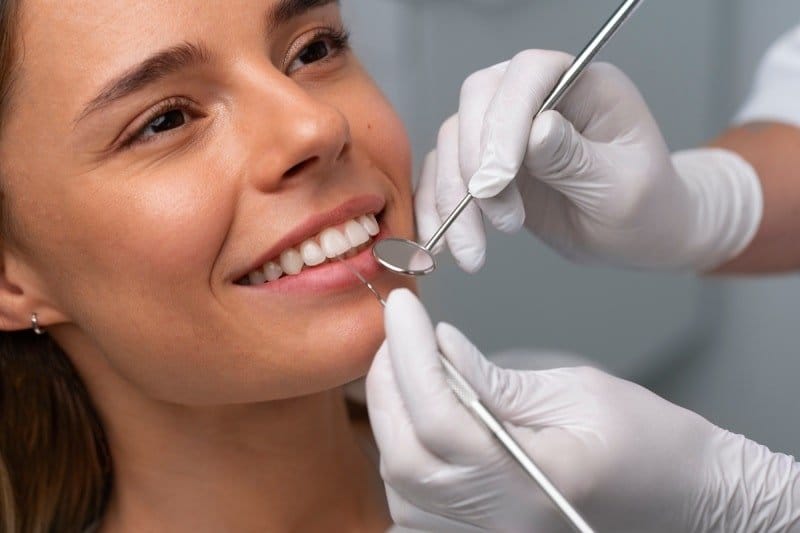
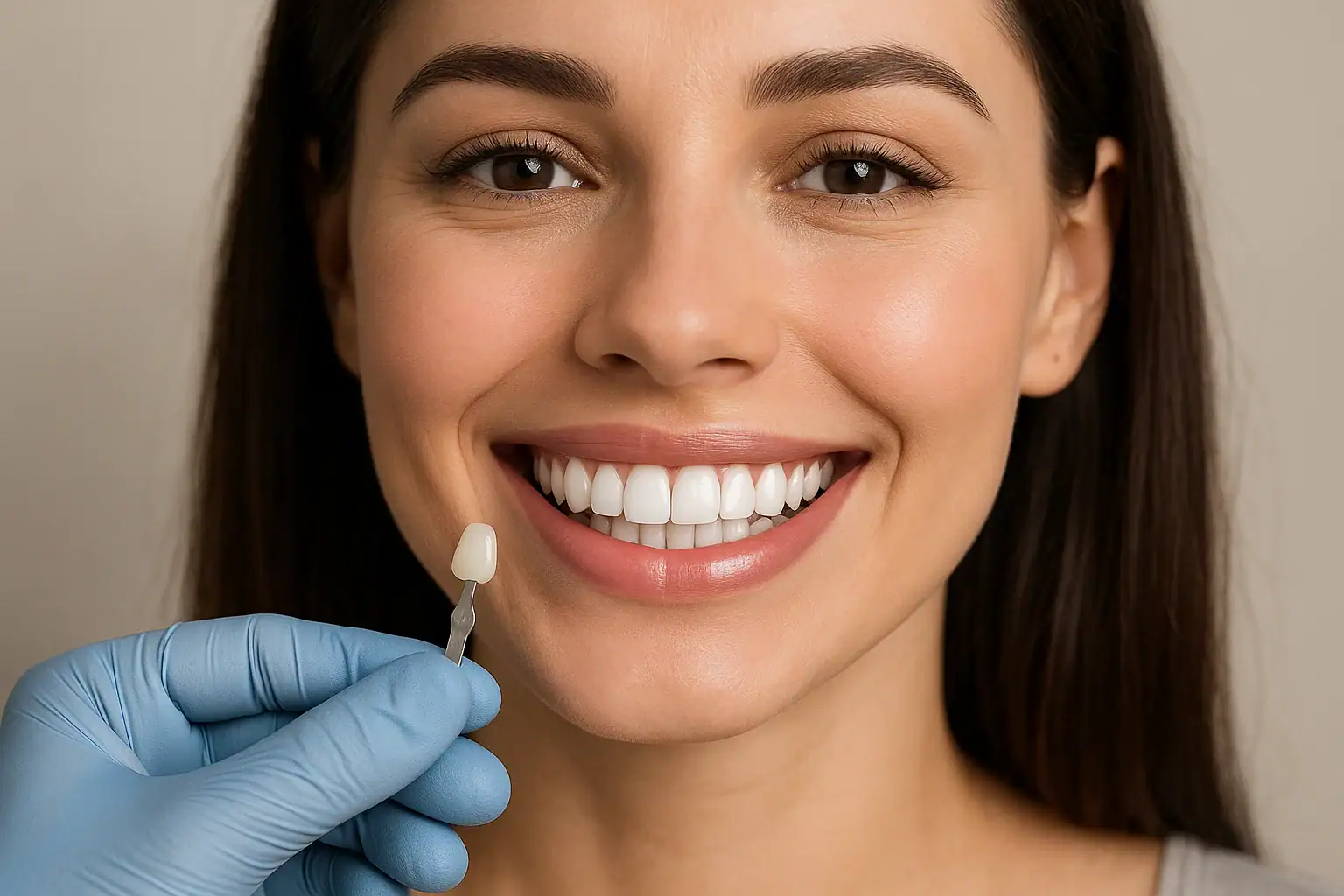
Cosmetic dentistry is the branch of dentistry that improves the appearance of teeth and gums, covering tooth colour, shape, size, alignment, position, symmetry and gum contour, and it crosses into restorative work whenever a crown or implant is involved. The usual procedures are whitening, porcelain veneers, implants, clear aligners, composite bonding, gum contouring and full smile makeovers. Cost depends on the procedure, the number of teeth and the material. Insurance rarely applies: cosmetic procedures are excluded unless the treatment also restores function.
- 01Cosmetic dentistry is defined by its target: tooth colour, shape, size, alignment, position, symmetry and gum appearance. Crowns and implants cross into restorative territory because they return function too.
- 02Cost is set by the procedure, the number of teeth treated, the material and the location, and a reliable figure comes only from a written plan after examination.
- 03Insurance is the usual disappointment. Tricare and most dental plans cover medically necessary work such as extractions, restorations, emergency care and basic periodontal treatment, and exclude veneers and whitening unless a functional component exists.
- 04The data behind the aesthetic promise: in a meta-analysis of 64 studies, five-year survival for tooth-supported single crowns was 98.5% for monolithic lithium disilicate, 97.1% for metal-ceramic and 96.8% for monolithic densely sintered zirconia (PubMed 41489982).
- 05Composite bonding is the lower-commitment option: pooled survival of resin composite laminate veneers in randomised trials was 88% (95% CI 81-94) over follow-up of 24 to 97 months (PubMed 38035903).
What Cosmetic Dentistry Covers
Cosmetic dentistry is the branch of dentistry that improves the appearance of the teeth and gums, and it is defined by what it changes: tooth colour, shape, size, alignment, position, symmetry and gum contour. General dentistry aims to keep the mouth healthy. Cosmetic dentistry works on how the smile looks, and the two overlap constantly, because a tooth that is decayed, cracked or surrounded by inflamed gum cannot be made to look good until it is healthy.
The boundary with restorative dentistry is also blurred. A crown on a broken molar or an implant replacing a missing front tooth restores function and appearance at the same time. When a treatment returns chewing, speech or protection for a weakened tooth, it counts as restorative as well as aesthetic.
The usual procedures range from small to extensive. At one end are whitening and composite bonding, which change colour or repair a chip with little or no removal of tooth structure. In the middle are porcelain veneers and crowns, which cover the tooth with a ceramic layer. Clear aligners and other orthodontic treatment move teeth into a new position. Gum contouring reshapes the soft tissue frame. At the far end are full smile makeovers, which combine several of these in one plan.
Interest in this kind of treatment has grown with rising expectations about appearance, the influence of photographs and social media, public-facing work and advances in digital, minimally invasive techniques. The reasons differ from one patient to the next: confidence in photographs, a job that involves speaking to people, or simply wanting the teeth to match the rest of the face. Whatever the reason, the plan starts with the same question, which feature of the smile the patient wants to change.
Whitening, Bonding and Gum Contouring
The least invasive cosmetic treatments change colour or make small repairs without covering the whole tooth. Professional teeth whitening uses peroxide-based gels, applied either in the clinic in a supervised session or at home with trays and gel supplied by the dentist. In-office options are sometimes combined with LED activation or laser whitening. Whitening changes the colour of natural teeth only. Existing fillings, crowns and veneers stay in the shade they were made in, which is worth knowing before starting.
Composite bonding uses tooth-coloured resin applied directly to the tooth and shaped by hand. It is used for closing small gaps, repairing chipped edges and evening out the symmetry of a smile, and it usually needs little or no drilling. Resin can also be used to make composite veneers covering the front of a tooth. In a systematic review of resin composite laminate veneers, the pooled survival across randomized controlled trials was 88% (95% CI 81% to 94%), with mean follow-up ranging from 24 to 97 months (PubMed 38035903). Surface roughness, colour mismatch and discoloration at the margins were the complications reported most often, and most were judged clinically acceptable with or without further treatment (PubMed 38035903).
Gum contouring, or gingivoplasty, reshapes the gum line. It is used when a smile shows a lot of gum, when the gum margins are uneven from tooth to tooth, or to prepare a balanced frame before veneers or crowns. Cosmetic dentistry works with the soft tissue as well as the teeth, and a treatment plan that ignores the gum line can leave well-made restorations looking out of proportion.
Veneers and Crowns
Porcelain veneers and crowns change the shape, colour and proportions of teeth by covering them with ceramic, and the evidence on how long they last is encouraging when they are planned well. Porcelain veneers are thin, custom-made shells bonded to the front surface of the teeth. They are used to correct discoloration that whitening cannot reach, gaps, chips and minor misalignment.
How much tooth is removed matters. In a retrospective study of 580 porcelain laminate veneers bonded in 66 patients and followed for up to 12 years, veneers bonded to dentin, or with preparation margins in dentin, were about 10 times more likely to fail than those bonded to enamel (PubMed 23342345). Survival was 99% for veneers whose preparation stayed within enamel and 94% for veneers with enamel only at the margins (PubMed 23342345). Keeping the preparation inside enamel is therefore a clinical decision with measured consequences, beyond a matter of style.
Crowns cover the whole tooth and are used when a tooth is heavily restored, cracked or root-canal treated. A meta-analysis of 64 studies estimated five-year survival for tooth-supported single crowns at 98.5% for monolithic lithium disilicate, 97.3% for veneered zirconia, 97.1% for metal-ceramic and 96.8% for monolithic zirconia (PubMed 41489982). Monolithic lithium disilicate and monolithic zirconia crowns showed significantly fewer ceramic fractures and chipping than veneered alternatives (PubMed 41489982).
These figures describe well-conducted studies with careful follow-up. In a single patient, bite forces, grinding habits and oral hygiene all shape how a restoration lasts, which is why a night guard or regular check-ups are sometimes part of the plan.
Implants and Orthodontics in a Cosmetic Plan
Some cosmetic goals cannot be reached by treating the surface of the teeth, and this is where implants and orthodontic treatment come in. When a tooth is missing, the gap affects the smile, chewing and sometimes speech. A dental implant replaces the root with a titanium post placed in the jawbone, and a crown is fitted on top once the bone has healed around it. Because it restores function as well as appearance, an implant sits on the border between cosmetic and restorative care.
Alignment problems are a different case. Crowded, rotated or spaced teeth can sometimes be disguised with veneers, but that approach removes tooth structure to hide a position problem. Moving the teeth first with orthodontic treatment often means fewer teeth need restoring afterwards, or none at all. Clear aligners straighten teeth with a series of removable plastic trays planned digitally from a scan. They are nearly invisible and can be taken out to eat and clean. Fixed brackets remain an option, particularly for more complex movements.
The order of treatment matters in a combined plan. Teeth are usually straightened first, whitened next, and restored last, so that veneers or crowns are made to fit the final position and matched to the final shade of the natural teeth. Changing that sequence can mean redoing work.
Smile Makeovers and Digital Planning
A smile makeover is a customised plan that combines several cosmetic procedures to reach a single outcome. Instead of treating one tooth or one problem, it looks at the smile as a whole: facial structure, tooth proportions, the line of the lips, how much tooth and gum show when the patient speaks and smiles, and what the patient wants to change.
Digital smile design is the planning step that brings these elements together. Photographs, video and intraoral scans are combined to model the proposed shape and position of the teeth before anything is done in the mouth. The patient can see a mock-up and discuss it, and the dentist can check that the proposal fits the face and the bite. Mosdent's digital planning is used to preview the proposed shape and position of the teeth before treatment starts.
People who tend to consider a makeover have several concerns at once, such as discoloured teeth, gaps, crooked or misaligned teeth, excessive gum display, chipped or cracked teeth, missing teeth or old restorations that no longer match. When only one of these is present, a single targeted treatment is usually enough.
Care for the whole family and cosmetic treatment can be provided in the same place, so that preventive and restorative care and aesthetic work are planned together. Mosdent provides general and aesthetic dental care in the same center.
Cost, Insurance and the Effect on Daily Life
The cost of cosmetic dentistry depends on the procedure, the number of teeth treated, the materials used, the clinician's experience and the location. A single whitening session and a full makeover involving many restorations sit at opposite ends of that range, so a meaningful figure can only come from a treatment plan based on an examination.
Insurance rarely helps with purely cosmetic work. Tricare and most dental insurance plans cover medically necessary treatment such as extractions, restorations, emergency care and basic periodontal treatment. Veneers and whitening are generally excluded unless the treatment also has a functional component, for example restoring a broken tooth. The exact wording of each policy decides what is covered, so it is worth checking before assuming a procedure qualifies.
The effect on daily life is the reason many patients seek treatment. People often describe feeling more confident in photographs and social situations, and communicating more naturally once they stop hiding their teeth. Better chewing and speech can follow when missing teeth are replaced or worn teeth restored. These effects vary from person to person and depend on starting expectations. A plan that sets realistic goals at the outset, and explains what each treatment can and cannot change, gives the patient a fair basis for judging the result.
Choosing a Cosmetic Dentistry Clinic
The useful checks when choosing a clinic are the ones that can be verified. The first is the clinician's experience with aesthetic cases. Cosmetic work combines clinical skill with a sense of proportion, and a dentist who does this regularly can show examples.
The second is the technology actually available. CBCT imaging, CAD/CAM production, 3D scanning, laser equipment and digital smile design all support planning and precision. Their presence does not guarantee a good result, but a clinic offering complex aesthetic work without digital planning is working with fewer tools.
The third is a real before and after portfolio. Look for cases similar to yours, photographed consistently, including close-ups. The fourth is the grade of materials used, whether zirconia, lithium disilicate (Emax) or porcelain, and whether the clinic can tell you which system it uses. The fifth is verified patient reviews. The sixth is documented sterilisation and hygiene standards.
A good first consultation also shows how the clinic thinks. It should include an examination of the teeth and gums, a discussion of what you want to change, and an explanation of which options fit your mouth, including the less invasive ones. You should leave knowing which procedures apply, in what order they would be done, and what each would involve.
Let's plan the right treatment together.
Free Assessment→- 1.Pjetursson BE, Pitta J, Balet A, Bjarnadottir GR, Sailer I, Romandini P. A Systematic Review and Meta-analysis Evaluating the Survival, Failure, and Complication Rates of Metal-Ceramic, Veneered, and Monolithic All-Ceramic Tooth-Supported Single Crowns-Part 1. Int J Prosthodont 2026;39:308-324. PubMed 41489982
- 2.Gurel G, Sesma N, Calamita MA, Coachman C, Morimoto S. Influence of enamel preservation on failure rates of porcelain laminate veneers. Int J Periodontics Restorative Dent 2013;33:31-9. PubMed 23342345
- 3.Lim TW, Tan SK, Li KY, Burrow MF. SURVIVAL AND COMPLICATION RATES OF RESIN COMPOSITE LAMINATE VENEERS: A SYSTEMATIC REVIEW AND META-ANALYSIS. J Evid Based Dent Pract 2023;23:101911. PubMed 38035903