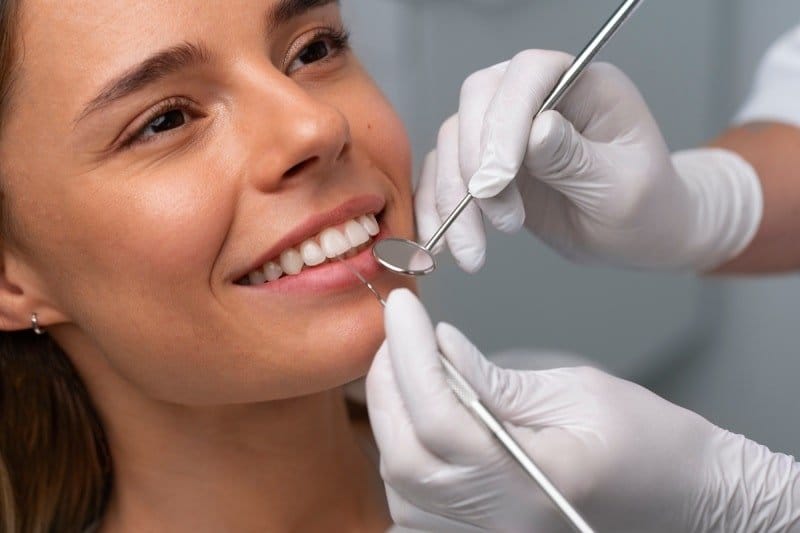
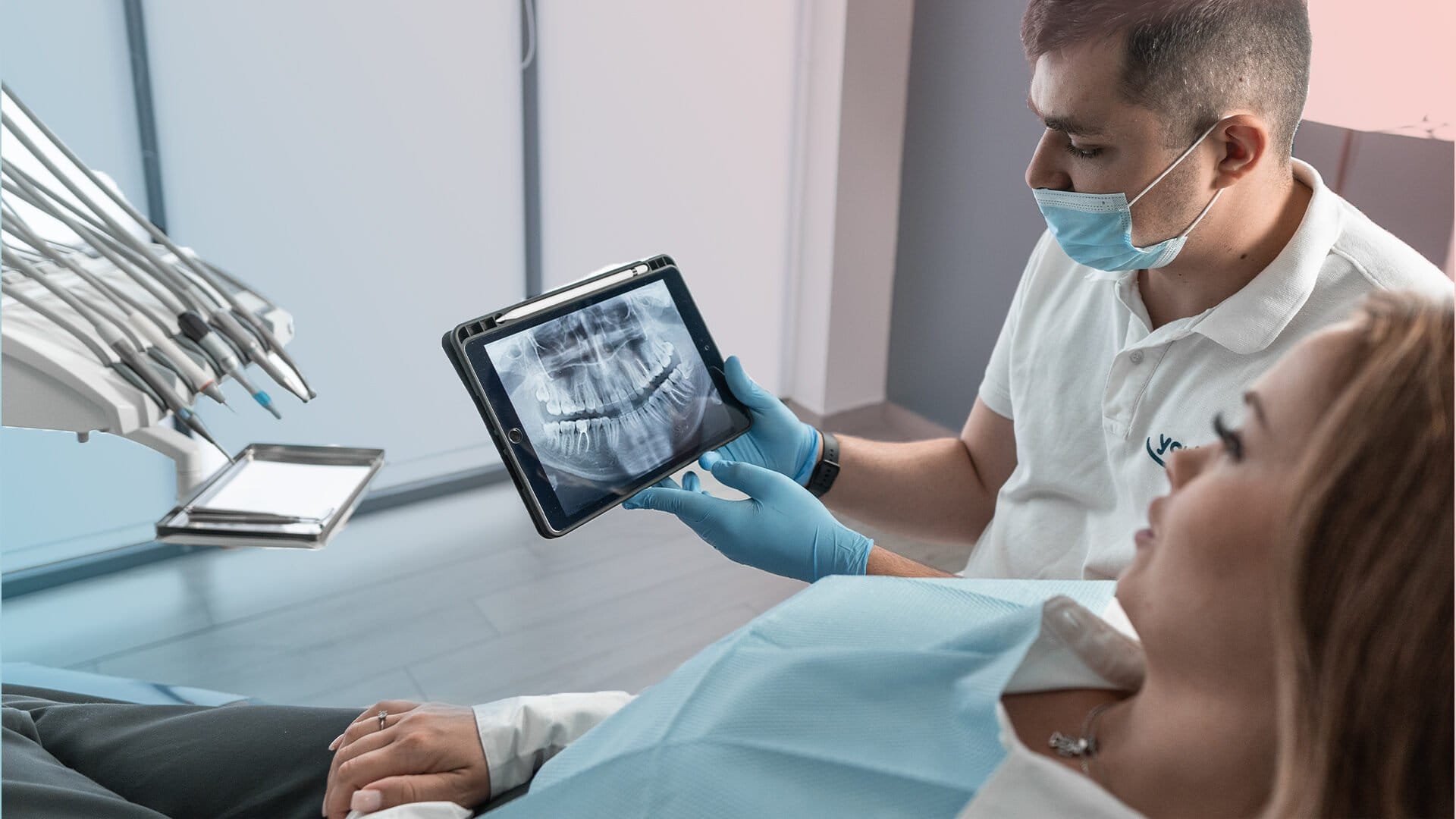
Restorative dentistry is the branch that repairs teeth damaged by decay, fracture or wear and replaces teeth that have been lost, using fillings, inlays and onlays, crowns, bridges, dentures and implants. Its workhorse is the direct resin composite filling: a systematic review of eight prospective trials, recording 80 failures over 62,030 restoration-months at risk, found an overall failure incidence of 1.55 lost posterior restorations per 100 restoration-years, with secondary caries and restoration fracture as the leading causes (PubMed 26003655). The goal is to return chewing and speech function while removing as little sound tooth structure as possible.
- 01Restorative dentistry covers two jobs: repairing the tooth that is still there with fillings, inlays, onlays and crowns, and replacing the tooth that is gone with a bridge, a denture or an implant.
- 02Posterior resin composite restorations failed at 1.55 per 100 restoration-years across eight prospective trials, with 62,030 restoration-months of follow-up at risk (PubMed 26003655).
- 03Secondary caries was the most common biological reason for failure, involved in 31 of the recorded failures, and it typically appeared from the third year onward rather than early (PubMed 26003655).
- 04Direct restorations outperformed indirect ones in the pooled comparison: across five randomised trials with 627 restorations in 279 patients, annual failure rates ran 0 to 5.4 percent for direct and 0 to 15.5 percent for indirect composite, risk ratio 0.61 (95 percent CI 0.47 to 0.79) (PubMed 39122602).
- 05Both reviews graded their own evidence as low or very low certainty, so these figures describe controlled trial conditions and should not be read as everyday practice rates.
Dental health is an important part of our general health. Decay, fractures or abrasions that occur in teeth in daily life can create both aesthetic and functional problems. Restorative dental treatment is a treatment area that aims to repair damaged teeth and restore their natural, aesthetic appearance. Today, the natural structure of the teeth can be preserved thanks to advanced filling materials, coatings, prostheses and implants.
/ Restorative Dentistry Applications
Restorative dentistry is a branch of dentistry that is used to repair various damages to teeth and restore their natural functions. It includes treatment methods that allow broken, worn, decayed or lost teeth to regain their former function. This type of treatment offers great advantages in terms of both aesthetics and health.
Restorative dental treatment can be applied to many different dental problems. This treatment method is preferred in the following cases:
- Treatment of Decayed Teeth
Tooth decay occurs as a result of bacteria in the mouth breaking down sugars and starches and creating acids. Decay can lead to tooth loss by eroding the tooth enamel and dentin layer over time. Within the scope of restorative treatment, decayed teeth are cleaned and repaired with filling materials.
- Repair of Broken or Cracked Teeth
Broken or cracked teeth may occur due to accidents, impacts or consumption of hard foods. Such damage can cause aesthetic concerns, as well as tooth sensitivity and pain. Broken and cracked teeth are treated using composite fillings, porcelain veneers or crowns.
- Treatment of Worn Teeth
Over time, teeth can wear down due to abrasive foods, hard brushing , teeth grinding or acidic drinks. With restorative treatment, these abrasions are corrected with the help of filling materials or coatings.
- Replacing Lost Teeth
Tooth loss causes both aesthetic and functional problems. Missing teeth can disrupt chewing function and cause digestive problems. New teeth are made to replace lost teeth with bridges, dentures or implant treatments .
- Elimination of Tooth Sensitivity
Sensitivity caused by abrasions on teeth or gum recession can negatively affect a person's daily life. Tooth sensitivity can be reduced with special filling materials and coatings within the scope of restorative treatment.
/ Methods and Advantages of Restorative Dental Treatment
- Filling Treatment
A filling is the process of cleaning tooth decay and repairing it with composite or amalgam materials. Today, white composite fillings are generally preferred because they offer a more aesthetic appearance.
- Crown (Coating) Treatment
Crown coating treatment is applied in larger tooth damages or fractures. Coatings made of durable materials such as porcelain or zirconium provide protection by completely enveloping the tooth.
- Dental Implants
Dental implants , which are made by placing titanium screws in place of missing teeth, are one of the most permanent and healthy solutions. They offer the closest alternative to natural tooth function.
- Dentures
In cases of multiple tooth loss, removable or fixed dentures specially designed for the patient are applied. These dentures help the person regain their dental functions.
- Inlay and Onlay Fillings
In cases of large tooth losses, special fillings prepared in a laboratory environment can be applied in order to preserve the natural structure of the tooth. These fillings provide a long-lasting solution by fully adapting to the tooth.
Advantages of Restorative Dental Treatment
Restores dental functions: Improves chewing and speaking functions.
Protects dental aesthetics : Provides whiter, straighter and healthier looking teeth.
Relieves pain and discomfort: Eliminates pain caused by decayed or broken teeth.
Prevents tooth loss: Ensures the protection of existing teeth and the long-term maintenance of oral health.
Increases self-confidence: Supports the individual's self-confidence with a healthier and more aesthetic smile.
Provides long-lasting dental health : Thanks to modern restorative treatment methods, teeth can remain healthy for years.
/ Frequently Asked Questions
- Who is suitable for restorative dental treatment?
It is suitable for individuals who have decay, fracture, abrasion or tooth loss. In addition, patients with aesthetic concerns can also benefit from this treatment.
- Is restorative dental treatment painful?
Thanks to advanced dentistry techniques, treatments are usually performed painlessly under local anesthesia.
- What should be the aftercare after treatment?
Regular tooth brushing, flossing and the care instructions recommended by the dentist should be followed.
- How long does restorative dental treatment last?
Restorative treatments can last for many years when good oral hygiene is provided after treatment.
- How many sessions does restorative dental treatment take to complete?
The duration of the treatment may vary depending on the method to be applied and the condition of the tooth. While simple fillings are done in a single session, implant or crown treatments may take several sessions.
Restorative dental treatment is one of the most important ways to maintain a healthy oral structure and have an aesthetic smile. If you are experiencing problems such as decay, broken or missing teeth, you should immediately consult a dentist and evaluate appropriate treatment options.
Let’s plan the right treatment together.
Free Assessment→- 1.Ástvaldsdóttir Á, Dagerhamn J, van Dijken JW, Naimi-Akbar A, Sandborgh-Englund G, Tranæus S, et al. Longevity of posterior resin composite restorations in adults – A systematic review. J Dent 2015;43:934-54. PubMed 26003655
- 2.Tennert C, Maliakal C, Suarèz Machado L, Jaeggi T, Meyer-Lueckel H, Wierichs Richard J. Longevity of posterior direct versus indirect composite restorations: A systematic review and meta-analysis. Dent Mater 2024;40:e95-e101. PubMed 39122602