
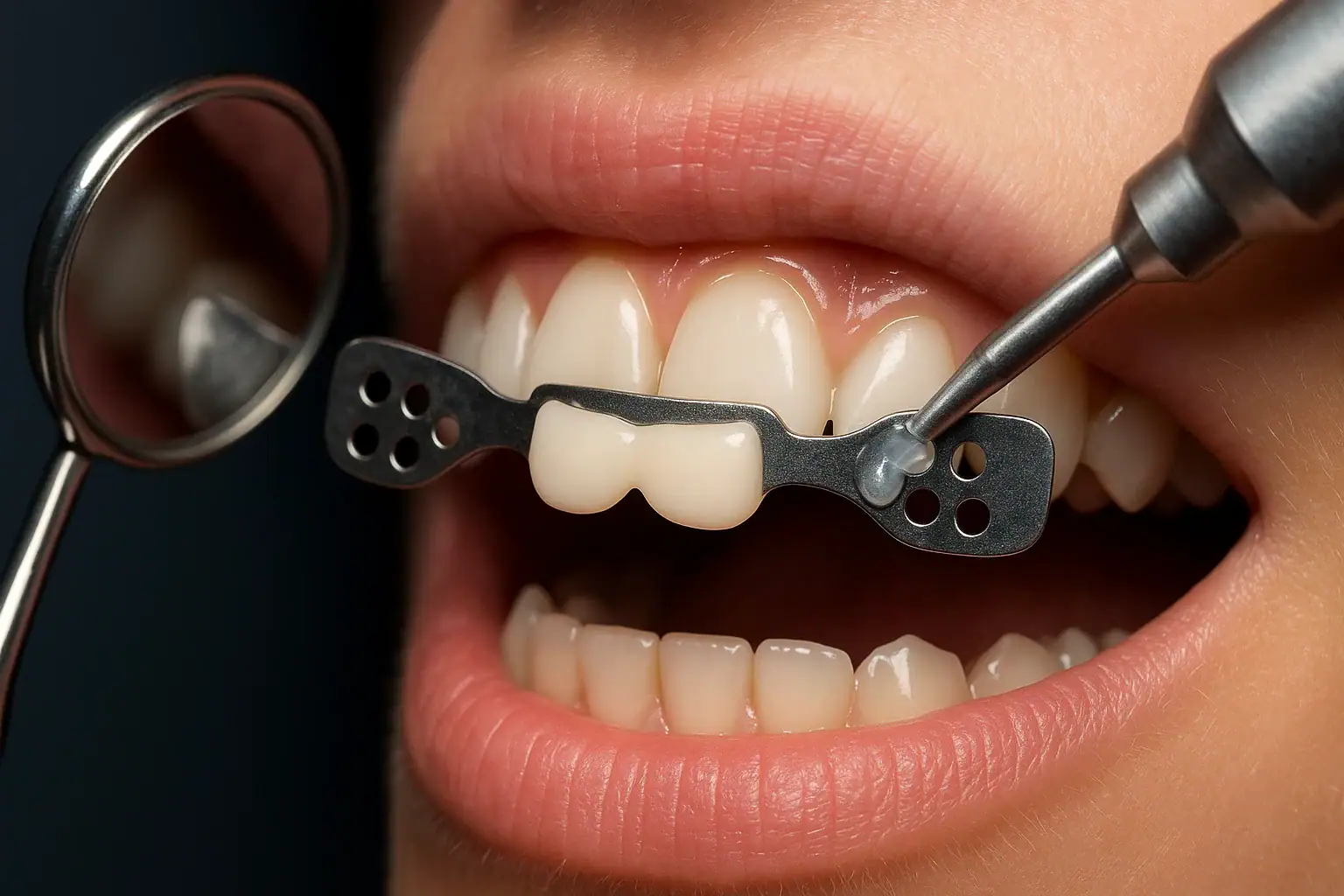
A Maryland bridge is a resin-bonded fixed dental prosthesis: a single replacement tooth carried on thin metal or ceramic wings that are cemented to the back surfaces of the neighbouring teeth, with little or no drilling of those teeth. It is used mainly for one missing front tooth where the adjacent teeth are healthy. A meta-analysis of 29 studies covering 2,300 resin-bonded bridges estimated survival at 91.4% after five years and 82.9% after ten years, with de-bonding the leading complication at 15% over five years (PubMed 28191679). Single-retainer designs survived significantly better than two-retainer designs.
- 01A Maryland bridge is a resin-bonded prosthesis, not a conventional bridge: the adjacent teeth are bonded to, not reshaped and crowned.
- 02Estimated survival across 29 studies and 2,300 resin-bonded bridges was 91.4% (95% CI 86.7 to 94.4) at 5 years and 82.9% (95% CI 73.2 to 89.3) at 10 years (PubMed 28191679).
- 03De-bonding is the characteristic failure mode, occurring in 15% (95% CI 10.9 to 20.6) over 5 years, ahead of chipping of the veneering material at 4.1% (PubMed 28191679).
- 04Design changes the odds measurably: bridges with one retainer survived significantly better and de-bonded less than those retained by two or more teeth, and anterior placement outperformed posterior (PubMed 28191679).
- 05In all-ceramic resin-bonded bridges reviewed across 14 studies, survival ranged from 76% to 100% over 3 to 10 years, with debonding followed by framework fracture as the leading causes of failure (PubMed 38706266).
The term “Maryland Bridge” refers to a modern, aesthetic and minimally invasive solution used in the treatment of missing teeth in the field of dental health. Offering a more conservative approach compared to traditional bridge treatments, this method aims to restore natural appearance and chewing function, most often where a front tooth is missing. Used safely in dentistry for years, the Maryland bridge is an effective and practical alternative for patients who want to solve the problem of missing teeth while preserving healthy dental tissue.
/ Maryland Bridge Definition, Benefits and Limitations
What Is a Maryland Bridge Dental Restoration?
A Maryland bridge is a type of dental prosthetic used to replace a missing tooth. Unlike traditional bridges, it is minimally invasive and involves bonding a false tooth (pontic) to the adjacent teeth using metal or ceramic wings.
Benefits of Maryland Dental Bridges
- Minimally invasive: Requires little to no alteration of adjacent teeth.
- Cost-effective: Often more affordable than implants or conventional bridges.
- Quick procedure: Typically completed in one or two visits.
- Aesthetic appeal: Modern materials blend well with natural teeth.
Comparison with Other Dental Bridge Types
Compared to traditional and cantilever bridges, the Maryland bridge stands out for its conservative approach. Traditional bridges require reshaping adjacent teeth, whereas cantilever bridges can exert uneven pressure. Maryland bridges avoid these complications, which is why they are used mainly for front teeth.
Limitations of Maryland Bridges
- Not suitable for all cases: Best for replacing front teeth.
- May debond over time: Less durable than implants .
- Requires strong abutment teeth: Adjacent teeth must be healthy.
Common Failure Causes
Debonding is often caused by biting into hard foods, insufficient enamel for bonding, or improper occlusion. Ensuring proper case selection and patient education helps reduce failure rates.
/ Maryland Bridge Placement, Longevity and Alternatives
How Is a Maryland Bridge Placed?
- Consultation and x-rays to determine suitability.
- Impression of the area is taken.
- The custom pontic with wings is fabricated.
- Bonding the bridge to the back of adjacent teeth using dental cement.
How Long Does a Maryland Bridge Last?
In a meta-analysis of 29 studies covering 2,300 resin-bonded bridges, survival was 91.4% after five years and 82.9% after ten years (PubMed 28191679). Regular dental checkups, good oral hygiene, and avoiding excessive bite pressure are key to longevity.
Who Is a Candidate for a Maryland Bridge?
Ideal candidates are those with a single missing front tooth, healthy adjacent teeth, and good oral hygiene habits. It is less suitable for patients with strong bite forces or poor enamel.
Maryland Bridge Maintenance and Aftercare Tips
- Brush twice daily with a soft-bristle toothbrush.
- Use floss threaders or water flossers to clean underneath the bridge.
- Avoid sticky or hard foods that may compromise the bonding.
- Schedule regular checkups to monitor integrity.
Alternatives to Maryland Bridges
- Dental Implants : Last longer in most cases, but need surgery and a healing period.
- Traditional Bridges: More suitable for molar replacements.
- Removable Partial Dentures: An option when several teeth are missing and cost is a concern.
/ Frequently Asked Questions
Am I a candidate for a Maryland dental bridge?
If you have a single missing front tooth and healthy adjacent teeth, you may be an ideal candidate. A consultation with a dentist is essential to confirm suitability.
Let’s plan the right treatment together.
Free Assessment→- 1.Thoma DS, Sailer I, Ioannidis A, Zwahlen M, Makarov N, Pjetursson BE. A systematic review of the survival and complication rates of resin-bonded fixed dental prostheses after a mean observation period of at least 5 years. Clin Oral Implants Res 2017;28:1421-1432. PubMed 28191679
- 2.Habibzadeh S, Khamisi F, Mosaddad SA, Fernandes GVO, Heboyan A. Full-ceramic resin-bonded fixed dental prostheses: A systematic review. J Appl Biomater Funct Mater 2024;22:22808000241250118. PubMed 38706266