
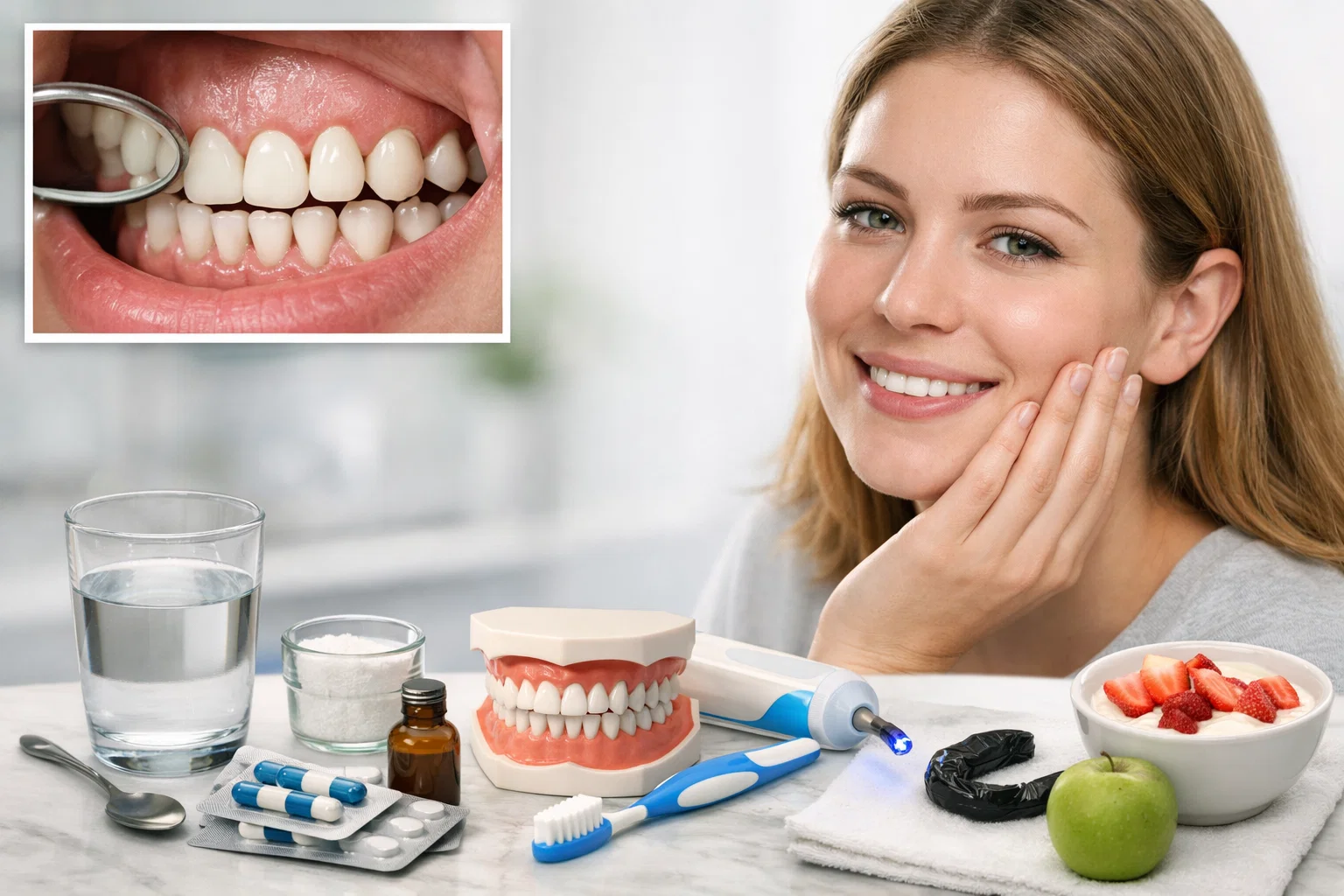
Tooth reduction, also called dental contouring or enameloplasty, removes a small amount of enamel to reshape a tooth's edges, length or symmetry; because enamel does not regenerate, the change is permanent and aftercare protects what is left. A systematic review of eight clinical studies on interproximal enamel reduction found no enamel demineralisation, no increase in caries incidence, no periodontal change and no dental sensitivity afterwards, though the authors graded overall study quality as low to very low (PubMed 34865310). For the first 24 to 48 hours avoid ice, hard nuts, sticky sweets and acidic drinks, and brush gently with a fluoride toothpaste.
- 01Enamel has no cells to rebuild itself, so tooth reduction is permanent by definition and every later decision has to work with the thickness that remains.
- 02Across eight clinical studies of interproximal enamel reduction, no demineralisation, caries increase or lasting sensitivity was recorded, but the evidence was graded low to very low certainty (PubMed 34865310).
- 03If sensitivity persists, ingredient choice matters: in 31 randomised trials, arginine toothpaste gave the largest effect (SMD -3.25) and potassium -1.28, while strontium showed no significant benefit (PubMed 25483802).
- 04Fluoride is the daily protection: in a Cochrane review of 96 studies, 1,500 ppm toothpaste reduced caries increment against non-fluoride toothpaste by 1.86 dfs in the primary dentition (PubMed 30829399).
- 05Bruxism is repetitive jaw-muscle clenching or grinding; a custom night guard is the barrier that keeps reshaped enamel from carrying that load directly.
Tooth reduction, also known as dental contouring, enameloplasty, or tooth reshaping, is a common cosmetic and functional dental procedure used to improve tooth shape, size, and symmetry. While the procedure itself is minimally invasive and causes little discomfort, what you do after tooth reduction plays a critical role in protecting your teeth and ensuring long-term success.
Aftercare decides how the reshaped enamel holds up. The four questions it comes down to:
- What should I do after tooth reduction?
- Is tooth reduction permanent?
- Can teeth become sensitive after contouring?
- What foods should I avoid after tooth reshaping?
/ Tooth Reduction Aftercare Basics
Tooth reduction is a cosmetic dental procedure where a small amount of enamel is carefully removed to reshape teeth. It is often used to:
- Correct uneven tooth edges
- Reduce slightly large or long teeth
- Improve symmetry before veneers or bonding
- Fix minor chips or overlaps
- Enhance smile aesthetics
Because enamel does not regenerate, proper aftercare is essential to protect the remaining tooth structure.
Although tooth reduction is conservative, it still alters the natural enamel layer. Without proper care, patients may experience:
- Tooth sensitivity
- Enamel erosion
- Increased risk of decay
- Uneven wear
- Gum irritation
Following the correct post-treatment steps helps maintain tooth strength, comfort, and appearance.
1. Expect Mild Sensitivity (This Is Normal)
After tooth reduction, mild sensitivity to hot, cold, or air is common. This happens because enamel thickness is slightly reduced.
What to do:
- Use lukewarm water
- Avoid extremely hot or cold foods
- Use toothpaste for sensitive teeth
Sensitivity usually resolves within a few days.
2. Avoid Hard, Crunchy, or Sticky Foods
In the first 24–48 hours, avoid foods that may stress freshly contoured teeth.
Foods to avoid after tooth reduction:
- Ice
- Hard nuts
- Sticky candy
- Chewing gum
- Hard bread crusts
Choose soft foods such as yogurt, pasta, eggs, soups, and smoothies.
3. Do Not Test Your Teeth
Many patients instinctively run their tongue over reshaped teeth. While harmless in moderation, excessive pressure or biting objects can irritate the teeth.
Avoid:
- Nail biting
- Pen chewing
- Opening packages with teeth
4. Brush Gently but Thoroughly
Continue brushing twice daily, but use a soft-bristled toothbrush.
Best practices:
- Gentle circular motions
- Non-abrasive toothpaste
- Avoid aggressive brushing
Overbrushing can accelerate enamel wear.
5. Use a Fluoride or Remineralizing Toothpaste
Fluoride strengthens remaining enamel and helps reduce sensitivity.
Recommended ingredients:
- Fluoride
- Hydroxyapatite
- Calcium phosphate
These ingredients help reinforce enamel after dental contouring.
6. Floss Carefully
Flossing remains essential. Be gentle near the gum line to avoid irritation.
Tip: If floss catches, inform your dentist; minor refinements may be needed.
/ Long-Term Care After Tooth Reduction
Managing Tooth Sensitivity After Tooth Reduction
7. Use Desensitizing Products
If sensitivity persists:
- Use desensitizing toothpaste for 2–4 weeks
- Apply fluoride gel (if recommended by your dentist)
Avoid whitening toothpaste during this period.
8. Avoid Acidic Foods and Drinks
Acids weaken enamel, especially after contouring.
Limit:
- Soda
- Citrus fruits
- Energy drinks
- Vinegar-based foods
If consumed, rinse your mouth with water and wait 30 minutes before brushing.
Long-Term Care After Tooth Reduction
9. Wear a Night Guard If You Grind Your Teeth
Bruxism (teeth grinding) can quickly damage reshaped enamel.
If you grind your teeth:
- Use a custom night guard
- Reduce caffeine and stress
- Address jaw tension early
10. Avoid Excessive Teeth Whitening
Over-whitening after tooth reduction can increase sensitivity and enamel dehydration.
If whitening is desired:
- Choose dentist-supervised treatments
- Avoid frequent over-the-counter kits
11. Schedule Regular Dental Checkups
Routine dental visits help monitor:
- Enamel thickness
- Tooth wear
- Bite alignment
Your dentist can intervene early if issues arise.
What Not to Do After Tooth Reduction
❌ Do not brush aggressively
❌ Do not chew ice
❌ Do not use abrasive toothpaste
❌ Do not ignore persistent sensitivity
❌ Do not skip dental visits
These habits can compromise results.
How Long Do Tooth Reduction Results Last?
Tooth reduction is permanent, but its success depends on aftercare.
With proper maintenance:
- Results can last for many years
- Teeth remain strong and aesthetic
- No additional treatment may be needed
In some cases, bonding or veneers may be recommended later for enhanced aesthetics.
Tooth Reduction vs. Veneers: What Comes Next?
Many patients undergo tooth reduction as part of:
- Veneer preparation
- Bonding treatments
- Smile design procedures
Your dentist may plan additional cosmetic steps depending on your goals.
Signs You Should Contact Your Dentist After Tooth Reduction
Contact your dentist if you experience:
- Severe or prolonged sensitivity
- Sharp edges
- Pain when biting
- Gum inflammation
- Visible cracks
Early correction prevents complications.
/ Frequently Asked Questions (FAQ)
Is tooth reduction painful?
No. Tooth reduction is usually painless and often does not require anesthesia.
Is tooth reduction safe?
Yes, when performed by an experienced dentist and followed by proper aftercare.
Can enamel grow back after tooth reduction?
No. Enamel does not regenerate, which is why aftercare is essential.
How long does sensitivity last after tooth reshaping?
Typically a few days to two weeks. Persistent sensitivity should be evaluated.
Can I eat normally after tooth reduction?
Yes, but avoid hard and acidic foods for the first 48 hours.
Can tooth reduction weaken teeth?
When done conservatively and cared for properly, it does not weaken teeth.
Can tooth reduction cause cavities?
Not directly, but poor hygiene after the procedure may increase cavity risk.
Is tooth reduction permanent?
Yes. The changes made to enamel are permanent.
Can I whiten my teeth after tooth reduction?
Yes, but wait until sensitivity resolves and avoid excessive whitening.
Is tooth reduction reversible?
No, which is why treatment planning and expert execution are crucial.
How do I protect my teeth long-term after contouring
- Gentle brushing
- Fluoride toothpaste
- Night guard if needed
- Regular dental visits
Final Thoughts: Protecting Your Smile After Tooth Reduction
Tooth reduction is a powerful yet conservative way to enhance your smile. While the procedure itself is quick, long-term success depends entirely on proper aftercare.
By following professional recommendations, maintaining excellent oral hygiene, and avoiding damaging habits, you can enjoy a healthier, more balanced smile for years to come.
If you’ve recently had tooth reduction or are considering it, consult an experienced dental professional to ensure your smile stays strong, comfortable, and beautiful.
Let’s plan the right treatment together.
Free Assessment→- 1.Gómez-Aguirre JN, Argueta-Figueroa L, Castro-Gutiérrez MEM, Torres-Rosas R. Effects of interproximal enamel reduction techniques used for orthodontics: A systematic review. Orthod Craniofac Res 2022;25:304-319. PubMed 34865310
- 2.Bae JH, Kim YK, Myung SK. Desensitizing toothpaste versus placebo for dentin hypersensitivity: a systematic review and meta-analysis. J Clin Periodontol 2015;42:131-41. PubMed 25483802
- 3.Walsh T, Worthington HV, Glenny AM, Marinho VC, Jeroncic A. Fluoride toothpastes of different concentrations for preventing dental caries. Cochrane Database Syst Rev 2019;3:CD007868. PubMed 30829399