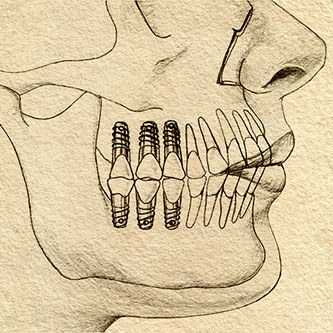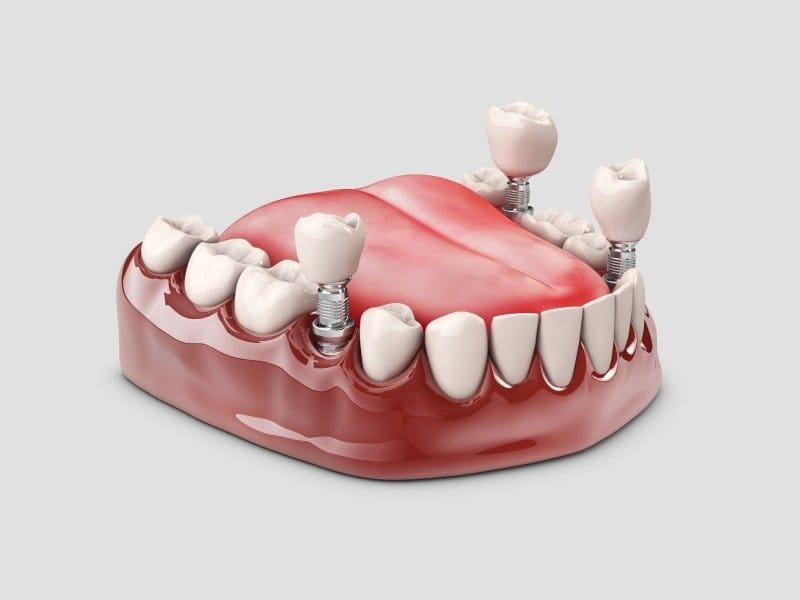
Healing after dental implant placement happens in two overlapping phases: the gum closes in roughly one to two weeks, and osseointegration, the bone bonding to the titanium surface, takes about three to six months before the final crown goes on. Across 23 studies following 7,711 implants for a mean of 13.4 years, cumulative survival was 94.6 per cent with 1.3 mm of mean marginal bone resorption (PubMed 25467739). Loading sooner is possible but not free: pooled across 39 randomised trials, immediately loaded implants survived slightly less often than conventionally loaded ones (RR 0.974, 95% CI 0.954 to 0.994) (PubMed 31421892).
- 01Soft tissue healing takes about one to two weeks; osseointegration, the bone bonding to the implant surface, takes about three to six months and is the phase that decides long-term stability.
- 02Long-term outcome is well documented: 23 studies, 7,711 implants, mean follow-up 13.4 years, cumulative survival 94.6 per cent and mean marginal bone resorption 1.3 mm (PubMed 25467739).
- 03Same-day teeth trade a small amount of survival for time: immediate loading gave a lower survival rate than conventional loading across 39 randomised trials (RR 0.974, 95% CI 0.954 to 0.994), with no difference in bone level, probing depth or implant stability (PubMed 31421892).
- 04For single implants in carefully selected patients the gap disappears: 10 randomised trials with 423 patients found no significant difference in failure or marginal bone loss between immediate and non-immediate loading (PubMed 35430123).
- 05Bone density, smoking, oral hygiene and systemic conditions such as diabetes change the timeline, which is why they are assessed before the surgical date rather than explained afterwards.
Dental implants are considered the gold standard for replacing missing teeth. They look natural, function like real teeth, and are designed for long-term use. What patients ask next is how long the healing takes.
/ How long healing takes after a dental implant and the first 24 hours
Understanding the dental implant healing time, the implant recovery timeline, and the osseointegration process helps patients feel more confident and prepared.
Understanding Healing Time After Dental Implant Surgery
Before we talk about days and weeks, it’s important to understand what actually happens after a dental implant is placed.
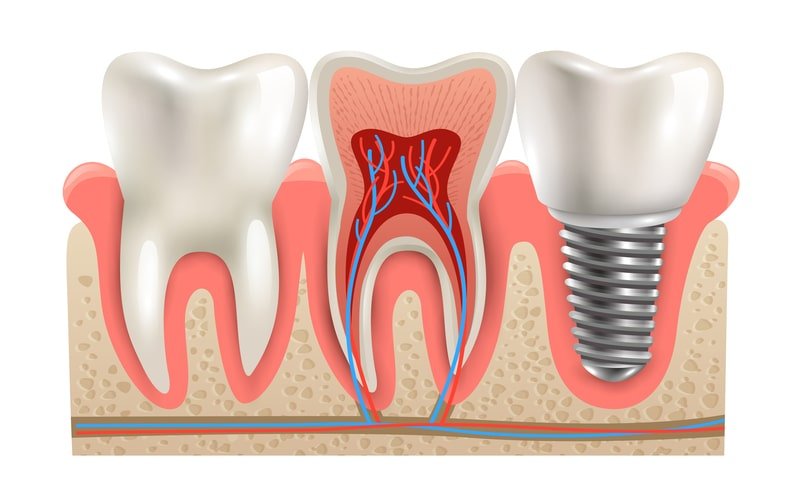
A dental implant is a titanium post surgically inserted into the jawbone. Over time, the bone grows around the implant and fuses with it. This biological process is called:
Osseointegration
Osseointegration is the key to implant success. During this phase, the implant becomes part of your jawbone, providing a stable and permanent foundation for your new tooth.
Average healing timeline:
- Initial healing: 1–2 weeks
- Bone integration: 3–6 months
- Full recovery with crown: 3–6 months
At Mosdent, advanced digital planning and minimally invasive techniques help shorten healing time and improve success rates.
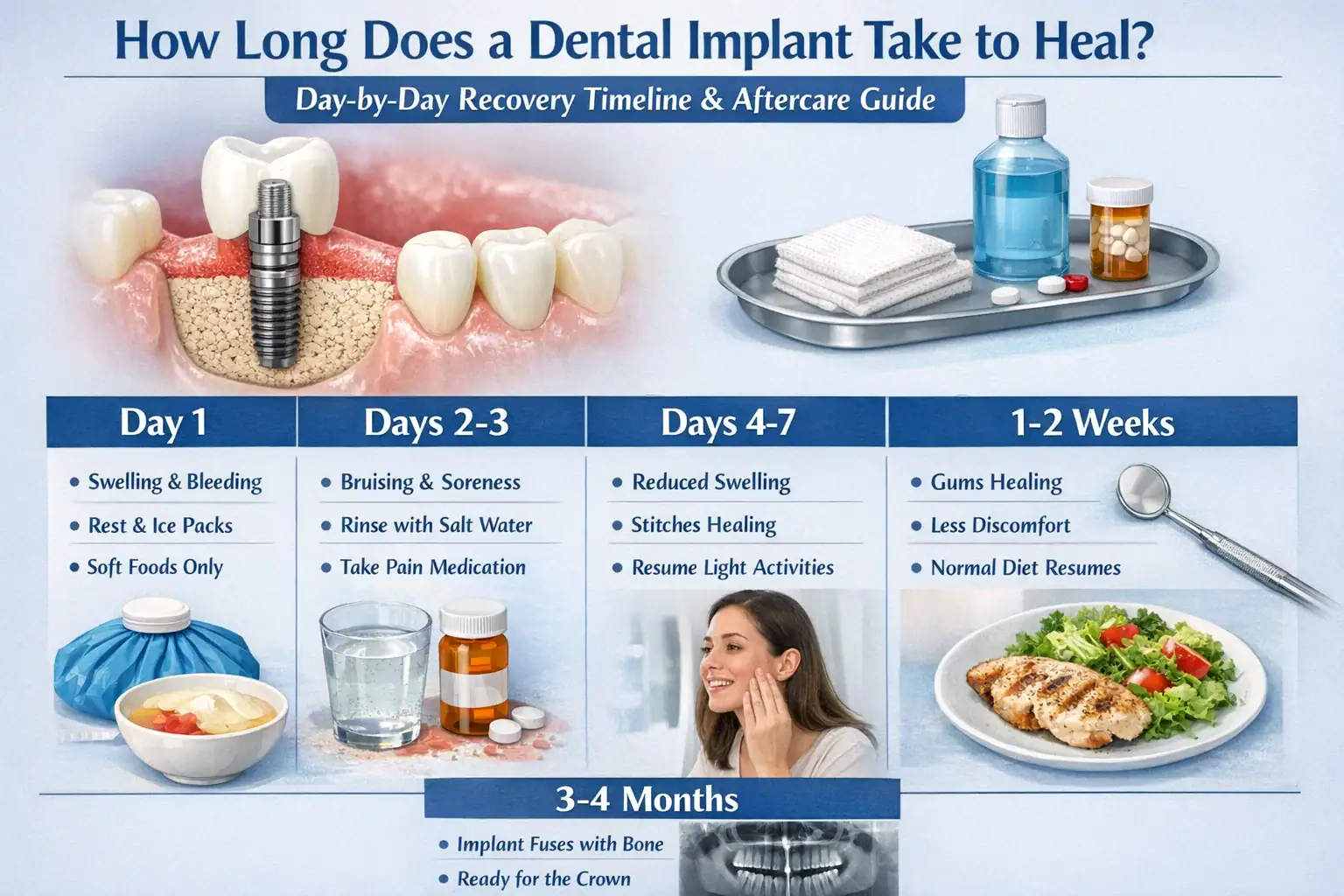
Day-by-Day Dental Implant Recovery Timeline
Let’s break down the dental implant recovery process day by day.
First 24 Hours After Implant Surgery
This is the most critical period of the dental implant healing process.
What you may experience:
- Mild bleeding
- Swelling around the implant site
- Slight discomfort or pressure
- Temporary numbness
These are normal and expected after oral surgery.
What to do:
✔ Apply cold compress
✔ Rest and avoid physical activity
✔ Eat soft, cold foods
✔ Avoid touching the implant area
Pain is usually mild and manageable with prescribed medication.
/ Dental implant recovery from swelling peak to final crown placement
Dental implant recovery continues through swelling, tissue healing, stabilization, and crown placement.
Days 2–3: Swelling & Inflammation Peak
Swelling usually peaks between day 2 and day 3. This is part of your body’s natural healing response.
Common symptoms:
- Puffy cheeks
- Slight bruising
- Jaw stiffness
- Mild soreness when chewing
By the end of day 3, most discomfort begins to decrease.
Tips to reduce swelling:
- Continue cold compress
- Sleep with your head elevated
- Avoid hot foods and alcohol
Days 4–7: Early Tissue Healing Begins
By the end of the first week:
- Swelling significantly decreases
- Pain becomes minimal
- Gum tissue starts healing
Many patients return to work within 3–5 days after implant surgery.
Soft tissue healing usually completes within 7–10 days.
Week 2: Gum Tissue Recovery
Around the second week:
- Stitches dissolve or are removed
- Gum tissue closes around the implant
- Daily life returns to normal
You can gradually resume:
- Light exercise
- Normal speaking
- Gentle chewing
However, the most important phase has just begun: bone healing.
Weeks 3–6: Implant Stabilization Phase
This stage is often called the silent healing phase because patients feel normal, but deep healing continues.
During this time:
- The jawbone begins bonding with the implant
- Implant stability increases
- Risk of infection drops significantly
Most patients feel completely normal by week 4.
Months 2–3: Osseointegration Progress
This is the most crucial phase of dental implant healing time.
Bone cells grow and attach to the implant surface, forming a strong bond. This process determines long-term success.
At Mosdent, we monitor this stage using digital imaging to ensure proper integration.
Months 3–6: Complete Healing & Final Crown Placement
By month 3–6:
- Implant fully integrates with bone
- Implant becomes stable like a natural tooth root
- Final crown or prosthesis is placed
Once the crown is attached, your implant functions exactly like a natural tooth.
/ Factors, aftercare and signs during dental implant healing
What Affects Dental Implant Healing Time?
Healing time varies from person to person. Several factors influence how fast implants heal.
Bone Density
Stronger bone heals faster and integrates better.
Smoking
Smoking significantly slows healing and increases failure risk.
Oral Hygiene
Good hygiene prevents infection and promotes faster recovery.
Overall Health
Conditions like diabetes may slow healing.
Advanced Technology
Clinics using digital planning (like Mosdent) achieve faster recovery and higher success rates.
How to Speed Up Dental Implant Healing
Follow these tips for faster healing:
✔ Maintain excellent oral hygiene
✔ Avoid smoking and alcohol
✔ Follow soft diet recommendations
✔ Attend follow-up appointments
✔ Take prescribed medication
Proper aftercare can significantly shorten recovery time.
When Can You Eat Normally After Dental Implants?
Typical timeline:
- First 48 hours: liquids & soft foods
- First week: soft diet
- After 2 weeks: semi-soft foods
- After crown placement: normal eating
Patients with same-day implants may chew sooner.
Same-Day Dental Implants vs Traditional Healing
At Mosdent, many patients qualify for immediate loading implants.
- Healing before crown: 3–6 months
Same-day implants:
- Temporary teeth in 24–72 hours
Signs Your Dental Implant Site Is Healing Properly
Good signs:
- Swelling decreases after 3 days
- No severe pain after first week
- No bleeding after 48 hours
- Gum tissue looks pink and healthy
If you experience severe pain or swelling after a week, contact your dentist.
Dental Implant Success Rate
Dental implants have a success rate of 95–98% when performed by experienced specialists.
At Mosdent, digital implant planning and experienced surgeons ensure high success and faster healing.
Why Choose Mosdent for Dental Implants?
Patients from around the world choose Mosdent because of:
✔ Advanced digital dentistry
✔ Experienced implant surgeons
✔ Same-day teeth solutions
✔ Personalized treatment plans
✔ International patient care
Final Thoughts: Patience Leads to Permanent Results
Dental implant healing takes time, but the reward is worth it: a strong, natural, and permanent smile.
With advanced technology and expert care at Mosdent, your implant journey becomes faster, safer, and more comfortable.
/ Frequently Asked Questions (FAQ)
How long does dental implant pain last?
Most discomfort disappears within 3–5 days .
How long before I can chew normally?
Soft foods after 1 week, normal chewing after crown placement.
Can healing after a dental implant be complete in 3 months?
Yes. Many implants fully integrate within 3–4 months .
How long does osseointegration take?
Typically 3–6 months , depending on bone quality.
Is dental implant recovery painful?
No. Most patients describe it as mild discomfort similar to tooth extraction.
Can implants fail during healing?
Yes, but it’s rare. Proper care and experienced surgeons minimize risk.
Let’s plan the right treatment together.
Free Assessment→- 1.Moraschini V, Poubel LA, Ferreira VF, Barboza Edos S. Evaluation of survival and success rates of dental implants reported in longitudinal studies with a follow-up period of at least 10 years: a systematic review. Int J Oral Maxillofac Surg 2015;44:377-88. PubMed 25467739
- 2.Chen J, Cai M, Yang J, Aldhohrah T, Wang Y. Immediate versus early or conventional loading dental implants with fixed prostheses: A systematic review and meta-analysis of randomized controlled clinical trials. J Prosthet Dent 2019;122:516-536. PubMed 31421892
- 3.Zhao G, Zhou Y, Shi S, Liu X, Zhang S, Song Y. Long-term clinical outcomes of immediate loading versus non-immediate loading in single-implant restorations: a systematic review and meta-analysis. Int J Oral Maxillofac Surg 2022;51:1345-1354. PubMed 35430123