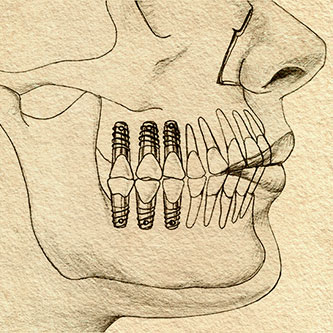
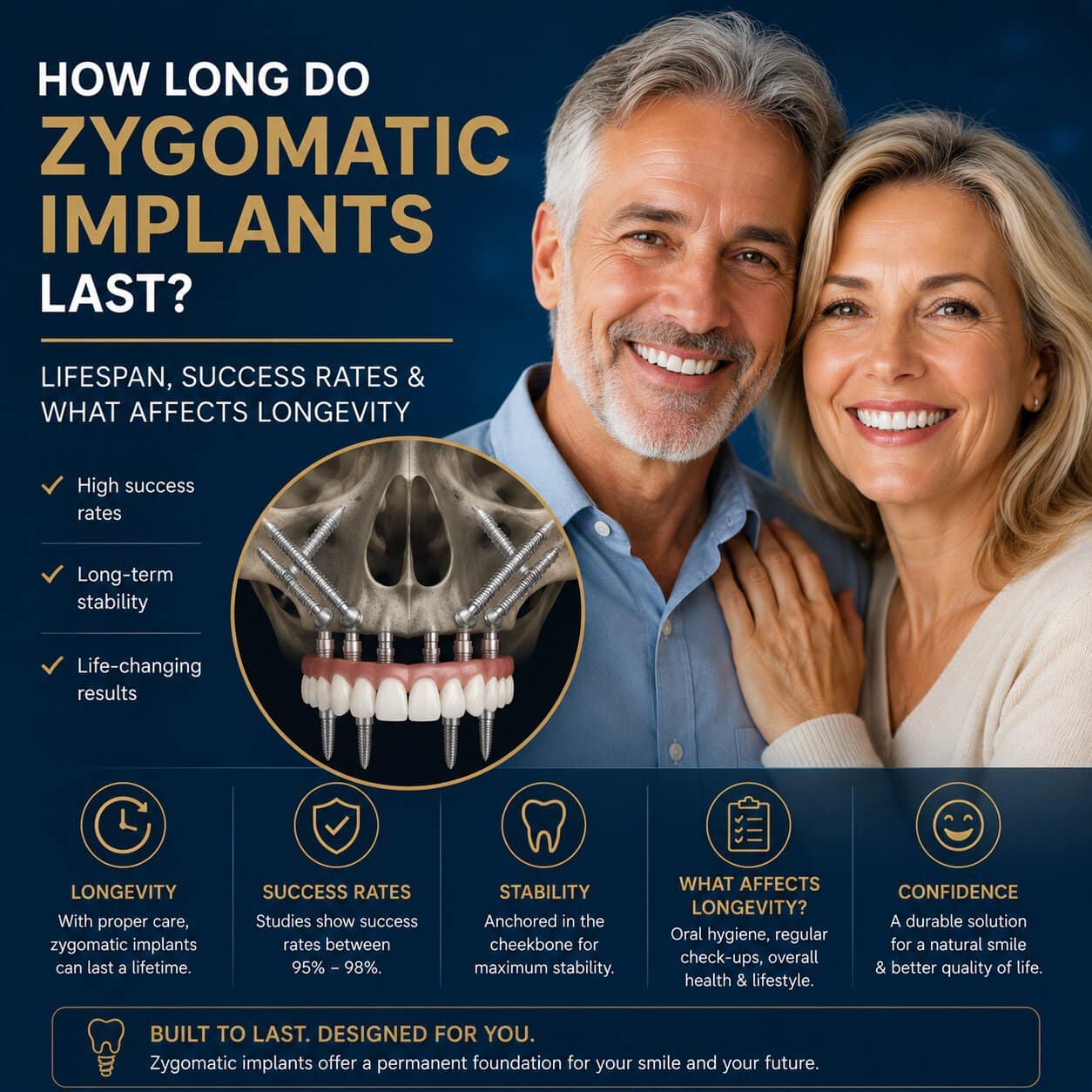
Zygomatic implants are long fixtures, typically 30 to 55 mm, that pass through the resorbed upper jaw and anchor in the cheekbone, which does not lose volume the way the alveolar ridge does. On longevity the pooled evidence is specific: across 18 studies covering 1,349 zygomatic implants in 623 patients with a mean follow-up of 75.4 months, survival was 96.2% at six years and the annual failure rate 0.7%; immediately loaded implants reached 98.1% against 95% for delayed loading, and sinusitis was reported in 14.2% of cases at five years (PubMed 37405545).
- 01Pooled survival is 96.2% at six years across 1,349 zygomatic implants in 623 patients, with a mean follow-up of 75.4 months and an annual failure incidence of 0.7% (PubMed 37405545).
- 02Immediately loaded implants survived at 98.1% against 95% for delayed loading in that analysis, a statistically significant difference (PubMed 37405545).
- 03Sinusitis is the most frequently reported biological complication, at 14.2% prevalence at five years, so sinus follow-up belongs in the maintenance plan (PubMed 37405545).
- 04In quad zygoma cases, where four zygomatic implants carry one full arch, seven studies gave 98% implant survival and 100% prosthetic success (PubMed 34920870).
- 05The anatomical difference is the point: a standard implant needs 8 to 10 mm of jawbone height, while a zygomatic implant anchors in the cheekbone and usually avoids bone grafting altogether.
Zygomatic Implants and Where They Anchor
Zygomatic implants are long fixtures, typically 30 to 55 mm, that pass through the resorbed upper jaw and anchor in the cheekbone, the zygomatic bone. They exist for patients who have been told they have too little bone for conventional implants, and the question most of those patients ask next is how long the result will last. How the treatment is planned, its stages and its cost are set out on the zygomatic implants page.
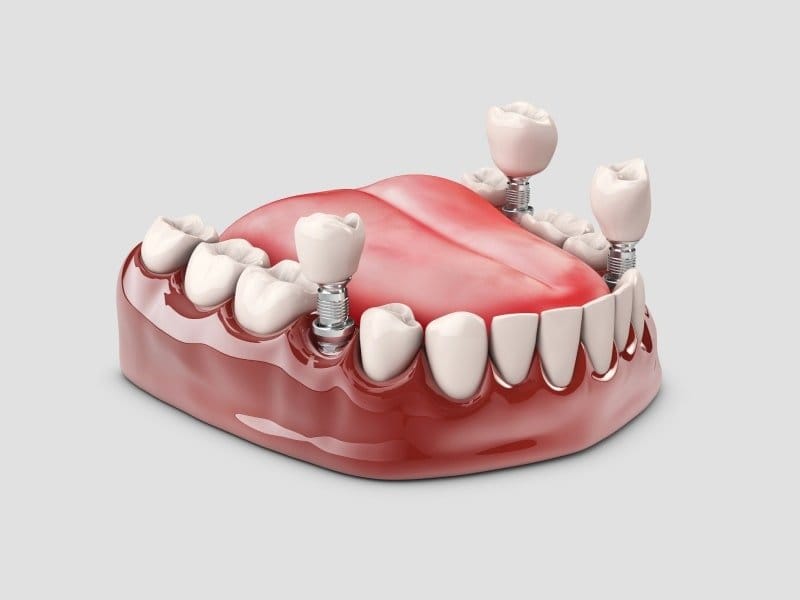
A conventional dental implant is placed into the jawbone and needs roughly 8 to 10 mm of bone height to integrate in a stable way. When the upper jaw has resorbed after tooth loss, gum disease, failed earlier implants or years of denture wear, that height is often missing. Standard implants can then only be placed after bone grafting, which can add six months or more to treatment before the implants go in.
The zygomatic implant bypasses the deficient ridge. It is angled so that it runs from the position of the future teeth through the remaining upper jaw bone and into the cheekbone. The cheekbone does not lose volume the way the tooth-bearing ridge does after teeth are lost, and that stable anchorage is the basis of the technique.
Longevity has two parts that are worth separating from the start. The first is the implant fixture itself, which either stays integrated in the bone or fails. The second is the prosthetic arch, the fixed set of teeth that the implants carry. The arch is subject to daily chewing loads and wear, and it has its own lifespan and maintenance needs regardless of how well the fixtures hold. The published figures below mostly describe the fixtures, and where they describe the prosthesis this is stated. A patient weighing the treatment needs both answers, because a fixture that survives for decades still carries teeth that will need repair or renewal along the way.
Survival Figures from Pooled Studies
The strongest pooled evidence comes from a systematic review and meta-analysis restricted to studies with at least three years of follow-up. It included 18 studies covering 1,349 zygomatic implants in 623 patients, with a mean follow-up of 75.4 months (PubMed 37405545). Mean implant survival was 96.2% at six years, and the annual incidence of implant failure was 0.7% (PubMed 37405545).
The same review reported mean implant success of 95.7%, where success was defined as survival without biological or neurological complications, and mean prosthesis survival of 94% (PubMed 37405545). The gap between implant survival and prosthesis survival is the practical reminder that the teeth on top need their own care.
An earlier updated review took a wider net. It included 68 studies with 4,556 zygomatic implants in 2,161 patients and 103 failures, and calculated a 12-year cumulative survival rate of 95.21% (PubMed 27422530). Most failures in that review were detected within the 6-month postsurgical period (PubMed 27422530). This timing matters for patients: once the implants have come through the first months of healing, later loss is uncommon.
Beyond the published follow-up the data thin out. Follow-up in the included studies ranged from 36 to 141.6 months (PubMed 37405545). No fixed number of years can honestly be promised for an individual patient. What the figures do show is a low rate of ongoing loss after the healing period, provided the factors discussed further down are kept under control.
Survival statistics describe groups of patients. Your own outlook depends on your bone, your general health, your habits and the quality of planning and follow-up, and the assessment before surgery is where those are examined.
Comparison with Standard Implants
A common question is whether zygomatic implants last as long as conventional implants. The authors of the six-year meta-analysis concluded that zygomatic implants have long-term survival comparable to conventional implants, and that prosthesis survival was similar to that of prostheses on conventional implants, with similar complications (PubMed 37405545).
For conventional implants, a meta-analysis of 18 prospective studies of contemporary implant systems put 10-year survival at the implant level at 96.4% (PubMed 30904559). The zygomatic figures sit close to this range, even though they come from patients who had lost too much upper jaw bone for standard implants without grafting.
These numbers should be read with care. The two reviews measured different patient groups over different periods, and they were not designed as a head-to-head comparison. The conventional implant figure also dropped to 93.2% in a sensitivity analysis that modelled patients lost to follow-up (PubMed 30904559), a reminder that reported survival depends partly on how missing patients are counted.
The choice between the two approaches is therefore made on anatomy. Where there is enough bone, or where a moderate deficit can be corrected with grafting or a sinus lift, standard implants are usually the simpler route. Where the upper jaw is severely resorbed, or grafting is unsuitable or has already failed, zygomatic implants avoid the grafting stage altogether.
At Mosdent, patients who may be candidates for either approach are assessed with 3D cone beam CT imaging by the oral and maxillofacial surgery team, to determine which solution suits their specific anatomy. The scan shows the remaining bone in the upper jaw, the size and position of the sinus and the path available to the cheekbone.
Recovery Time and Visits Compared with Bone Grafting
Recovery after zygomatic implant surgery has been measured against the main alternative, bone grafting followed by conventional implants. In a multicentre randomised trial of 71 patients with severely resorbed upper jaws, those who received immediately loaded zygomatic implants reported on average 7.17 days of total and 12.17 days of partial impaired activity, against 7.42 and 14.24 days in the grafting group (PubMed 29806663). The zygomatic group needed on average 1.34 days to have a functional prosthesis, compared with 444.32 days after grafting (PubMed 29806663).
The trial also counted visits. Up to one year after loading, patients made on average 15.12 dental visits with zygomatic implants and 19.72 with grafting, a difference that was not statistically significant (PubMed 29806663). For a patient who travels for treatment, the practical difference is timing: the fixed provisional arch comes at the start, without more than a year of grafting and healing first.
The 2026 Cochrane review bases this comparison on one randomised trial of 71 participants followed for three years. It concluded that zygomatic implants probably reduce time to rehabilitation (1.34 versus 444.32 days) and probably reduce implant failures, but probably increase the risk of complications (PubMed 42489150). The authors rated the certainty of the evidence as moderate to low. The trade-off is speed and fewer implant losses against more complications to manage, which is why sinus health and follow-up belong in the plan from the first consultation.
Sinus Health and Other Complications
Sinusitis is the complication most closely linked to zygomatic implants, because the implant path runs near or through the maxillary sinus. In the six-year meta-analysis it was the most frequently encountered biological complication, with a prevalence of 14.2% at five years (PubMed 37405545).
The earlier review reported lower complication rates: sinusitis 2.4%, soft tissue infection 2.0%, paresthesia 1.0% and oroantral fistulas 0.4% (PubMed 27422530). Its authors cautioned that these numbers might be underestimated, because many included studies did not mention the prevalence of these complications, and noted that sinusitis can appear several years after surgery (PubMed 27422530). Part of the difference between the two reviews may reflect how carefully complications were recorded in the underlying studies.
For a patient, the lesson is that sinus health belongs in the long-term plan. Symptoms such as persistent congestion on one side, facial pressure or discharge after zygomatic implant surgery should be reported and examined, and sinus review is part of routine follow-up.
Other complications relate to the surgical path. The implant passes close to the orbital floor, the infraorbital nerve and the sinus walls, which explains the reported cases of altered sensation and why precise planning precedes the first incision. Soft tissue problems around the point where the implant emerges into the mouth are handled with cleaning and, where needed, minor corrective treatment.
Technical complications also occur on the prosthetic side. In a review of arches carried on four zygomatic implants, the most common prosthetic complications reported were fracture of the definitive prosthesis and loss of the interim prosthesis after the failure of at least one implant (PubMed 34920870). These are repairable in most cases, but they are part of the maintenance picture.
Surgical Experience, Gum Health and Smoking
Zygomatic implant placement is a demanding procedure. Because the surgical path runs close to the orbital floor, the infraorbital nerve and the sinus walls, the experience of the surgeon and the quality of three-dimensional planning weigh heavily on the result. Mosdent's surgical team performs zygomatic implant procedures with 3D digital planning, so that the implant path is mapped before surgery begins. In a 2026 survey informing the first global consensus guideline on the edentulous upper jaw, 118 experts from 37 countries reached strong consensus, above 95% agreement, on the need for specialised training to place zygomatic implants and on routine CT or CBCT imaging for implant planning (PubMed 41732056).
Gum and soft tissue health is the second factor. Peri-implantitis, the inflammatory condition that affects gum and bone tissue around implants, is a primary cause of late implant complications, and it is one of the named risk drivers for zygomatic implant failure along with smoking and uncontrolled systemic disease. Patients with active gum disease who proceed to implant surgery without treatment carry a higher risk.
Before any zygomatic implant procedure at Mosdent, the periodontology team carries out a full assessment. Active gum disease is treated first, and in some cases gum surgery or periodontal flap surgery is performed before implant placement proceeds. Where remaining natural teeth have deep pockets or bone loss, dealing with them first reduces the bacterial load that could later reach the implants.
Smoking is the third factor and the one patients can change. Tobacco impairs blood flow to healing tissues, slows integration of the implant with bone and raises the risk of peri-implantitis. For patients who smoke, stopping before and after surgery is strongly recommended, and it is discussed openly during treatment planning at Mosdent. Patients who cannot stop entirely should know that the risk remains higher for as long as they smoke.
Systemic Health, Hygiene and the Prosthetic Arch
Conditions that affect bone metabolism or immune response can affect integration and long-term implant stability. Uncontrolled diabetes, osteoporosis and autoimmune diseases fall into this group. Patients with well-controlled diabetes can have good implant outcomes; the emphasis is on control, and poorly managed systemic conditions increase complication risk. Medication history matters as well, since some drugs used for bone conditions change how the jawbone heals, so the full list of medicines is reviewed before surgery.
Implants cannot develop cavities, but the tissue around them is susceptible to inflammation when hygiene is neglected. The area where the implant emerges into the mouth must be kept free of bacterial biofilm. Patients with a fixed arch on zygomatic implants need a consistent routine: a soft-headed electric toothbrush, interdental brushes and, in some cases, a water flosser or cleaning tools designed for fixed prostheses. The hygienist shows how to reach under the arch, since that is where cleaning is most often missed.
The prosthetic arch itself determines a large part of the long-term experience. Whether it is an All-on-4 style bridge, an All-on-6 configuration or a custom full-arch restoration, it is subject to daily mechanical loads. Sound materials, a carefully designed bite and regular professional maintenance extend its life and protect the implants from excess stress. Patients who grind their teeth at night may need a protective appliance.
Follow-up visits tie these factors together. Zygomatic implants need periodic professional monitoring: radiographic checks, soft tissue assessment, inspection of the prosthesis and review of the bite. Detecting peri-implant changes early allows treatment before complications escalate, and sinus symptoms can be reviewed at the same visits. A published maintenance protocol for zygomatic implants proposes five steps, from an intraoral, extraoral and jaw joint examination and a magnified look at the soft tissue where the implant passes into the mouth, through peri-implant health indices and gentle finger pressure on the tissues, to an examination of the prosthesis and photographic records (PubMed 37886911). Its authors note that zygomatic implants have a peri-implant anatomy of their own, which makes the usual periodontal measurements unsuitable (PubMed 37886911).
Same-Day Teeth and Loading Protocols
Zygomatic implants are frequently suitable for immediate loading, meaning a fixed provisional arch is attached on the day of surgery. The dense cheekbone often gives the implants enough primary stability for this without waiting for full integration.
Immediate loading did not shorten survival in the pooled data. In the six-year meta-analysis, mean survival was 98.1% for immediate loading against 95% for delayed loading, a statistically significant difference (PubMed 37405545). The earlier review found the same direction: studies that exclusively evaluated immediate loading showed a statistically lower failure rate than studies evaluating delayed loading (PubMed 27422530). In the review of arches on four zygomatic implants, all prostheses in the included studies were immediately loaded with interim prostheses that were later replaced by a definitive prosthesis (PubMed 34920870).
These results come from selected patients, and immediate loading is only used when the stability measured during surgery allows it. The provisional arch is designed to work within controlled loads while integration proceeds, and patients are usually asked to keep to a softer diet during that period. Once integration is confirmed, it is replaced with the definitive prosthesis.
For patients who have lived with dentures or missing teeth for years, leaving the operating room with a fixed set of teeth changes daily life from the first day. This approach is often combined with All-on-4 and All-on-6 style protocols, where zygomatic implants carry the back of a full arch when the upper jaw bone is insufficient for posterior standard implants, and standard implants carry the front.
Who Is Considered for Zygomatic Implants
Zygomatic implants are one option among several and are reserved for specific situations. The ITI consensus report states that zygomatic implants are mainly indicated in cases with maxillary bone atrophy or deficiency (PubMed 37698775). A systematic review of indications, which screened 1,266 records and included 10 studies, found extreme maxillary bone atrophy to be the main indication, while noting that what counts as extreme atrophy is not uniquely defined across studies (PubMed 37391575). Typical candidates have severe upper jaw bone loss that would make standard implants impossible without extensive grafting, previously failed conventional implants in the upper jaw, or health factors or earlier failed grafts that make grafting unsuitable. Some patients choose them to avoid long bone regeneration procedures and reach fixed teeth sooner. Patients with certain defects of the upper jaw, including after tumour surgery, may also be considered, although studies of patients rehabilitated after maxillary resections presented lower survival rates (PubMed 27422530).
The number of implants follows the anatomy. Typically two to four zygomatic implants are used, one or two per side, usually combined with two to four standard implants in the front of the jaw. When the front of the jaw cannot take standard implants either, four zygomatic implants can carry the arch alone. In that quad zygoma configuration, seven studies gave 98% implant survival and 100% prosthetic success (PubMed 34920870), although the authors called for further long-term studies to strengthen the evidence (PubMed 34920870).
Patients with only moderate upper jaw bone loss may still be candidates for standard implants, sometimes combined with a sinus lift to add bone volume. A thorough 3D assessment determines which approach balances complexity, risk and expected outcome for each person.
The procedure is performed under general anaesthesia or deep sedation in most centres. Discomfort after surgery is managed with prescribed pain relief. Recovery is more involved than after a standard implant because the surgical path is longer.
Warranty, Price and the Written Plan
A warranty and implant survival answer different questions. Survival is what the studies measure, and in the long-term meta-analysis the annual incidence of zygomatic implant failure was 0.7% (PubMed 37405545). A warranty is a contractual promise about what the clinic or the manufacturer will do if something fails, and it is only as specific as the written document.
Mosdent's published terms for implant treatment give implant components a lifetime manufacturer guarantee and cover the clinical work for five years. Crowns and other prosthetic work carry their own written warranty, follow-up appointments during the warranty period are free, in person or by video call, and every guest receives a certificate listing the serial numbers of their implants. A zygomatic case adds a full-arch prosthesis and often combines zygomatic and standard implants, so the plan should name the warranty for each part. At Mosdent the itemised plan is issued in writing after the CBCT scan is read.
On Mosdent's current price list, a zygomatic implant starts from €890, depending on the implant system; the full-arch prosthesis is priced separately, and the figure for your case is set in that written plan. The reviews cited in this article do not report what it costs to maintain zygomatic implants over the years, so no evidence-based maintenance figure can be given. That cost depends on the follow-up schedule and on any repair or renewal of the prosthesis.
Completing the Smile and Arranging an Assessment
Once the implants have integrated and the definitive prosthesis is in place, some patients choose to address remaining aesthetic points. A smile design plan coordinates the full-arch restoration with the lips and soft tissues. Pink dental aesthetics reshapes the gum line to frame the new teeth. For patients with remaining natural teeth, teeth whitening aligns their shade with the prosthetic restoration, and is done before the final shade of the arch is chosen. Patients who want a broader aesthetic change alongside the functional restoration can discuss a Hollywood smile design.
Mosdent offers zygomatic implant treatment as part of its full-arch implant solutions, carried out by the surgical team with 3D digital planning. International patients are supported from the first consultation through recovery.
The assessment is where the published figures become a personal plan. The questions answered there are how much bone remains in the upper jaw and where, whether the sinuses are healthy, whether gum disease or other teeth need treatment first, how general health conditions and medicines affect healing, whether smoking is part of the picture, and how many zygomatic and standard implants the arch needs. The answers decide whether zygomatic implants are the right route, or whether standard implants with grafting would serve better.
If you have been told you do not have enough bone for conventional implants, Mosdent can review your existing scans or arrange new imaging. To discuss your case, contact Mosdent with any radiographs you already have.
Let's plan the right treatment together.
Free Assessment→- 1.Brennand Roper M, Vissink A, Dudding T, Pollard A, Gareb B, Malevez C, et al. Long-term treatment outcomes with zygomatic implants: a systematic review and meta-analysis. Int J Implant Dent 2023;9:21. PubMed 37405545
- 2.Varghese KG, Gandhi N, Kurian N, Daniel AY, Dhawan K, Joseph M, et al. Rehabilitation of the severely resorbed maxilla by using quad zygomatic implant-supported prostheses: a systematic review and meta-analysis. J Prosthet Dent 2023;130:543-552. PubMed 34920870
- 3.Howe MS, Keys W, Richards D. Long-term (10-year) dental implant survival: A systematic review and sensitivity meta-analysis. J Dent 2019;84:9-21. PubMed 30904559
- 4.Chrcanovic BR, Albrektsson T, Wennerberg A. Survival and Complications of Zygomatic Implants: An Updated Systematic Review. J Oral Maxillofac Surg 2016;74:1949-64. PubMed 27422530
- 5.Visconti RF, Greco K, Cotticelli C, Ambrosi A, Esposito MA. Interventions for replacing missing teeth: zygomatic implants for the rehabilitation of the severely atrophic edentulous maxilla. Cochrane Database Syst Rev 2026;7:CD004151. PubMed 42489150
- 6.Al-Nawas B, Aghaloo T, Aparicio C, Bedrossian E, Brecht L, Brennand-Roper M et al. ITI consensus report on zygomatic implants: indications, evaluation of surgical techniques and long-term treatment outcomes. Int J Implant Dent 2023;9:28. PubMed 37698775
- 7.Polido WD, Machado-Fernandez A, Lin WS, Aghaloo T. Indications for zygomatic implants: a systematic review. Int J Implant Dent 2023;9:17. PubMed 37391575
- 8.Strauss FJ, Brunello G, Thoma DS, Kopp I, Stilwell C, Jung RE et al. 1st Global Consensus for Clinical Guidelines for the Rehabilitation of the Edentulous Maxilla: A Single-Round Survey on Standard, Short, and Zygomatic Implant-Supported Prostheses. Clin Oral Implants Res 2026;37 Suppl 30:S135-S154. PubMed 41732056
- 9.Sanavia C, Vallerga E, Alessi F, Tealdo T, Bevilacqua M, Alberti C et al. Five Steps for the Maintenance and Interception of Complications in Zygomatic Implants. Dent J (Basel) 2023;11:226. PubMed 37886911
- 10.Davó R, Felice P, Pistilli R, Barausse C, Marti-Pages C, Ferrer-Fuertes A et al. Immediately loaded zygomatic implants vs conventional dental implants in augmented atrophic maxillae: 1-year post-loading results from a multicentre randomised controlled trial. Eur J Oral Implantol 2018;11:145-161. PubMed 29806663