Dental implants usually remain possible with sinus prolapse, a maxillary sinus floor that has dropped toward the ridge after upper back teeth were lost, leaving too little vertical bone for an implant to anchor in. The height is rebuilt first by sinus floor elevation, which lifts the Schneiderian membrane and builds graft bone beneath it. Across 1,598 sinus lift surgeries, membrane perforation occurred in 30.6% of cases; implants placed under repaired membranes survived at 97.68% against 98.88% under intact membranes, a difference that was not statistically significant (PubMed 34250560).
- 01Sinus prolapse is the combined result of ridge resorption after tooth loss and downward sinus pneumatization, so the usable bone shrinks from both directions at once.
- 02Membrane perforation is common rather than exceptional: 30.6% across 1,598 lateral-window sinus lift surgeries in a seven-study meta-analysis (PubMed 34250560).
- 03Perforation was not a risk factor for implant survival once repaired, with 97.68% survival under repaired membranes versus 98.88% under intact ones (relative risk 0.977, p = 0.229) (PubMed 34250560).
- 04Graftless lateral elevation with simultaneous implant placement pooled 97.5% survival over 660 implants, with a mean bone height gain of 5.7 mm and a 3.0% rate of sinus infection (PubMed 29980356).
- 05In that same analysis five-year survival was 93.1% and implants longer than 13 mm carried a lower hazard of failure (hazard ratio 0.64) (PubMed 29980356).
If you have been told that your sinuses have dropped too close to your upper jaw and you are considering dental implants, the question is whether an implant can still be anchored there. The answer depends on how much vertical bone is left between the sinus floor and the ridge, and it is rarely a simple yes or no.
/ Sinus Prolapse and Dental Implant Eligibility
What Is Sinus Prolapse (Maxillary Sinus Pneumatization), and Why Does It Matter for Implants?
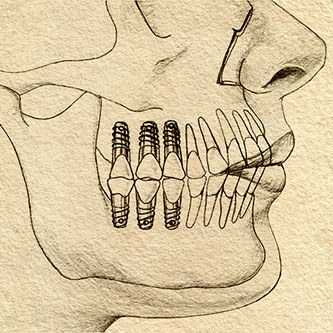
The maxillary sinuses are air-filled cavities that sit directly above the upper back teeth, the premolars and molars. They are separated from the tooth-socket area by a thin lining known as the Schneiderian membrane.
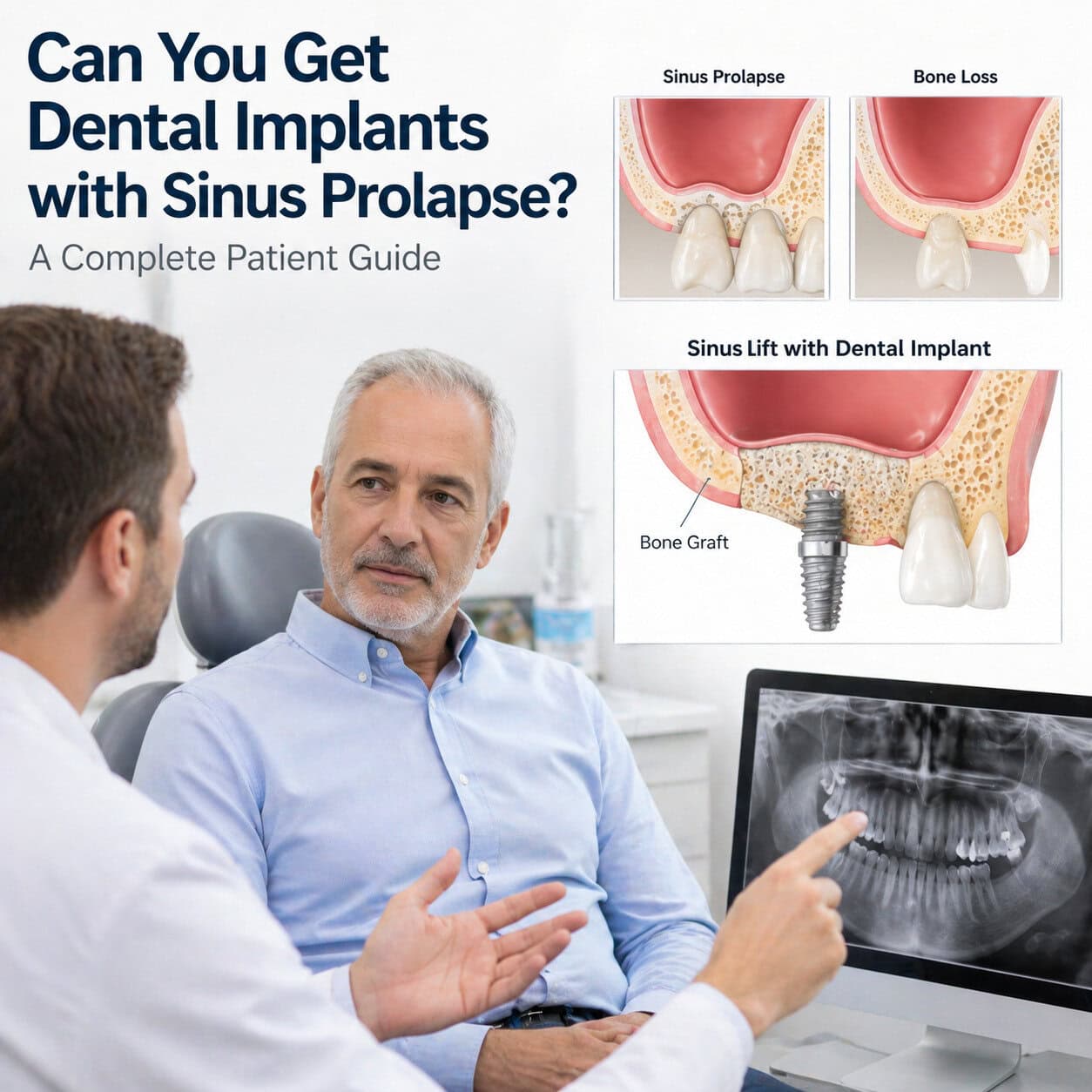
When upper posterior teeth are lost, the jawbone beneath the sinus floor gradually resorbs. At the same time, the sinus cavity naturally expands downward through a process called pneumatization. The result is a condition commonly described as sinus prolapse or sinus descent: the sinus floor drops progressively lower, leaving very little usable bone between the sinus and the intended implant site.
For a dental implant to integrate successfully, the implant needs to be anchored in enough bone, typically at least 8–10 mm of vertical height. When sinus prolapse reduces this height to just a few millimetres, placing an implant directly is not safe or predictable. But that does not mean implants are impossible.
Can You Still Get Dental Implants?
Yes, in most cases, patients with sinus prolapse can still receive dental implants through a preparatory surgical procedure called a sinus lift (also known as sinus augmentation or sinus floor elevation).
The sinus lift creates the bone foundation that implants require. It is one of the most well-documented procedures in oral surgery, with decades of clinical evidence supporting its predictability. At Mosdent, our implant specialists have performed this procedure across a wide range of anatomical scenarios, including patients with as little as 2–3 mm of residual bone height.
/ Understanding the Sinus Lift: What Actually Happens
A sinus lift dental implant procedure involves lifting the sinus membrane upward and filling the space created beneath it with bone graft material. Over several months, this graft integrates with the patient's natural bone, building a stable platform for implant placement.
There are two main surgical approaches:
1. Lateral Window Technique (Direct Sinus Lift)
Used when bone height is severely reduced, typically below 4–5 mm. The surgeon creates a small opening in the outer wall of the sinus, gently elevates the membrane, and packs bone graft material into the space. This approach allows for a larger increase in bone volume and is the gold standard when significant augmentation is needed. Implants may be placed at the same time or after a healing period of 4–9 months, depending on the clinical assessment.
2. Crestal (Transcrestal) Technique, Minimally Invasive Sinus Lift
Used when there is at least 5–6 mm of existing bone. The surgeon accesses the sinus through the same site where the implant will be placed, using precision instruments to elevate the membrane from below. This approach is less invasive and may allow simultaneous implant placement in suitable cases.
Both techniques are supported by strong clinical outcomes. Your surgeon will determine which approach is appropriate based on your imaging, anatomy, and overall oral health. Our bone graft specialists evaluate each case individually before recommending a protocol.
/ Sinus Membrane Perforation: The Risk You Should Know About
One of the most discussed complications in sinus lift surgery is sinus membrane perforation, a small tear in the Schneiderian membrane during the elevation process.
Perforation rates in the literature range from approximately 11% to 56%, with rates directly tied to surgeon experience, the anatomy of the sinus, and the thickness and condition of the membrane itself. At experienced centres, the rate is significantly lower.
Small perforations often heal on their own without any consequences. Larger tears require management at the time of surgery, typically using a resorbable collagen membrane placed over the tear to protect the graft site. In most cases, even when a perforation occurs and is properly managed, the overall outcome for the implant remains favourable.
Signs that something may require attention after sinus lift surgery include:
- Persistent nasal congestion or discharge from one side
- A sensation of air passing between your mouth and nose
- Pressure or pain beneath the cheekbone beyond normal healing
- Fever or signs of infection
If you experience any of these symptoms following treatment, contact your dental team promptly. Our oral and maxillofacial surgery team is experienced in both preventing and managing such complications.
/ Sinus Lift Candidate Criteria and Treatment Timeline at Mosdent
Most patients with sinus prolapse are candidates for the combined sinus lift and implant procedure, provided that:
General health considerations are met. Uncontrolled diabetes, active cancer treatment, severe osteoporosis, or ongoing bisphosphonate therapy may affect candidacy. Your clinician will review your full medical history before planning treatment.
The sinuses are free of active infection. Chronic sinusitis, nasal polyps, or other sinus pathology should be treated before augmentation surgery is planned. An ENT consultation may be required in some cases.
Adequate healing time can be committed. The full process, from sinus lift to final implant restoration, can take anywhere from 6 to 18 months depending on how much bone augmentation is needed. Patients who smoke have lower success rates and should ideally stop smoking before and after surgery.
Bone quality in surrounding areas is acceptable. Even with a sinus lift, certain cases of advanced bone loss may require additional augmentation using bone graft procedures alongside the sinus elevation.
Step 1: 3D Imaging and Consultation
We begin with cone beam CT (CBCT) scanning, which gives us a precise three-dimensional view of your sinus anatomy, residual bone height, and membrane condition. This imaging is essential, it allows us to plan the surgery with accuracy and predict which technique is most appropriate.
Step 2: Pre-Surgical Assessment
If sinus pathology is identified, we coordinate with ENT specialists as needed. Medical history, medications, and bone density are all factored into your personalised treatment plan.
Step 3: Sinus Lift Surgery
Performed under local anaesthesia. Sedation is available for patients who prefer a fully relaxed experience. The procedure typically takes 1–2 hours per side.
Step 4: Healing and Bone Integration
The graft material consolidates and new bone forms over 4–9 months. During this phase, you will attend check-up appointments to monitor progress through clinical examination and imaging.
Step 5: Implant Placement
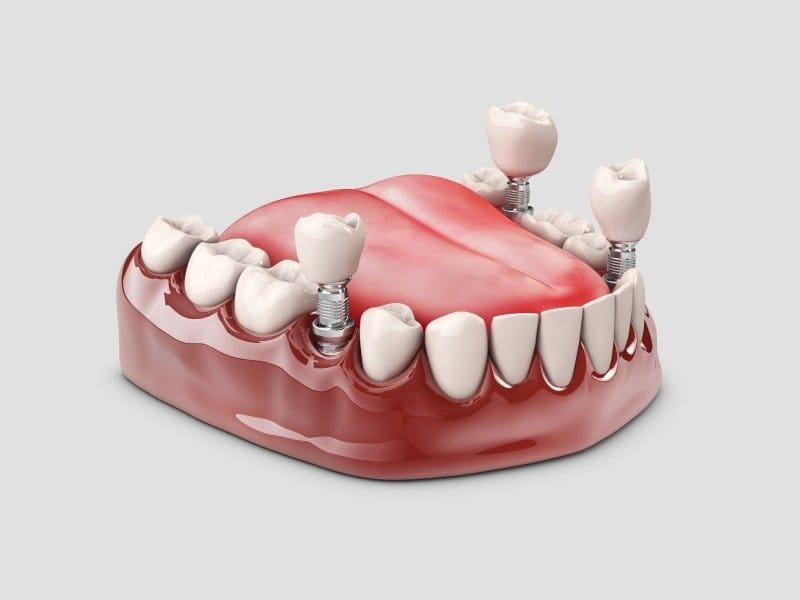
Once sufficient bone volume is confirmed, implants are placed. After a further osseointegration period, the final crown or prosthesis is fitted, completing your implant treatment .
/ Sinus Lift and Implant Treatment Options in Istanbul
All-on-4 and All-on-6: Alternatives When Bone Loss Is Extensive
For patients who have lost most or all of their upper teeth and have widespread bone loss across the posterior maxilla, individual implants with multiple sinus lifts may not always be the most practical path. In such cases, All-on-4 or All-on-6 implants may offer a full-arch solution using strategically angled implants that avoid the sinus region altogether, sometimes reducing or eliminating the need for sinus augmentation.
Whether this approach is appropriate depends entirely on your individual anatomy and the number of teeth being replaced. Your Mosdent clinician will present all viable options at your consultation.
Why Choose Istanbul for Sinus Lift and Implant Treatment?
Patients increasingly choose Turkey, and Istanbul in particular, for complex implant procedures, including sinus augmentation. The reasons are well-documented: internationally trained specialists, advanced imaging technology, and treatment costs that are significantly lower than in the UK, Germany, or Scandinavia, without any compromise in clinical standards.
Mosdent Dental Hospital has been operating in Istanbul since 1992. We hold a Ministry of Health authorisation for International Health Tourism, are subject to rigorous biannual inspections, and have an expert team that includes specialists in implantology, oral surgery, and periodontology working under one roof.
For international patients travelling for sinus augmentation Turkey, we coordinate every aspect of your care, from initial imaging to final restoration, with full communication support in English throughout.
/ Frequently Asked Questions
Is a sinus lift painful? Most patients report that the procedure itself is not painful, as it is performed under local anaesthesia. Post-operative discomfort is generally mild to moderate and well-managed with standard pain relief. Swelling and some nasal congestion in the days following surgery are normal.
Can the sinus lift and implant be done in the same surgery? In some cases, yes, when there is sufficient existing bone height. In others, a staged approach is safer, with the implant placed after the graft has consolidated. Your surgeon will advise based on your imaging.
How long does the whole process take for international patients? Patients travelling from abroad typically complete the sinus lift and preparatory work on a first visit, then return for implant placement and final restoration after the healing period. We provide detailed treatment timelines at the initial consultation.
What happens if I have gum disease as well? Active gum disease needs to be treated before implant surgery. Untreated periodontal disease significantly increases the risk of implant failure. Our periodontology team manages this as part of the overall treatment plan.
Will my dental insurance cover this? Coverage varies significantly by provider and country. We provide full itemised treatment plans that you can submit to your insurer prior to travel.
Book Your Consultation at Mosdent
If you have been told you have sinus prolapse or insufficient upper jaw bone for dental implants, a specialist assessment is the first step, not the last. Some of the patients who come to Mosdent have been told elsewhere that implants are not possible for them, and the assessment starts by establishing whether that is still the case.
Our dental implant team is available for in-person and online consultations. We work with patients from across Europe, the Middle East, and beyond.
This article is intended for general informational purposes. Individual clinical situations vary. Please consult a qualified dental specialist for a personalised assessment.
Let’s plan the right treatment together.
Free Assessment→- 1.Díaz-Olivares LA, Cortés-Bretón Brinkmann J, Martínez-Rodríguez N, Martínez-González JM, López-Quiles J, Leco-Berrocal I, et al. Management of Schneiderian membrane perforations during maxillary sinus floor augmentation with lateral approach in relation to subsequent implant survival rates: a systematic review and meta-analysis. Int J Implant Dent 2021;7:91. PubMed 34250560
- 2.Dongo V, von Krockow N, Martins-Filho PRS, Weigl P. Lateral sinus floor elevation without grafting materials. Individual- and aggregate-data meta-analysis. J Craniomaxillofac Surg 2018;46:1616-1624. PubMed 29980356