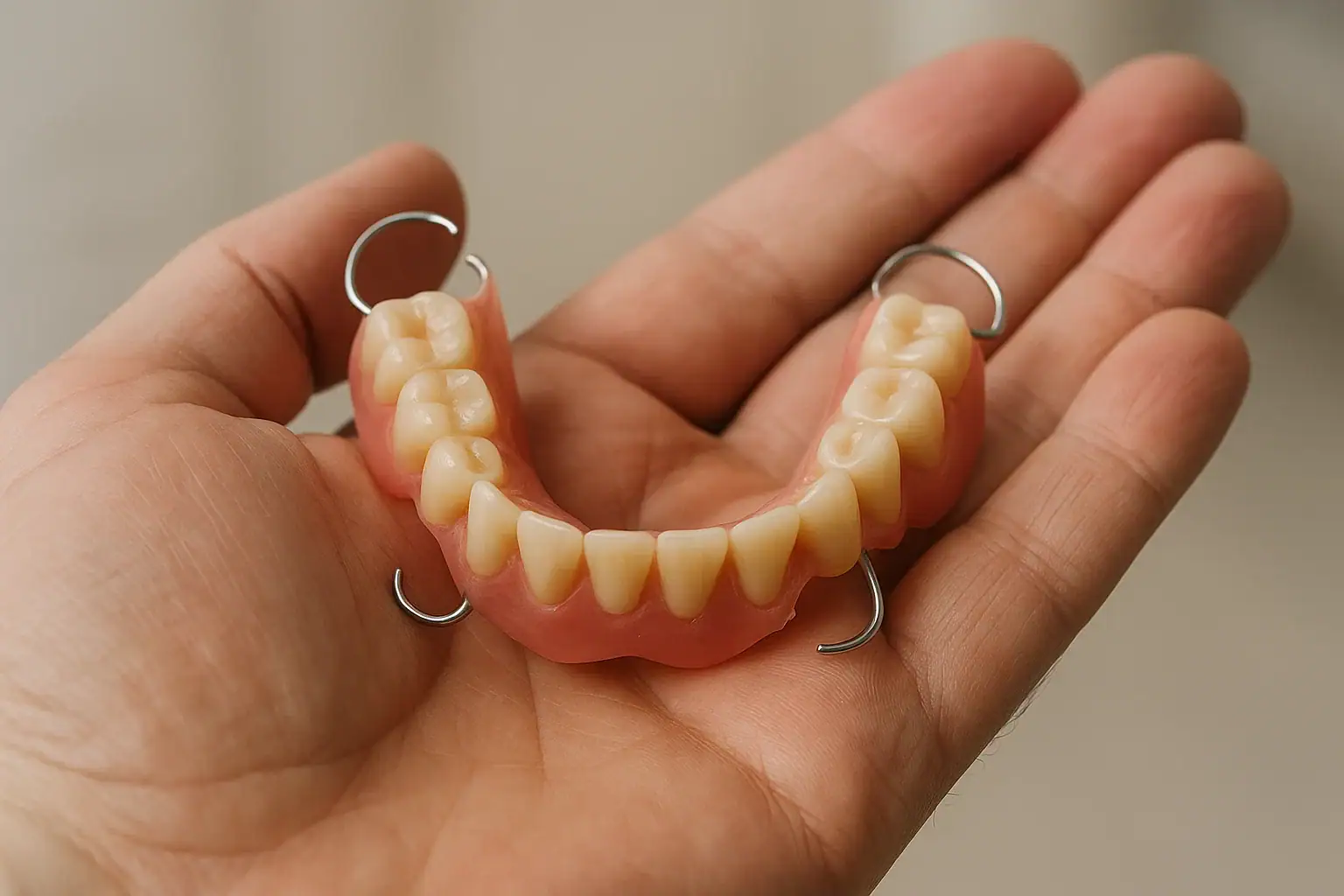
A partial denture is a removable appliance that replaces one or more missing teeth in an arch that still has natural teeth, built from artificial teeth on an acrylic, cobalt-chrome or flexible resin base and held by clasps or precision attachments. It is the non-surgical alternative to a bridge or an implant. In a meta-analysis of 46 studies covering 4,359 prostheses and 4,072 wearers, five-year survival was 95.1 percent for cast-clasp partial dentures and 91.7 percent for those retained by telescopic crowns, with no significant difference between the two designs (PubMed 39043477).
- 01A partial denture replaces gaps in an arch that still has natural teeth; a full denture replaces the whole arch, and the two are not interchangeable options.
- 02Five-year survival was 95.1 percent for cast-clasp partial dentures and 91.7 percent for telescopic-crown designs across 46 studies, 4,359 prostheses and 4,072 wearers (PubMed 39043477).
- 03In the same analysis tooth mobility and probing depth stayed unchanged over long-term wear while the gingival index rose, and abutment teeth carried about twice the extraction risk after five years.
- 04Edentulism affected 353 million people worldwide in 2021, an age-standardised prevalence of 4.11 percent, and is projected to pass 660 million by 2050 (PubMed 39192495).
- 05Replacement is usually driven by fit rather than breakage: gum and bone shrink under the base, so partials are remade periodically. In one ten-year analysis, median survival was 73 months for metal-based and 45 months for acrylic designs (PubMed 39029614).
/ Partial Denture Basics and Function
Partial dentures are used to address missing teeth.
Introduction to Partial Dentures
Tooth loss is a common issue that affects millions of people worldwide. Whether due to aging, injury, or dental disease, missing teeth can significantly impact your appearance, oral health, and quality of life. Fortunately, partial dentures offer an effective and affordable solution to restore your smile and function. In this comprehensive guide, we’ll explore everything you need to know about partial dentures from types and materials to costs, insurance coverage, and care tips.
Definition of a Partial Denture
A partial denture is a removable dental appliance used to replace one or more missing teeth in either the upper or lower jaw. Unlike full dentures, which replace an entire arch of teeth, partial dental dentures are designed to fill gaps between natural teeth without requiring the removal of healthy ones.
Anatomy of a Partial Denture
A typical partial denture consists of:
- Artificial teeth made from acrylic or porcelain
- Base (acrylic, metal, or flexible resin)
- Clasps or precision attachments to anchor to natural teeth
- Optional gum-colored flanges for a natural appearance
How Do Partial Dentures Work?
Partial dentures help restore oral function by:
- Filling spaces to prevent adjacent teeth from shifting
- Supporting the structure of the mouth and facial muscles
- Allowing proper speech, chewing, and appearance
They are typically designed to be easily inserted and removed by the patient for cleaning and maintenance.
/ Partial Denture Types and Treatment Fit
Understanding the different types of partial dentures is essential when deciding which option best suits your needs and budget.
1. Acrylic Partial Dentures
- Made from pink acrylic resin
- Often considered as a temporary or transitional option
- More affordable, but bulkier and less comfortable
- Prone to breakage over long-term use
2. Metal Framework Partial Dentures
- Constructed with a cobalt-chrome base
- Strong, durable, and lightweight
- Custom-designed for a precise fit
- Ideal for long-term use and better support
3. Flexible Partial Dentures
- Made from flexible thermoplastic materials such as Valplast or Flexite
- No metal clasps, blend naturally with gum color
- Very comfortable and less likely to cause irritation
- Great option for patients allergic to metal
4. Precision Attachment Partial Dentures
- Use mechanical attachments instead of visible metal clasps
- Provide superior fit and aesthetics
- Often require crowns on adjacent teeth for anchorage
- Higher cost but excellent cosmetic outcome
Benefits of Partial Dentures
- Restored Functionality : Eat and speak more comfortably
- Improved Aesthetics : Regain a confident, natural-looking smile
- Prevention of Tooth Movement : Keep neighboring teeth in place
- Facial Structure Support : Help restore facial contour and reduce sunken-cheek appearance
- Non-Invasive Treatment : No surgery required
- Reversible Option : Can be adjusted or removed easily
- Affordable Alternative : Lower cost than dental implants
Who Is a Good Candidate for Partial Dentures?
You may be an ideal candidate for partial dentures if you:
- Have one or more missing teeth
- Have healthy gums and some remaining natural teeth
- Are not eligible or ready for dental implants
- Want a cost-effective and minimally invasive solution
- Seek a removable and adjustable prosthetic option
/ Partial Denture Treatment Process and Cost Expectations
Getting partial dentures begins with a dental assessment and planning.
1. Initial Dental Assessment
Your dentist will evaluate your oral health, remaining teeth, and jaw structure. If necessary, decayed or damaged teeth may be extracted before proceeding.
2. Impressions and Bite Registration
Detailed impressions and bite records are taken to fabricate a custom-fit partial denture .
3. Try-In and Fitting
You may receive a wax try-in to check the aesthetics and fit before the final version is made. Once fabricated, the dentist will fine-tune it to your bite and comfort level.
4. Adjustment Period
You’ll be instructed on how to insert, remove, and clean your partial denture . Some initial soreness or difficulty speaking is normal and usually subsides with use. Soreness that does not settle should be shown to the dentist: the NHS lists badly fitting dentures among the common causes of mouth ulcers and advises a check for any ulcer that lasts longer than 3 weeks, even one that looks like the familiar canker sores. Soreness that does not settle should be shown to the dentist: the NHS lists badly fitting dentures among the common causes of mouth ulcers and advises a check for any ulcer that lasts longer than 3 weeks, even one that looks like the familiar canker sores.
How Much Do Partial Dentures Cost?
The cost of partial dentures can vary depending on materials, complexity, customization, and location.
| Type of Denture | Average Cost (USD) |
|---|---|
| Acrylic Partial Denture | $300 – $800 |
| Metal Framework Partial Denture | $900 – $2,500 |
| Flexible Partial Denture | $1,000 – $1,800 |
| Precision Attachment Denture | $2,000 – $4,000 |
Additional Cost Considerations
- Initial consultation: $50 – $150
- Tooth extractions (if needed): $100 – $300 per tooth
- Adjustments and relining: $100 – $500
- Periodic replacement, usually sooner for acrylic than for metal-based designs (PubMed 39029614)
How Much Do Partial Dentures Cost Without Insurance?
If you don’t have dental insurance, the full cost is paid out-of-pocket. Choosing materials and types greatly impacts affordability.
Payment Plans and Financing Options
Many dental clinics offer financing plans through providers like CareCredit or in-house installments to make partial dental dentures more accessible.
/ Partial Denture Maintenance and Treatment Alternatives
Proper care can extend the life of your partial denture and maintain oral hygiene. It also helps prevent fungal infection: denture stomatitis, often linked to a Candida biofilm, affects wearers of partial as well as complete dentures, and the NHS advises cleaning dentures and not wearing them at night to lower the risk of oral thrush. It also helps prevent fungal infection: denture stomatitis, often linked to a Candida biofilm, affects wearers of partial as well as complete dentures, and the NHS advises cleaning dentures and not wearing them at night to lower the risk of oral thrush.
Daily Care Tips
- Rinse dentures under lukewarm water after meals
- Brush gently with a soft-bristle brush and denture-specific cleanser
- Never use toothpaste, it may scratch the surface
- Store in a denture-cleaning solution overnight to retain shape
Long-Term Maintenance
- Regular dental check-ups every 6 months
- Professional cleaning if plaque buildup occurs
- Monitor for loosening, cracking, or staining
Common Challenges
- Difficulty with speech or eating initially
- Gum irritation or sore spots
- Increased saliva production
Solutions
- Practice speaking with dentures at home
- Return to your dentist for bite and comfort adjustments
- Use dental adhesives if advised by your provider
When to Replace a Partial Denture
- Visible wear or staining
- Loose fit due to gum or bone shrinkage
- Changes in facial structure
How long partial dentures last depends on care and material type: in a ten-year analysis of 1,893 partial dentures, median survival was 73 months for metal-based designs and 45 months for acrylic ones (PubMed 39029614).
1. Dental Bridges
- Fixed restoration supported by neighboring teeth
- Natural look and feel
- Requires reshaping healthy adjacent teeth
2. Dental Implants
- Surgically implanted titanium posts
- Most stable and long-lasting option
- High upfront cost and healing time
3. Snap-On Dentures (Implant-Supported)
- Dentures attached to implants
- More stable than traditional removable options
- Costlier than standard partial dentures
/ FAQs About Partial Dentures
What Is a Partial Denture?
A removable appliance that replaces one or more missing teeth while anchoring to surrounding natural teeth.
How Much Do Partial Dentures Cost?
Costs vary between $300 and $4,000 depending on the type and complexity.
How Much Do Partial Dentures Cost Without Insurance?
Without insurance, expect to pay between $900 and $2,500 depending on the material and provider.
How Much Are Flexible Partial Dentures?
On average, flexible partial dentures cost between $1,000 and $1,800 due to the advanced material used.
Do Partial Dentures Look Natural?
Yes. Modern materials, especially flexible and precision dentures, offer highly realistic aesthetics.
How Long Do Partial Dentures Last?
It depends on material and maintenance: in a study of 1,893 partial dentures, median survival was 73 months for metal-based and 45 months for acrylic designs, and more maintenance visits were linked to longer service (PubMed 39029614).
Conclusion on Choosing a Partial Denture
Partial dentures are a practical, affordable, and aesthetically pleasing solution for patients with one or more missing teeth. Whether you choose acrylic, metal, or flexible partial dentures, restoring your smile doesn’t have to be complicated or costly. With proper care, these appliances can improve your quality of life and oral health dramatically. Speak to your dentist to evaluate the best option tailored to your needs and budget.
Let’s plan the right treatment together.
Free Assessment→- 1.Drummond LB, Bezerra AP, Feldmann A, Gonçalves TMSV. Long-term assessment of the periodontal health of removable partial denture wearers: A systematic review and meta-analysis. J Prosthet Dent 2025;134:1664-1685. PubMed 39043477
- 2.Nascimento GG, Alves-Costa S, Romandini M. Burden of severe periodontitis and edentulism in 2021, with projections up to 2050: The Global Burden of Disease 2021 study. J Periodontal Res 2024;59:823-867. PubMed 39192495
- 3.NHS. Mouth ulcers. Page last reviewed 11 March 2024.
- 4.Perić M, Miličić B, Kuzmanović Pfićer J, Živković R, Arsić Arsenijević V. A Systematic Review of Denture Stomatitis: Predisposing Factors, Clinical Features, Etiology, and Global Candida spp. Distribution. J Fungi (Basel). 2024;10(5):328.
- 5.NHS. Oral thrush (mouth thrush). Page last reviewed 5 June 2023.
- 6.Ahmed KE, Li H, Peres KG. Longevity of acrylic and cobalt-chromium removable partial dentures-A ten-year retrospective survival analysis of 1246 denture-wearing patients. J Dent 2024;148:105253. PubMed 39029614