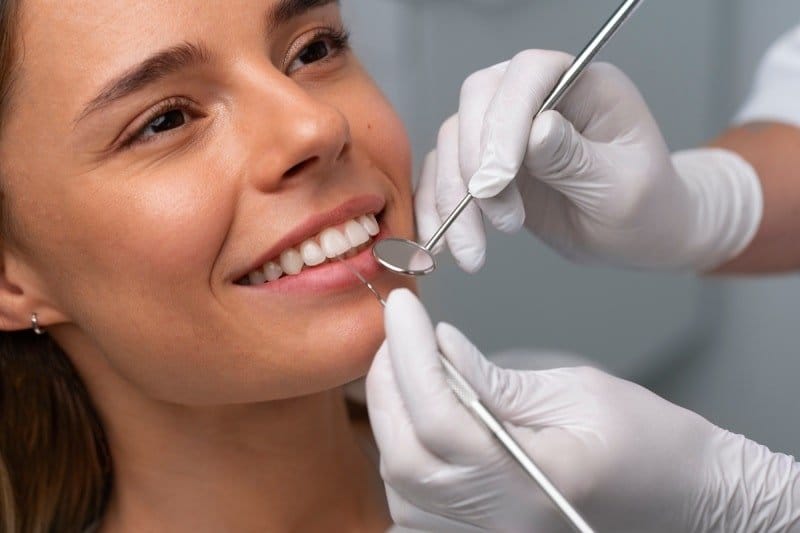

Dental calculus, commonly called tartar, is dental plaque that has mineralised with calcium and phosphate from saliva into a hard deposit bonded to the tooth surface, which is why a toothbrush and floss no longer shift it and instrumentation is needed. Cochrane pooled two trials in 1,711 regularly attending adults without severe periodontitis: six-monthly scale and polish reduced calculus levels against no scheduled treatment (standardised mean difference -0.32, 95% CI -0.44 to -0.20) but made little or no difference to gingivitis, probing depths or oral health-related quality of life over two to three years (PubMed 30590875).
- 01Tartar is not a different substance from plaque, it is plaque that has hardened with salivary minerals; that phase change is exactly what puts it beyond the reach of home cleaning.
- 02Against no scheduled treatment, planned scale and polish reduced calculus at both intervals tested: standardised mean difference -0.32 (95% CI -0.44 to -0.20) six-monthly and -0.19 (95% CI -0.31 to -0.07) twelve-monthly, on high-certainty evidence (PubMed 30590875).
- 03Six-monthly beat twelve-monthly on calculus by a small margin (standardised mean difference -0.13, 95% CI -0.25 to -0.01) but not on gingivitis (0.03, 95% CI -0.09 to 0.15), and the review calls the clinical importance of these reductions unclear (PubMed 30590875).
- 04That evidence covers healthy adults who already attend regularly; it does not cover people with severe periodontitis, for whom recall intervals are set clinically rather than by these trials (PubMed 30590875).
- 05The home half is measurable too: powered brushes reduced plaque by 11% in the short term and 21% beyond three months, and gingivitis by 6% and 11%, pooled from 51 trials with 4,624 participants (PubMed 24934383).
Tartar cleaning and dental care are one of the basic elements of maintaining oral health. Tartar is a plaque accumulation that accumulates on teeth and hardens over time. If tartar is not cleaned, it can cause infections in teeth, gum disease and even tooth loss. This article will include everything you are curious about tartar cleaning, dental care and oral health.
Dental tartar, importance and cleaning methods
What is Dental Tartar?
Tartar is formed by the mineralization of bacteria and food residues that accumulate on the teeth over time. Initially soft, plaque hardens and turns into tartar if not cleaned with regular brushing. Tartar is not only aesthetically unpleasant, but can also lead to inflammation of the gums and decay.
The Importance of Dental Tartar Cleaning
Tartar cleaning is a procedure that should be done by a professional dentist. Tartar cannot be cleaned by brushing and flossing at home. If tartar accumulates for a long time, it can cause gum inflammation, tooth loss and bad breath. In addition, tartar cleaning makes your teeth look whiter and healthier.
How to Clean Dental Tartar?
- Visiting the Dentist: Tartar cleaning is usually done by a dentist or dental hygienist. Your dentist uses various tools to remove plaque and tartar from your teeth.
- Ultrasonic Cleaning: During tartar cleaning, tartar is loosened and cleaned by ultrasonic devices. This method removes tartar effectively and is usually well tolerated.
- Manual Cleaning: After ultrasonic cleaning, the remaining residue on the tooth surfaces is cleaned by manual cleaning.
Dental care routine, cleaning frequency and benefits
Basic Rules of Dental Care
It is important to create an effective dental care routine to prevent tartar formation and maintain overall oral health. Here are the basic rules to follow in dental care:
Regular Teeth Brushing
Brush your teeth at least twice a day, morning and evening, with fluoride toothpaste. Brushing your teeth is the most important step to prevent tartar formation.
Use Dental Floss
Don't forget to use dental floss to clean plaque between your teeth. Dental floss cleans bacteria buildup in places where a toothbrush can't reach.
Use of Mouthwash
Antiseptic mouthwashes help kill lingering bacteria in the mouth and prevent bad breath.
Balanced Diet
Your dental health depends on what you eat. Cutting back on sugary foods and eating a diet rich in vitamins supports the health of your teeth.
Regular Dentist Checkups
Visit your dentist at least every six months. These regular checkups help prevent tartar buildup and detect dental disease at an early stage.
How Often Should Dental Tartar Cleaning Be Done?
Tartar cleaning is usually a procedure that should be done once or twice a year. However, people who have rapid tartar buildup may need to have their teeth cleaned more frequently. Your dentist will determine how often you need to have your teeth cleaned based on your oral structure and dental health.
Benefits of Dental Tartar Cleaning
- Oral Health: Cleaning tartar prevents inflammation of the gums and reduces the risk of tooth loss.
- Aesthetic Appearance: Cleaning tartar helps you have whiter and healthier teeth.
- Elimination of Bad Breath: Tartar contains bacteria that can cause bad breath. Cleaning tartar eliminates this problem.
Tartar cleaning and regular dental care are very important for a healthy mouth and a beautiful smile. You can protect your oral health by brushing your teeth regularly, flossing, and getting professional cleanings. Remember, oral health is directly related to the overall health of your body, so you should take the necessary care of your dental care.
Let's plan the right treatment together.
Free Assessment→- 1.Lamont T, Worthington HV, Clarkson JE, Beirne PV. Routine scale and polish for periodontal health in adults. Cochrane Database Syst Rev 2018;12:CD004625. PubMed 30590875
- 2.Yaacob M, Worthington HV, Deacon SA, Deery C, Walmsley AD, Robinson PG, et al. Powered versus manual toothbrushing for oral health. Cochrane Database Syst Rev 2014;2014:CD002281. PubMed 24934383