
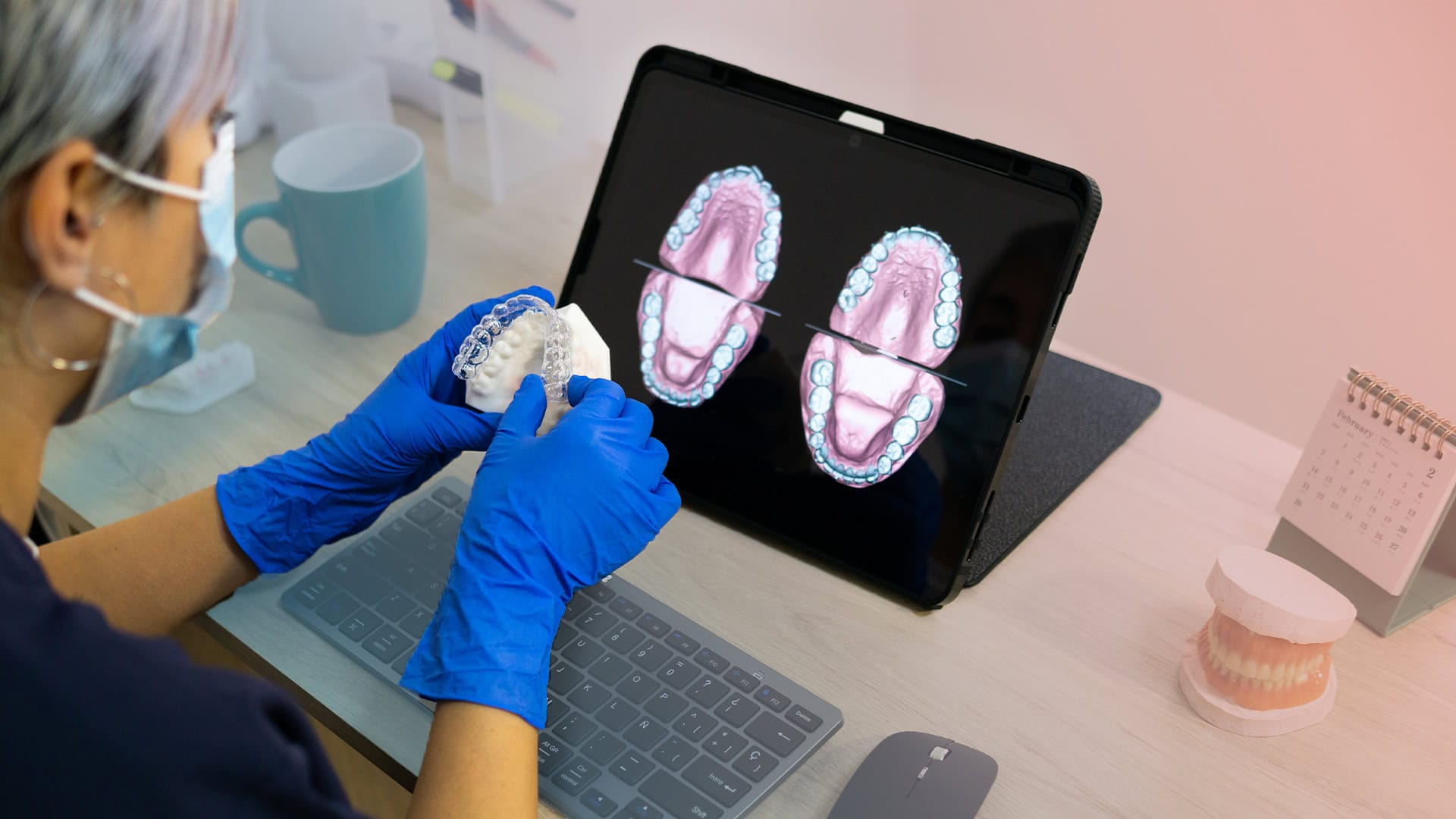
Artificial intelligence in dentistry means software that analyses clinical images and patient data to support, not replace, the dentist's diagnosis: caries detection on radiographs, periodontal bone loss assessment, orthodontic planning and oral lesion screening. Accuracy is measurable. In a meta-analysis of 21 studies drawn from 2,442 records, AI reading bitewing radiographs for approximal caries reached a pooled sensitivity of 0.94 and specificity of 0.91 (PubMed 39396775). The same review is explicit that positive findings must be verified by a dentist; the final diagnosis stays with the clinician.
- 01AI in dentistry is decision support, not autonomous diagnosis: the software produces a preliminary reading and the dentist confirms or overrules it before any treatment decision is taken.
- 02For approximal caries on bitewing radiographs, pooled AI sensitivity was 0.94 and specificity 0.91 across 21 studies; negative predictive value ran from 0.79 to 1.00, so these systems are strongest at ruling approximal caries out (PubMed 39396775).
- 03Positive predictive value in the same meta-analysis ranged from 0.15 to 0.87, which is exactly why an AI-flagged lesion is verified by a dentist before anything is drilled (PubMed 39396775).
- 04Performance is task-dependent rather than uniform: a systematic review of 33 paediatric dentistry studies reported accuracy from 60% to 99% and sensitivity from 20% to 100%, depending on the task (PubMed 38449036).
- 05Artificial intelligence is used in five clinical areas: digital radiograph interpretation, early caries detection, orthodontic movement simulation, oral cancer screening and patient data tracking, all of them adjuncts to the examination rather than substitutes for it.
/ Revolutionary Technology in Dentistry and Artificial Intelligence Use
New technologies are entering our lives every day in the field of dental health. In recent years, artificial intelligence-supported dental treatments have been helping both dentists and patients follow the process more clearly by offering faster and more measurable diagnostic support.
What is Artificial Intelligence and How is it Used in Dentistry?
Definition of Artificial Intelligence
Artificial intelligence (AI) is a technology that enables machines to gain human-like learning, analysis and decision-support abilities. It is used in the healthcare sector, especially in dentistry, to support diagnosis and treatment planning.
Applications of Artificial Intelligence in Dentistry
- Digital Radiography Interpretation:
Fast and detailed analysis of X-ray images.
- Early Stage Caries Detection:
Automatic flagging of incipient caries that the eye may miss.
- Orthodontic Treatment Planning:
Simulation of tooth movements and support in preparing the orthodontic plan.
- Oral Cancer Screening:
Systems that flag abnormal tissues and lesions more quickly.
- Patient Tracking and Management:
Automatic analysis of appointment, treatment process and patient data.
/ Advantages and Diagnostic Areas of AI-Supported Diagnosis
Faster Diagnostic Process
AI can analyze images of dental problems faster than classical reading methods. An image a radiographer or dentist would examine for minutes can be pre-assessed by AI software in seconds.
More Measurable Results
It adds a layer of review for details the eye may miss. Small cavities, fine cracks or early cyst-like appearances can be flagged by AI systems, and the dentist weighs these findings with the clinical examination.
Personalized Treatment Plans
AI can analyze data on the patient's oral structure and support planning of suitable treatment options, so the decision rests on the patient's current oral condition rather than a standard template.
Chance of Early Intervention
In serious conditions such as oral cancer, early findings are valuable for clinical evaluation. AI can support timely evaluation by flagging tissue changes that may be linked to such diseases earlier.
Which Diagnoses Can Artificial Intelligence Support in Dentistry?
Detection of Caries
On digital X-rays, AI-supported systems can flag early-stage caries quickly. The dentist makes the final decision, weighing the image finding with the intraoral examination.
Early Diagnosis of Periodontal Diseases
Periodontal problems such as gum recession and bone loss can be noticed at an early stage with AI-supported image analysis. These systems do not judge gum tissue alone; radiographic bone level, clinical measurements and examination findings are read together.
Orthodontic Problems
Jaw structure, tooth positions and malocclusion (a faulty bite) can be mapped with AI, so current tooth positions, planned movements and the bite relationship are assessed more systematically when the orthodontic plan is prepared.
Oral Cancer Screening
AI algorithms can analyze abnormal tissue changes or lesions and flag areas that look risky. A flag does not amount to a diagnosis; the dentist or relevant specialist examines suspicious areas clinically and, if needed, arranges further evaluation.
/ Artificial Intelligence-Assisted Dental Treatment Systems in Practice
Artificial Intelligence-Assisted Dental Treatment Systems:
Image Recognition Systems
Artificial intelligence systems that work on digital radiography, panoramic x-ray and 3D tomography images support dentists by performing detailed analysis. These systems mark specific areas in the image and provide a preliminary reading that helps the dentist's evaluation.
Machine Learning Algorithms
Machine learning algorithms trained on data from hundreds of thousands of patients analyze new incoming data and produce fast predictions. These predictions do not replace clinical diagnosis; the dentist evaluates the patient's history, examination and imaging findings together.
Patient Communication with NLP (Natural Language Processing)
Chatbot systems can guide patients by answering their questions quickly. During the pandemic in particular, they offered convenience in remote patient follow-up for appointment reminders, general information and process management.
How Will Artificial Intelligence Affect Dentistry Education?
Next Generation Dentist Profile
Dentists of the future are expected to combine clinical skills with the ability to interpret artificial intelligence systems correctly and to know their limits.
Technologies Integrated into Education
In dentistry faculties, artificial intelligence-supported analysis methods and digital diagnosis modules have already begun to be added to course curricula. These courses aim to help students use digital tools consciously in image reading and clinical decision-making.
/ AI Integration in Dental Clinics and the Patient Experience
Technology Investment
First of all, clinics need to invest in the right artificial intelligence solutions. Software that is compatible with digital radiography systems and can be assessed for data security and clinical use should be preferred.
Physician and Staff Training
In order for artificial intelligence to be used effectively, it is essential that dentists and clinic staff receive training on these systems. It should be clear what the software measures, what it does not measure and when it needs the dentist's confirmation.
Patient Information
Properly informing patients about AI-supported diagnosis and treatment planning methods supports trust. Patients should be told clearly that the software is an analysis tool that assists the dentist and that the decision stays with the dentist.
AI-Supported Treatment Experience from the Patient Perspective
In traditional dental treatments, patients could experience long waiting times, complicated diagnostic processes and uncertainties. With AI-supported dental treatments, the patient experience is changing through faster image assessment and clearer planning.
Fast Diagnostic Support:
How reliable this support is has been measured for one task. A 2024 meta-analysis of 21 studies on AI detection of caries between teeth on bitewing radiographs reported a pooled sensitivity of 0.94 and specificity of 0.91, while the positive predictive value ranged from 0.15 to 0.87 (PubMed 39396775). The authors conclude that AI is useful for preliminary screening but that positive findings should be verified by a dentist to prevent unnecessary treatment.
Less Anxiety, More Confidence:
The fast and consistent diagnostic support provided by AI can help patients understand the treatment process better.
Personalized Approaches:
AI-supported systems help shape the treatment plan around each patient's oral structure and clinical data.
/ Frequently Asked Questions (FAQ) in Artificial Intelligence-Assisted Dental Treatments
Is artificial intelligence diagnosis completely independent of human control?
No. Artificial intelligence provides a preliminary analysis, the final diagnosis is always checked by the dentist.
Can artificial intelligence-assisted diagnosis be incorrect?
Yes, it can. The likelihood of error varies with the system used, the image quality and the clinical task being assessed. In a systematic review of 33 pediatric dentistry studies, reported accuracy ranged from 60% to 99% depending on the task (PubMed 38449036).
Are artificial intelligence-assisted treatments more expensive?
Generally no. In the long run, it can create a cost advantage where it helps plan less intervention in less time.
Is my patient information secure?
Yes. Full compliance with GDPR and similar data security regulations is the aim, and patient data must be protected under the applicable legislation.
Does artificial intelligence shorten the treatment period?
Yes, the diagnosis and treatment planning stages in particular can move faster. The chair time of the treatment itself depends on the type of procedure.
Artificial Intelligence is Launching a New Era in Dental Health
Artificial intelligence-supported dental treatments offer tools aimed at a faster, more measurable and safer future for both patients and dentists.
Artificial intelligence technology is expected to find wider use in dentistry in the coming years.
Let’s plan the right treatment together.
Free Assessment→- 1.Carvalho BKG, Nolden EL, Wenning AS, et al. Diagnostic accuracy of artificial intelligence for approximal caries on bitewing radiographs: A systematic review and meta-analysis. J Dent. 2024;151:105388. doi:10.1016/j.jdent.2024.105388
- 2.Rokhshad R, Zhang P, Mohammad-Rahimi H, Shobeiri P, Schwendicke F. Current Applications of Artificial Intelligence for Pediatric Dentistry: A Systematic Review and Meta-Analysis. Pediatr Dent 2024;46:27-35. PubMed 38449036