
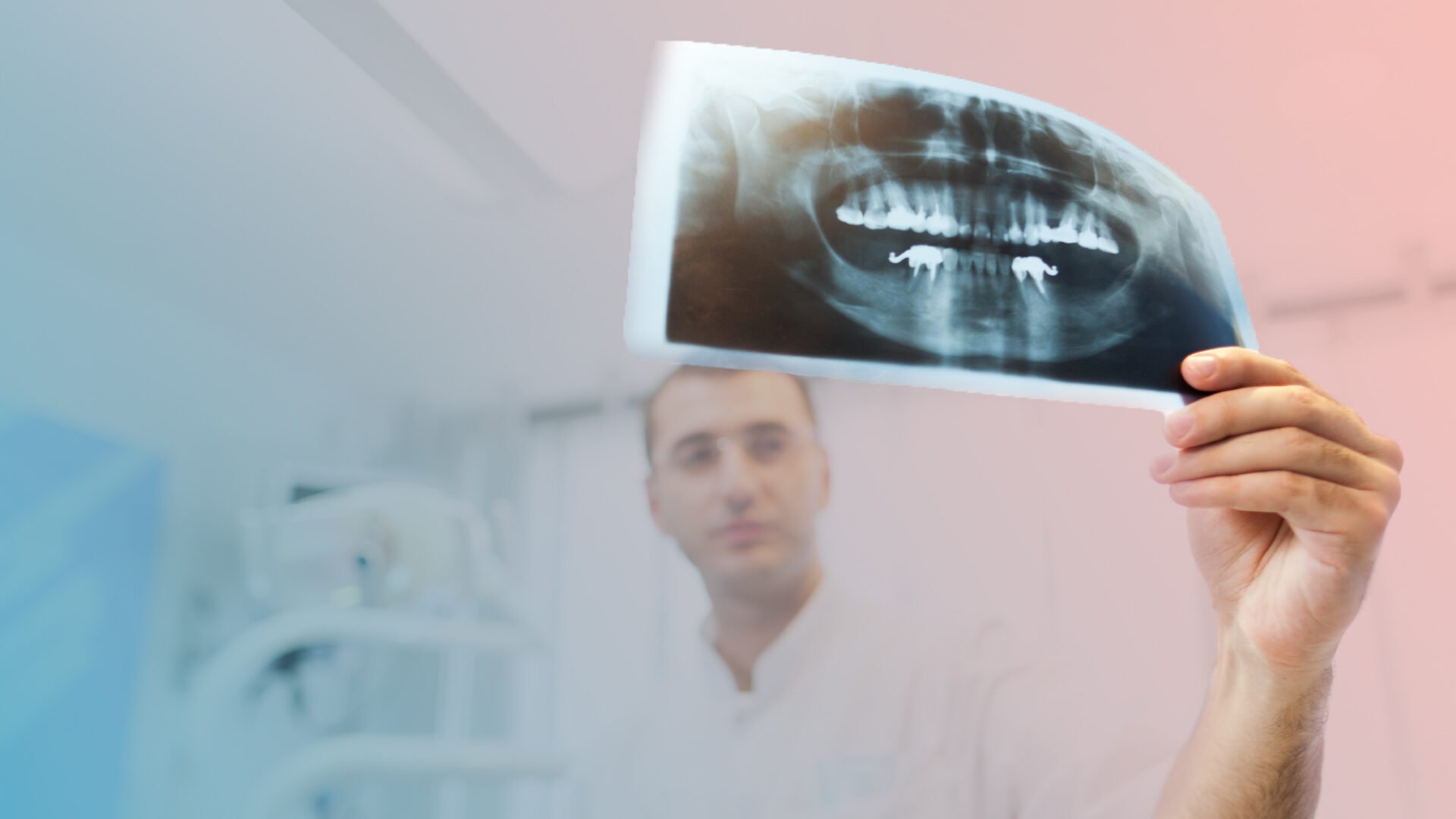
A panoramic radiograph is a single extraoral image that captures the whole dental arch, both jaws, the jaw joints and the maxillary sinuses in one pass, produced while the tube and receptor rotate around a head held still for roughly 10 to 15 seconds. Measured effective doses were 14.2 microsieverts on one panoramic unit and 24.3 on another, against 34.9 microsieverts for a full-mouth intraoral series with rectangular collimation and 170.7 with round collimation (PubMed 18762634). It answers questions a single intraoral film cannot: impacted teeth, cysts, jaw fractures and implant site assessment.
- 01One exposure covers the whole arch, both jaws, the jaw joints and the sinuses, where periapical and bitewing films show only a few teeth each.
- 02Measured effective doses: 14.2 and 24.3 microsieverts for two panoramic units, against 34.9 microsieverts for a full-mouth intraoral series with rectangular collimation and 170.7 microsieverts with round collimation (PubMed 18762634).
- 03Lower than a full-mouth series is not the same as lower than every intraoral film: a four-image posterior bitewing set measured 5.0 microsieverts, well below a panoramic exposure (PubMed 18762634).
- 04The scan itself takes about 10 to 15 seconds with the head fixed, and with digital receptors the image reaches the record immediately for the dentist to read in the same appointment.
- 05Main indications: orthodontic planning, locating impacted teeth including wisdom teeth, detecting cysts, tumours and lesions, assessing bone loss in periodontal disease, evaluating trauma, and planning implant position and bone height.
With the advancement of digital x-ray technology, panoramic films play a vital role in dentistry and general oral health. Unlike traditional single-tooth x-rays, panoramic films provide detailed visualization of all structures in the mouth.
/ Panoramic Film and Areas of Use
What is Panoramic Film?
Panoramic film is a dental technology that presents the mouth, jaw, and teeth in a single x-ray image. This type of x-ray helps create a detailed map of the teeth, jaw, jaw joints, and sinuses.
Working Principle of Panoramic Film
Panoramic X-ray machines perform a 360-degree scan by fixing the patient's head. During this scan, the X-rays create a wide-ranging image of the teeth, jawbone, sinuses and other oral structures.
Differences Between Panoramic X-Ray and Other Imaging Methods
- While periapical and bitewing x-rays only show a few teeth, panoramic films show the entire oral structure.
- It provides a safer option for patients by emitting less radiation.
- It provides comprehensive information in orthodontic and surgical planning processes.
Areas of Use of Panoramic Film
Panoramic films are widely used in many areas of dentistry. They play an important role in:
Orthodontic Treatment Planning
- For braces treatment and orthodontic corrections, it is necessary to examine the current condition of the teeth in detail.
- The relationship between the teeth and the bone structure is observed.
- The irregularities in the jaw structure and missing teeth are determined.
Impacted Tooth Detection
- It is used to determine the position of impacted teeth, especially wisdom teeth.
- It allows the dentist to make accurate planning before surgical procedures.
Diagnosis of Tooth and Jaw Cysts
- Panoramic films help in the early detection of cysts, tumors or lesions in the mouth.
- In this way, possible diseases can be detected and treated at an early stage.
Evaluation of Periodontal Diseases
- Used in the diagnosis of periodontal diseases such as bone loss.
- It can show the level of progression of gum diseases.
Evaluation of Oral, Dental and Jaw Traumas
- Used to detect fractures and cracks resulting from accidents or traumas.
- Provides clear planning before surgical intervention.
/ Advantages, Procedure and Treatment Roles of Panoramic Films
Advantages of Panoramic Films
Panoramic films have many advantages over conventional dental X-rays. These can be listed as follows:
- Offers a wide field of view: It allows the entire oral structure to be examined in a single frame.
- It is a fast and practical method: It allows all teeth to be viewed at once.
- It contains less radiation: It is taken with a lower radiation dose than conventional X-rays.
- It can be transferred to digital media: It makes it easier to store and review patient records.
- It offers early diagnosis: It allows for early diagnosis of oral diseases.
How is a Panoramic X-Ray Taken?
Panoramic X-rays are simple, and you feel nothing while the machine moves around your head. The procedure is carried out as follows:
- The patient's head is fixed and positioned correctly.
- The device rotates around the patient while imaging is done with X-rays.
- The scan takes about 10-15 seconds.
- The image is instantly transferred to the digital environment and evaluated by the dentist.
The Role of Panoramic X-Ray in Orthodontic Treatment
- Evaluation of jaw structure
- Analysis of suitability for braces treatment
- Following changes during the treatment process
Panoramic X-Ray and Implant Treatment
- Measuring jaw bone density
- Determining the correct position for implant placement
- Post-operative follow-up and evaluation
Misconceptions About Panoramic Films
- Misconceptions about the amount of radiation
- The misconception that only dentists can use it
- Its advantages and disadvantages over other imaging methods
/ Frequently Asked Questions About Panoramic Films
Are panoramic X-rays harmful?
Panoramic X-rays emit low doses of radiation and are a safe imaging method. However, they should only be taken with a doctor's recommendation to prevent unnecessary radiation exposure.
How long does it take to take a panoramic X-ray?
It is usually completed in 10-15 seconds and can be transferred to digital media instantly.
Can pregnant women have panoramic X-rays?
It is recommended not to take X-rays during pregnancy unless necessary. When an X-ray is necessary, fetal lead shielding is no longer recommended, because the dose that dental imaging delivers to the fetus is negligible (PubMed 37530694).
Which diseases can be detected with panoramic X-rays?
Many conditions such as previously unnoticed cysts, impacted teeth, tumors, and jawbone problems can be detected.
In which cases do dentists request panoramic films?
Panoramic films are requested in cases of orthodontic treatment, implant planning, impacted tooth detection, gum disease and trauma.
Can panoramic X-rays be used in children?
Yes, panoramic films can be used safely in children to follow tooth development and for orthodontic treatment planning.
Panoramic films are a very important imaging tool that facilitates the diagnosis and treatment process in dentistry. They allow for detailed evaluation of the jaw and tooth structure, and play a critical role in early diagnosis and treatment planning. Using panoramic films during regular dental check-ups is very important to maintain oral and dental health. You can have a healthy smile by having panoramic films taken when needed by consulting your dentist.
Let’s plan the right treatment together.
Free Assessment→- 1.Ludlow JB, Davies-Ludlow LE, White SC. Patient risk related to common dental radiographic examinations: the impact of 2007 International Commission on Radiological Protection recommendations regarding dose calculation. J Am Dent Assoc 2008;139:1237-43. PubMed 18762634
- 2.Benavides E, Bhula A, Gohel A, Lurie AG, Mallya SM, Ramesh A, et al. Patient shielding during dentomaxillofacial radiography: Recommendations from the American Academy of Oral and Maxillofacial Radiology. J Am Dent Assoc 2023;154:826-835.e2. PubMed 37530694