
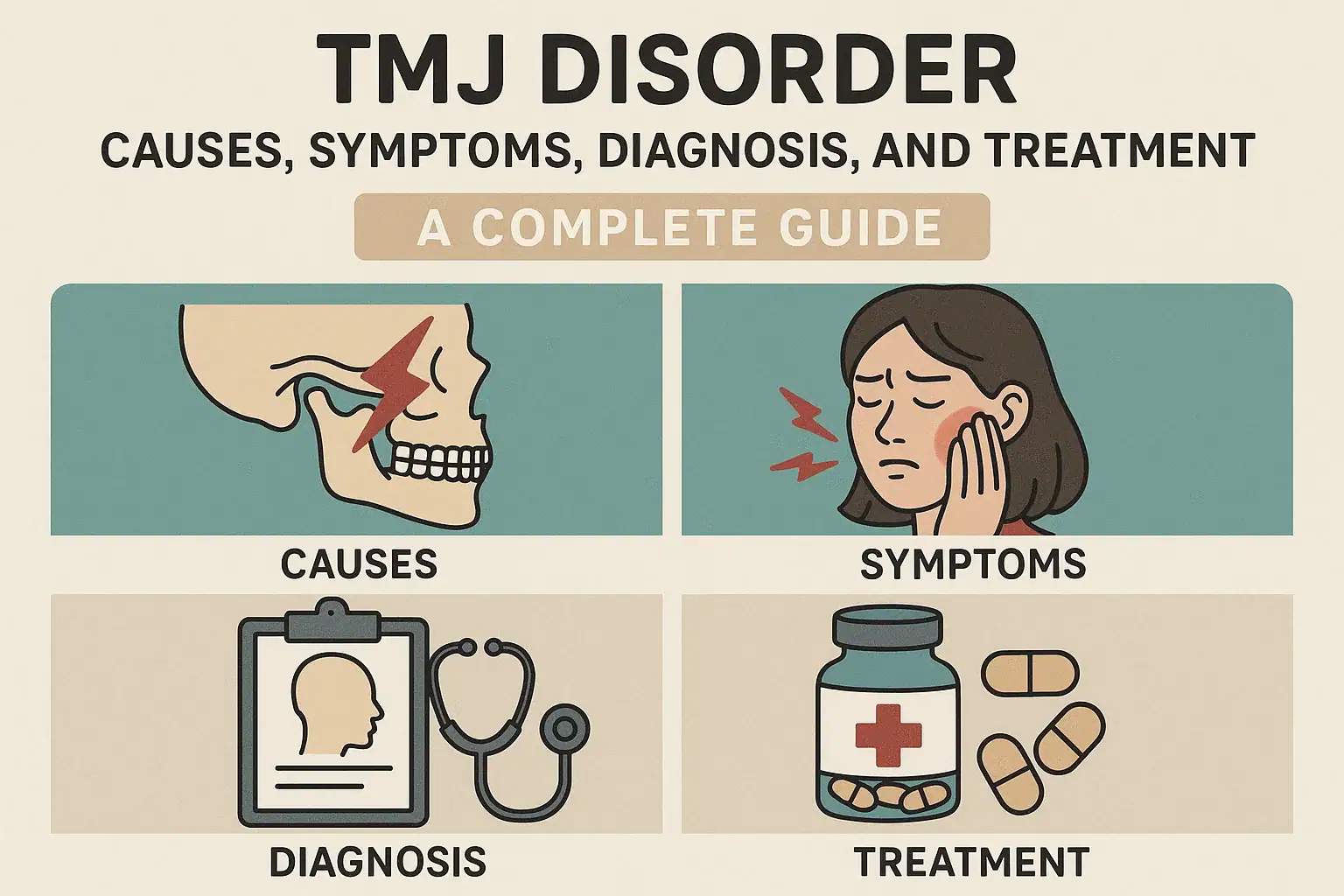
TMJ disorder, more precisely temporomandibular disorder or TMD, is a group of conditions affecting the jaw joint, the chewing muscles and the surrounding tissues, producing jaw pain, clicking or grinding, headaches, ear discomfort and limited opening. A meta-analysis of 74 studies covering 172,239 subjects put the global prevalence at 34 per cent, with the 18 to 60 age group the most exposed (PubMed 38592227). Acute flares often improve in 2 to 6 weeks with conservative care, and the plan runs self-care first, then physical therapy, splints and medication, with procedures reserved for resistant structural problems.
- 01TMD is not one condition: it splits into myofascial muscle pain, internal derangement of the disc with or without reduction, and degenerative or inflammatory joint disease, and the three are handled differently.
- 02A meta-analysis of 74 studies and 172,239 subjects reported global prevalence of 34 per cent, ranging from 47 per cent in South America to 33 per cent in Asia and 29 per cent in Europe (PubMed 38592227).
- 03Normal interincisal opening is about 40 to 55 mm; a click points to the disc while crepitus points to degeneration, which is how the examination separates the types.
- 04Acute flares often improve in 2 to 6 weeks with conservative care, while recurrent or chronic TMD waxes and wanes over months and is managed rather than closed out in one course.
- 05Splint therapy has trial evidence behind it: a network meta-analysis of 48 randomised controlled trials found moderate to very low quality evidence for occlusal splints, with counselling therapy plus a hard stabilisation splint producing the largest improvement (PubMed 31982236).
/ Introduction and TMJ 101: What Is TMJ Disorder?
TMJ disorder (often shortened to TMD, for temporomandibular disorders) refers to a group of conditions affecting the temporomandibular joint (the hinge connecting your jaw to the skull), the chewing muscles, and the surrounding tissues. These problems can cause jaw pain, clicking or popping, headaches, ear discomfort, and even difficulty opening or closing the mouth.
What is TMJ disorder / what is a TMJ disorder?
TMJ disorders are musculoskeletal conditions involving the jaw joint and chewing muscles. They range from muscle overuse and inflammation to internal joint problems (like a slipped/displaced disc) and degenerative changes (arthritis). Injury is a separate route to joint pain: for fractures of the condyle, the part of the lower jaw that forms the joint, a meta-analysis of 14 studies found less later TMJ pain and malocclusion after open reduction and internal fixation than after closed treatment, although postoperative infection tended to be more frequent. Injury is a separate route to joint pain: for fractures of the condyle, the part of the lower jaw that forms the joint, a meta-analysis of 14 studies found less later TMJ pain and malocclusion after open reduction and internal fixation than after closed treatment, although postoperative infection tended to be more frequent.
A quick tour of the joint
- TMJ is a paired joint (left and right) with a cartilage disc between the skull and lower jaw (mandible).
- It works like a hinge + sliding joint (rotation + translation).
- Chewing muscles (masseter, temporalis, pterygoids) and ligaments guide movement.
When any of these structures are strained, inflamed, or miscoordinated, painful TMJ disorders can result.
Extra Detail: TMJ is one of the most complex joints in the body because it must allow both hinge and sliding movements simultaneously. This dual function is why dysfunction can be so disruptive.
/ Symptoms and Types of TMJ Disorders
Recognizing the symptoms of TMJ disorders helps you and your clinician pinpoint the type and severity:
- Jaw pain or tenderness, often in front of the ear
- Clicking, popping, or grinding (crepitus) sounds with opening/closing
- Limited opening (difficulty opening wide/yawning) or jaw locking (open or closed)
- Headaches (temporal), ear pain/fullness, tinnitus (ringing) without ear disease
- Chewing fatigue, facial aching, pain with talking/singing
- Deviation of jaw to one side when opening
- Neck/shoulder soreness, often from posture and muscle co-contraction
- Tooth wear or morning jaw tightness from clenching/grinding (parafunction)
⚠️ Red flags: fever, marked swelling/redness, trauma with obvious deformity, numbness, or unexplained weight loss warrant urgent evaluation to rule out other causes.
Extra Notes on Symptoms
- Some patients also report dizziness, vertigo, or balance issues, likely from shared neural pathways with the ear.
- Eye strain or pain behind the eyes can occur when jaw and neck muscles tighten together.
- Chronic fatigue or poor sleep often accompanies bruxism-related TMJ disorder.
Clinically, TMD is often grouped into three broad categories:
- Myofascial (muscle) pain
Overuse, trigger points, and hyperactivity in chewing muscles; commonly linked with stress, bruxism (clenching/grinding), and posture.
- Internal derangement (disc disorders)
- Disc displacement with reduction : clicking/popping but jaw still moves fully.
- Disc displacement without reduction : “closed lock,” limited opening, painful deviation.
- Degenerative/Inflammatory joint disease
Osteoarthritis, rheumatoid arthritis, psoriatic arthritis, capsulitis/synovitis; often presents with crepitus and stiffness.
Advanced Detail: In clinical research, TMJ disorders are further subclassified into more than 10 diagnostic categories by the Research Diagnostic Criteria for Temporomandibular Disorders (RDC/TMD).
/ Causes and Diagnosis of TMJ Disorder
What are the causes of TMJ disorder / what causes TMJ disorder?
TMD is multifactorial. Common contributors include:
- Parafunctional habits : clenching, grinding, nail/pen biting, chewing gum
- Stress and anxiety : increase baseline muscle tension and bruxism (awake or sleep)
- Acute trauma : blow to the jaw, whiplash, prolonged mouth opening (long dental visits)
- Posture : forward head/rounded shoulders alter mandibular position and muscle loading
- Joint overload : heavy chewing, one-sided chewing, hard diets
- Disc mechanics : lax ligaments or altered condyle-disc coordination
- Systemic factors : generalized joint hypermobility (e.g., Ehlers-Danlos), inflammatory arthritis, connective tissue disorders
- Hormonal and demographic factors : TMD is more prevalent in females aged 20–40
- Malocclusion : bite discrepancies may contribute in some cases, but rarely the sole cause
Case Insight: A 28-year-old female with stressful workload and bruxism may develop jaw clicking and headaches without obvious joint damage, purely myofascial TMJ disorder triggered by stress.
Diagnosis: How Clinicians Evaluate TMJ Disorders
A thorough history and exam usually make the diagnosis:
- History: onset, habits (clenching, gum), stress, trauma, dental work, systemic illness
- Palpation: tenderness in masseter/temporalis/pterygoids; joint line pain
- Range of motion: normal interincisal opening ≈ 40–55 mm ; note deviation or locking
- Joint sounds: click (disc), crepitus (degeneration)
- Provocation tests: pain on resisted opening/closing, biting on tongue depressor
- Dental exam: tooth wear facets, fractures from bruxism
- Imaging (as indicated):
- Panoramic X-ray : gross bony changes, exclude other pathology
- MRI : gold standard for disc position and soft tissues
- CT : bony detail if osteoarthritis/trauma suspected
- Ultrasound (select centers): disc movement assessment
Differential diagnosis to consider: ear infections, neuralgias, migraine/cluster headaches, sinusitis, giant cell arteritis, dental abscess, salivary gland disease, cervical spine disorders. Imaging has limits here: in patients with TMJ osteoarthritis checked against CBCT, a standard panoramic radiograph picked up less than 67% of the flattening lesions on the condyle, so a normal panoramic image does not rule out joint changes. Imaging has limits here: in patients with TMJ osteoarthritis checked against CBCT, a standard panoramic radiograph picked up less than 67% of the flattening lesions on the condyle, so a normal panoramic image does not rule out joint changes.
/ TMJ Disorder Treatment and Daily Management
How Long Does TMJ Disorder Last?
The timeline varies:
- Acute flares (from stress, dental work, minor strain): often improve in 2–6 weeks with conservative care.
- Recurrent/chronic TMD : symptoms may wax and wane over months; with consistent self-care and targeted therapy, many patients achieve durable control.
- Degenerative or systemic disease-related TMD can be longer-standing and requires ongoing management .
✅ Good news: Most people improve significantly with non-surgical, conservative treatment and behavior changes.
TMJ Disorder Treatment: A Step-By-Step Plan
Phase 1: Self-Care & Behavior Change
- Soft diet, avoid wide yawning/chewy foods
- Heat or ice therapy for pain
- Stress reduction and habit awareness
- Posture correction and micro-breaks
- Avoid gum chewing or nail biting
Phase 2: Targeted Therapies
- Physical therapy (manual release, jaw/neck exercises, TENS, low-level laser)
- Oral appliances (stabilization splints/night guards)
- Medications : NSAIDs, short-term muscle relaxants, low-dose antidepressants for chronic cases
- Injections : corticosteroids, hyaluronic acid, botulinum toxin (for select refractory cases)
- Adjunctive care : acupuncture, biofeedback, mindfulness-based pain control
At Mosdent this stepwise plan runs as jaw joint treatment: history and examination first, splint therapy and physiotherapy next, imaging only when the findings call for it. The appliance itself is a night guard made from your own scan, and the whole area sits under TMJ and bruxism.
Phase 3: Procedural/Surgical Options
- Arthrocentesis, arthroscopy, open surgery, or total joint replacement in advanced structural cases
Home Exercise Toolkit
- Controlled jaw opening and closing
- Isometric jaw holds (gentle resistance)
- Chin tucks and neck stretches
- Scapular retraction to improve posture
- Relaxed tongue-up jaw rest position
Lifestyle, Prevention, and Flare Control
- Adequate sleep, stress control, and hydration
- Ergonomic workstation setup
- Anti-inflammatory diet rich in omega-3s
- Avoid excessive caffeine/alcohol (worsen bruxism)
- Night guard use for bruxism management
Special Populations
- Musicians/singers : need scheduled rests, hydration, posture work
- Hypermobile patients : avoid extreme opening, gentle stabilization needed
- Arthritis patients : systemic disease control vital
- Post-trauma/whiplash : combined cervical and TMJ rehab is most effective
/ Frequently Asked Questions
What is TMJ disorder?
A group of conditions affecting the jaw joint and chewing muscles, causing pain, noises, and restricted motion.
What causes TMJ disorder?
Stress, clenching, trauma, poor posture, systemic arthritis, or disc displacement.
How long does TMJ disorder last?
2–6 weeks in acute flares; chronic cases can persist but usually improve with therapy.
What are the symptoms of TMJ disorders?
Pain, jaw noises, limited opening, ear symptoms, chewing difficulty, headaches, facial or neck pain.
What is the best TMJ disorder treatment?
Stepwise: self-care, PT, splints, medications, injections, and surgery only for resistant structural problems.
Conclusion
TMJ disorder is common, multifactorial, and highly treatable without surgery in most cases. By understanding the symptoms of TMJ disorders, learning your own triggers, and following a step-by-step TMJ disorder treatment plan, most people can achieve long-term comfort and restore normal function.
With consistent home care, professional guidance, and lifestyle adjustments, TMJ disorder does not have to control your life.
✅ Final Note: The earlier you seek evaluation, the easier it is to prevent chronic pain patterns and protect your jaw health.
Let’s plan the right treatment together.
Free Assessment→- 1.Zieliński G, Pająk-Zielińska B, Ginszt M. A Meta-Analysis of the Global Prevalence of Temporomandibular Disorders. J Clin Med 2024;13. PubMed 38592227
- 2.Al-Moraissi EA, Farea R, Qasem KA, Al-Wadeai MS, Al-Sabahi ME, Al-Iryani GM. Effectiveness of occlusal splint therapy in the management of temporomandibular disorders: network meta-analysis of randomized controlled trials. Int J Oral Maxillofac Surg 2020;49:1042-1056. PubMed 31982236
- 3.Im YG, Lee JS, Park JI, Lim HS, Kim BG, Kim JH. Diagnostic accuracy and reliability of panoramic temporomandibular joint (TMJ) radiography to detect bony lesions in patients with TMJ osteoarthritis. J Dent Sci. 2018;13(4):396-404.
- 4.Jazayeri HE, Lopez J, Khavanin N, Xun H, Lee UK, Best DL, et al. Comparative Benefits of Open versus Closed Reduction of Condylar Fractures: A Systematic Review and Meta-Analysis. Plast Reconstr Surg. 2023;151(4):664e-672e.