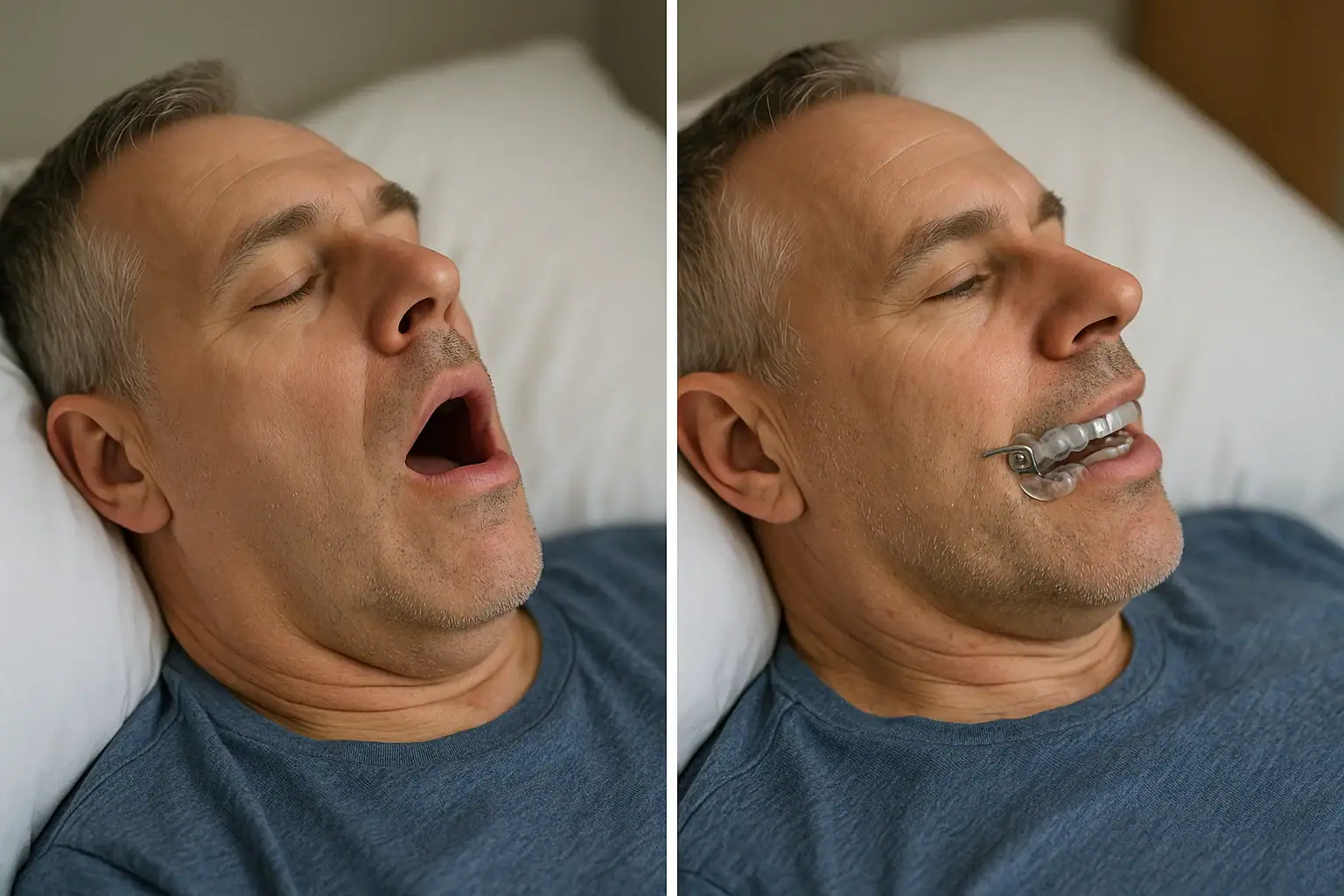
Oral appliance therapy for obstructive sleep apnoea uses a custom mandibular advancement device that holds the lower jaw and tongue forward during sleep, widening the upper airway so it collapses less often. It is the main alternative for patients who cannot tolerate CPAP. In a meta-analysis of 14 randomised trials covering 249 CPAP and 247 device users, CPAP lowered the apnoea-hypopnoea index further (weighted mean difference -7.08, 95% CI -9.06 to -5.10), while Epworth sleepiness scores did not differ between the two groups (PubMed 32534403). Diagnosis stays with a sleep physician; the dentist designs, fits and monitors the device.
- 01Obstructive sleep apnoea is common: a literature-based global analysis estimated 936 million adults aged 30-69 with mild to severe disease and 425 million with moderate to severe disease (PubMed 31300334).
- 02A mandibular advancement device is a custom splint worn only at night that treats the airway mechanically, with no machine, tubing or mains power involved.
- 03Head-to-head randomised evidence favours CPAP on the breathing measure: AHI weighted mean difference -7.08 events per hour (95% CI -9.06 to -5.10) across 14 trials, with no difference in Epworth sleepiness score (PubMed 32534403).
- 04Oral appliances are used mainly in mild to moderate apnoea and in CPAP-intolerant patients; severity is set by a sleep study, not by the dental examination.
- 05Follow-up is part of the treatment: advancement is titrated in small increments and appliance fit, symptoms and jaw comfort are rechecked at review visits.
Obstructive sleep apnea (OSA) is a common but often underdiagnosed sleep disorder that affects millions worldwide. It occurs when the upper airway collapses repeatedly during your sleep, causing disruption in breathing and lowering oxygen levels.
Traditionally, Continuous Positive Airway Pressure (CPAP) therapy has long been the gold standard for this disorder. However, many patients struggle with comfort and compliance during their treatment.
This is where dentists trained in oral appliance therapy for sleep apnea play a crucial role. These specialists use custom-made mandibular advancement devices (MADs) to offer an effective, non-invasive solution that improves sleep quality and reduces the health risk associated with sleep-disordered breathing.
/ What Is Obstructive Sleep Apnea (OSA)?
OSA is a condition characterized by repeated episodes of partial or complete upper airway obstruction during sleep, despite ongoing respiratory effort. In other words, respiration gets interrupted multiple times during sleep, despite trying to take air. These interruptions, known as sleep apneas (complete blockage) and hypopneas (partial blockage), cause fragmented sleep and oxygen desaturation.
Prevalence and Risk Factors of Obstructive Sleep Apnea
According to the American Academy of Sleep Medicine (AASM), OSA affects roughly 15–30 percent of males and 10–15 percent of females, with many cases remaining undiagnosed. Some risk factors include:
- Obesity or increased neck circumference.
- Anatomical variations, such as retrognathia, enlarged tonsils or nasal obstruction.
- Alcohol or sedative use.
- Aging and male gender.
Health Implications
Untreated OSA contributes to several systemic health problems, including:
- Hypertension and cardiovascular disease, mostly due to chronic intermittent hypoxia.
- Metabolic dysfunction, such as type 2 diabetes.
- Cognitive and mood disturbances, including depression and anxiety.
- Daytime sleepiness, which increases accident risks.
As a result, early diagnosis and effective management are essential for patients to prevent severe complications and systemic issues.
/ How Oral Appliance Therapy Works and Evidence of Effectiveness
How Oral Appliance Therapy Works
Oral Appliance therapy (OAT) involves using a custom-fitted device worn in the mouth during sleep. This appliance, typically a mandibular advancement device (MAD), works by gently positioning the lower jaw and tongue forward. This forward movement enlarges the upper airway and reduces the likelihood of breathing collapse.
These appliances are individually designed by trained dentists who ensure both comfort and efficacy in dental sleep medicine.
Evidence of Effectiveness
Studies have shown that oral appliances significantly reduce the Apnea-Hypopnea Index (AHI) in patients with mild to moderate OSA, often improving oxygen saturation and reducing snoring intensity.
A recent study published in the Journal of Clinical Sleep Medicine (2015), assessed the effectiveness of MAD vs. CPAP treatment, finding that oral appliance therapy was equally effective as CPAP in reducing symptoms and improving quality of life in mild to moderate OSA, probably due to better patient adherence with oral appliances over time. However, CPAP showed greater physiological improvement, and it’s still considered the gold standard treatment for OSA in most systematic reviews .
/ Oral Appliance vs. CPAP and Dentist Qualification
Comparison: Oral Appliance vs. CPAP
- Mechanism : While CPAP delivers pressurized air to keep the airway open, oral appliances make the tongue and jaw move forward to prevent airway collapse.
- Effectiveness : CPAP treatment is effective in all OSA severities, while oral appliances are effective only in mild to moderate cases.
- Comfort : CPAP treatment usually requires bulky equipment and may cause dryness or discomfort, while an oral appliance is small, discrete and more tolerable for most patients.
- Portability : While CPAP requires a machine and tubing, our appliances are compact and travel-friendly.
- Compliance : Most studies show that CPAP compliance is approximately 50–60 percent, while oral appliance shows from 80% to 90%.
As a result, oral appliance therapy offers a viable, scientifically supported alternative for patients who cannot tolerate CPAP.
Is a Dentist Qualified to Treat OSA? What to Ask.
While OSA is a medical condition, dentists specialized in this therapy display a collaborative role in its management, particularly in fitting and monitoring oral appliances. However, not every dentist is trained to provide sleep-disorder care.
Specialists qualified to treat OSA typically undergo specialized education in dental sleep medicine, recognized by some organizations such as:
- The American Academy of Dental Sleep Medicine (AADSM)
- The European Academy of Dental Sleep Medicine (EADSM)
Despite their qualifications, the dentist’s role only begins after diagnosis and is mainly focused on fabrication, adjustments and follow-up care of these oral appliances.
Questions To Ask Your Dentist
To start your treatment, ensure your dentist is properly trained by asking:
- Do you have a certification or training in dental sleep medicine?
- Do you collaborate with a sleep physician for diagnosis and follow-up?
- What type of oral appliance do you recommend and why?
/ Choosing a Sleep Dentist for Oral Appliance Therapy
Choosing a Sleep Dentist: What to Look For
Selecting your practitioner is crucial to obtaining a sleep dentistry solution. Consider the following:
Experience and Accreditation
Look mainly for dentists accredited by professional organizations such as the AADSM or the American Board of Dental Sleep Medicine.
Collaborative Approach
The best professionals work in partnership with other specialists, particularly sleep specialists, primary care physicians and sometimes otolaryngologists. This ensures that OSA is properly diagnosed and oral appliance therapy is monitored through the appropriate follow-up.
Customization and Technology
Receiving an effective oral appliance depends on precision. As a result, your dentist should use digital scanning, advanced materials and adjustable designs that allow for incremental improvements of jaw position to achieve the perfect airway patency and comfort.
Long-Term Follow-Up
As a chronic condition, OSA requires ongoing management. Therefore, choosing a dentist who provides regular follow-up visits to assess appliance wear, monitor symptoms and coordinate with other specialists is critical.
Additional Benefits of Oral Appliance Therapy
Besides improving sleep and reducing apnea events, oral appliance therapy offers additional advantages, such as:
- It reduces snoring, benefiting both the patient and their partner and family.
- It improves daytime energy and concentration.
- It provides better cardiovascular outcomes.
- It provides easy maintenance and portability, especially for frequent travelers and people with busy schedules.
Let’s plan the right treatment together.
Free Assessment→- 1.Benjafield AV, Ayas NT, Eastwood PR, Heinzer R, Ip MSM, Morrell MJ, et al. Estimation of the global prevalence and burden of obstructive sleep apnoea: a literature-based analysis. Lancet Respir Med 2019;7:687-698. PubMed 31300334
- 2.Li P, Ning XH, Lin H, Zhang N, Gao YF, Ping F. Continuous positive airway pressure versus mandibular advancement device in the treatment of obstructive sleep apnea: a systematic review and meta-analysis. Sleep Med 2020;72:5-11. PubMed 32534403