
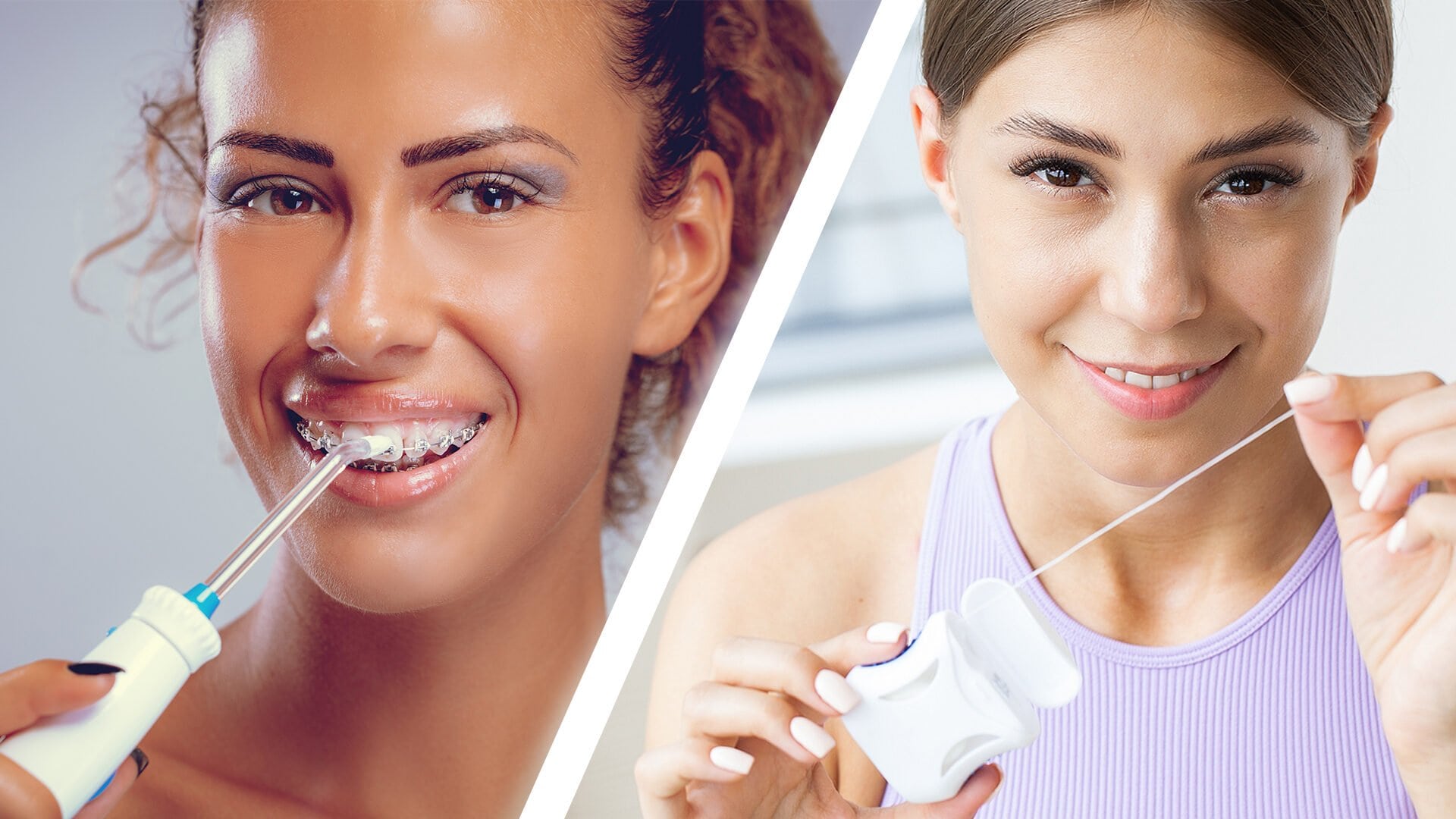
Dental floss and an oral irrigator are both interdental cleaning tools, but they work differently: floss mechanically scrapes biofilm off two adjacent tooth surfaces, while an irrigator flushes debris and disrupts loose plaque with a pressurised water jet. Neither replaces the other. In a network meta-analysis of 16 trials in periodontal maintenance patients, adding an oral irrigator to routine hygiene improved gingival index, bleeding scores and probing depth in 2 of 3 comparisons, while interdental brushes beat floss for plaque reduction in 2 of 4 comparisons (PubMed 34561655).
- 01Floss removes plaque by direct mechanical contact with the tooth surface; an irrigator clears debris and disrupts biofilm hydraulically, so the two are not interchangeable.
- 02Adjunctive irrigation showed a significant benefit on gingival index, bleeding scores and probing depth in 2 of 3 comparisons within a 16-trial network meta-analysis (PubMed 34561655).
- 03Interdental brushes outperformed floss on plaque reduction in 2 of 4 comparisons in that same analysis and ranked highest overall for interdental plaque removal (PubMed 34561655).
- 04The European workshop on primary prevention recommends floss only at sites of gingival and periodontal health where an interdental brush cannot pass without trauma (PubMed 25639826).
- 05Baseline hygiene is the fixed part of the regimen: brushing twice daily for at least two minutes with fluoride toothpaste, plus once-daily interdental cleaning in gingivitis patients (PubMed 25639826).
Floss and Irrigators Clean Between the Teeth in Different Ways
Dental floss and an oral irrigator are both tools for cleaning between the teeth, and neither replaces the toothbrush. A toothbrush cleans the outer and inner surfaces of the teeth well, but its bristles reach only partly into the narrow spaces where two teeth touch. Plaque and food debris left in those spaces feed the bacteria behind gum inflammation, cavities between the teeth and bad breath, which is why an interdental tool is added to brushing.
The two tools work by different mechanisms. Floss is a thin thread of nylon or PTFE that is pulled between two teeth and wiped against each tooth surface. It removes plaque by direct mechanical contact, including at tight contact points where little else fits. An oral irrigator, often called a water flosser, is an electric or battery-powered device that sends a pulsed jet of water between the teeth and along the gum line. It flushes out debris and disrupts loose plaque hydraulically, and it reaches areas that are hard to get to with a thread, such as the spaces around brackets, implants and bridges.
Because the mechanisms differ, the two tools are not interchangeable. Floss does well where contact is tight and the surfaces need scraping. The irrigator does well where the shape of the mouth or an appliance makes threading floss slow and awkward, and where the gum is sensitive. A third option, the interdental brush, is a small cylindrical or conical brush that passes between the teeth where the space allows it, and it appears in most of the research that compares these tools.
The question of which one is more effective therefore depends on the mouth in question. Clinical trials give a measured answer for groups of patients, and the practical choice is then made tooth by tooth.
What the Trials Show When the Tools Are Compared
The comparison has been studied in patients who have been treated for gum disease and are in regular maintenance. A network meta-analysis of 16 trials in periodontal maintenance patients found that adding an oral irrigator to regular hygiene improved the gingival index, bleeding scores and probing depth in two of three comparisons (PubMed 34561655). In the same analysis, interdental brushes gave significantly better plaque reduction than dental floss in two of four comparisons, and cylindrical and conical interdental brushes were ranked highest for removing interdental plaque (PubMed 34561655). The authors noted the low certainty of the evidence and drew no definite conclusion recommending one device over the others (PubMed 34561655).
A Cochrane review looked at home-use interdental cleaning devices added to brushing in 35 randomised trials with 3,929 adults (PubMed 30968949). It concluded that using floss or interdental brushes in addition to toothbrushing may reduce gingivitis, plaque or both more than toothbrushing alone, and that interdental brushes may be more effective than floss (PubMed 30968949). The evidence for oral irrigators was limited and inconsistent: they may reduce gingivitis at one month, but this was not seen at three or six months, and they did not reduce plaque more than brushing alone (PubMed 30968949). Across the review the certainty of the evidence was low to very low, and many participants started with little gum inflammation.
Read together, these studies do not crown a single winner. An irrigator can add a benefit for gum inflammation, especially in patients under periodontal care. Interdental brushes perform well for plaque where they fit. Floss keeps its place at tight contacts where nothing else passes.
How to Use Dental Floss
Flossing works when it is done gently and reaches the gum line on both teeth of each contact.
Take a length of floss long enough to wrap the ends around the middle fingers of both hands, leaving a short working section between the thumbs and index fingers. Slide the floss between two teeth with a gentle back-and-forth motion; do not snap it down onto the gum. Once it is through the contact, curve it into a C shape against the side of one tooth and move it up and down, reaching slightly below the gum line. Then curve it against the neighbouring tooth and repeat. Move to a clean section of floss for each space so that plaque is not carried from one gap to the next.
Floss comes waxed or unwaxed, flavoured or unflavoured, and as tape or thread. Waxed floss and tape slide more easily through tight contacts, and soft or expanding types are gentler for people with sensitive gums. Floss holders and pre-threaded flossers help people who find it hard to wrap floss around their fingers, though they are less able to curve the floss around each tooth.
Flossing once a day is the usual recommendation for people who use floss. Harsh sawing movements can cut the gum, so the pressure should stay light, and the floss should follow the curve of the tooth. Where an interdental brush passes between the teeth without force, the evidence above favours the brush for those spaces; floss is kept for the contacts where the brush does not fit.
How to Use an Oral Irrigator
An oral irrigator is simple to use, but a few details make the difference between effective cleaning and a wet bathroom.
Fill the reservoir with lukewarm water. Lean over the sink, place the tip in the mouth and close the lips enough to keep water from splashing, letting it run out into the sink. Start at the lowest pressure setting and increase it gradually to a medium level that feels comfortable. Aim the tip at the gum line at roughly a right angle to the teeth, and move it slowly along the gum line, pausing briefly between each pair of teeth. Work systematically, from the back teeth to the front on the outer side, then on the inner side, in both jaws.
Pressure is the setting to watch. A jet that is too strong can irritate or injure the gum, while a moderate setting cleans effectively. People with inflamed gums often notice some bleeding in the first days, which usually eases as the inflammation settles.
Hygiene of the device matters as well. Water left standing in the reservoir allows bacteria to grow, so the reservoir is emptied and left to dry after each use, and the tip is replaced according to the manufacturer's instructions. Antiseptic liquids should be added to the water only after checking with the dentist, since some are not meant for use in an irrigator.
The device is used alongside brushing, once or twice a day, and fits well at the end of the evening routine.
Braces, Implants and Bridges
For people with fixed appliances or restorations, the balance between the tools shifts.
With braces, floss has to be threaded under the archwire at every contact point, which is slow and which many patients give up on. An oral irrigator flushes debris from around the brackets and under the wire quickly, and it does not need to be threaded. For patients in orthodontic treatment it is therefore a practical option. Floss threaders and orthodontic floss with a stiff end make flossing with braces possible, and small interdental brushes can clean around the brackets.
Implants and bridges bring a similar problem. A bridge joins several teeth together, so ordinary floss cannot pass through the contacts between them; the area under the false tooth has to be cleaned with a floss threader, special bridge floss or an irrigator. Around implants, soft tools are preferred, and metal-wire brushes are avoided because they can scratch the implant surface. Irrigators are widely used by implant patients for this reason, alongside soft interdental brushes that fit the spaces.
In all these situations, the irrigator supplements brushing and does not remove the need for it. Plaque that sticks firmly to brackets, crowns and implant abutments still has to be brushed away, and regular professional cleaning removes what home care misses. Patients with appliances or implants usually benefit from a hygiene visit at which the dentist or hygienist shows which tools fit their own mouth.
Side Effects and Safe Use
Both tools are safe when used correctly. The Cochrane review found no severe adverse events caused by interdental devices, and no evidence of differences between study groups in minor effects such as gum irritation (PubMed 30968949).
Bleeding when someone starts flossing is a frequent concern. It usually means the gum was already inflamed, a sign of gingivitis, and it tends to settle within days as regular cleaning reduces the inflammation. The right response is to continue gently with correct technique. If bleeding persists beyond a couple of weeks, or if the gum is swollen or painful, it is worth having it checked, because it can signal gum disease that needs professional treatment.
Flossing too hard can cut the gum, particularly when floss is snapped down through a tight contact. Floss can also shred or break in tight spaces or on the rough edge of an old filling; floss that catches repeatedly at the same spot is worth mentioning to the dentist, since it can point to a broken filling or a cavity.
The main risk with an irrigator is excessive pressure, which can irritate the gum. A moderate setting is enough. The second is poor cleaning of the device: bacteria can grow in water left in the reservoir, so the reservoir is emptied and dried after each use.
People with a recent extraction, surgery or implant placement should ask their dentist when to restart interdental cleaning at that site, since a strong water jet or a floss thread can disturb healing tissue in the first days.
Choosing a Routine for Your Mouth
The fixed part of the routine is brushing. The European workshop on the primary prevention of periodontitis supported brushing twice a day for at least 2 minutes with a fluoride toothpaste and recommended once-daily interdental cleaning for patients with gingivitis (PubMed 25639826). The same workshop concluded that floss could be recommended only for sites of gingival and periodontal health where interdental brushes will not pass without trauma, and that elsewhere interdental brushes are the device of choice for interproximal plaque removal (PubMed 25639826).
From there, the choice of tool follows the mouth. Where the spaces between the teeth are tight and the gums are healthy, floss suits those contacts. Where the spaces allow it, an interdental brush of the right size is a strong option. Where braces, implants or bridges make threading difficult, or where the gum is inflamed and sensitive, an oral irrigator is a practical addition. Many people end up combining tools: an interdental brush for the wider back spaces, floss for tight front contacts, and an irrigator around an appliance.
Other habits support the routine. A fluoride toothpaste protects the enamel. A diet that limits frequent sugary and acidic snacks lowers the risk of decay. Drinking water through the day keeps the mouth moist. An antiseptic mouthwash can be added when the dentist recommends it, as a supplement to mechanical cleaning.
Regular check-ups complete the picture. At a check-up the dentist or hygienist can see where plaque is being missed, measure the gum, choose the right interdental brush sizes and show the technique for each tool. The tool that a person actually uses every day, correctly, is the one that protects the gums.
Let's plan the right treatment together.
Free Assessment→- 1.Shamsoddin E. What is the best mechanical device to clean the teeth in periodontal maintenance patients?. Evid Based Dent 2021;22:91-93. PubMed 34561655
- 2.Chapple IL, Van der Weijden F, Doerfer C, Herrera D, Shapira L, Polak D, et al. Primary prevention of periodontitis: managing gingivitis. J Clin Periodontol 2015;42 Suppl 16:S71-6. PubMed 25639826
- 3.Worthington HV, MacDonald L, Poklepovic Pericic T, Sambunjak D, Johnson TM, Imai P, et al. Home use of interdental cleaning devices, in addition to toothbrushing, for preventing and controlling periodontal diseases and dental caries. Cochrane Database Syst Rev 2019;4:CD012018. PubMed 30968949