
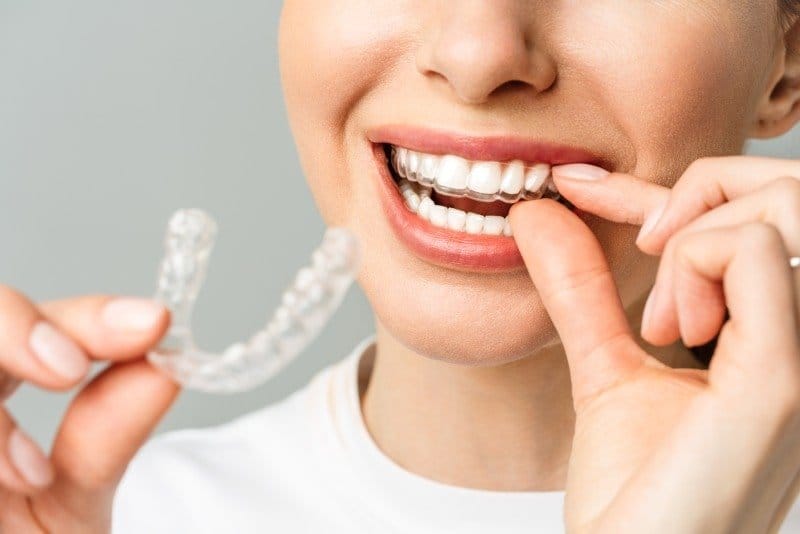
Clear aligners are a series of removable, custom-made orthodontic trays that gradually move teeth. At Mosdent, treatment is planned over 6 to 24 months, although the exact time depends on the movements required and how consistently the aligners are worn for 20 to 22 hours a day. Wear time is hard to maintain: in a study of 2,644 patients, only 36% reached the target wear time across most of their aligners (PubMed 34300269). Not every orthodontic movement is equally predictable with aligners, so an examination and digital treatment plan are essential.
Clear aligners are thin, transparent orthodontic trays made to fit over the teeth. A series of custom-made aligners moves the teeth in small planned stages. In everyday conversation, "clear braces" often refers to the same treatment, meaning removable trays instead of metal brackets and wires.
Invisalign is the best-known brand name in this field, but other aligner systems are also available. Our Invisalign treatment page explains the system in more detail. Choosing between braces and aligners is a separate decision, and it depends on the movements needed in the individual case, not only on appearance. You can read more in our guide to braces or clear aligners.
How clear aligner treatment works
Clear aligner treatment starts with an examination and a digital scan of the mouth. Our dentists may also request the necessary X-rays. The current position of the teeth and the intended final position are then mapped into a digital treatment plan. This planning stage helps determine whether aligners can produce the required movements.
Clear aligners are effective for some movements, but not all movements are equally predictable. Evidence suggests that they can be useful for aligning and levelling the dental arch and for intruding front teeth. They are less predictable for extrusion and for rotating teeth with rounded shapes (PubMed 25412265). Large rotations, significant bite problems, and cases involving extractions may be better suited to bracket treatment or a combined approach.
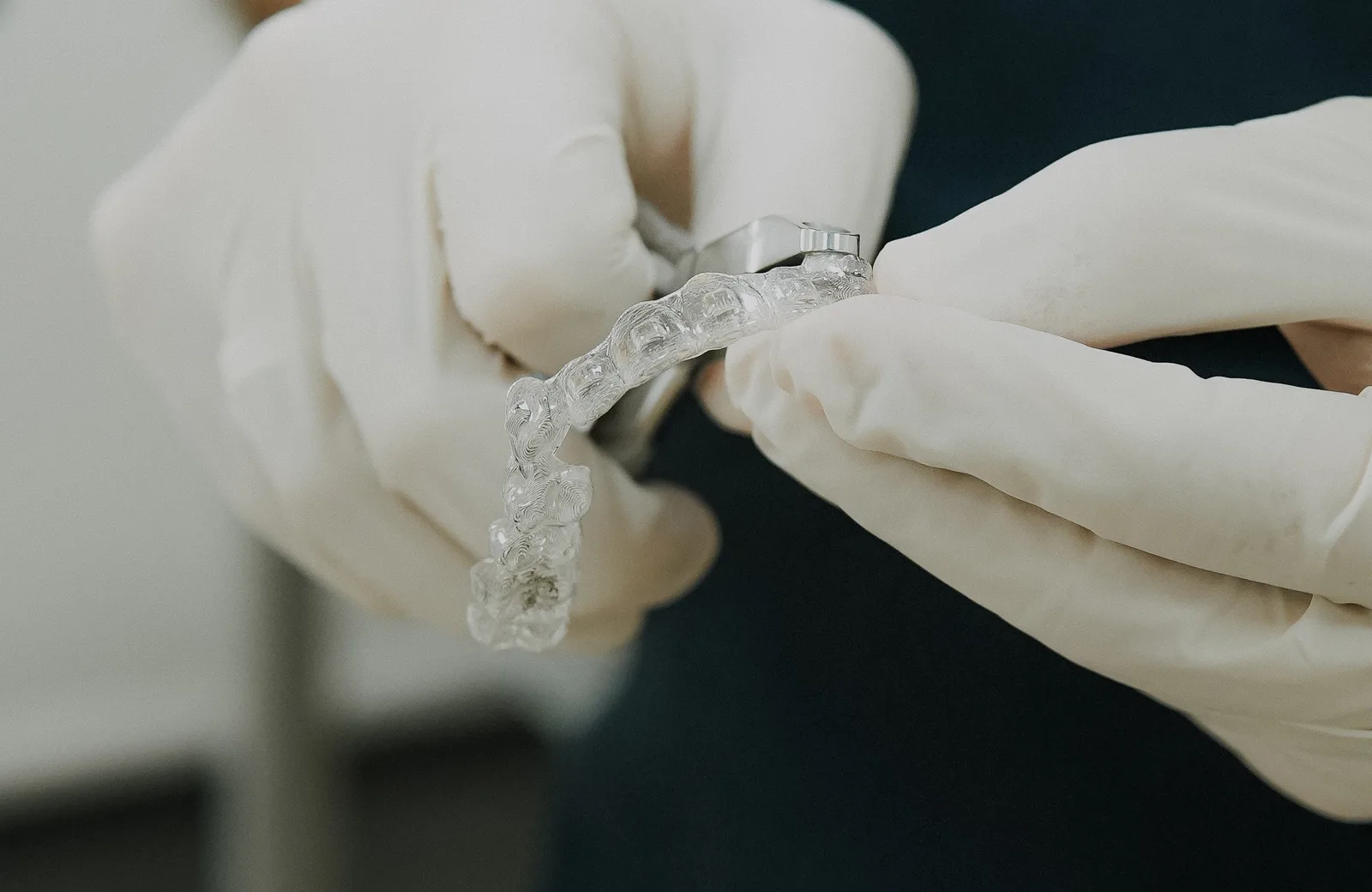
Once the plan is approved, a series of aligners is produced. Some teeth may receive small, tooth-coloured attachments. These bonded shapes help the aligner apply force in the intended direction and are removed when treatment is complete. For adults, attachments can influence visibility more than the clear tray itself. This is discussed further in our guide to adult Invisalign treatment.
Each aligner is generally worn for about two weeks before moving to the next one. Check-ups are usually arranged around once a month so the dentists at Mosdent can assess whether the teeth are following the plan. When the active series is finished, retention begins. A retainer or a fixed wire helps maintain the new tooth positions. Retention is not an optional extra, because teeth can move back towards their previous positions without it.
Clear aligner treatment duration
At Mosdent, treatment is planned over 6 to 24 months. Mild crowding may be treated towards the shorter end of this range, while cases involving more teeth or more complex movements may take longer. A 2025 meta-analysis of 15 trials and 1,084 patients found no significant difference in duration or treatment quality between clear aligners and braces in non-extraction cases, with braces ahead in extraction cases (PubMed 41127933). An earlier review had pooled three studies showing aligner treatment 6.31 months shorter, although one study of extraction cases found braces faster (PubMed 30674307).
That average does not predict an individual case. One reason is that a planned movement may not be fully achieved by the first series. In one study, the average accuracy of planned movement was 41% across 401 front teeth in 37 patients (PubMed 19121497). A later study by the same research group recorded an average of 50% (PubMed 32620479). Additional aligners for refinement are therefore commonly included in treatment planning. They do not automatically mean that treatment has failed.
Wear time is the other major factor. Aligners should be worn for 20 to 22 hours a day and removed only for eating, drinking anything other than water, and brushing. In a series of 2,644 patients, only 36% reached the target wear time across most of their aligners, while others achieved it partly or rarely (PubMed 34300269). Missing several hours repeatedly can slow progress and extend treatment.
Daily care and use of clear aligners
The clear aligner daily routine is straightforward, but the rules matter. Remove the aligners before eating. Water is the only drink recommended while they are in place. Hot drinks can deform the material, coloured drinks can stain it, and sugary liquid trapped between the tray and the teeth can contribute to decay.
To remove an aligner, start at the back teeth. Lift the inner edge gently with a fingernail on one side and then the other, gradually working towards the front. Pulling from one point at the front can crack the tray. To insert it, seat it over the teeth and press it into place with your fingers. Do not bite the aligner into position.
After eating, brush the teeth before putting the aligners back in. If brushing is not possible, rinse the mouth thoroughly. Because the tray covers the teeth for many hours, food debris should not be left underneath it.
Clear aligners may make oral hygiene easier than fixed braces because they can be removed for brushing. A review found lower plaque and gingival index scores among clear aligner users than among fixed brace users, but this is not automatic protection. The benefit depends on maintaining a consistent brushing routine (PubMed 42270616).
How should clear aligners be cleaned?
Rinse the tray with lukewarm water whenever it is removed. At least once a day, clean it with a soft toothbrush and a non-abrasive cleaner, or with water if advised by the clinic. At regular intervals, a cleaning tablet or another chemical cleaning method can be used.
Never use hot water. Heat can deform the tray, and a deformed aligner may no longer move the teeth as planned. Research comparing cleaning methods has considered mechanical cleaning, chemical cleaning, and combinations of both. It did not identify one universally superior method, but a multi-step routine combining mechanical and chemical cleaning was indicated as the most effective approach (PubMed 35206954).
Discomfort and problems during clear aligner treatment
When changing to a new clear aligner, pressure and tenderness during the first day or two are common. Mild changes to speech can also occur at first and usually settle within a few days. A sharp edge that irritates the tongue or cheek should be reported to the clinic, because it may need adjustment.
Comparative evidence indicates that clear aligner patients report significantly less pain than fixed brace patients, particularly during the early stage of treatment. Quality-of-life measures also favoured aligners during the first week, first month, and at the end of treatment (PubMed 42270616). Severe or persistent pain is not the expected pattern, so contact the clinic for advice if it occurs.
What if an aligner breaks, is lost, or is forgotten?
Contact the clinic and do not throw the aligner away. If a small crack is present and the tray still fits fully, our dentists may advise continuing with it. If it has split or no longer fits, patients are often asked to return to the previous aligner until a replacement is arranged.
Keep the previous aligner in its case throughout treatment. If the current tray is lost, the previous one may help maintain the tooth position while the clinic decides whether to replace it or alter the sequence. Do not move to the next aligner early without clinical advice.
Forgetting an aligner for a few hours is unlikely to undo treatment. Put it back in when remembered and return to the planned routine. After one or two days without wearing it, the teeth may move slightly and the tray may feel tight. If it still seats fully, contact the clinic and follow the advice given. If it does not fit, stop forcing it and seek instructions. Always place a removed aligner in its case rather than wrapping it in a napkin.
Clear aligner suitability and cost factors
Clear aligners may suit patients whose growth is complete and who have mild to moderate crowding, spacing, bite irregularities, or orthodontic relapse. A systematic review found the evidence-based indication to be mainly non-extraction treatment for mild to moderate malocclusion in patients with completed growth. Effectiveness was more limited for closing extraction spaces and bodily expansion of the dental arch (PubMed 30264270).
Advanced skeletal bite problems, large rotations, and cases requiring jaw surgery may need fixed braces or an orthognathic treatment plan. The important question is not simply whether clear aligners are good, but whether they can produce the specific movement required in your case. Our crowded teeth treatment page provides further information. You can contact Mosdent to arrange an assessment and meet the team on our dentists page.
What drives the cost?
The cost of clear aligner treatment depends on the complexity of the tooth movements, the number of aligners required, whether attachments or additional refinement sets are needed, the length of active treatment, and the retention plan after alignment. Any required examinations, scans, X-rays, reviews, and replacement trays may also affect the overall fee.
For international patients, it is important to check what is included in the proposed plan and how follow-up is organised before treatment begins. Our transparent price list provides current treatment information. The final suitability and treatment plan can only be confirmed after an examination.
Key takeaway
Clear aligners can be a practical option for selected orthodontic problems, particularly when removable trays and discreet appearance are important. Their success depends on choosing movements they can perform predictably, wearing them for 20 to 22 hours daily, keeping both teeth and trays clean, and completing the retention stage. An individual assessment is the right starting point.
Let's plan the right treatment together.
Free Assessment→- 1.Ke Y, Zhu Y, Zhu M. A comparison of treatment effectiveness between clear aligner and fixed appliance therapies. BMC Oral Health 2019;19:24. PubMed 30674307 (accessed 6 September 2026)
- 2.Alhafi ZM, Hajeer MY, Alam MK, Jaber ST. Quality and stability of orthodontic treatment outcomes with clear aligners versus fixed appliances: a systematic review and meta-analysis. Eur J Orthod 2025;47(6):cjaf091. PubMed 41127933
- 3.Kravitz ND, Kusnoto B, BeGole E, Obrez A, Agran B. How well does Invisalign work? A prospective clinical study evaluating the efficacy of tooth movement with Invisalign. Am J Orthod Dentofacial Orthop 2009;135:27-35. PubMed 19121497 (accessed 6 September 2026)
- 4.Haouili N, Kravitz ND, Vaid NR, Ferguson DJ, Makki L. Has Invisalign improved? A prospective follow-up study on the efficacy of tooth movement with Invisalign. Am J Orthod Dentofacial Orthop 2020;158:420-425. PubMed 32620479 (accessed 6 September 2026)
- 5.Timm LH, Farrag G, Baxmann M, Schwendicke F. Factors Influencing Patient Compliance during Clear Aligner Therapy: A Retrospective Cohort Study. J Clin Med 2021;10:3103. PubMed 34300269 (accessed 6 September 2026)
- 6.Rossini G, Parrini S, Castroflorio T, Deregibus A, Debernardi CL. Efficacy of clear aligners in controlling orthodontic tooth movement: a systematic review. Angle Orthod 2015;85:881-9. PubMed 25412265 (accessed 6 September 2026)
- 7.Papadimitriou A, Mousoulea S, Gkantidis N, Kloukos D. Clinical effectiveness of Invisalign® orthodontic treatment: a systematic review. Prog Orthod 2018;19:37. PubMed 30264270 (accessed 6 September 2026)
- 8.Kaur K, Quadri SA, Saini RS, Alarcón-Sánchez MA, Heboyan A. Comparative impact of clear aligners versus fixed orthodontic appliances on periodontal health, pain, and quality of life: a systematic review and meta-analysis. BDJ Open 2026;12:60. PubMed 42270616 (accessed 6 September 2026)
- 9.Charavet C, Gourdain Z, Graveline L, Lupi L. Cleaning and Disinfection Protocols for Clear Orthodontic Aligners: A Systematic Review. Healthcare (Basel) 2022;10:340. PubMed 35206954 (accessed 6 September 2026)